Couldn’t Do It Today

Fabrizio del Wrongo writes:

Posted in Uncategorized | Tagged , , , , , , | 1 Comment

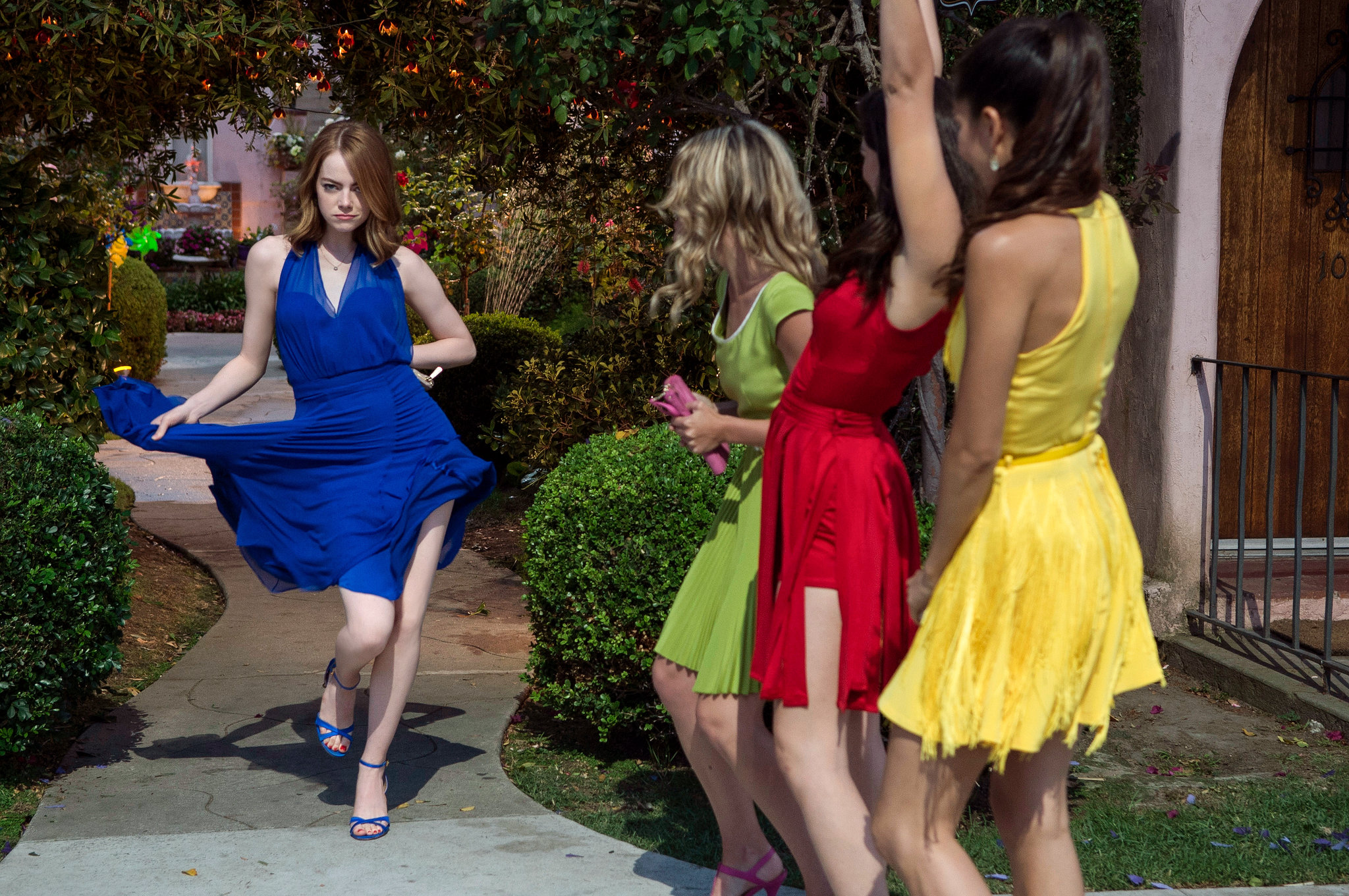
Movie Still Du Jour

Blowhard, Esq. writes:

stonelalaland

Emma Stone and friends in LA LA LAND (2016)

Click on the image to enlarge.

Posted in Movies | Tagged | 1 Comment

My Year in Music

Blowhard, Esq. writes:

Favorite Album of the Year: “Wild Things” by Ladyhawke

Honorable Mention: “Blue & Lonesome” by The Rolling Stones

Favorite Movie Soundtrack: “The Neon Demon” by Cliff Martinez

Honorable Mention: “La La Land” by Justin Hurwitz and Benj Pasek & Justin Paul

Favorite Porn Remix Soundtrack: “Sextape 4” by Drixxxe

Favorite Historical Reissue: “The Great Blues Vocals & Guitar” by T-Bone Walker

I’m Still Not Into Hard Bop or Avant-Garde Jazz But I’m Trying: “The Atlantic Years in Mono” by John Coltrane

Favorite Soul Album: “Changes” by Charles Bradley

Yet Another Radiohead Album That Doesn’t Contain A Single Song as Good as “Creep”: “A Moon Shaped Pool” by Radiohead

I Really Liked the First Single but the Whole Album Was Pretty Lame: “This Is What The Truth Feels Like” by Gwen Stefani

Newcomer to Watch: “Hero” by Maren Morris

Really Glad They Have a New Album But I’m Bummed It’s a Xmas One: “Christmas Party” by She & Him

Close Runner-Up For Least Favorite Album But It Had One Song That I Sorta Liked: “Lemonade” by Beyonce

Least Favorite Album of the Year: “Blond” by Frank Ocean

Posted in Music | Tagged , , , , , , , , , , , , , , , , , | 9 Comments

Naked Lady of the Week: Stephi

Paleo Retiree writes:

Back here I introduced the delightful amateur bikini model who calls herself Stephi. Stephi’s best-known on Microminimus, the fan-participation branch of the genius Australian bikini company Wicked Weasel, but she also shows herself off on Flickr.

With her auburn hair, her sprinkling of freckles, her friendly smile, her love of the sun and her physical rambunctiousness, Stephi instantly conveys “fit, ripe and good-natured California nature-girl.” But she conveys something else as well: a combo of guilelessness, sweetness, and naughty wholesomeness that’s similar to what comes across in paintings by the great American pinup artists of the ’40s and ’50s. Yet she’s a modern woman too, bringing to bear a very present-day degree of awareness of herself and her effects. As a pinup girl, she isn’t just being surprised-while-ripe in the old style; she’s a full participant in the creation of the situation, and she’s definitely getting something fizzy out of it that pleases her too. Stephi’s awareness is maybe better described as “agency” than as today’s more common, sarcasm-heavy “attitude,” praise the lord. Sweetness and sexiness prevail in the end, and we can all be grateful for that.

It seems to me that part of why Stephi’s able to suggest multiple sides is that, like many of the most memorable erotic models — Dita Van Teese, for instance — she isn’t just a fantasy object. (Not that anything’s wrong with pure objects of fantasy, of course.) Her spirit’s a more overflowing one than that; she’s got personality to share as well as a real performer’s spark. Working with her talented photographer-husband, Stephi’s able to project herself into the scenario and into the moment with joy and abandon. She can inhabit and project seductress as convincingly as Western-movie heroine, slinky glamor as convincingly as bubbly innocence. Btw, in case you’re skeptical that Stephi’s got a good brain in her head, do read our interview with her. She’s as sharp as can be, and knows exactly what she’s up to.

Some good news that I’m pleased to relay today is that Stephi and her husband have created a couple of lavish photo books. In other words, if you’ve got a hankering to linger over Stephi’s mischief, body and beauty, there’s no longer any need to pay an ongoing fee, or to join Microminimus or Flickr. In “Stephi: The Kinky Side,” toys, leather and metal contrast lusciously with smooth, curvy and translucent flesh. They bring out something extra-saucy in Stephi’s expressions too. “Commando Stephi” lives up to its hilariously sweet-and-square (in the best pinup tradition), punning title. It reminds me of some of my favorite B-movies of the 1970s, and I have little higher praise in me to offer than that. The electronic versions of the books strike me as very reasonably priced, while the on-paper versions are printed beautifully.

Nudity (and even some sweetly innocent kink) after the jump. The pix, by the way, are exclusive to UR. They’re also guaranteed to bring considerable sunlight and warmth into your soul as the December days grow shorter and colder.

Continue reading →

Posted in Books Publishing and Writing, Commercial art, Performers, Photography, Sex | Tagged | 3 Comments

Architecture and Color

Paleo Retiree writes:

Posted in Architecture | Tagged | Leave a comment

Doug Henwood’s “My Turn”

Paleo Retiree writes:

My wife and I got so caught up in the Presidential election that we had some fascination with Hillary left over afterwards, so last week we treated ourselves to a read of this short book denouncing Hillary Clinton from the left. It’s an expansion of a striking article that Doug Henwood did for Harper’s back in November of 2014. Many lefties and Hillaryites were furious with Henwood for undermining their candidate. Is it better to be honest about a politician’s failings or to do propaganda for what one feels to be the lesser of two evils?

Henwood portrays Hillary as pushy, graspy and opportunistic, someone who has never really stood for anything other than Clinton success and who, at this point in her life, manages to be both out of touch with everyday people yet deeply convinced that the world owes her bigtime. (Hence the book’s title.) If anything, she’s a NeoCon — George W. Bush II. But mainly she’s an unprincipled “machine politician.”

Much of what she and Bill have done to climb in the world and enrich themselves appears to be legal — they’re both smart lawyers, after all. But, as Henwood shows very convincingly, a pattern of self-interest, greed and sleaziness is overwhelmingly apparent. It also established itself very early on. About Hillary and Bill’s years in Arkansas, Henwood writes:

The state did all kinds of business with Rose [law firm], from routine bond issues to more complex litigation. Having the state do business with a law firm that employed the governor’s wife seemed a little smelly to many. But, no matter — the Clintons would soon be leaving town. Ambitions as expansive as theirs couldn’t be satisfied in the Ozarks.

Henwood has a wry, sly and biting sense of humor that makes a nice counterpoint to his generally measured tone, his ferocious researching and his fervent leftie principles. “She swears like a longshoreman, one of her more endearing traits,” he writes. There’s certainly nothing that’s proper in an uptight-rightie kind of way in him. It’s a fast, amusing and enlightening read.

Henwood is more concerned with nailing down facts than with Hillary’s psychology, which he lets speak for itself and which is fun to speculate about afterwards. I’d love to buy Henwood a drink and get him to talk about what he really thinks is going on with her. What a fascinating, if also appalling, character Hillary is. My wife is deeply convinced that Hill has immense “who am I really?” identity issues and is likely crazy. What would Henwood say to that?

About a quarter of the book consists of elaborate, meticulous footnotes. They’re fun to explore. Throughout the book there’s a feeling of Henwood saying to his critics and opponents, “Come on and do your best. Just see if you can find any factual mistakes here.”

Full disclosure: though we’ve never met up in person I’ve been in touch in small ways with Doug Henwood for years. Back in the 1980s I subscribed to his great ‘zine Left Business Observer, I learned a lot about how the world works from his book “Wall Street,” and I currently follow his regular provocations on Facebook with interest and delight.

Related

Posted in Politics and Economics | Tagged , , | 3 Comments

Happy Thanksgiving

Blowhard, Esq. writes:

vintage-pinup-musket-turkey-thanksgiving

Posted in The Good Life | Tagged , | 4 Comments

Monsters of Depravity

Fabrizio del Wrongo writes:

cropped-fotothek_df_ps_0000010_blick_vom_rathausturm

[A] political chain reaction was set in motion by the French Revolution. Deprived of the services of the professional army officered by aristocrats of the Monarchy, the revolutionary government had recourse to a levée en masse of the population. The people of the countries overrun by the French armies, after their own professional armies had been shattered, achieved liberation by means of similar armies of conscripted civilians. The European wars waged between 1792 and 1815 were the first of the Peoples’ Wars, so called because they were fought between peoples in arms and not as hitherto by professional armies maintained in peacetime by the rulers to enforce their wishes.

At first appeals to simple patriotism proved sufficient to inspire conscripted civilians with military ardour. Later the discovery was made that conscripted civilians fought better if they had been induced to hate the enemy against whom they were fighting. So gradually was evolved and perfected the modern science of emotional engineering, the purpose of which is to convince the average citizen that the citizens of the state against which it has been decided to wage war were monsters of depravity, barbarous, perfidious and cruel, with whom any thought of peace was impossible, to overcome whom no personal sacrifice would be too great.

Inevitably warfare conducted in an artificially inspired frenzy of fear and hatred changed its character. Thus began the period of so-called Total War to use the term adopted to describe hostilities waged regardless of the Rules of Civilized Warfare. Naturally the average civilian serving as a soldier, knowing nothing and caring less of military traditions, and having been taught that it was his patriotic duty to believe that the enemy was committing atrocities of every description, felt himself free to act as he had been assured the enemy was acting. Hate propaganda always lays the greatest stress on the contention that the enemy is solely responsible for the outbreak of hostilities in order to generate in the mind of every individual soldier a personal grievance against the enemy for having wantonly forced him to leave home and endure the hardships and dangers of a campaign.

The act which may be cited as marking the end of the age of civilized warfare and the beginning of the age of Total War was the acceptance of the Lindemann Plan on the 30th March 1942.

The last stage of the chain reaction was the adoption of war-crimes trials as a method of disposing of captured leaders of the vanquished side which inevitably must make the future conduct of warfare more ruthless than ever. Now that every general knows that in the event of defeat he will assuredly be done to death by the victors if he falls into their hands, he can hardly be expected to hesitate to order the commission of any enormity which seems to him to offer some hope of staving off defeat.

— F.J.P. Veale

Posted in Books Publishing and Writing, History | Tagged , , | Leave a comment

Notes on “Eight Days a Week”

Fabrizio del Wrongo writes:

beatles_indianapolis

“Eight Days a Week,” Ron Howard’s new documentary on the Beatles’ touring years, isn’t anything new, and yet it caused me to see its subject in a new light. Like similar works it uses the Beatles as a proxy for what we think of as the ’60s. Yet that familiarity has a purpose. Because of it, and because the character and dramatic arc of his subject are so well known, Howard never has to push his POV; his themes emerge organically — and perhaps only semi-intentionally — from the material, so that you become aware of them almost before you’ve had a chance to make mental note of them. It’s the kind of picture that’s all the more suggestive for being so straightforward.

The movie is most novel when it’s striking semi-sinister notes. Howard gives us the Beatles not just as a force of youth and vitality, but as agents of entropy, anxiety, and fin-de-siècle enervation. Their American performances in particular are presented so as to foreground their ominous elements. Watching them I found myself wondering: Is it possible that what made the foursome so exciting was their packaging of irresistible and overwhelming force within a container so outwardly benign? There are moments during their live performances when this modest container seems inadequate, as though it were bulging outward in a futile attempt to accommodate whatever it is that’s roiling inside of it. And the kids screaming in the audience do more than anticipate the impending explosion; they incarnate their idea of it.

The Beatles entered America in New York greeted by what seemed like an outpouring of joy. Three years later, after their last American performance in Chicago, they exited the venue in what one member describes as an “armored meat wagon.” They’d come to embody a societal change that neither they nor anyone else had the power to anticipate let alone control — and they were scared for their safety. By the time they quit touring that change threatened to tear the country apart. Woodstock and Altamont loomed on the horizon. In “War and Peace” Tolstoy wonders if Napoleon was an agent of the Revolution or merely a particle in the wave caused by its energy. Ultimately he abandons the question, declaring it impossible to identify the mysterious force by which a people is made to move. In “Eight Days a Week” one can see the people moving, and the Beatles being swept along with them.

Posted in Movies, Music, Performers | Tagged , , , , , , , | Leave a comment

Architecture and Color

Paleo Retiree writes:

Posted in Architecture | Tagged | 1 Comment