Scalia’s Sore Winners

Blowhard, Esq. writes:
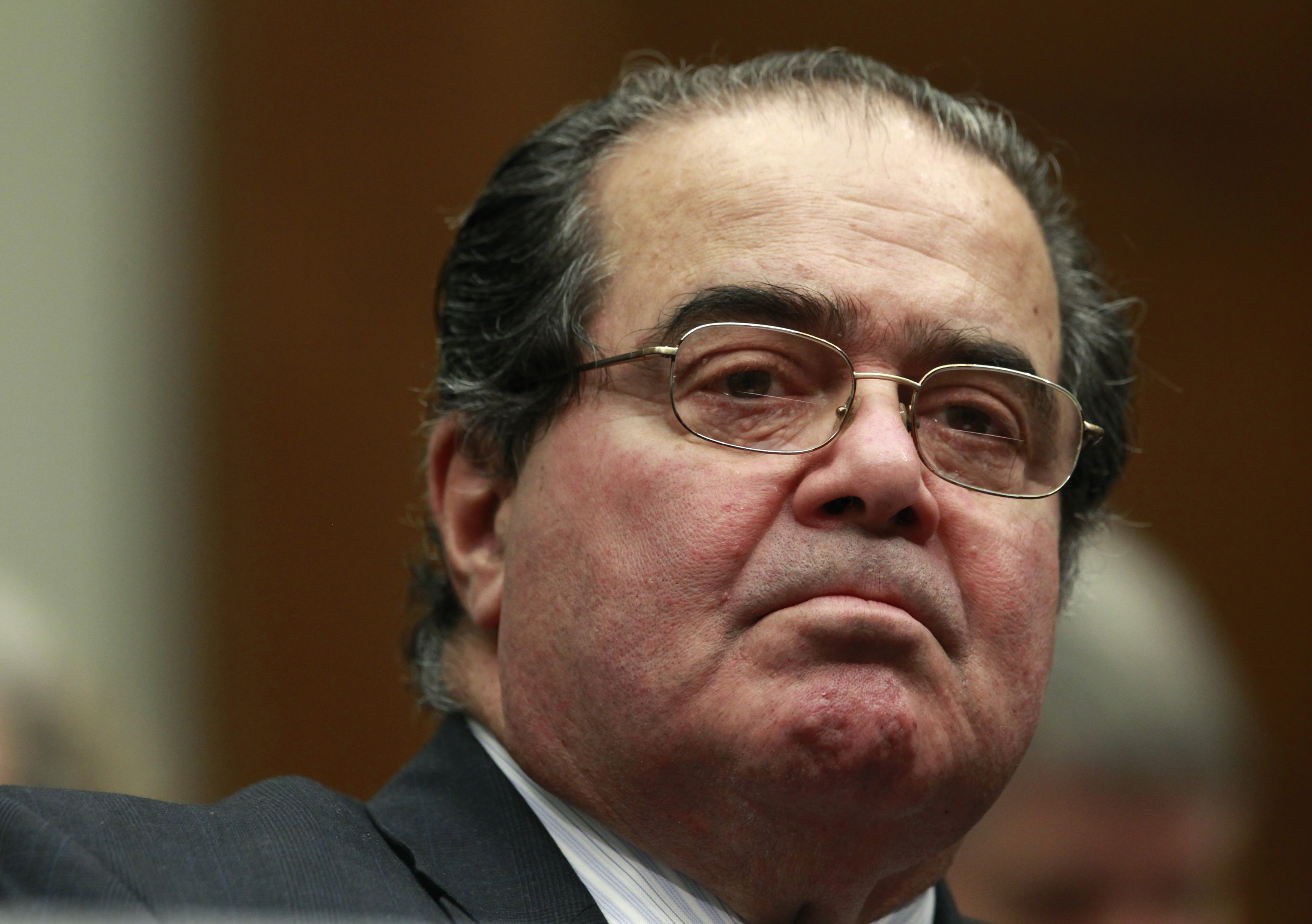
I spent a good part of the weekend marveling at the lefty reaction to Antonin Scalia‘s unexpected death. Did your Facebook feed shamelessly explode with unrestrained celebration too? There are few things more grotesque than watching a bunch of sore winners gloating over the death of a political rival. Proggies were alternatively dancing on his grave, letting out whoops of joy, or soberly explaining how they don’t normally welcome the death of anyone, but hey, sometimes exceptions must be made. An example of one of the more restrained comments:

As a general principle, I agree that one should not speak ill of the dead. But considering that Antonin Scalia tangibly worsened the lives of millions upon millions of people, supported points of view that scapegoat and demonize, and used his power as a Supreme Court justice to validate the idea that businesses should be able to do pretty much anything they want, and generally acted like a condescending, hateful asshole throughout his stint on the court, I don’t really see how anyone owes him any consideration.

Translation:

  • “tangibly worsened the lives of millions upon millions of people” = “wrote dissents in Lawrence v. Texas and the gay marriage cases”
  • “used his power as a Supreme Court justice to validate the idea that businesses should be able to do pretty much anything they want” = “supported Christian pastry chefs who didn’t want to bake cakes for gay couples”
  • “generally acted like a condescending, hateful asshole” = “disagreed with me and was scathingly unrepentant about it”

My initial response was to wonder what their reaction would be if righties greeted Ruth Bader Ginsburg’s death with “ding dong, the witch is dead” sing-a-longs. Strike that — I know exactly what would happen. The NYT, HuffPo, Vox, Vice, DailyKos, and the other organs of progressive thought would go into overdrive for the next month delivering one handwringing thinkpiece after another about conservative misogyny and antisemitism.

None of this is to say I was a big Scalia fan. Like many Cathedral minions, he was a haughty elitist who was way too worshipful of the Ivy League axis for my taste. I disagreed with his views on the 8th Amendment and his opinion in Gonzales v. Raich was particularly odious. But he was a champion of the 4th Amendment, 1st Amendment, and due process — all liberal values. His robust defense of the 6th Amendment’s Confrontation Clause tangibly helps criminal defendants more than Beyoncé’s latest stab at Black Lives Matter faux-radicalism. None of that crap matters, though, because he had the temerity to believe that the Constitution is silent on abortion even though that’s a perfectly reasonable interpretation given that, um, the Constitution is silent on privacy and abortion. Not to mention, as with gay marriage, his was the minority opinion on the issue. Last I checked, gay marriage and abortion were legal in all 50 states.

The left has done a brilliant job over the decades of turning its constituents into one-issue voters. For feminists, abortion is the be-all-end-all of women’s rights. Likewise, being in favor of gay marriage is now part of that package even though, oh, thirty years ago no one — not even the gay establishment — gave one shit about gays being able to marry. In favor of abortion and gay marriage? Great, everything else is forgiven. Against them? Sorry, you could spend all of your spare time feeding orphans and clothing the homeless, you’re a fucking shitlord who needs to die. This is how the Party of Compassion™ operates.
Posted in Law, Politics and Economics | Tagged , , | 9 Comments

DVD review: “Hitch Hike”

Paleo Retiree writes:

image

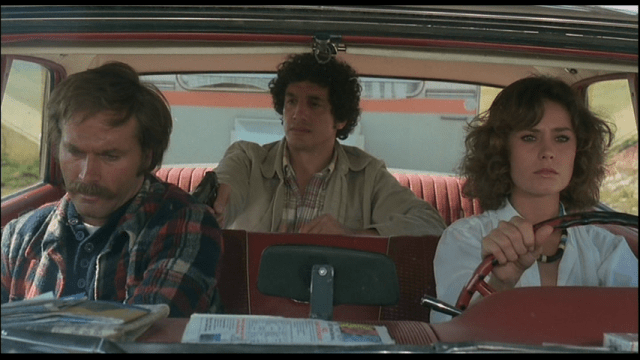
I really enjoyed this smart, well-paced little Italian road/horror movie from 1977, directed and co-written by Pasquale Festa Campanile from a novel by Peter Kane.

It’s partly low-budget exploitation sleaze, partly an exercise in austere, well-shaped literary cinema, and partly flamboyant Sam Shepard-style knockabout marital drama. Franco Nero and Corinne Clery are a feuding, stylish, impossibly good-looking Italian couple (with near-matching cats’ eyes!) driving thru the American Southwest, who pick up a hitcher (David Hess), who turns out to be a violent criminal on the run. I found the film to be a great mixture of tense moment-to-moment drama and shrewdly deployed plot turns, action bits and set pieces. Some well-integrated themes (mostly identity and the meaning of freedom) may merit a few seconds’ contemplation too — they at least add something to the film’s high-low texture. The cinematography is blazing, moody and laconic in a ’70s road-movie way that now feels “classic,” and the landscapes are overblown and a little off in ways that make the action feel otherworldly and mythic. (Though set in the U.S., the film was in fact shot in Italy.) If you can imagine a spaghetti-westernized version of something like “Joy Ride,” this is it. A juicy and excitable score by Ennio Morricone contributes a lot to the sinister, overresonant tone.

The actors chew the scenery with tons of sexy gusto. Hess does a reprise of his legendary “Last House on the Left,” downtown bad-boy actor thing; Clery isn’t just unbelievably pretty, she’s reactive, alive and real; and Franco Nero shows off a terse and telegraphic acting language that seems a wonderful expression of both hypermasculinity and vulnerability. There’s more than a little Fred C. Dobbs (of “Treasure of the Sierra Madre”) in Nero’s depiction of a man in desperate need of reclaiming his pride. Note to self: come up with a blog posting where you justify your conviction that Franco Nero is in a class with such other masters of masculinity as Lino Ventura and Humphrey Bogart.

And — at least for those of us with a taste for this sort of thing — the film is a supersatisfying wallow in ’70s art/entertainment values: violence, shaggy haircuts, pants (especially bellbottoms and Euro-tight blue jeans), cars in the desert, long takes, angry sex, nudity (both justified and gratuitous), and especially the threat of rape. (Trigger warning: I really, really miss the uninhibited, even lavish, way that ’70s movies so often made use of sex, rape and nudity.) “Hitch Hike” is like a cross between an Antonioni movie (“The Passenger” especially) and a Roger Corman quickie, and in a good way. The DVD — which Amazon is currently offering for $6.16 — includes a worth-a-look 20-minute-long doc consisting mainly of interviews with Nero, Clery and Hess about the making the film.

Posted in Movies | 1 Comment

Architecture and Color

Paleo Retiree writes:

Posted in Architecture | Tagged , | 1 Comment

“Sicario”

Fabrizio del Wrongo writes:

Sicario-2015-after-credits-hq-1

Director Denis Villeneuve’s previous movies, “Incendies” and “Enemy” (I haven’t seen the 2013 “Prisoners”), were unabashed art films, as structurally showy as they were meticulous in their aural and visual detailing. In “Sicario,” written by Taylor Sheridan, Villeneuve jettisons most of the formal flamboyance but retains the art film aesthetic. The result is a meat-and-potatoes crime picture with suggestive, unsettled undertones. Shot by Roger Deakins to emphasize the hungry darkness nibbling at the edges of the frame, and blessed with a roiling, string-and-drum-heavy score by Jóhann Jóhannsson, the movie has a weirdly immersive effect. Watching it, you may feel as though you’re sinking into something untoward.

That’s part of Villeneuve’s strategy: The characters in “Sicario” are anything but rooted. Players in the Mexican drug trade, they traverse the U.S.-Mexico border with an ease that belies their wariness. They know they’re on unsure ground, and that to pause for reflection is to risk something worse than maroonment. Though he flirts with topicality (the screenplay is rife with references to immigration and the War on Drugs), Villeneuve has little interest in political point scoring. This was clear in “Incendies,” in which the Lebanese war of the ’80s was used to show the spiritual effects of armed conflict, without appeal to issues or factions. (It’s a movie about war with a capital “W.”) The themes in “Sicario” seem to spring from the same urge to broaden and generalize: It’s a Conradian riff on the precariousness of civilization.

As it is in the work of Cormac McCarthy, Sam Peckinpah, and countless others, the Mexico of “Sicario” is the antithesis of Anglo America — the refutation of our tidy notions of law and order. As an idea this is overly simplistic, but it’s fertile ground for a director with Villeneuve’s taste for the mythic. You can sense the director’s excitement in staging his key set pieces, a traffic jam assassination attempt on the road into Juarez, and an exploration of a smuggling route burrowed into the dusty terrain of the border area. In the former, fish-out-of-water agent Kate Macer is initiated into the world of casual warfare. Editor Joe Walker teases out the implications of the situation — the cars, the painstakingly slow movement, the mundane-sinister passengers — until you feel, along with Macer, on edge, overexposed, vulnerable. It’s a boffo suspense sequence. But it’s the latter set piece that provides the movie with its thematic and narrative crescendo. It shows us Macer crossing the line, both physically and morally, as she literally descends into the underworld. Villeneuve and Deakins signal her moral discombobulation by varying the style of their footage: We see the action from an objective, naturalistic perspective, in the subjective ghost imagery yielded by night-vision technology, and from the God-like perspective of a satellite. The sequence is notable for the way in which it maintains identification with Macer while slowly subverting her point of view. When she emerges on the tunnel’s far side, in Mexico, her authority within the story is overthrown: She’s knocked off her feet, rendered unable to proceed, and the narrative coalesces around a different character.

One of the biggest missions of contemporary Hollywood consists in finding meaty roles for women within genres that are traditionally male. It isn’t always easy: Filmmakers tend to either overcompensate, as in the recent “Star Wars” film, in which the central uberfraulein remains untainted by sexist paradigms, like the character arc, or they’re the subjects of awkward compromise. “Zero Dark Thirty” provides an example of the latter problem: Its female agent, played by Jessica Chastain, feels tacked onto the main narrative. Contrary to what you’ve heard, “Zero Dark Thirty” director Kathryn Bigelow isn’t particularly interested in women: She’s a poet of machismo. And her movie is predictable in the way it makes Chastain’s Maya feel like an addendum to the images of hunky guys busting heads and capably filling out their ACUs. Villeneuve and Sheridan have found a way to avoid that pitfall: They make Macer’s failure to play with the boys, and her inability to grok the moral implications of her mission, into the movie’s focal point. Consequently, “Sicario” is anything but a validation of Macer’s skill and authority. She’s playing the dumb rookie, the Ethan Hawke role from “Training Day,” and the screenplay repeatedly batters her, repudiates her, subverts her. Eventually we discover that the story we’re watching isn’t Macer’s at all; it belongs to Benecio Del Toro’s lone-wolf assassin. The revelation leaves Macer seeming like an intruder in someone else’s movie.

Is this kind of switcheroo too cute —  too meta — to work within the framework of a popular entertainment? Possibly. But it didn’t bother me while watching “Sicario,” perhaps because our realization of Macer’s dispensability dovetails so neatly with the movie’s themes. Broadly speaking, “Sicario” is about Macer’s awakening to context. And by walking the viewer through a similar awakening, Villeneuve manages to tweak formal expectations while bringing his movie to a fairly satisfying close. If, at the end of “Sicario,” Macer realizes she’s an inconsequential player in a system she hasn’t fully understood, we realize we’ve been duped by the movie’s surface story. If you can accept the trick, it’s a fairly neat one.

Nevertheless, I regret that Villeneuve didn’t find a way to give greater life to Macer’s disillusionment, to bring it farther into the center of the movie’s drama. As it stands, Del Toro’s character enjoys the big dramatic moment, while Macer is treated like a pawn in a game of chess, sacrificed to facilitate a big move. This may be Villeneuve’s intent, and I’m certainly happy to see a filmmaker buck trends to comment on, rather than cater to, the present hunger for female-empowerment parables. But there’s something incomplete about Macer, something that nags after the movie’s end. Is this a problem? It may be for lead actress Emily Blunt. She gives a nervy, alert performance, one that builds on her grave delicacy, but it’s an almost wholly physical performance. It has to be, because the screenplay gives most of its good lines and character moments to Del Toro and, in the role of Macer’s superior, Josh Brolin. (They’re terrific, delivering movie star charisma in broad, exciting strokes.) Maybe this isn’t so much a problem as a difficulty. “Sicario” is so persuasive that it’s easy to excuse a few difficulties.

Posted in Movies | Tagged , , , , , , , | 9 Comments

Naked Lady of the Week: Angie George

Fabrizio del Wrongo writes:

ag-cover

Angie is a slender British model notable for her legs and very photogenic pudendum. She was posing for older-lady material in the early ’00s, so I reckon she’s close to 50 now, though the internet claims she remains a popular model, sex actress, and escort. Glad to know she’s keepin’ on.

I like her elfin features and her big, TV-commercial smile. (The latter can communicate a bit of naughtiness when she wants it to.) Her boobs are pretty nice, too. I tend to be turned off by fake boobs, but Angie has one of the  nicer (and more natural-looking) pairs around. What is the key to a successful set of sham hooters? I reckon it’s all in the hang — they need to have some natural sag and elasticity to them. And Angie’s have that in spades.

Nudity below the line. Have a great weekend.

Continue reading

Posted in Photography, Sex, The Good Life | Tagged , , , | 1 Comment

Juxtaposin’: Two Waltzes

Blowhard, Esq. writes:

Posted in Music | Tagged , | 1 Comment

“The Godfather is Boring”

Blowhard, Esq. writes:

gfisboring

When I was a kid, lo these many years ago, “The Godfather” was the go-to guy movie. One of the cable stations (I think it was A&E?) played “The Godfather Saga” regularly. My friend’s father seemed to have it constantly in the VCR. I clearly recall a Playboy playmate saying in her centerfold data sheet “Can you ever watch ‘The Godfather’ too much?” to signal to the boys how cool she was.

But “Goodfellas” seems to have overtaken”The Godfather” as the top guy movie and, apparently, even “Casino” is pulling past Coppola’s mob drama. A couple of comments from a recent”Godfather” v. “Casino” thread:

  • “I know The Godfather is great and we can never say anything is better than it ever. But Casino is better.”
  • I just watched The Godfather for the first time about 2 years ago. It’s well acted and all, but I found it boring as fuck.”
  • “I’ve never fallen asleep during Casino. You’re right. Fuck it. Casino > The Godfather.”

Whoa, wait — what? People think not just that “Casino” is better than “Godfather”, but that the latter is boring? After a highly unscientific Google search, I was surprised to learn that, yeah, a lot of people think it’s a big bore:

  • Why is “The Godfather” considered such a perfect film? “Everybody I’ve spoken to, and every review I’ve seen, praises the living fuck out of the Godfather for every single aspect of it. Nobody can seem to find anything wrong with it at all. But I’ve found one problem with it: It’s BORING!
  • Why is “The Godfather” so highly acclaimed? “However the Godfather 1 and 2 left me bored to tears. …The whole thing feels like an unrealistic soap opera, yet it is acclaimed as one of the greatest movies not just in the genre, but of all time. Can someone explain to me what I’m missing?”
  • Is It Just Me, Or Is The Godfather Overrated? “I was sure I’d be treated to a cinematic tour de force, that I’d never look upon film in the same way again, and that I’d be totally enraptured by the intricacies and relationships of the Corleone family. Instead, I found myself bored, clock-watching, and wishing I was in front of a documentary about holidaying teenagers on BBC Three instead. …What’s perhaps the most frustrating thing is that the basis for a brilliant film is there.”
  • The Godfather: The most boring film ever made. “I mean, let’s face it, it has nothing to do with reality. It moves slowly, almost no action, and the drama that is there……is so artificial that it’s not worth the time by a longshot. And oh, the time… The first one is 175 minutes of pure bore, the other not far off.”

Tastes and sensibilities change, I guess. Just another example of how out of touch I am with current movie culture.

Posted in Movies | Tagged , , , , | 17 Comments

Curation: Van Morrison

Paleo Retiree writes:

Did you notice the other day that Van Morrison received a Knighthood? As someone who has spent countless hours being charmed and transported by his music — Sir Van has been to me what Bob Dylan has been to many other Boomers — I was thrilled. As someone who has spent many evenings exploring the concerts of Sir Van’s that are on YouTube, I’m celebrating his Knighthood by presenting the two concerts of his that I’m fondest of. The Montreux show is tighter and jazzier; the Belfast one is in his more usual loose, Celtic/Beat bard sound. Fantastic bands in both cases.

Small note: Van is a notoriously prickly guy as well as a legendarily uneven performer. The only time I saw him live the concert was a huge stinker, one of the most disappointing shows I’ve ever attended. But the shows I’m featuring here I enthusiastically endorse.

Related

Posted in Music, Performers | Tagged , , | 6 Comments

Architecture and Color

Paleo Retiree writes:

Posted in Architecture | Tagged , | 2 Comments

Naked Lady of the Week: Lindsey Vuolo

Blowhard, Esq. writes:

lvcoverAs the nakedless Playboy redesign is revealed this week, I thought I’d celebrate one of my favorite playmates from the past couple of decades: Miss November 2001 Lindsey Vuolo. After gaining playmate status, Miss Vuolo spent a few years in the Playboy trenches doing newsstand specials and making sporadic television appearances but she never attained the stardom of her colleagues like Holly Madison or Kendra Wilkinson. Possible she had the bad luck to be a somewhat generic brunette in an era of blonde bombshells. Or maybe her religious beliefs prevented her from fucking Hef to get ahead, who knows.

Not many photosets of her out there, as the pictures below show, so let’s be appreciative of the nudity we have. Have a good weekend.

Continue reading

Posted in Sex, The Good Life | Tagged , , , , | Leave a comment