

Fenster writes:
Sir Barken Hyena’s post on the subject of a video game company hiring without need for candidates to provide resumes is suggestive of some broader themes at play (or at work?) in the world of credentialing.
Credentials come in many shapes and sizes, and are issued by lots of different institutions. But higher education is a key actor in the credentialing game. Indeed, credentialing is the better part of what higher education is about nowadays, though many institutions are loath to admit it.
True, many colleges aspire to the old model of character building, good citizenship and absorbing the best civilization has on offer. But that was only partly true in the good old days when colleges were for an elite. Now that higher education has been massified, there’s just no way the old model suffices as a guide or even a simple description.
Institutions stamp their graduates in ways that employers are supposed to find helpful. That stamp may signify intrinsic intellectual firepower irrespective of what is actually learned. That’s the message sent by the high end universities–“believe you me, this guy is really smart elsewise we would not have accepted him.” Or the stamp may signify specific skills have been learned, as with a business or engineering degree. Either way, the credential consists of two things committed to parchment: the name of the degree (e.g., Bachelor’s, Master’s) and the name of the institution (e.g., Harvard, University of Phoenix).
Why does this have to be so? Other than convention, accreditation rules and sixteen tons of institutional inertia, why is it that institutions are the ones that magically confer the credential? And for that matter, what is the magic of the degree itself?
If employers could find out what they wanted to find out about prospective employees without the need for an institution to confer a degree, would that not put a crimp in the leverage institutions hold in establishing credentials?
Here is a link to Mozilla’s Open Badge Project. The idea here is that as technology puts increasing pressure on higher education, one of the results will be an unbundling of services, including those related to reputation and credentialing.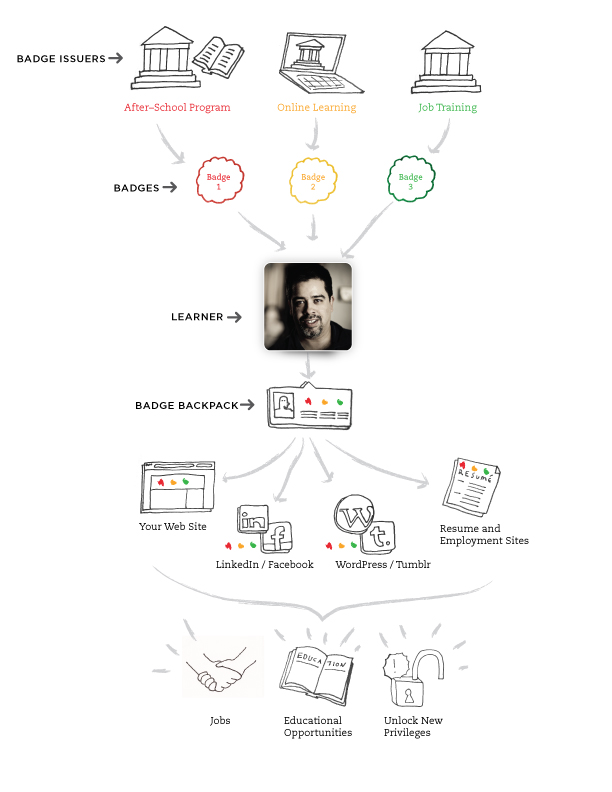 I think you can see the logic here. Skills can be unbundled and expressed via a vehicle like a badge, which is discrete, portable, understandable and able to be picked up at any place good at giving them out. Under this model, there is no huge need for either of the current givens: one institution and a degree. Students can pick up badges where they will, and whether they cohere into something called a degree fades in importance.
As Sir BH’s post might suggest, this kind of thing can work quite effectively in areas like software engineering, where unbundled descriptions–if reliable–can be helpful to employers is assessing a candidate’s qualifications. Yeah yeah it doesn’t work as well in the liberal arts. We have heard that all-purpose caveat before–e.g., “college is more than skill transfer; it is the whole experience.” That is true enough, but only for the students for whom the whole experience is suitable and/or affordable.

 Blowhard, Esq.
 Callowman
 Sherbrooke
 Eddie Pensier
 Enzo Nakamura
 Epaminondas
 Fabrizio del Wrongo
 Fenster
 Brundle Guy
 Glynn Marshes
 Paleo Retiree
 Atypical Neurotic
 Question Lady
 Sax von Stroheim
 Sir Barken Hyena
 The Mistaken
 Uncouth Reflections
Brilliant stuff. I’m rooting for the whole structure to get torn down myself, even from a lib-arts point of view. The more options, the better.
Hey, another player in the “credentializing” game: the book publishing biz. (Which in some ways has acted like an extension of college for decades …) You’re a “real writer” only if you’ve “gotten a book published.” Baloney to that, of course. Fun to see that whole pretence melting under the pressures of advancing technology. Like blogging software, for instance.
LikeLike
As someone who has a Master’s in Post-Colonial Eco-Feminism and *still* can’t find a job I find this article ridiculous.
LikeLike
I think Salman Khan nailed it correctly when he stated that there’s a gap between what employers are looking for and what schools offer (here http://www.forbes.com/sites/peterjreilly/2012/08/16/can-we-prevent-an-education-bubble/). As more young people learn that they can skip college by providing useful skills, modern education as we know it will end. For now, schools act as if they are the only way someone can be employed. In reality, many of my non-degreed peers have obtained higher up jobs just by showing employers what they are capable of in skills. Education really isn’t as necessary as everyone thinks – but right now it has a dominating marketing plan that few want to question.
LikeLike
Very interesting stuff, thanks for sharing. This is the kind of thing that’s going to remake all of our institutions in the coming years. What the ultimate form things will take is hard to say now, but decentralization is the keynote of the age, clearly.
LikeLike
Pingback: Wither Colleges? | Uncouth Reflections