
Blowhard, Esq. writes:
Camille Paglia — professor, provocateur, scourge of leftist academics and feminists — has a new book on visual art and was in town recently to lecture on it.

I trekked over to the Skirball Cultural Center on the westside.
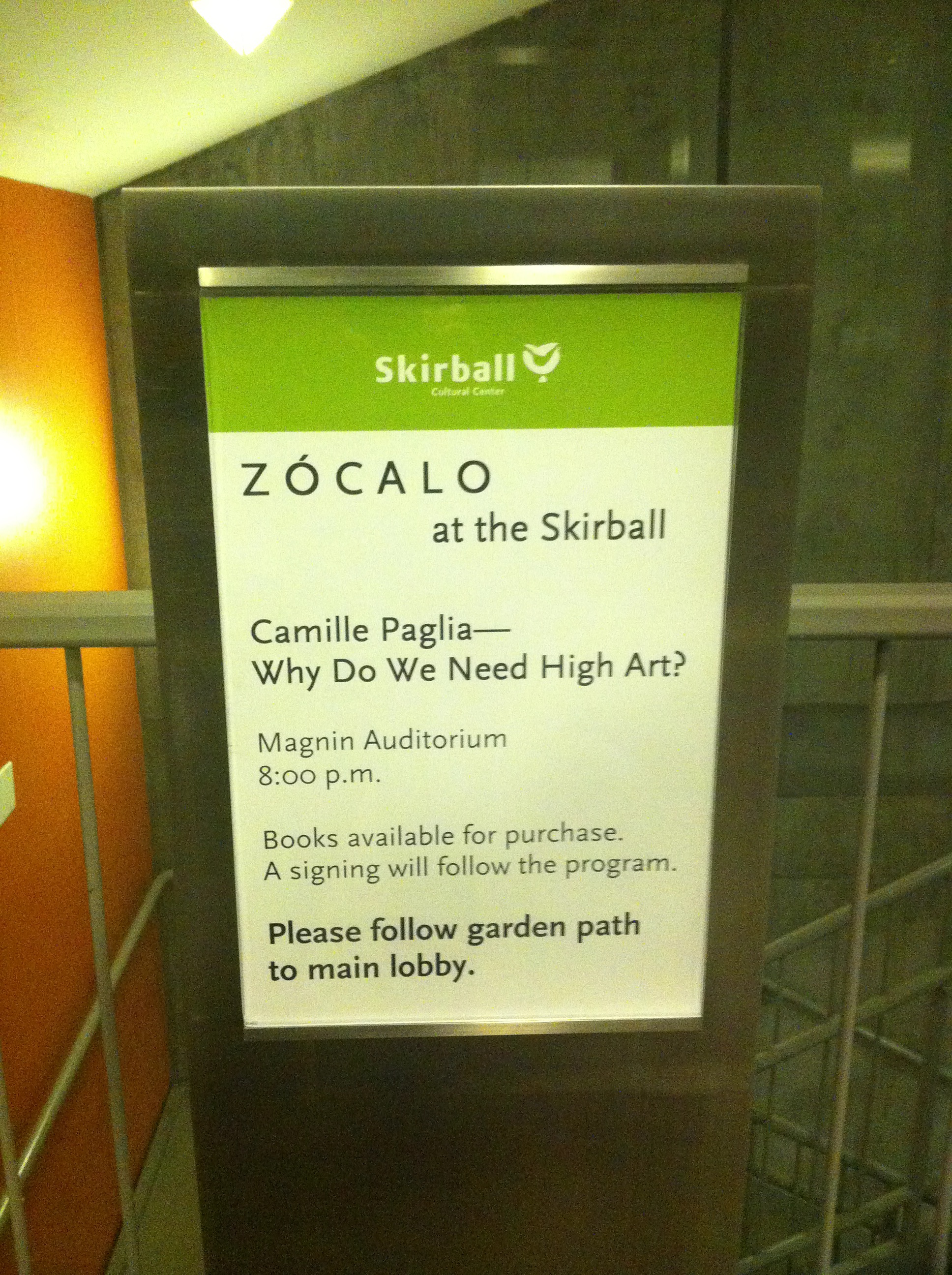
Us fancy L.A. intellectuals milled about the lobby before the show.

La Paglia was 15 minutes late. She came out — black shirt, jeans, black boots, and black leather jacket — and said, “I wrote this book because…” and proceeded to talk for about 40 minutes straight with hardly a breath.
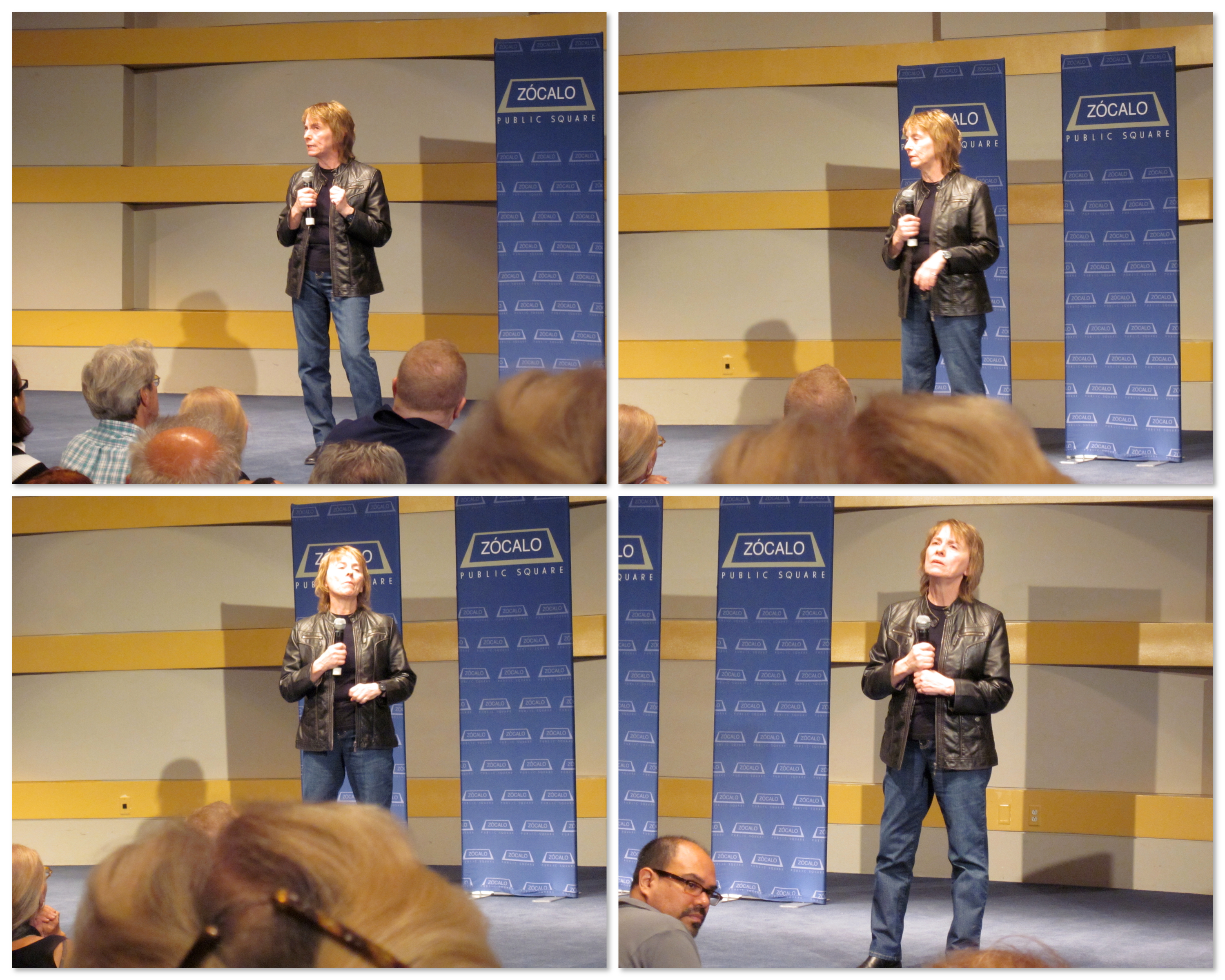 Her lecture was basically all the main points from the book’s and a healthy mix of shots at her favorite targets, like a rock band plugging the new album while also including a few greatest hits. As predictable as the jabs at academe, Gloria Steinem, and French poststructuralists may have been, the crowd (including your humble correspondent) ate it up, hooting along as she delivered her barbs. But hey, don’t take my word for it, you can watch the lecture here. And here’s some more photos of the event.
As for the book itself, I finished it today and enjoyed it quite a bit. Paglia would probably chafe at this characterization but her book felt like a series of blog posts. Each chapter begins with an image and is followed by a 3-5 page essay that weaves together the work’s history, context, and her own interpretation. Because one of her explicit aims is to show people that art belongs to everyone, her writing is clear, accessible, and jargon-free. I don’t know about you, but my visual art eduction from K-12 was nonexistent. We’re schooled in literature and exposed to a wide range of classics, but visual art and music fall by the wayside. I’m guessing this is at least partly explained by our Protestant tradition that reveres the written word but is suspicious of images. It wasn’t until I took an elective survey course in college that the worlds of sculpture, painting, and architecture were opened up to me.
One of the stand-out chapters for me was of an artist I had never heard of previously, Tamara de Lempicka.

Not only did Limpicka work in one of my favorite styles, Art Deco, she had a hell of an interesting life:
With her haute couture and Garbo cheekbones, Lempicka did not disguise her naked ambition for social prestige as well as commercial success. Her sophisticated persona was the antithesis of scrabbling bohemian mythos. She attended and threw lavish, risqué parties in Paris and expertly manipulated the media for maximum publicity. Arrogant and opinionated, she never deferred to men in the art world or courted romances with male artists. As detailed in Laura Claridge’s riveting 1999 biography, Lempicka was a liberated new woman with her own agenda, which included cocaine-fueled bisexual adventures in seedy riverside bars.
Art deco and cocaine-fueled bisexual adventures? I almost broke the Internet, I hit that Amazon 1-Click button so hard.
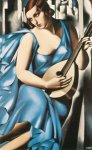
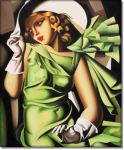


By the way, if any of these works or style looks familiar, you’ve likely seen them before.

 Blowhard, Esq.
 Callowman
 Sherbrooke
 Eddie Pensier
 Enzo Nakamura
 Epaminondas
 Fabrizio del Wrongo
 Fenster
 Brundle Guy
 Glynn Marshes
 Paleo Retiree
 Atypical Neurotic
 Question Lady
 Sax von Stroheim
 Sir Barken Hyena
 The Mistaken

Haven’t kept up with that diva for years. She seems back again, or maybe never left and I just tuned out. Always liked her critical mind but never knew what to make of what I felt to be her shapeshifting intelligence, like you never knew when she would stop waxing rhapsodic about something, pivot and rant.
LikeLike
She has been out of the cultural scene for about 5 years while researching and writing this book. She was missed. http://pjmedia.com/lifestyle/2012/10/13/welcome-back-to-the-woman-wars-camille-paglia/
LikeLike
Best way to learn about the arts is on your own anyway. The school version is only worthwhile to the extent that it explains what is accepted and promoted by our cultural overlords — which is good, I guess, because it makes it easier to know when to tell them to stick it. The stuff they teach on 20th-century art is particularly abysmal.
LikeLike
Although it’s not a tour through all of art history, Jean Clay’s Romanticism is another great source for concise, blog-posty writing. Not to take attention away from Paglia’s book, but just to add another, since there don’t seem to be very many out there for us to enjoy.
The basic unit of the book is a few large, brilliant color pictures, a pithy sentence summary as a header, and about a blog post’s worth of prose. These are grouped into four or five major chapters (on color, the movement away from 3-D immersion, etc.), each chapter having its own thumbnail-rich survey, along with an introductory chapter. And It’s generally very accessible to laymen, as long as you have a good visual sense, with the occasional French flare for words like “frontality”.
I really appreciate his organization around “variables” that you could measure in any period or place, rather than try to make the Romantic movement seem too unique. How much chiaroscuro is there? Or where does it lie on the spectrum of immersive 3-D depth vs. theatrical lack-of-depth? So the book also provides at least an implicit picture, by contrast, of art history in the periods before and after. Sometimes he even draws parallels to much earlier and much later periods, as though there’s a cyclical pattern in some of these features.
What really stands out, of course, are all the pictures — I can’t recall ever seeing an art history or analytical book that relied more on images than words. It’s more like, “Hey, don’t take my word for it, and don’t think I just cherry-picked a few examples for an entire chapter.” You get to digest so much of the original material yourself, not just rely on stereotyped and canonical famous paintings.
LikeLike
“We’re schooled in literature and exposed to a wide range of classics, but visual art and music fall by the wayside. I’m guessing this is at least partly explained by our Protestant tradition that reveres the written word but is suspicious of images.”
We could test that by looking at Catholic schools, from elementary through college-level. Do they give a better musical and visual education? Don’t know myself.
The lack of interest in those areas doesn’t feel so much like a purity / taboo thing, where words are pure and images and sounds are potentially dangerous. Whether among educators or students, you don’t sense a kind of “ack, don’t go there!” kind of reverence. It’s more like indifference, like images and sounds just don’t strike a chord with them; and like they aren’t lifted up by the power of words, but only that it’s a medium that they can process and understand, so they’ll go with that.
Modern humans are becoming more cerebral and less corporeal. The full suite of our senses are becoming deadened, so that palpable things like images and sounds increasingly do not resonate with us on a basic perceptual level, leaving us to subsist more and more on words alone.
LikeLike
Paglia has words for Protestant art in the intro. Education takes a hit too. I’m reviewing the book after the election is finally over, and will discuss the dismal state of American education.
BTW, Uncouth, love the drinks on the bar pic.
LikeLike
Thank you and thanks for checking out the blog. After you write your review, come back and link to it in the comments.
LikeLike
Here’s the de Lempicka video for “Open Your Heart”, also by Madonna, but during the ’80s Deco revival when it was more playful, less self-conscious, and in color:
The sweeter, more light-hearted melody sounds more Jazz Age-y too.
LikeLike
Paglia’s one of a kind, a true American original. Yeah, sure, she’s unpredictable, inconsistent, and probably about half nuts to boot, but she makes a lot of good points. You never quite know what she’s going to say when she opens her mouth, but that’s a good thing, these days.
LikeLike
Not a fan of hers. But love that you were literally willing to go down the garden path.
LikeLike
I sure was and I even have photographic proof.
LikeLike
It just struck me that you could be talking about Madonna instead, and the discussion would have it’s own bizarre internal logic. Note on the video: try watching it to track 1 of “Tthe K & D Sessions” Disc 2. (David Holmes, “Gone”)
LikeLike
Do you buy her argument about Lucas and Sith (at 36:36)? I haven’t liked much of 1, 2 or 3, and the idea that the final fight in Sith is like grand opera seems to strain. I mean, how is it that different, really, from any of the other majestic and meaningful and lava-filled grand climaxes now on display? The Ring even has the Wagner allusion. So why Sith? I will probably view again since Camille can sneak up on you with her odd insights, but I am not expecting much more than usual special effects sword ‘n sorcery.
LikeLike
Paleo has always run a respectful and interesting establishment.
LikeLike
I am struck by the generosity of spirit in the above comments–no ego filled rants, but a lot of heart-centered responses. There is hope for the world, yet…
LikeLike
Can’t seem to reply to a reply. Per your request, my piece ended up too long for my editor but I’ve not had time to wrestle it back. But somebody else did a great interview with Paglia about the book. Her’s ended up a little long too (Paglia is everywhere topic wise and writing about her does not lend itself to brevity) so she has outtakes from that interview here. http://acculturated.com/2012/12/17/my-camille-paglia-interview-the-outtakes/#more-6526
Link to the full interview at that post.
LikeLike