
Fabrizio del Wrongo writes:
Movies aimed at revealing the essential brutishness of man are pretty hard to pull off. Attempting to scrape through the moral shell — to, in effect, reveal the rottenness of existence — they often end up feeling, well, pretty rotten. An example that springs to mind is the Soviet war screecher “Come and See,” a movie so intent on rubbing your nose in awfulness that watching it feels a bit like being subjected to an act of ritual humiliation. Filmmakers will sometimes attempt to sidestep this by larding the material with pseudo-profundities. “Apocalypse Now” is a case in point. The ending of that movie, in which Brando squats in a temple and spouts undergraduate-level gush about mythology, feels like Coppola desperately trying to will the movie into being about something more than cool war scenes — to assure us he’s got more on his mind than helicopters and fireworks. It didn’t have to be that way: Coppola could have followed Conrad more closely and made the movie about the Martin Sheen character’s slow disavowal of the trappings of civilization. But instead he chose to make Sheen a mini-Kurtz from the start, and so his journey feels perfunctory and suspenseless. When your movie opens with your main character naked and howling into the abyss, where can you go but into mythology?
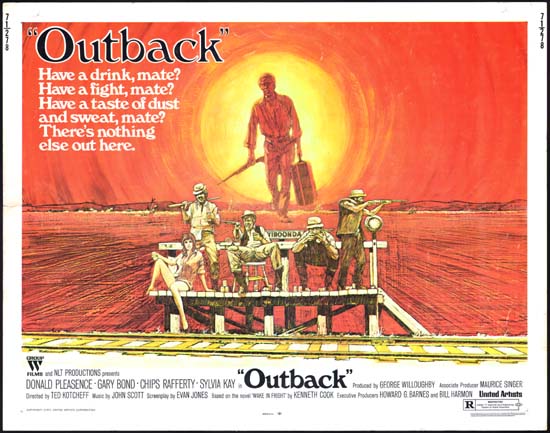
“Wake In Fright” follows the Conradian model more closely, and yet it still feels sort of half-formed. Directed by Ted Kotcheff, and scripted by Evan Jones from a Kenneth Cook novel, it uses the Australian outback as a crucible of civilization and morality, here personified by English schoolteacher John Grant. Played by Gary Bond, Grant has been assigned to a lonely, land-locked smidge of human habitation located somewhere in Australia’s dingiest nether regions. There he teaches in a one-room schoolhouse of the type familiar from westerns and stories of American pioneering. When Christmas break rolls around he takes the train to the town of Bundanyabba (aka “the Yabba”), whence he hopes to obtain transportation to Sydney and his girlfriend. Instead he falls in with a clutch of gamblers, eventually losing all his money, and he’s forced to spend his vacation with the locals, a collection of rotgut types who are like adult versions of the degenerate boys from Pinocchio’s Pleasure Island. When they’re not filling themselves with booze and gambling they’re barreling out into the brush to engage in hand-to-hand battles with the local wildlife (more on that later). The Yabba and its surroundings are like a Hobbesian anti-paradise.
Kotcheff and cinematographer Brian West have given the picture a great look: its palette is acidy, almost piss-hued, but with blotches of primary color visible on the ’70s-era cars and ramshackle structures. And the editing (by Anthony Buckley) and shot composition have an effect that’s cumulatively expressionistic: it makes the townsfolk of the Yabba seem “off” in ways you can’t quite put your finger on; you sense their hospitality is teetering right on the edge of menace. The movie is at its best when it’s underplaying: the scenes showing Grant being introduced to the Yabba are effective because they sneak up on you, then quickly morph from conveyors of local color to suggestions of maniacal male id that’d be right at home in a movie by David Lynch. (Chips Rafferty, playing the Yabba’s sheriff, is especially good at this game; his performance might be described as “genially intimidating.”) I was particularly amused (and unsettled) by a gag involving the townsfolk repeatedly offering to provide Grant with free booze. He always hesitates, then grudgingly accepts, sensing, perhaps, that a refusal would be tantamount to a challenge. Of course, there’s a certain amount of emasculation inherent in this ritual: Grant is so lacking in agency that he’s not even allowed to pay for his own drinks.
The conception of the John Grant character is problematic: the movie can’t decide whether he’s an audience surrogate or a martyr figure. The two roles may well be contradictory and Bond isn’t up to either of them regardless. Noble and aquiline in the O’Toole mold but lacking O’Toole’s cool, fascinating indomitability, Bond takes all of his character’s motivations and reduces them to a single constipated expression: a sort of pained grimace that says “get me outta here.” It’s not enough to sustain the movie, especially once the action moves to the outback, where Grant falls in with a group of louts who force him to play along with their caveman shenanigans. Here the screenplay might have given Grant a goal, a hope of escape, or something to do other than stand around and look put-upon. But aside from a sexual encounter, which is unsexy and goes nowhere, he’s just along for the ride, and the movie starts to feel as inevitable and as dirge-like as that ride up the river to Colonel Kurtz.
Kotcheff and Jones compensate by continually upping the ante on shocks. The biggest comes during the movie’s centerpiece, a nighttime orgy of kangaroo slaughter, forced upon Grant by his tormentors, which we’re meant to understand as a sacrament of brutality. The sequence, a conscious amplification of the hunting scene from “The Rules of the Game,” has an eerie beauty: picked out of the dark by spotlights, the eyes of the goofy-gallant creatures glow red before they’re blown to the ground, where they twitch and then stop moving like mechanical toys whose springs have lost tension. The killing is obviously real, and it’s impossible to distance yourself from it once the men leave their vehicles and start beating and hacking the animals to pieces. (Unlike the Renoir scene, which is poised at a right angle to the rest of the movie, the killing here is integrated and staged in close quarters. It’s damn near right on top of you.) I’m happy to admit that I watched much of this through the censoring shadows of my fingers. Yet I saw enough of it to wonder: Does this work better as a comment on abasement, or as a proof of it?
However you take the sequence there’s no doubt that Grant is supposed to be transformed by what goes on in it. But as there wasn’t much there to begin with, it’s a transformation without substance. And the movie can’t quite recover from the psychic impact of all that carnage — it just kind of peters out after Grant emerges from his bender. (Subsequent shocks, such as a homosexual encounter with a character played by Donald Pleasence, go off like wet firecrackers.) Near the end of the film, Grant, disgusted with himself or Australia or possibly the whole damn human race, tosses his broken eyeglasses to the ground in apparent renunciation. It’s a fusty, too-literary bit of symbolism that does full justice to the movie’s half-effectiveness.
Related
- “Wake In Fright” is regarded as a forgotten classic in some quarters. I see Nick Cave has called it “the best and most terrifying film about Australia in existence” — which perhaps says more about Cave’s opinion of Australia than it does about the movie.
- An interview with Kotcheff which focuses on “Wake In Fright.” Kotcheff, by the way, is best known for directing “First Blood.” He’s a pretty talented guy, and it’s nice to see him receiving some praise.
- The negative of the film was lost for years. According to this story, it was discovered in Pittsburgh (!?) and saved just before it was destroyed. The restoration used for the new DVD looks great. It really is a terrific looking movie.

 Blowhard, Esq.
 Callowman
 Sherbrooke
 Eddie Pensier
 Enzo Nakamura
 Epaminondas
 Fabrizio del Wrongo
 Fenster
 Brundle Guy
 Glynn Marshes
 Paleo Retiree
 Atypical Neurotic
 Question Lady
 Sax von Stroheim
 Sir Barken Hyena
 The Mistaken

Sounds like this would make a good double-bill with “Walkabout.”
LikeLike
Yeah, maybe. I liked this better than “Walkabout,” except for the part with Jenny Agutter’s bush.
LikeLike
It’s a nice idea for a thread: movies that accept the brutishness. What fools we mortals be, after all.
I see a lot in Friedkin (esp. Sorcerer). Also Kubrick. The brutishness is seldom in your face but he doesn’t present a particularly romantic view of the world and its creatures.
Anything with Charlotte Rampling in it.
LikeLike
I think it helps if you’re a genuine humanist — i.e, someone who likes and admires people and who has real insight into their behavior — when you’re working with material like this. Peckinpah makes it fascinating because he’s obviously in love with all the piss and vinegar of his subjects. Plus, his violence has an allure — it pulls you in and forces you to sort out your reponses. A movie like “Deliverance” works largely because of the genre engineering, but also because of the characters and the movie-star acting.
One of the interesting things about Kurosawa’s “Ran” is that the movie is bleeeeak to its very bones, and Kurosawa keeps most of the action at a distance. And yet the movie is incredible, perhaps BECAUSE its vision is so damn steely. But then “Ran” is a unique, masterpiecy sort of thing, and it’s not fair to compare other movies to it.
I think “Wake In Fright” would have worked better as a sick comedy about emasculation. But it doesn’t go there, even though it flirts with it a bit. It’s intended as a STATEMENT, and that’s where it’s soggy. I also probably would have liked it more had it been a squalid spaghetti-western type of thing with an actual plot. It has the atmosphere for it.
LikeLike
And then there’s “Lord of the Flies” …
Don’t know that I could watch kangaroos getting killed. When animals are really killed on film I tend to turn the film off. I still feel a little torn about the hunt in “Rules of the Game.” Couldn’t they have figured out how to use models? Or would the hunt have happened anyway?
I notice that Ted Kotcheff’s name has been all over “Law & Order: Special Victims Unit” since the ’90s. He’s kept very busy (and has no doubt gotten very rich).
LikeLike