
Fabrizio del Wrongo writes:
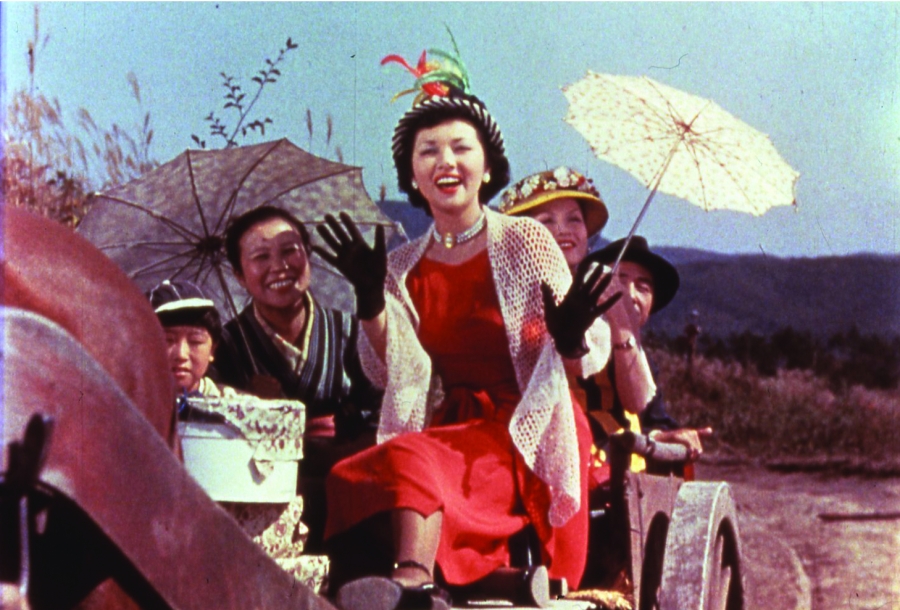
This sprightly, sweet-spirited comedy from 1951 was the first full-length Japanese film made in color. It features Hideko Takamine and Toshiko Kobayashi as Kin and Maya; they’re a couple of big-city strippers who cause a scandal when they pay a visit to Kin’s hometown, a bumpkinish enclave out of Japan’s pre-industrial past. The girls are like a pair of exotic birds: wearing garish costumes and singing American-influenced songs, they clop through the town on heels with a blithe indelicacy that recalls the gold diggers played by Jean Harlow. Unable to separate the girls’ apparent sophistication from their obvious decadence, the townsfolk are both fascinated and appalled; some take them as avatars of a new Western “art.”
Director Keisuke Kinoshita shoots the early scenes in subdued earth tones, the figures looming over shallow horizon lines like big paper cut outs. Later, during a festival sequence which highlights the movie’s main conflict, he transitions to milling crowds and primary colors in order to suggest the invigorating effect the girls have had on the populace. Much of the movie works off basic oppositions of this sort: when the town’s blind poet laureate intones a plodding ode to civic virtue, it’s meant as a contrast to Kin’s signature song, a Mae West-like stab at knowing blowsiness in which she claims the ridiculous stage name Lily Carmen.
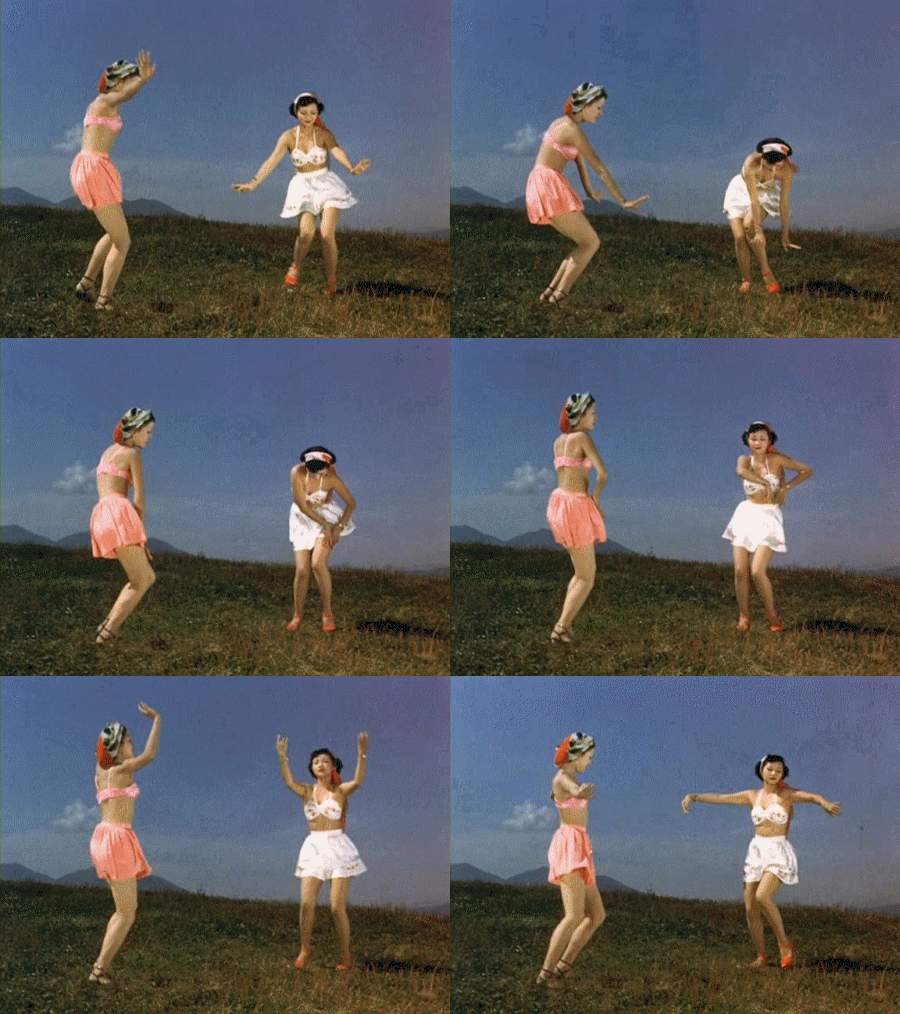
As is often the case with Kinoshita the movie’s tone is a bit too assiduously homespun (his sensibility suggests a cheekier Norman Rockwell). But when he allows a hint of parody to undercut the wholesomeness he achieves a pleasing tartness. This is particularly evident during two scenes in which Kin and Maya perform. One is a hillside pastoral that gradually turns into a strip tease, the girls’ bare skin attracting the attention of a group of hikers and some wayward cows (the images have the flesh-on-nature rosiness of a photograph by Bunny Yeager). The other is a screwball-ish bit in which Kin and Maya put on their big “dance” show. Here Kinoshita implies the effects of nudity by intercutting the performance with the rapt faces of audience members, but he also lets us see the seriousness with which the girls approach their act. They maintain that seriousness even as the band conductor gets a little over-excited at the prospect of boobies and exceeds his tempo (the film speeds up along with him).
There’s a real generosity at work here — an acknowledgement of the inadequacy of art labels and an unwillingness to disregard the pleasures of “low” culture. Afterwards, as the girls ride out of town, they’re followed by all the men who saw and will never forget their clunky little performance. Meanwhile, the blind poet reasserts order by reprising his lame paean.
“Carmen Comes Home” can be streamed via Hulu+.
Related:
- Kinoshita directed a sequel in 1952, called “Carmen’s Innocent Love.” It plays like a Japanese attempt at screwball comedy, and it pokes frenetic, satirical fun at many elements of post-war Japanese society. It, too, is available on Hulu+.
- In fact, a ton of Kinoshita-directed movies are available on Hulu+. Though he’s never been highly regarded in the West, Kinoshita was an important guy at the Japanese studio Shochiku, and he deserves to be recognized as one of the major figures in Japanese movie history. Here’s his Wikipedia entry. Looks like a biopic based on his life was recently released in Japan.
- Kinoshita was the mentor of Masaki Kobayashi, whom I wrote about back here.
- Kin and Maya do their thing:

 Blowhard, Esq.
 Callowman
 Sherbrooke
 Eddie Pensier
 Enzo Nakamura
 Epaminondas
 Fabrizio del Wrongo
 Fenster
 Brundle Guy
 Glynn Marshes
 Paleo Retiree
 Atypical Neurotic
 Question Lady
 Sax von Stroheim
 Sir Barken Hyena
 The Mistaken
 Uncouth Reflections
Nice review. I just signed up for Hulu+, so I’ll be checking it out.
LikeLike
Curious to hear what you think of Hulu+. Shit-tons of Japanese movies on there. Criterion must have inked some kind of deal with Shochiku.
LikeLike
Pingback: “Untamed” | Uncouth Reflections
Pingback: Notes on “Here’s to the Young Lady” | Uncouth Reflections