
Paleo Retiree writes:
A trendlet I’ve been noticing recently is one that has built on another trendlet I first noticed some years ago. Here are some visuals to illustrate:
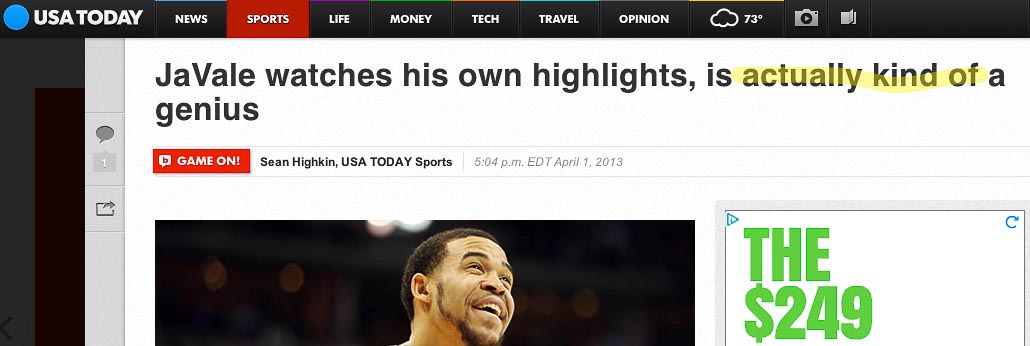
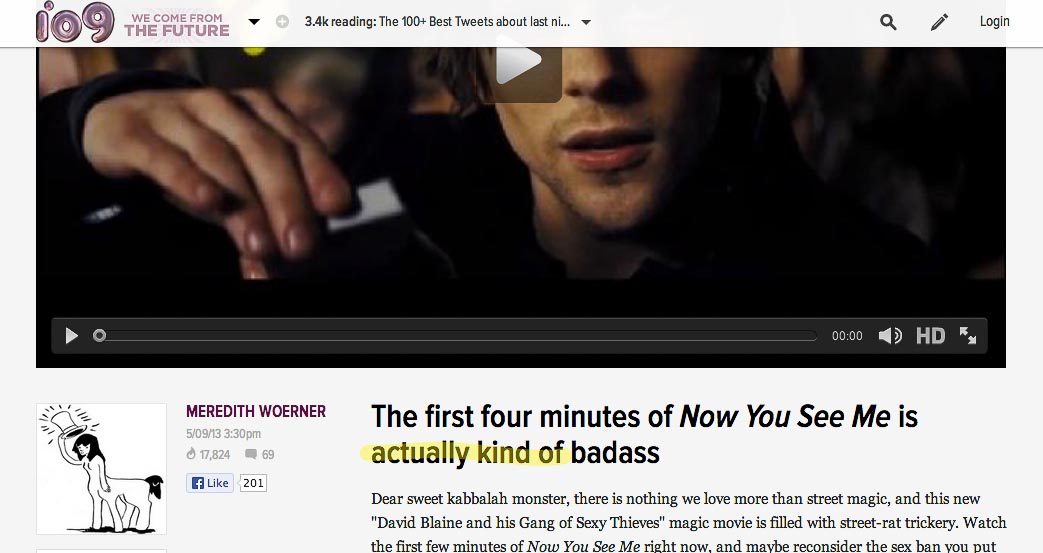

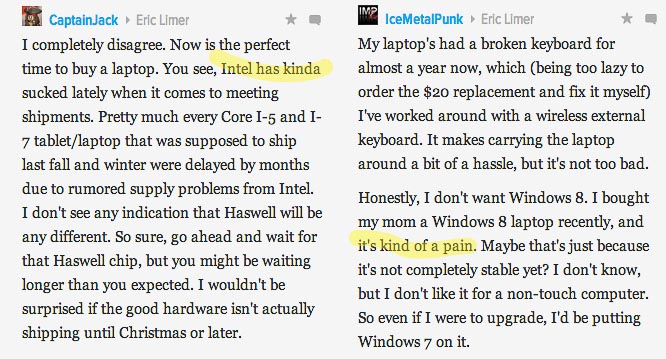


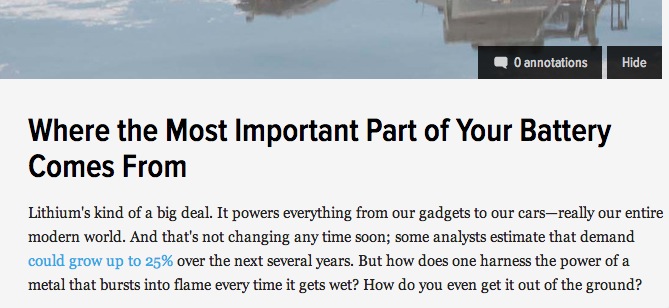 Oops, forgot to use highlighter in those final examples — but if you’re like me the “kind of”s will be popping out at you anyway.
The trendlet I first started noticing some years back (5 years? more?) was young men using the expression “kind of” in conversation a lot. These days, “kind of”s are cropping up all over the place in writing: in journalism, blogposts, comments and ads.
What’s going on? When did some people decide to start using the expression “kind of” hyper-often? And who decided it was OK to take the expression into published writing? As an old-school publishing guy, I’m puzzled.
My tendency is to see the writing thang in large part as a chance to enjoy playing with words while also having an opportunity to fix the goofs and stumbles I’m prone to when I speak. I might well use a “kind of” while I’m dumping my first impressions into the keyboard and onto the screen … but 99% of the time I’ll go back in and erase it before hitting the “Publish” button. “Kind of” indicates a mistake; writing, or at least rewriting, for me is a chance to fix my mistakes.
In conversation, “kind of” has usually served two purposes. Used one way, it’s a treading-water-while-deciding-on-a-real-word gambit. You aren’t sure what word to use next; by saying “kind of” you give yourself an extra second or two to decide on a word that really does convey what you intend. Used in another way, “Kind of” is a modifier — it conveys something like, “the thing I’m describing resembles this other thing, but only in some ways.”
Now blogging — and especially blog-commenting — are two of the most conversational, informal forms of writing that have ever existed, and god knows “kind of” shows up in the speech of many people with great regularity. So maybe a big part of what’s going on here is simply that many youngsters (these days anyone 35 or under is a “youngster” to me) are typing like they speak. And why shouldn’t they?
But my hunch is that more is going on here than just that. I think the “kind of” bit has become its own chunk of something-or-other. I don’t think these “kind of”s are mistakes, or even just unedited bits. They aren’t being used unconsciously. If they were, why would the Virgin ad be featuring “kind of”? That particular “kind of” didn’t just happen to show up. Ads are scrutinized by committees full of people before they’re finally approved and published. Someone — probably numerous people — wanted to feature a “kind of” in the middle of that ad.
So, in many of these cases, the “kind of” is a deliberate effect, and the effect is intended. But what is the intent? Given that widespread use of “kind of” probably originated with Boomers, I as a Boomer should be less puzzled than I am. But the way “kind of” is currently used feels unfamiliar to me.
Here’s some of what occurs to me as I ponder the phenom. I picture generations of kids whose upbringings and educations consisted ‘way more than mine did of being encouraged to express themselves freely … I picture teen boys and young men racing through the day underslept and overcaffeinated — hurried, wound-up and exhausted all at the same time … I picture guys with bed-head at coffee shops … Guys competing with each other to express something like “Dude, I know I should get a nap and then behave sensibly but I can’t stop playing videogames while chomping on stupid packaged foods!” … I picture a world of buzzy, gabby boys, dumping their every feeling on whoever happens to be present … Young men talking on top of each other in true hen-party fashion, like a table full of gossipy, mutually-validating women …
Hey, have I mentioned recently that in the old world of masculinity part of the craft of being a guy was keeping some of your thoughts and feelings to yourself? In the bad old days, a real man always held something in reserve. See Steve McQueen for an extreme example of this: “Bullitt,” “Junior Bonner” and “The Thomas Crown Affair” are all terrific at peddling the McQueen mystique and image, they’re all very enjoyable films, and they’re all readily findable on Amazon and Netflix.
A real man doesn’t just blurt out whatever the hell is coursing through his over-amped nervous system, in other words. (Come to think of it, a real man doesn’t cultivate an over-amped nervous system either. He reserves that state for true fight-or-flight situations.) But today’s young males do blurt, and they do it incessantly; they gab rather like ditzy girls — though, being guys, the effect they create is completely different. Today’s young guy often seems exhausted from the effort of keeping up with a spinning-out-of-control, ADD mind … He’s constantly modifying in real time what comes tumbling out of his mouth, in a chain of ever-branching clauses, gear-shifts and sudden turns that puts the intricacies of Henry James’ late writing to shame … He’s too hooked on velocity, dazzled by himself and self-pleased — all that positive reinforcement he was raised with! — to slow down and gather his thoughts together … (Would organizing his thoughts and his words be a square thing to do?)
And what’s going on with the “actually kind of” combo that shows up in some of my examples? What’s being described isn’t just “kind of” something, it’s apparently “actually kind of” something.
What purpose does the “actually” serve? Traditionally, “actually” indicates some combo of anticipation, surprise, and correction: “While I know you’re probably expecting one thing, the real fact is something else entirely.” So when this new “actually kind of” usage comes along, are we meant to be surprised — maybe even shocked … But by what? That the something under discussion is “kind of”? What sense does that make? “Actually kind of” is a traffic jam of an idiom: “Actually” sharpens up what’s coming, while “kind of” makes what’s coming fuzzy. So maybe it’s just a three-word-long, treading-water-while-looking-for-a-better-word ploy.
But I suspect that I’m being goofy, looking for a traditional word-meaning or a traditional function in “actually kind of.” Maybe the purpose of the idiom is all in the tone, in the approach, in the posture that it suggests. And what is that posture? My stab at it: reluctance, surprise, all tempered by a drawling smart-aleckiness. It’s wannabe-cool kids trying to hold the stage in the face of other, competing wannabe-cool kids. It’s the everyday-prose version of what David Foster Wallace and Dave Eggers put between covers.
“Kind of” and “actually kind of” — nonsense that ought to be knocked out of youngsters? Or part of the genuine voice of a generation?

 Blowhard, Esq.
 Callowman
 Sherbrooke
 Eddie Pensier
 Enzo Nakamura
 Epaminondas
 Fabrizio del Wrongo
 Fenster
 Brundle Guy
 Glynn Marshes
 Paleo Retiree
 Atypical Neurotic
 Question Lady
 Sax von Stroheim
 Sir Barken Hyena
 The Mistaken
 Uncouth Reflections
I find it has a weird, almost British deference to it. It’s so wishy washy, it leaves an out if anyone protests that “no it’s not like that” because you said “kind of”. It’s like they find a direct statemnet too challenging.
LikeLike
Yeah. Yet isn’t it also a sly way of being aggressive? “I’m reluctant to force this on you …” — that kind of thing, both holding-back and insistent?
LikeLike
Yes, and it is connected with the constant pose of irony, of never really liking anything except for its kitsch value. “I know we aren’t supposed to genuinely like anything, especially anything mass-produced or in pop culture, but this is *actually kind of* awesome.” Perhaps it also implies that the thing is cool in a way its makers didn’t see or intend? “Fellow hipster, you and I both know we are smarter than the people who made Sony’s new laptop. But somehow this corporation full of squares made something–accidentally?–that is *actually kind of* cool.”
LikeLike
Sheesh whatta mess! It means everything and nothing
LikeLike
“nonsense that ought to be knocked out of youngsters? Or part of the genuine voice of a generation?”
Kind of both, actually.
LikeLike
LOL!
LikeLike
It started with John Cusack in Better Off Dead telling the paper boy (“I want my two dollars!”) that his – Cusack’s, not the paper boy’s – grandma had hijacked a bus full of penguins “… so, it’s kind of a family crisis right now.”
Also, unconscious drones channel the Matrix.
LikeLike
Excellent cultural history, tks. Plus: there can’t be many people who have a better memory for what happened in “Better Off Dead” than you do.
LikeLike
I actually use these weak-sister rhetorical devices kinda often myself, both in blog comments and ad copywriting. In ads, I think they’re mostly intended to communicate a relaxed, casual, chatty tone. “Hey, c’mon, we both know how repulsive cat excreta can be, but ya know, this cat litter actually kinda stops odors dead in a way I wouldn’t have believed was possible before I tried it…” It seeks to bury the vulgar sell in a warm, friendly stream of buddy-buddy blather.
I’m actually kinda surprised you’re asking the question, because among writers I respect – among guys who can sneak a serious, sometimes even seditious point into a super-friendly phrasing that might include the “word” “thang”, you’re one of the most conversational writers I can think of.
LikeLike
“It seeks to bury the vulgar sell in a warm, friendly stream of buddy-buddy blather” — that’s great. There’s a “I’m sharing a confidence, and infusing it with a sense of genuine surprise” note to it too, I guess.
Me, I’m just marveling over the way the “kind of” and “actually kind of” things have made their way from conversation into print, and thence into headlines and ad copy. Funny how some language bits float right up to the surface, isn’t it? While others get forgotten … Another example of Darwinian selection at work, I suppose. I wonder if there’s any way to explain these developments.
LikeLike
I think its most recent usage stems from this:
LikeLike
LOL, tks. The reluctant-braggart note there is hilarious.
LikeLike
“these days anyone 35 or under is a “youngster” to me”
Not gonna lie, I actually kinda resent that. I hate to be “that guy” and have to call you out like that, but it is what it is.
LikeLike
LOL.
LikeLike
“Actually” and “kind of” aren’t taken literally. They’re emotional minimizers. Think of them as the opposite of intensifiers like “totally” or “fucking,” which are also not taken literally.
Like in the ’80s, you’d say “That movie was totally fucking awesome.” Now it’s “That movie is actually kind of amazing.”
You can chain them back to back because they don’t contribute any informational content. They’re just two layers of emotional minimizing, in the way that “totally” and “fucking” are two layers of info-free emotional intensifying.
The stress and intonational contour is pretty similar between the two cases, minimizing and intensifying. Kids say “actually” in a half-surprised way, like they don’t expect things to be cool. (And who can blame them?) It’s not really surprised, and it’s not in a correcting way. “Kind of” is not drawn-out, unsure, or waffling — it’s an emphatic “KIND of.” That movie is ACTually KIND of aMAZing. Slight rise in intonation, not in the Valley Girl question-asking way, but like “huh, who’d have thought?”
They want to express their excitement, but over the past 20 years, excitement has become suspect. Who knows what kind of creepy behavior excitement could lead to? There’s a serious “keep it in your pants” code among young people, as though spirited expression were like flashing strangers in public.
Hence, they need to make these conspicuous demonstrations that they’re not letting their excitement take off the ground — using minimizers instead of intensifiers, hover-handing instead of grabbing the girl’s butt, wearing drab schlubby clothing for what should be a high-energy occasion, wearing cologne that only smells like sand and ocean mist, and so on. “See, I’m not getting too excited, what little libido I do have is under control, so don’t get creeped out by me and exclude me from the (dull, boring) group.”
LikeLike
That makes a lot of sense. Sad to think some youngsters don’t feel free to express excitement freely.
LikeLike
BTW, the first high-profile use of “kind of” as an emphatic minimizer (not in an ironic way a la Better Off Dead) is the annoying alterna song “Breakfast at Tiffany’s” by Deep Blue Something from 1994. The early-mid-1990s saw the start of the continuing shift away from excitement and toward dullness in youth culture.
The singer is addressing his estranged girlfriend or wife, who thinks they have nothing in common. The chorus:
And I said, What about Breakfast at Tiffany’s?
She said, I think I remember the film
And as I recall, I think, we both kinda liked it
And I said, Well that’s, the one thing we’ve got
Wow man, just feel the passion sizzling off of the page. No less than three minimizers to deaden the impact of “we both liked it” — “as I recall,” “I think,” “kinda.”
LikeLike
Yeah, my theory is that it’s the current form that “cool” takes. “Can’t get a rise out of me. I’m bored, and I’ve seen it all” — there was a lot of that around many decades ago. The “actually kind of” form of blah/cool seems similar.
LikeLike
And just as a reminder that we shouldn’t be so bewildered by contempo youth culture, this isn’t the first time that it’s become more about dullness rather than excitement, nor the first time that intensifiers have dropped out of youth slang.
The Flaming Youth of the Roaring Twenties gave us “absolutely” and “positively.” Like “totally” and “fucking,” they could be chained for extra effect, and they even engaged in a little wordplay — “absotively, posilutely.”
What happened to those words during the mid-century? Flaming Youth was out, as the pendulum swung toward the Revenge of the Nerds end. The intensifiers of the ’20s were gone, and so was its black humor slang. Now it was more slang fit for the Boy Scouts — ah gee, swell, heck, neat, etc. That’s just like today — you rarely hear young people swearing. Not even “god” — it’s back to “gosh.”
Historical periods of dull youth culture invariably feature Bowdlerization, censorship (especially the kind to protect youngsters from indecency), and the like. It’s this exaggerated fear of excitement that could lead to the apocalypse, overly buttoning themselves up, and ultimately bursting at the seams. The 1780s and ’90s, after the Age of Reason / Enlightenment. The Fin-de-siecle after the Victorian era. The 1960s (distinct from “The Sixties”), after the mid-century. And whatever is in store for us after our current dull period, which I predict will end around the turn of the next decade.
LikeLike
You’ve lost me here, but I’m entertained nonetheless.
LikeLike
Pingback: Father Knows Best: Weird Asian Nazi Fetish Edition | Patriactionary
How about conversations full of ‘and I was like “OMG”, and then he was like (+ face expression) and we were like “oh come ooon” and he was like (+ gesture)’ etc etc… Way more annoying.
LikeLike
I started using “kind of” in my writing when I was commenting/posting heavily on message boards, and I got tired of internet lawyers trying to take me to nerd court because whatever comparison or reference I made wasn’t exact enough for their discerning intellects. I.e., instead of saying Jack Kirby is the John Ford of comic books, and have some fatbeard come back at me with 100 reasons why John Ford and Jack Kirby are nothing alike, I’d start saying “Jack Kirby is kind of the John Ford of comics”, which usually provide enough weasel/wiggle room to get past the knee-jerk corrections that even the most casual, off-the-cuff observations/comments/hypotheses provoke in your typical message board participant.
LikeLike
>>I got tired of internet lawyers trying to take me to nerd court
LOL. Using that next time I run into some too-literal-no-sense-of-fun-or-provocation commenter on reddit.
LikeLike
The one that really gets under my skin (although I don’t see it so much in print as much as in ads) is the “Really? REALLY!?!?” thing that kids say when you’ve annoyed them. Makes me want to stab my ears.
LikeLike
I am gratified to see this community has more or less– shall I say kind of?– wended around to the point I wanted to make. To wit:
“Would organizing his thoughts and his words be a square thing to do?”
Precisely.
LikeLike
Pingback: Documentary Recommendations | Uncouth Reflections
Pingback: No, I Don’t Fucking Love It | Uncouth Reflections
The increasing misuse of ‘literally’ also irks me, to no end, same as the ‘actually, kind of’ misuse.
http://willsmiscellany.wordpress.com/2014/02/01/journalistic-misunderstanding-of-what-literally-means/
LikeLike