
Paleo Retiree writes:
As I was scrolling through some pics I snapped during a trip the Question Lady and I took through the Midwest a few years ago, I was struck — for about the zillionth time — by the contrast between the buildings our elites used to build for us and the ones they inflict on us these days. Let me illustrate. Some old official buildings from the Midwest:
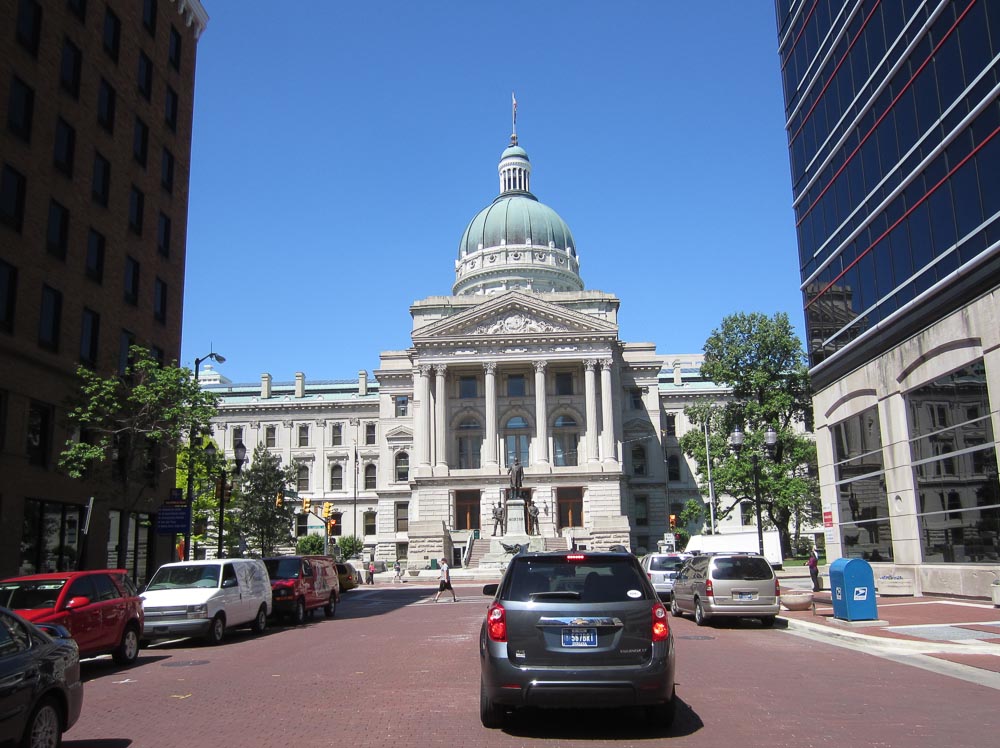
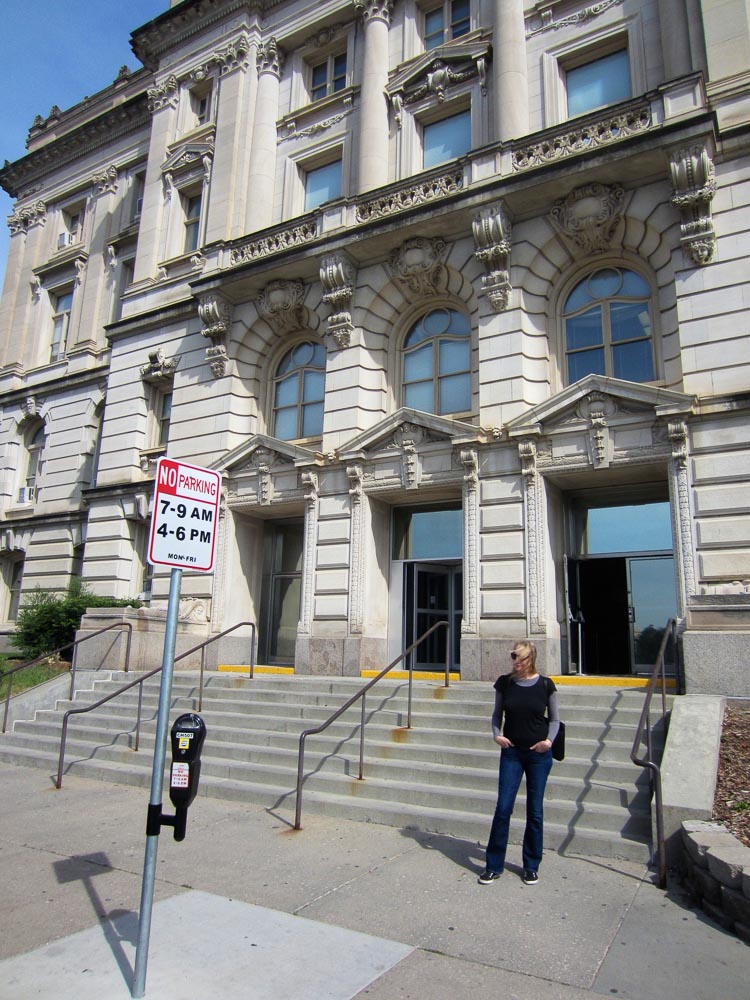

Hey, you get a glimpse of the Question Lady in a few of those shots. Cool.
Now a sampling of far-more-recent official buildings:


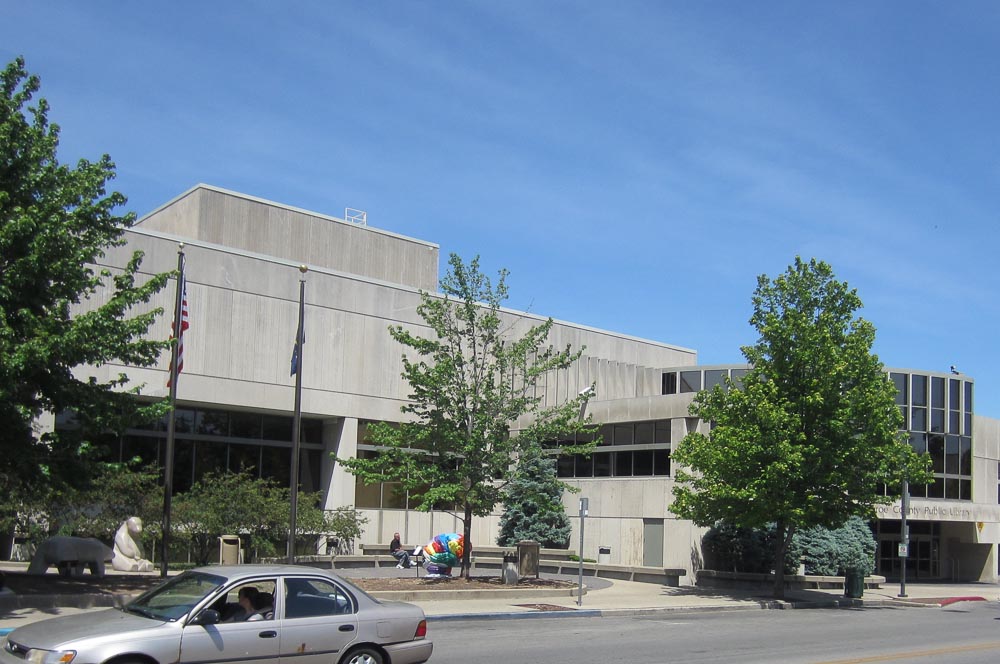
When and why did our elites start erecting dreary structures? Part of the rationale for the new concrete-and-glass shoebox style is that it’s more accessible and democratic — it’s literally more leveled-out. Does that rationale work for you? Or is it bullshit? Do the new-style (ie., modernist concrete/glass shoeboxes) buildings express more or less respect for everyday people than the older buildings do?

 Blowhard, Esq.
 Callowman
 Sherbrooke
 Eddie Pensier
 Enzo Nakamura
 Epaminondas
 Fabrizio del Wrongo
 Fenster
 Brundle Guy
 Glynn Marshes
 Paleo Retiree
 Atypical Neurotic
 Question Lady
 Sax von Stroheim
 Sir Barken Hyena
 The Mistaken

Geez, even the fascists had better taste, architecturally speaking, than moderns. Blech!
But gorgeous old buildings in your first examples. Good on the Midwest!
LikeLike
There’s a LOT of trad architectural pleasure to be had in the Midwest, at least judging from our one-week long trip. Nearly everything that’s new, though, is about as bad as can be. I wonder why midwesterners haven’t put up more a fight against dumbass modernism. Don’t they know what they’ve got, and that it’s worth protecting? Are they too trusting and accepting of what people from the outside think is important and stylish?
LikeLike
Good questions. I do hope they at least hold on to the good, even if they’re foolishly giving into stupid modernism in new government buildings, etc.
LikeLike
Good point. At least the fascists liked art deco: http://www.telegraph.co.uk/culture/art/3591841/Dark-side-of-Art-Deco.html
LikeLike
Interesting; didn’t realize that, but I knew they certainly liked good classical-influence stuff…
LikeLike
It’s not ‘art’ if it can be enjoyed by the masses.
LikeLike
A shame, that understanding… Stupid SWPLs…
LikeLike
LOL. Funny how with so many of these new-style official buildings you can see that the high-art/purer-than-thou thing has merged with the mania for cheapo/convenient/easy/cost-saving thing.
LikeLike
Indeed. Very self-serving, that, to declare as ‘artistic’ something that saves the State expense. How convenient…
LikeLike
The Midwest is full of Scandinavians, the folks who gave us Mid-Century Modern interiors and IKEA furniture, so why wouldn’t they go for drab minimalism on the outside of buildings as well?
It’s not until you go out into places that are peopled by more fiery-blooded Celtic frontiersmen types that you find Art Deco on every block downtown.
New York City seems to have suffered less of the fate of its Puritanical region because it had so many hot-blooded people pouring in (for better or worse), and the City dominated all surrounding areas. Unlike, say, Boston and its suburbs, where the sober Saxons could contain the Catholic influence.
LikeLike
Yeah, nobody’s more Art Deco than those Scotch-Irish frontiersmen types.
LikeLike
You’d see it too if you left the house and toured more of the country. There’s more Deco in Phoenix and Tulsa than there is in Minneapolis, even though the 1930 populations of those cities were 50,000, 140,000, and 460,000. The Wild West liked its buildings flashy, not dreary.
LikeLike
Yeah, because those are newer cities. Art Deco came from France and was heavily promoted by Hollywood in the US. Hollywood introduced Art Deco to most of the country. It has nothing to do with Scotch-Irish frontiersmen types.
Stick to BSing about topics nobody cares enough to call you out on.
LikeLike
In fairness to the Nordic-Americans, they do have one of the few cool-looking buildings in the country to post-date Art Deco — though way more of a (Deco) revival project than creating something truly new. Hey, whatever, I’ll take inspired revival over bland novelty any day.
Gallery of pictures of the Wells Fargo Center, Minneapolis (1988).
Awesome chiaroscuro at night (shades of Georgia O’Keefe’s Radiator Building painting?), and high-contrast polychrome in the daytime (orange, blue, black, and white). Unlike other Deco revival buildings of the ’80s and early ’90s, it’s got a decent amount of variation in the scale of objects and details, although the scale variety still isn’t as mesmerizing as in the original buildings.
The Seventies and Eighties brought out the fun-lover in everyone — even the Nords, who gave us ABBA and commissioned Deco revival buildings.
LikeLike
What I take from the architects I know is that architects want to be admired by their peers, and what they appreciate is being “original”, and following some bs abstract theory of what architecture is about, totally unrelated from how buildings look and feel once built.
LikeLike
Pingback: Modern Architecture is Hideous
I’d almost venture to say the democracy is incompatible with high art.
LikeLike
Maybe, but the first chapter of this book is all about how 19th-century Americans were crazy about Shakespeare: http://www.amazon.com/Highbrow-Lowbrow-Emergence-Hierarchy-Civilization/dp/0674390776
LikeLike
There was not much in the way of entertainment choice in those days.
I wonder how popular Shakespeare would have been if online porn, sports and I love Lucy were available to them. The market giveth what the people wanteth.
LikeLike
>>There was not much in the way of entertainment choice in those days.
Compared to now, I guess you’re right, but there was plenty of “low” art for them to choose from instead of Shakespeare.
LikeLike
Once upon a time (and for whatever interesting reasons) there was much less of a distinction between high art and commercial/popular/folk art than we’ve got today, as well as more ways to use an interest in commercial/popular/folk art as a steppingstone into the higher arts. If you dug Benny Goodman, for instance, it wasn’t all that huge a leap to start listening to symphonies and opera. Cultural experiences existed along more of a continuum than we’ve got these days. These days the low-end stuff (hiphop, trash TV, etc) and the higher-end stuff seem to inhabit completely different universes, and to be almost completely self-contained. How can someone who’s excited by reality TV (and whose universe consists of trash-TV type entertainments) learn to find any entertainment value in art movies, poetry, or concert music? It’d be like trying to master Chinese. Why bother?
LikeLike