
Fabrizio del Wrongo writes:
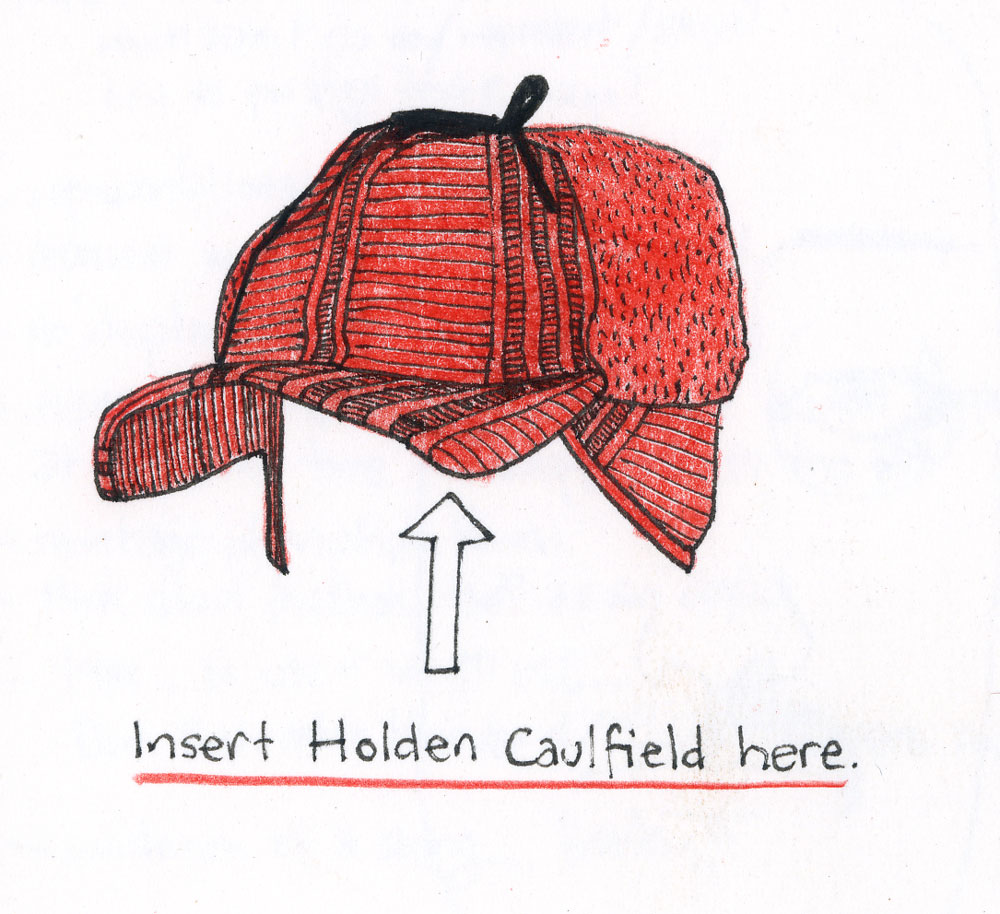
A life-of-Salinger documentary, directed by Shane Salerno, recently became available on Netflix Instant. It’s called simply “Salinger.” I took a chance on it. For a movie about a writer who was active for only 25 years, it’s pretty long — over two hours. And if you’re at all cynical about Salinger’s reputation (as I tend to be), the stench of all the incense burning can get pretty thick. The early portions are primarily devoted to Salinger’s celebrity fanboys — guys like Philip Seymour Hoffman and Edward Norton, along with some academic types — gushing about their hero. They say things like, “Salinger’s idea of perfection is really perfection and shouldn’t be tampered with,” which as a critical statement isn’t too far removed from “Batman roooooollllzzzz.” It’s long been my suspicion that more stupid things have been said and thought about Salinger than any other cultural figure of the twentieth century. Nothing presented in “Salinger” caused me to reexamine that impression.
But as the doc became focused on Salinger’s private life, a large portion of which was devoted to his hermitage in rural Connecticut New Hampshire, my interest was piqued. Who isn’t intrigued by the bizarro affectations of a cultural icon? Much of what was presented about Salinger the man struck me as pretty interesting.
A few points/observations:
- The young Salinger was something of a fame whore: he was hyper-ambitious, dying to be published in “The New Yorker,” prone to kissing up to power brokers, etc. Nothing unusual about that, of course — it’s hard to make it as a writer without being both full of yourself and willing to polish a few knobs. Still, I kept wondering: “What would Holden think?” It contradicts the image, no?
- Salinger had a thing for the ladies, especially the underage ones. Oddly, his first significant love, socialite Oona O’Neill, ended up marrying Charlie Chaplin, another guy who liked to — ahem — dabble in the pleasures of not-so-adult women. One gets the sense that Charlie and ol’ J.D. would’ve had a ball cruising the middle-school playground for potential playmates.
- The movie has a beaucoup difficult time dealing with Salinger’s experience during the war. First he was a shining example of anti-Nazism, then he married a former Nazi (she was, of course, both very pretty and very young). You can almost hear Salerno exhale in relief when the union ends in divorce. What was going on there? According to the film there’s a lack of information regarding this portion of Salinger’s life. I suspect there’s also a lack of curiosity.
- The location of Salinger’s bunker — and it really was a sort of bunker — wasn’t as secret as it was often made out to be. It was the focus of regular pilgrimages made by reporters, fans, and crazy people — though it’s often hard to distinguish where one category ends and another begins. Many of these folks expected Salinger to reveal to them the meaning of existence, and they were dismayed when he turned out to be a crotchety old guy in a bathrobe. One disappointed acolyte recounts being dismayed when, upon being pinned down at the bottom of his driveway, Salinger simply gave him the stink eye and asked if he might be suffering from some kind of mental problem. Salerno treats figures like this sad pilgrim with a degree of uncertainty. It’s possible he recognizes the similarity between the pilgrim’s conception of Salinger and his own.
- During the last years of his life, Salinger’s hobby was writing MASH notes to female teenagers whom he noticed in the media. He seems to have succeeded in getting into the pants of a few of them. Call it Famous Recluse Game.
While discussing the film (and Salinger) with co-blogger Paleo Retiree, he pointed me towards a few recent articles about the author. You can read one of them here. The guy who wrote the article is a smart guy, and he makes a bunch of good points. He also seems to be an eminent expert on Salinger. But the take expressed in the linked-to piece — that it’s folly to compare Salinger with his most famous character, Holden Caulfield — strikes me as a tad overstated. Granted, any such analogy is going to be overly simplistic. But as simplistic analogies go, the Salinger-Caulfied one is pretty potent, no? According to the folks interviewed for the documentary, Salinger spent his later years hiding from the world while watching old movies (including “Lost Horizon,” a picture dealing with eternal youth) and courting teeny boppers. Of the those who managed to become close to him, at least one claims to have been advised by Salinger to renounce the phoniness of public life. She also claims that Salinger believed that the only person capable of portraying Holden in a movie was himself. Provided all this is true (and who knows if it is?), why shouldn’t we see Holden as being a partial reflection of Salinger? It sure would explain some things . . .
The doc also caused me to reconsider a question I’ve been pondering since first reading “The Catcher in the Rye” back in eighth grade. Namely: What in the hell do people see in this lame book? Back then my take was that Holden was a sorry little shit — the biggest phony in the novel — and that Salinger, while not explicitly endorsing Holden’s point of view, was far too willing to treat it with kid gloves — to elevate Holden’s woe-is-me, it’s-all-bullshit pose to a kind of naive heroism. But maybe that’s an unfair take. It’s been a while since eighth grade, after all.
My experience is that many people who love the book view Holden as a sort of larval saint; they look up to him. Further, my vague sense is that Holden’s point of view — and Salinger’s treatment of it — held considerable appeal for the post-war audience. To that audience the idea that a young person might see through the corruptness of traditional America — might pierce the veil separating society from the golden light of truth — was a mighty powerful one, even if the “truth” in this case amounted to little more than Holden blowing mouth farts at the system.
Seen in this light Holden (and, I guess, Salinger) is similar to James Dean or John F. Kennedy, two men who remain famous more for what they represented (youth, change, great hair) than for what they accomplished. Modern Americans and their idols, eh? It’s all about intentions and potential — about what you say and represent. And if you’re gone before you have a chance to live up to your image, so much the better — it’s further proof of just how rotten everything is. I wonder: Is it a coincidence that Salinger, like Dean and Kennedy, was effectively taken from us before his potential (whatever that might have been) could be fully realized?
Anyway, I’m curious how UR readers take “Catcher.” As a great novel? The alienated blurt of a generation? A dopey forerunner of YA fiction? And why are people still talking about it 60 years after it was published?
Related

 Blowhard, Esq.
 Callowman
 Sherbrooke
 Eddie Pensier
 Enzo Nakamura
 Epaminondas
 Fabrizio del Wrongo
 Fenster
 Brundle Guy
 Glynn Marshes
 Paleo Retiree
 Atypical Neurotic
 Question Lady
 Sax von Stroheim
 Sir Barken Hyena
 The Mistaken
 Uncouth Reflections
Best ever piece of Catcher in the Rye criticism:
http://www.whysanity.net/monos/sdop.html
LikeLike
Love that play.
LikeLike
“Catcher in the Rye” — like “Fahrenheit 451” and “Lord of the Flies” — is one of those middle-school classics that somehow passed me by. From everything I’ve heard about the novel, I don’t think it holds much appeal for adults. Seems like the kind of thing that, if you’re going to respond to it, it hits you when you’re young.
When I was in Bauman Rare Books recently (the super fancy antiquarian bookstore that Rebecca Romney works at in Vegas), I chatted with one of the clerks for a while about their collection. I asked, “Is there anything here that you say to yourself, ‘God, why on Earth would people spend money on that?'” She laughed and said, “‘Catcher.’ I just don’t get it.”
LikeLike
Yeah, it’s hard to figure what adults see in it. Based on the doc (which is informative and worth seeing, despite the jokes I’ve made at its expense), there are a lot of grown-ups who view it as a Great Work. I think Salinger has retained a lot of pull as a figure; he stands for something.
LikeLike
When I was thirteen, I found Holden terribly moving. And I find him moving today as well. But I also find him profoundly frightening, as he is obviously very ill. As Guare writes powerfully, there’s a reason that Chapman was holding “Catcher in the Rye” outside the Dakota. If Holden hadn’t been institutionalized at the end of the novel, God knows what would have happened (and I’m making the very dubious assumption that Salinger would have had enough insight to write a horrible outcome). Tragically, Mark David Chapman acted out what seem like similar troubles in what might well be “Catcher in the Rye”’s “other ending.”
I think “Catcher” is a great book despite its creator’s much-too-tender, too-lofty intentions. I think it should be taught as a cautionary tale, rather than as a portrait of young man too sensitive for this world (that’s how it was taught to me, at sixteen, in the 60s). To me, it’s a very important book, more relevant every year; it should be taught in high school and discussed at length.
LikeLike
“Much-too-tender” is definitely a good way to describe it. Is it still widely taught in school? I would imagine so, but I’m not sure.
LikeLike
A certain current Nobel Laureate President of the USA can’t help but spring to mind.
LikeLike
Yeah, he’s one of the weirdest cases. Though I’m not sure what Obama’s image is now. It’s almost like the moment of his greatest influence as a cultural figure was during the ’08 election.
LikeLike
Just imagine what would have happened if he’d been shot by a white racist shortly after receiving the prize.
LikeLike
Works about alienation are boring, off-putting, and degrading when they don’t evoke a sense of a larger connection that ought to be there but is not, or that used to be there but no longer is. This requires that the characters be shown as curious about other people, and capable of and willing to drop their guard in order to connect with others.
Why then aren’t they actually connecting with one another, the audience will naturally ask? Passivity or paralysis as character flaws will do the trick — they’re capable of connecting but are frozen in place. That makes them less sympathetic, though, and the atmosphere less believable — how could there be so many people with so many crippling character flaws?
The audience will buy it more if there are larger, almost sinister forces that are keeping folks apart who want to come together. What particular force it is doesn’t matter too much, as long as it’s impressionistic rather than spelled-out. Otherwise it becomes a sermon about some particular social evil, rather than a portrayal of the social fabric being unraveled by forces that are hard to see and hence almost beyond our control (here and now, at any rate). Nothing wrong with a sermon from an angry prophet denouncing the hypocrisy of our time, but it doesn’t make for good art and entertainment.
Books like Catcher in the Rye, and emo culture more broadly, fail at a more basic level. The alienated protagonist is not very curious about other people and doesn’t feel like he should change himself in order to fit in with the crowd. He comes off more as a self-centered, self-advancing brat who wants the unconditional love, acceptance, and regard that parents are supposed to provide their children. And whether they did or not in his case is irrelevant — he’s trying to impose those demands on the wider community, when they’re only appropriate to make on his parents.
Who wants to read a book about a brat who refuses to grow up, a toddler nearly devoid of empathy who sees other people as frustrating obstacles to the unconditional realization of all of his wants?
Isn’t it strange how a movie like Big does a better job of portraying teenage frustration and alienation? Tom Hanks’ character finds other people interesting, and tries to adapt himself to the grown-up world that he’s been thrust into. Making an honest effort to fit in makes the character more sympathetic to the audience, because we’ve all been there. And rather than wallowing in self-pity, he sucks it up and gives it his best shot.
Ordinary teenage frustration is not one of those phenomena caused by malevolent cosmic forces, and it ought to be overcome over the course of the story. The alienation in Taxi Driver isn’t going to resolve itself by the end of the movie because it’s not ordinary. It’s expected that the atmosphere persist into the end credits. Treating the obstacles of the child-to-adolescent transition as permanent and beyond any attempt to overcome them, is the height of drama queen behavior.
LikeLike
“Who wants to read a book about a brat who refuses to grow up, a toddler nearly devoid of empathy who sees other people as frustrating obstacles to the unconditional realization of all of his wants?”
Yeah, I guess that’s my feeling about the book in a nutshell. I don’t feel too romantic about youth, do you? To me it was a state to be escaped rather than cherished. It seems to me that the ’60s (and I do think “Catcher” is a ’60s novel, even though it was released in the early ’50s) are really inseparable from the romanticization of youth and young people.
I guess I can see how a young person would identify with Holden. Not sure what they get out of him aside from that, though. And I have no idea what adults get out of the book.
LikeLike
I haven’t read it since 9th grade, but my memory of the vibe of Catcher is more one of infantilization than romanticization of youth. “Wah, I don’t wanna change just so I can quote-unquote fit in!” Then get lost, you little dork.
I always felt like the romantic part of life was in the 20s, and even when I was little, couldn’t wait to get there and did whatever I could to fit in with the cool older kids until it was my turn. Not too long ago, high school kids thought it was cool to have a couple 20-something friends from whom they could pick up some good influences (and bad ones).
Holden Caulfield wants the opposite — to arrest development before he has to undergo any rites of passage that would initiate him into the next stage of life. If a cultural work is going to focus on characters who aren’t fully adolescent, it should be about their preparation for and completing those rites of passage. Weird Science is a way better take on the awkwardness of coming of age, and social misfits who transform themselves in order to fit in with peers and score pretty girlfriends.
Also worth mentioning the overly saccharine Wes Anderson-ish version of arrested development: the deliberate re-winding of the plot of life before all that awkward adolescent stuff, back to naive childlike bliss, rather than trying to let adolescence play out or even fast-forward to the better stages of life in early adulthood.
LikeLike
I’m not saying that “Catcher” is romantic. I’m saying that many of the people who feel strongly about Holden and his alienation are romantic about youth in general, and that this informs their take on the book.
LikeLike
I imagine I’ll be the only person defending “Catcher in the Rye” here, but whenever I’ve entered a discussion of it, readers seem to see it in one of two ways: a boring slog about a selfish, over-privileged little creep, or a tragedy in the making. (I guess there are people out there who, like Salinger, see it as the snuffing out of Holden’s little candle, but I haven’t met them.)
I love Agnostic’s eloquence, and am startled by how differently I see the book. “The alienation in Taxi Driver isn’t going to resolve itself by the end of the movie because it’s not ordinary.” But I would argue that the level of alienation Holden represents isn’t ordinary either. In fact, if Holden gets out of the mental hospital he may well turn into Travis Bickle, subject to headlong crushes, mystified about how to bring up sex with women, obsessed with rescuing the young ones he thinks are innocents (in their hearts, at least), and frustrated to an unbearable level.
To me, “Big” is a different kettle of fish altogether. It’s a lovely exploration of how young teens develop on all levels. Hanks plays a really ordinary kid, and that’s the great beauty of the movie. But Holden is seriously strange and lost, a kid who could easily go insane. That’s the fear and loathing in the book that grabs me and doesn’t let go. I could catalogue moments of attempted empathy by Holden, or empathy that is quickly extinguished, but that WOULD be boring. Still, if I wanted to name a boring book about someone absolutely selfish, devoid of empathy and alienated even from himself, I’d come up with “American Psycho” a lot faster than “Catcher.” Granted, “A-Psycho” is not about an adolescent, but it does fail to “evoke a sense of a larger connection that ought to be there but is not, or that used to be there but no longer is.”
I would like to see “Catcher” filmed–and filmed well. The trouble with comparisons to “Taxi Driver,” “Big,” and any other film is that books and movies reach our hearts in profoundly different ways. Consider different actors who might play Holden–reaching into different eras, think of Timothy Hutton, Tobey Maguire, Sal Mineo …. the meaning of it all becomes much more fluid. Then add a director. If “Catcher” was a movie, this would be a much different discussion.
As for whether “Catcher” is taught in school these days, I don’t really know. What books ARE taught to kids these days? Why can’t I get my godsons on the phone when I need them?
LikeLike
I’d be willing to bet that Holden grew up to be “American Psycho”, The guy creeped me out even when I was an adolescent and was supposed to “identify” with him.
LikeLike
About the context of the book’s release and initial success — I think lots of young or youngish people resonated with the bratty theme during mid-century malaise. That was a period of profound cocooning, folks refusing to sit near other community members at a fast food restaurant, and insisting that everyone eat in their parked cars instead. They didn’t want to let their guard down, and they showed at best a shallow interest in connecting with their fellows.
Mid-century solipsism didn’t have the hostile, competitive, and divisive streak that it does in the Millennial era, as it was a period of falling inequality, where folks were expected not to raise a hue and cry to advance themselves up the status ladder. Still, the social-emotional void of the period is impossible to miss for anyone who takes an honest look at it, especially contemporary chroniclers like the painter Edward Hopper.
Hopper’s paintings at first look like a naturalistic take on De Chirico’s surreal portrayal of isolation and alienation. But the spaces that are nearly abandoned of people, and the harsh dark-light contrast in his paintings creates a surreal atmosphere within a mundane setting. This allows the viewer to believe that there are sinister, hard-to-pin-down forces keeping these people disconnected from one another, since they look like emotionally normal folks.
Film noir achieved the same effect using the same means. Movies are better able to humanize the characters since they unfold over time, unlike the snapshot shown in a painting. So little fleeting moments of characters letting their guard down, reaching out to others for help, and the other side providing it. The Big Heat is the best example of the humanizing strain of film noir.
LikeLike
I don’t agree with Agnostic about the spirit of Midcentury, but he’s dead right about “Catcher”…
LikeLike
BTW the locale of his hideaway was New Hampshire I believe. Cornish, a nice little town on a lovely stretch of the Connecticut River some miles from Dartmouth. Now mostly forgotten, it was the home of an artist’s colony around the turn of the last century, one that attractedi St. Gaudens and Maxfield Parrish among others. The St. Gaudens home and gardens are worth a visit if you are nearby.
LikeLike
Thanks. I’m was probably confused by the Connecticut River, which I believe is mentioned in the movie.
LikeLike
High concept elevator pitch: Catcher in the Rye and Catch-22 and One Flew Over…
Put them all together and you’ve got this amazing character. Q: What super-apowers should he have?
LikeLike
Right now I’m trying to compare and contrast Caulfield’s rejection of the ruling hypocrisies of his day with neoreaction’s rejection of the ruling hypocrisies of our own day. Not crazy about it but it has to be done, I guess.
Not all ruling hypocrisies are equally awful, in our defense. But then again Moldbug makes a good case that our hypocrisies are theirs, plus time. Which makes Caulfield more sympathetic, and us less.
LikeLike