
Blowhard, Esq. writes:
The old Cincinnati library. It was demolished in 1955.
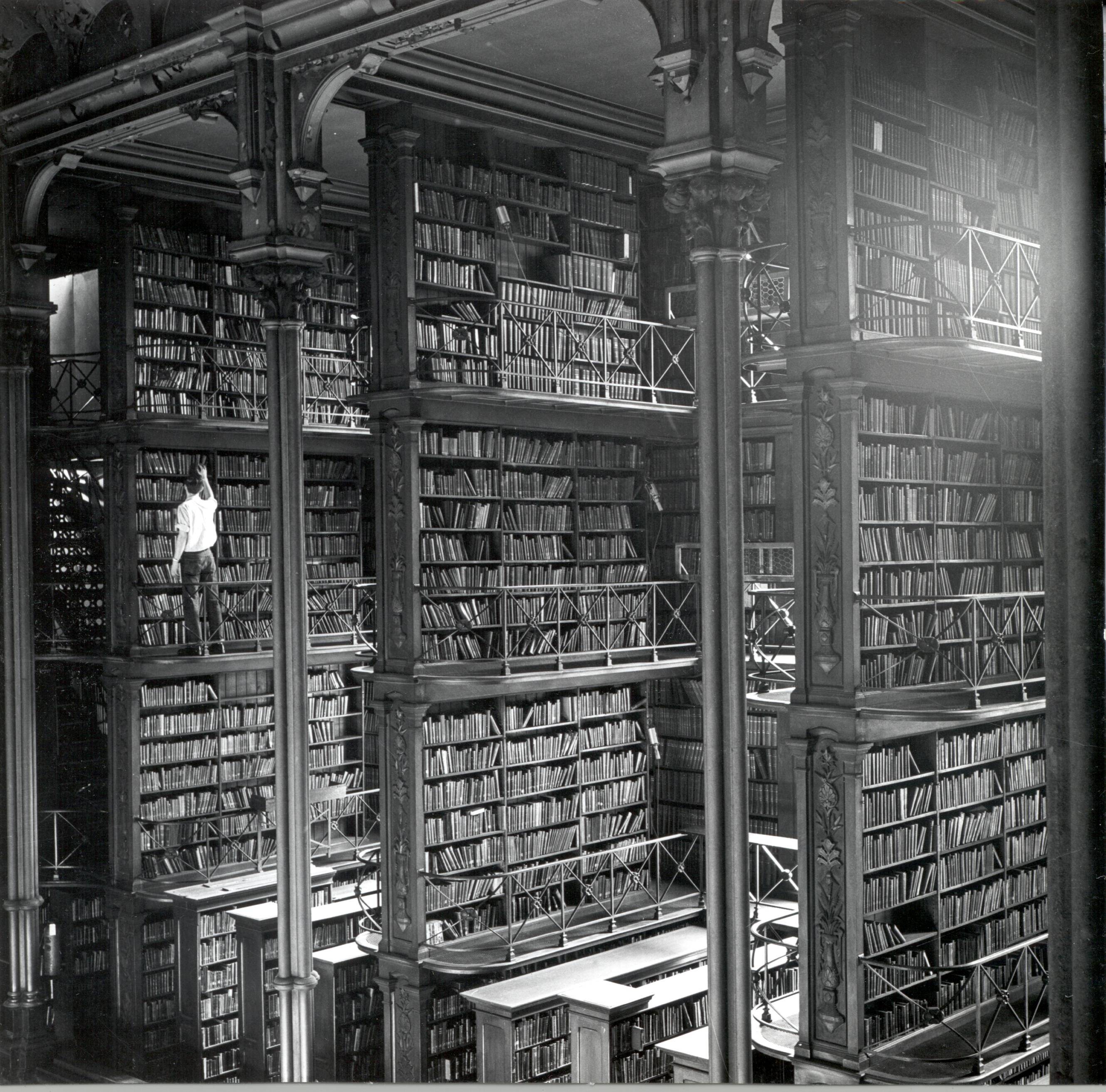 BuzzFeed has more photos here.
Blowhard, Esq. writes:
The old Cincinnati library. It was demolished in 1955.
BuzzFeed has more photos here.

Have a WordPress.com account? Log in now.

 Blowhard, Esq.
 Callowman
 Sherbrooke
 Eddie Pensier
 Enzo Nakamura
 Epaminondas
 Fabrizio del Wrongo
 Fenster
 Brundle Guy
 Glynn Marshes
 Paleo Retiree
 Atypical Neurotic
 Question Lady
 Sax von Stroheim
 Sir Barken Hyena
 The Mistaken
Tragedy.
LikeLike
For some reason this strikes me as the nerdy version of that famous photo of construction workers building the Empire State Building, eating lunch on a girder. Awesomeness.
LikeLike
Did they search that place for Rosebud?
More seriously, this photo actually deserves the adjective “awesome.”
LikeLike
I agree. Yeah, the looked for Rosebud but no one could find it. However, the basement had the Ark of the Covenant,
LikeLike
LOL. I wonder if there were signs telling browsers to not look down. One glance over my shoulder and I would have taken a header, no question.
LikeLike
It looks as if the building took much of its charm from the bookstacks and the other library-specific accoutrements. After the library moved it was just another old building and not especially worth saving.
Peter
LikeLike
Yeah, could be. I wonder if photos exist of it empty so we can judge for ourselves.
LikeLike
Disagree. That’s one of the reasons these buildings are so missed. A lot of these buildings aren’t particularly beautiful but they’re not offensive either. I think that’s one of the things that gets completely missed by the architectural profession. Sometimes a buildings virtue lays in it not being offensive and attention seeking but just quietly mingling in.
Looking at the photos, one of the things that strikes me is just how intelligently they used natural light to illuminate the space. Decoration seems subordinate to function and thus the architect was able to both grandeur and achieve practicality. The level of detailing visually breaks up what is otherwise a very large space, humanising it. And the spaces they had just seemed to “work”. The public buildings of the 19th C always seemed convey a sense of occasion as opposed to going to today’s “book warehouses” where the whole environment is bland.
Modern libraries are just shit.
Check out the Peabody Library. People want to get married there!
LikeLike
Great photo, wonderful building shame torn down.
On the other hand, this photo brings me back to when I was first a doctoral student. How tiring it was to do research. Go to Reader’s Guide. Hopefully find the right topic name in the bulky thousand page volumes. If not, put A-C back and look for a similar topic name in thousand page G-H. Handwrite citations. Go to paper card catalog to see if in library holdings. If not, start over or go to Interlibrary and fill out long form. If yes, traipse up stairs, perhaps even as lovely as the ones in the photograph, to find paper volume of periodical. Is it shelved? Maybe no. Check volumes to be shelved. Check reading tables. Eventually find volume. Read abstract? Relevant? No? Start over If yes, carry heavy bound volume to copy machine down gorgeous stairs. Feed nickels in, page by page. Congratulations! That’s one paper of your literature review.
No thanks, even in these nice digs. Give me Google Scholar any old day. Find topics, click. Or authors, click. Or titles or subjects, click. Find articles, click. Download articles, click.
Nicholson Baker had that provocative piece in the New Yorker in 1994 arguing not only that card catalogs should be preserved but that they were inherent superior to digital. If that argument wasn’t rubbish then, it surely is now.
Yet that photo is beautiful.
LikeLike
Pingback: Mid-November Linkage | Patriactionary
Looks like CGI.
LikeLike
Yeah, I know what you mean, the repetition of the stacks.
LikeLike