
Sax von Stroheim writes:
I picked up the first seven issues of Red Hood and the Outlaws from the same digital comics sale that netted me those Batman comics. As I noted (briefly) in that post, Red Hood and the Outlaws is one of the many current Batman-spin-off comics. I wanted to read Scott Snyder and Greg Capullo’s Batman because I heard it was good. I wanted to read Scott Lobdell and Kenneth Rocafort’s Red Hood and the Outlaws because I heard it was horribly sexist and “strongly objectionable”.

I think my next post may be about how terrible superhero comic book covers have gotten over the years
First, a little background:
Red Hood is a weird, only-in-superhero-comics character. Red Hood’s secret identity is Jason Todd, who used to be Robin, Batman’s sidekick. To be precise, he was the second Robin (the first was Dick Grayson, who was played by Burt Ward in the TV show and who grew up to become Nightwing). Back in 1989, the Batman writers killed off Jason Todd as part of a ghoulish interactive marketing campaign that let fans call one of two 1-900-numbers in order to vote on whether or not he would live or die. Given how decadent and bloodthirsty superhero comics have become, it was a closer vote than one might expect (5354 for him to die, 5271 for him to live), though it turned out to be one of the earliest, biggest steps down that path of decadence.
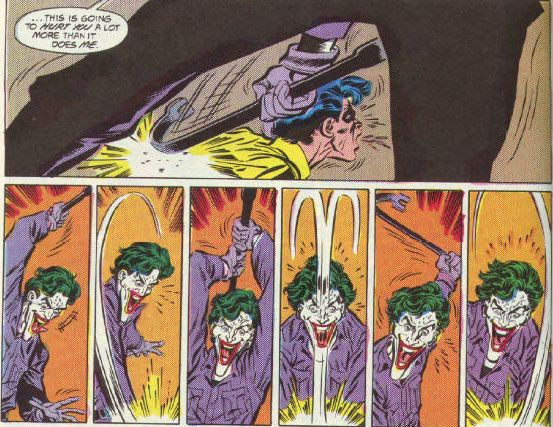
This is what you get if you’re not a popular enough character
Anyway, the fanboys had spoken and the writers obeyed their wishes by having the Joker beat Jason Todd to death (shouldn’t the Joker have used some kind of elegant, crazy death trap?). Of course, no one stays dead in superhero comics—there’s more money to be made with IP that you can use than there is with IP that you can only mourn—so eventually Jason Todd had to come back. I’m not clear on all of the plot details behind his return (and I can’t be bothered to look it up on Wikipedia, though that info is probably on this page if you are that kind of person), but the gist is he came back from dead pissed off at both the Joker, for killing him, and Batman, for letting the Joker kill him. He put on a red hood (the same red hood that the Joker used before he became the Joker…
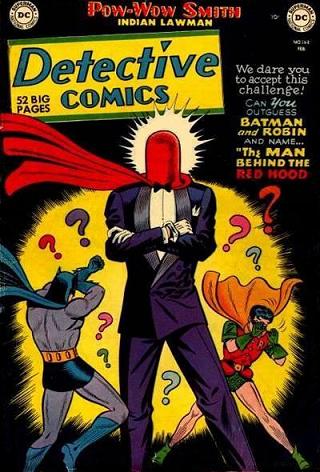
This Red Hood was not the Joker when this comic was published, but would later be “retconned” into being the Joker by the great Alan Moore: Schrödinger’s Supervillain
Uh, man, it’s when I read back something like that last part – “the same red hood that the Joker used before he became the Joker” – that the byzantine nuttiness of these things really hits me. I mean, I like that kind of nuttiness and it’s really almost completely unique in pop culture. Even though more and more of pop culture has come under the influence of superhero comics, the “mainstream” version of these stories—the Nolan Batman movies or Joss Whedon’s Avengers—are straightforward, streamlined, de-weirded versions of the can’t-believe-any-of-this-is-done-with-a-straight-face-but-I-assure-you-it-is convoluted goofiness of genuine, high octane superhero comics. If you don’t have an appreciation for that kind of weirdness or aren’t interesting in cultivating such an appreciation, I don’t think it’s worth reading any of these contemporary superhero books. Even if you do, there are many better places to start than Red Hood and the Outlaws, but maybe I should save that for the actual review part of this post.) and started to rob and kill and terrorize Gotham City’s criminals. This made Batman angry, because Batman has a code against killing and also because he likes to be the #1 vigilante in his town. After a bunch of confrontations and misunderstandings, Batman and Red Hood make-up and Red Hood becomes just another Batman spin-off character, along with Nightwing, Batwing, Batgirl, Batwoman, and Red Robin.
So, that’s the backstory, more or less what you’d be expected to know before reading Red Hood and the Outlaws #1, which starts with Red Hood leaving Gotham City to pursue his career as a vigilante out of Batman’s shadow. He teams up with a character called Arsenal, Green Arrow’s ex-sidekick, and Starfire, an unbelievably powerful alien princess who used to be Nightwing’s (that is, the original Robin’s) girlfriend but is now suffering from a kind of self-induced amnesia common to people from her planet. The charges of sexism center on how Starfire is drawn—ridiculous superhero cheesecake stuff—and written—she’s really into casual sex and, because she’s an alien, all human dudes are interchangeable to her. By the end of the third issue she’s gotten it on with both Red Hood and Arsenal and the joke is that she can’t be bothered to tell them apart. They pretend to be cool with it, but are both secretly jealous. For some reason, this is all very upsetting to a lot of people who write about superhero comics on the Internet.

“Strongly objectionable”
Personally, I found the sexist stuff to be the best the part of the comic: it reminds me of Barbarella and other raunchy, Eurotrashy sci-fi from magazines like Heavy Metal. It’s a funny set-up: two would-be bad boys both competing for the affection of an impossibly gorgeous alien princess who is only using them for their bodies. If the comic has a problem it’s that this isn’t the centerpiece, it’s just a subplot, and the main plot is some reheated pulp dish (with elements reaching all the way back to the old Shadow radio and magazine serials) that involves Red Hood getting caught up in a war between two mystical secret societies who have been fighting over the fate of humanity since the Dawn of Man sequence from 2001: A Space Odyssey.
To be fair, critics of the sexist stuff have one reasonable point: this comic isn’t for children (it’s for 12-16 year-old boys and 40 year-old men who have the same tastes as 12-16 year-old boys), but Starfire is one of the main characters of Teen Titans Go!, a cartoon aimed at little kids that’s broadcast on the very kid-centric Cartoon Network. This seems like bad brand management on the part of Warner Brothers and DC Entertainment.
Still, it strikes me as odd that anyone would find these comics “strongly objectionable”. I mean, find them ludicrous or boring or badly written, fine—but to object to them because they contain cheesecake art and play into adolescent fantasies seems a bit much. What’s wrong with a little fantasy? Did Barbarella do any permanent harm to kids who encountered it back in the 1960s? And, with all of the different comics out there, with all of the different pieces of pop culture to choose from, why do so many people take offense if a given comic, movie, TV show isn’t meant for them? Isn’t it kind of nutty to expect, let alone demand, that every single comic, movie, or TV show caters to your own tastes and prejudices?
(“But,” one of the critics might say, “Nerd culture, in particular, has a ‘woman problem’.” And I might even agree with that, but, if so, the problem is more biomechanical than cultural.)
Anyway, I liked these comics, overall. The main storyline is indeed tired and generic, but the bits in between (especially the goofy sex stuff) are funny. Lodbell refreshingly, straightforwardly gives the audience what it wants, without any pretenses that this he’s supposed to be telling a weighty, serious story. I’m not sure I’d keep reading, past the issues that I already bought (unless the later ones went on sale, too), but I’ll definitely keep my eye out for more work by Lobdell and Rocafort. They seem to know what they’re doing.
Related
- I wrote about some recent Batman comics, here.
 Blowhard, Esq.
 Callowman
 Sherbrooke
 Eddie Pensier
 Enzo Nakamura
 Epaminondas
 Fabrizio del Wrongo
 Fenster
 Brundle Guy
 Glynn Marshes
 Paleo Retiree
 Atypical Neurotic
 Question Lady
 Sax von Stroheim
 Sir Barken Hyena
 The Mistaken
 Uncouth Reflections
The feminist scolds and White Knights who attack this stuff are something else, aren’t they? I dunno what’s so difficult about admitting you don’t have a taste for something, letting other people enjoy what they enjoy, and then moving on. No, instead places like Jezebel, xojane, the Hawkeye Initiative, et al. churn out these ridiculous pieces about how sexy chicks in comics are ruining the world. Unbelievable.
LikeLike
It’s especially weird to me when they go after stuff like comics, which are traditionally trashy, marginal, goofy, lowbrow, and in-bad-taste.
LikeLike
Yeah, that’s a good point. Why do you think they go after comics at all? Because they’re easy low-hanging fruit?
LikeLike
Presumably they do because they see themselves as full members (at least!) of nerd culture. The rest follows a predictable route.
LikeLike
In the case of comics, I think it has something to do with how the geek fallacies operate: everyone should be included, everything should be inclusive. The same kind of issues/arguments pop up in Dungeons & Dragons-type circles, too. Which is odd, since these hobbies are so marginal to begin with, and their “marginality” (or at least their idiosnycracy) is part of the draw in the first place.
LikeLike
“Did Barbarella do any permanent harm to kids who encountered it back in the 1960s?”
Well, now that you mention it. Anyone recall what happened when they grew up?
LikeLike
Pingback: Superheroes in Therapy | Uncouth Reflections