
Blowhard, Esq. writes:
I was just at Ticketmaster buying tickets for an event when the inevitable CAPTCHA gatekeeper popped up. I was surprised to see this:
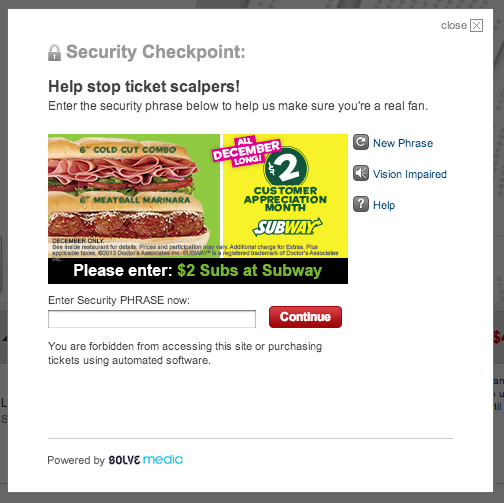 America: We never let an opportunity pass to sell you something or hawk crappy food. It would be against our religion to do so. Also, aren’t CAPTCHAs supposed to funky and near-illegible to fool computers? All of the sudden they’re perfected an easily-read one?
Related

 Blowhard, Esq.
 Callowman
 Sherbrooke
 Eddie Pensier
 Enzo Nakamura
 Epaminondas
 Fabrizio del Wrongo
 Fenster
 Brundle Guy
 Glynn Marshes
 Paleo Retiree
 Atypical Neurotic
 Question Lady
 Sax von Stroheim
 Sir Barken Hyena
 The Mistaken
 Uncouth Reflections
Keep it classy, America.
LikeLike
Next stop — the secret code only shows up at the end of a 30-second flash ad.
(Did you miss it? Simply hit “replay” and enjoy another 30-second ad of your choice.)
LikeLike
Ugh, I have no doubt they’re beta testing that as we speak.
LikeLike
“Also, aren’t CAPTCHAs supposed to funky and near-illegible to fool computers? All of the sudden they’re perfected an easily-read one?”
That may have been true in the past, but if memory serves me correctly, the near-illegible word CAPTCHAs of the past were used by Google to get scanned pages translated into words. For example, when Google was launching Books, it had trouble getting all the book pages that it had scanned translated into plain text, so they used their CAPTCHA-based web security service to get people to transcribe words that their text-rendering software missed. IIRC, they coupled a known scanned word with an unknown one, so that whenever anyone tried to enter a CAPTCHA, they were unwittingly doing transcription work for Google.
The thing with CAPTCHAs, though, is that as long as they are image-based, they are fairly difficult for computers to read. Thus, the crystal-clear image used above is secure because a) it’s an image, which makes it hard to decipher and b) there are a lot of words in the image, which makes it hard for an automated program to discern which words should be entered.
Cf. http://www.google.com/recaptcha/learnmore for more about CAPTCHAs.
LikeLike
Cool, thanks for the info.
LikeLike
Pingback: Ads Everywhere | Uncouth Reflections