
Eddie Pensier writes:
Re-reading this post from last November at Sasha’s blog:
Not long ago, I was wondering at how some words got to have two opposite meanings. There were two I knew of immediately: sanction, which means both “to allow” and “to prohibit”; and peer, which means both one’s equal (“a jury of one’s peers”) and one’s superior (“a peer of the realm”).
Much pondering gave me some other examples:
first degree which is the worst sort of murder but the least worst sort of burn;
handicap, which can mean an advantage, or a disadvantage;
to lease, offering something for rent or being the one who rents it;
and strike, either to hit something or (in baseball) to not hit something.
Off the top of my head I came up with two others: seed, either to add seeds to something (“seeding a field”) or to remove seeds from something (“seeding a lemon”); and similarly, dust, to remove dust (“dusting the shelves”) or add it (“dust the cake with powdered sugar”).
If that’s not confusing enough for you, here’s a list of 75 other self-contradicting words and terms. Not all of them are exact opposites, but they’re illustrative of the greater point that the English language is greater and stranger than any of us realize.
Readers, what are some of your favorite English quirks?
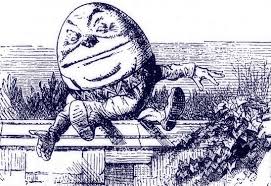
‘When I use a word,’ Humpty Dumpty said in rather a scornful tone, ‘it means just what I choose it to mean – neither more nor less.’ Illustration by Jon Tenniel.

 Blowhard, Esq.
 Callowman
 Sherbrooke
 Eddie Pensier
 Enzo Nakamura
 Epaminondas
 Fabrizio del Wrongo
 Fenster
 Brundle Guy
 Glynn Marshes
 Paleo Retiree
 Atypical Neurotic
 Question Lady
 Sax von Stroheim
 Sir Barken Hyena
 The Mistaken
 Uncouth Reflections
Yin is the opposite of yang, but at the same time, in some odd way, the same.
LikeLike
Ayyy! Do not forget the homonyms that are antonyms!
raise – raze
fetid – feted
wrought – rot
LikeLike
Hi Manolo. Great example! Although, saying those words aloud, I realize that there is a slight difference in the way I pronounce “Wrought” and “Rot”. Not huge, but noticeable. I suppose it depends on one’s accent.
LikeLike
Pingback: Linkage for a Mid-February Saturday Night | Patriactionary