
Blowhard, Esq. writes:
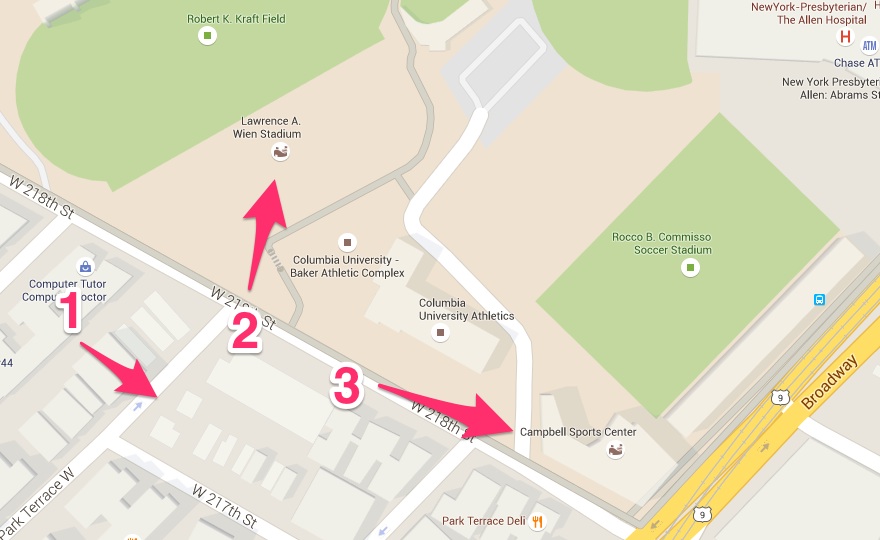
Submitted for your consideration, 20th century architectural history in miniature, as illustrated by three buildings. Located in Inwood neighborhood of upper Manhattan, each is located right next to the other. Here’s a map in the order we’ll be looking at them:
Many of the residential buildings in Inwood date from the 20s and 30s and are built in the Art Deco and Tudor Revival styles.


Charming and beautiful, no? Across the street is…this. It’s Lawrence A. Wien Stadium, where the Columbia football team loses plays. The field is named after Robert Kraft, owner of the New England Patriots and Columbia alum. Built in 1982 in the Brutalist style, it resembles a prison guard tower.


Finally, just east of the stadium is the Campbell Sports Complex, designed by Columbia professor Steve Holl who took his inspiration from football diagrams. It looks like a neurotic robot insect to me.


The New York Times loved it (“a tough, sophisticated and imaginative work of architecture”) but the local residents weren’t as enthusiastic:
Inwood neighbors say they understand the problem but contend the design, by the acclaimed architect Steven Holl, a Columbia professor, is out of character with the sedate Art Deco and Tudor-style apartment buildings to the south. The angular Holl building would be set partly on stilts and accented by terraces and stepped ramps that echo urban fire escapes.
“It does not relate well to the community,” said Gail Addiss, 61, an architect who lives opposite Baker Field. “It’s similar to Frank Gehry architecture — large metal things whose glare is going to cause more brightness to reflect into people’s windows.”
Which style do you prefer?
Related
- A short history of Columbia University’s involvement in Inwood.

 Blowhard, Esq.
 Callowman
 Sherbrooke
 Eddie Pensier
 Enzo Nakamura
 Epaminondas
 Fabrizio del Wrongo
 Fenster
 Brundle Guy
 Glynn Marshes
 Paleo Retiree
 Atypical Neurotic
 Question Lady
 Sax von Stroheim
 Sir Barken Hyena
 The Mistaken

Northern Manhattan sure looked and felt great when it was suburban and Celtic rather than urban and Ashkenazi.
1982 is a very late date for a large Brutalist project, especially in fashion-conscious New York. The Jews really held out to the bitter end on the whole vanguard totalitarian thing.
LikeLike
Since modern culture is pretty much a prison anyway, and tends to have all its works on the outside, like an insect, the two sports complexes are very much in tune with the zeitgeist.
As little affection as I have for Ayn Rand and her brutalist “heroes” (like, none), I think Howard Roark’s solution commends itself in these cases.
LikeLiked by 2 people
Interesting background from Wikipedia (though likely already known to most UR readers):
Although it seems to have taken the passage of decades for fans of this school to recognize that its moniker is a little too apt.
LikeLiked by 1 person
You should look at pictures of my undergraduate university: UMass Dartmouth.
Even though it’s an example of Brutalism done RIGHT, it’s just so WRONG.
LikeLiked by 1 person
The difference between the houses and the sports complex: the houses were paid for by the people who use them, the complexes by distant uninvolved officials. Radically different priorities. In fact, the utter lack of owner-built Brutalist houses speaks volumes about the style. Only those who aren’t threatened with living in these machines for living will have them built.
LikeLiked by 1 person
nice for kraft that it is only the inoffensive field and not the offensive stadium that is named after him.
LikeLiked by 1 person
Pingback: Victoria Day Mini-Linkfest | Patriactionary
Having lived in earthquake prone LA and SF for many years (moved to SF 2 weeks before the Loma Prieta earthquake, a pretty big one, (6.9)…I think that building on the skinny little poles will fall down with the first good shake, and they DO have earthquakes in NY. I’ve been through one there. Same for many of the freeway overpasses and ramps here in Texas 60 to 100 feet in the air on single supports. Boom, all fall down.
LikeLiked by 1 person