“The Babadook”

Fabrizio del Wrongo writes:

img_recent041

In “The Babadook,” Australian writer-director Jennifer Kent marries the haunted house film to the psychological thriller. It’s a potent union, one that allows her to explore inward-looking themes related to grief and motherhood while delivering the tropes demanded by fans of the “Insidious” and “Sinster” franchises. But despite the nods to traditional spookers, Kent’s touch is unique: she, cinematographer Radek Ludczuk, and editor Simon Njoo favor rhythm and juxtaposition over the long-take sinuousness one expects of a genre in which real-time identification with a hauntee is the norm. Here the action is inseparable from the space inside mom Amelia’s head, and the horrors slide onto the screen as though they’ve been dislodged from the peripheries of your consciousness. The picture is expressionistic without being dreamlike; its sleep-deprived jangliness may remind you of “Repulsion” or Friedkin’s “Bug.”

The titular nasty is a figure out of a children’s book, a red-covered slab that mysteriously appears one day in the room of Amelia’s son Samuel. As kids will, Samuel develops a fixation with the book, and as his attachment to it grows the film’s look begins to dovetail with the minimalistic menace of the tome’s seemingly hand-drawn illustrations. (Production designer Alex Holmes is careful not to overdo it: by the time you notice echoes of the book’s design in the decor of Amelia’s home, you’ve succumbed to his strategy.) Soon the Babadook seems all too real, and we start to develop an inkling of what this boogeyman represents. Though at first he seems an outgrowth of Samuel’s youthful awkwardness, by the film’s final third it’s clear that he’s also a manifestation of Amelia’s grief over the loss of her husband, who died en route to the hospital on the occasion of Samuel’s birth. The Babadook lurks like a parasite in the shared imagination of mother and son: he’s the dead father with whom neither has reckoned.

This muddling of Amelia’s and Samuel’s psyches — the two are joined at the neurosis — is part of what makes “The Babadook” so interesting. The movie opens with the pair in bed; together yet somehow separate, they’re like lovers going through a rough patch. It’s a motif that Kent returns to continually; at one point Samuel even jumps onto Amelia’s bed while she’s masturbating, cutting her off mid-crescendo. I hate to call the picture Oedipal, because there is little in it that is suggestive of fate, issues of heredity, or the Greeks, but it’s clear that Kent wants to get at the way in which motherhood, sex, and emotional dependency are all mixed up at the subatomic level. What she comes up with is uniquely feminine — as evocative of the messiness of motherhood as “Eraserhead” is of the messiness of fatherhood.

There’s no denying that “The Babadook” contains a unique depiction of single motherhood. It’s devoid of insipid “you go girl” posturing. Perhaps more importantly, the story provides no salve for the wound caused by the missing dad. (Even at the movie’s end, he remains a fearsome, ravenous presence.) Perhaps this isn’t surprising: With its emphasis on the nuclear family, the neutralization of threats, and the preservation of normality, the haunted house picture has always been somewhat traditionalist, a fact which helps explain why the most memorable movie families of recent years have been those featured in horror films. When the bogeys come, the family unit is forced into focus in a way that highlights its comforts as well as its tensions.

Kent’s eye for social dynamics is felt throughout the movie. In her characterization of Samuel, for instance, she displays a keen understanding of little boys. In a nod to the horror genre’s creepy-kid trope, Samuel is a nightmare problem child, but he’s also a sympathetic prisoner of a female-dominated universe. His mother does her best to tolerate his horseplay and his injury-causing contraptions, but to his teachers and playmates they’re existential threats. Of course, Samuel is kept docile through medication (what kid isn’t these days?), and when mother and son finally retreat to their home — possibly for good — it’s framed as an escape from the persecution of school counselors and all-girl princess parties. In most films of this type the final third is heralded by the arrival of paranormal investigators or spiritualists. In “The Babadook” it’s a pair of social workers who come knocking at Amelia’s door. (And what is more frightening than social workers?)

The Samuel character wouldn’t work absent the performance of Noah Wiseman, who never seems less than totally in control of his freakiness. Whatever level of energy Kent asks for, he gives, and it’s damnably hard to catch him lurching in the transitions between vulnerable urchin and quasi-malevolent shrieker. But it’s Essie Davis’ Amelia on whom the effectiveness of “The Babadook” really depends: her wide (and wide-open) face is the portal through which we access the movie’s drama. And what a portal. There is scarcely a moment in which Davis’ physiognomy does not seem hot-wired to the internal trauma she’s presenting. Her performance has the bird-like sensitivity — that almost painful quality of over-susceptibility — that we associate with silent-film actresses. Yet she keeps Amelia rooted in a normality that would seem banal if it weren’t so unaffected. It prevents the characterization from tipping into abstraction.

Watching Davis I repeatedly thought of Giffith actress Mae Marsh, of whom Pauline Kael wrote:

She looks as if she could be a happy, sensual, ordinary woman. The tragedies that befall her are accidents that could happen to any of us, for she has never wanted more than common pleasures. There is a passage in “Intolerance” in which Mae Marsh, as a young mother who has had her baby taken away from her, grows so distraught that she becomes a voyeur, peeping in at windows to simper and smile at other people’s babies. It’s horrible to watch, because she has always seemed such a sane sort of girl. When Lillian Gish, trapped in the closet in “Broken Blossoms,” spins around in terror, we feel terror for all helpless, delicate beauty, but when Mae Marsh is buffeted by fate every ordinary person is in danger.

Davis has that same sympathetic sort of normality, and it grounds the movie. You hang in there because you want to see it preserved.

Posted in Movies, Performers | Tagged , , , , , , , , , | 3 Comments

Architecture Du Jour

Paleo Retiree writes:

The midsection of the General Electric Building, a 50-story Deco/Gothic skyscraper built in 1931 and designed by the Beaux Arts-educated John W. Cross. It’s in Manhattan, at Lexington Ave. and 51st St.

Related

Posted in Uncategorized | Tagged , , , , | 4 Comments

Naked Lady of the Week: Evgenia Eremina

Fabrizio del Wrongo writes:

ee-cover

The Russian Evgenia was one of the more prolific nude models of the ’00s. She was a great camera subject, one with a lightbulb smile and terrific lines. So terrific were those lines that her photographers often focused on her silhouette rather than on specific body parts.

There was something lyrical and all-natural about her. She was refreshing, sylph-like. In her early photos, which are often set outdoors, she seems impossibly healthy despite her  slight frame.

I use the past tense because I suspect she’s retired. I wrote a little about her here.

Blue-eyed Russian nakedness below the fold. Happy weekend.

Continue reading

Posted in Photography, Sex, The Good Life | Tagged , , , | Leave a comment

Linkage

Blowhard, Esq. writes:

  • Learning new ideas and having your assumptions challenged are patriarchal. College should be a warm, validating, soothing hugbox.
  • More babies who shouldn’t be allowed to sit at the grown-up’s table.
  • While in line and the drug store the other day, I watched a Dominican man and black woman be extremely nice to one another. He was in a hurry, asked her to cut in line, she said yes, he tried repeatedly to pay for her purchases, she politely declined and told him to spend the money on his mom for Mother’s Day. I know I know, I was also shocked that two POC could be so courteous to one another! Then I figured it out. They sensed my White Privilege™ observing them and were putting on this charade solely for my benefit. Had I not been there, the Dominican dude would’ve robbed the store and the black woman would’ve looted it.
  • This video is less than four minutes but I still challenge you to sit through the whole thing.
  • Another example of the disaster that was 60s and 70s “urban renewal.”
  • What uneducated plebs. Quick, let’s get a gaggle of architecture professors to properly lecture them what’s good for them.
  • “In 1960, only 15 percent of grades were in the ‘A’ range, but now the rate is 43 percent, making ‘A’ the most common grade by far.” More here.
  • A pizza blogger stops blogging to open up his own pizza restaurant. Welp, I guess this means it’s time for me to start my own architecture firm.
  • Photo Gallery Du Jour: Italy in the early 80s.
Posted in Linkathons | 8 Comments

Architecture Du Jour

Blowhard, Esq. writes:

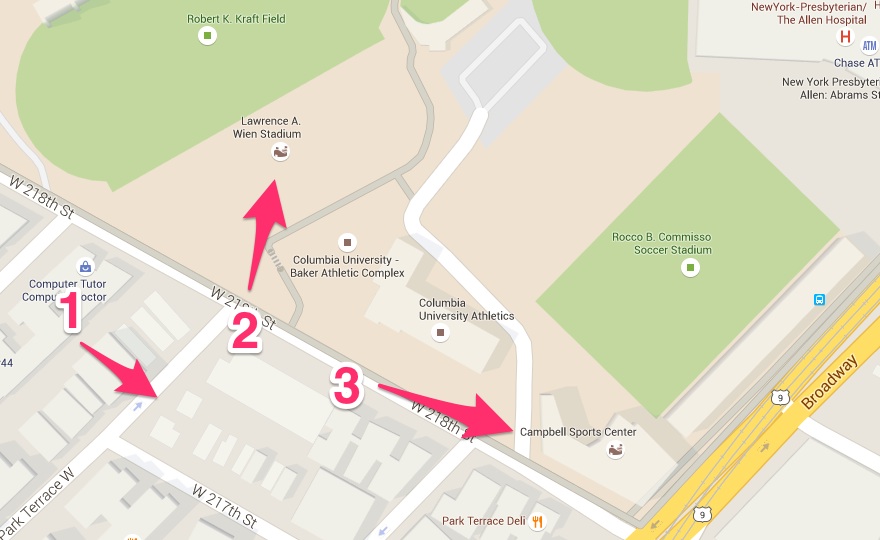
Submitted for your consideration, 20th century architectural history in miniature, as illustrated by three buildings. Located in Inwood neighborhood of upper Manhattan, each is located right next to the other. Here’s a map in the order we’ll be looking at them:

inwoodcontrastmap

Many of the residential buildings in Inwood date from the 20s and 30s and are built in the Art Deco and Tudor Revival styles.

Charming and beautiful, no? Across the street is…this. It’s Lawrence A. Wien Stadium, where the Columbia football team loses plays. The field is named after Robert Kraft, owner of the New England Patriots and Columbia alum. Built in 1982 in the Brutalist style, it resembles a prison guard tower.

Finally, just east of the stadium is the Campbell Sports Complex, designed by Columbia professor Steve Holl who took his inspiration from football diagrams. It looks like a neurotic robot insect to me.

The New York Times loved it (“a tough, sophisticated and imaginative work of architecture”) but the local residents weren’t as enthusiastic:

Inwood neighbors say they understand the problem but contend the design, by the acclaimed architect Steven Holl, a Columbia professor, is out of character with the sedate Art Deco and Tudor-style apartment buildings to the south. The angular Holl building would be set partly on stilts and accented by terraces and stepped ramps that echo urban fire escapes.

“It does not relate well to the community,” said Gail Addiss, 61, an architect who lives opposite Baker Field. “It’s similar to Frank Gehry architecture — large metal things whose glare is going to cause more brightness to reflect into people’s windows.”

Which style do you prefer?

Related

Posted in Architecture | Tagged , , , , , | 8 Comments

Four Movie Posters for “Danger: Diabolik”

Fabrizio del Wrongo writes:

Mario Bava’s “Danger: Diabolik” is one of those movies that lovers of ’60s-era design can’t help but love. Bava is known for horror movies, but “Diabolik,” with its vivid, comic-book palette and loopy, Bond-inspired sets taps a more playful vein of the maestro’s personality. In many ways it’s the sexy-silly spoof that “Barbarella” tried to be but wasn’t. Bava being one of the great color cinematographers in history, few were better suited than he to bringing the day-glo world of comics to life. It’s a shame he never did another movie of this type.

Danger- Diabolik (Italian)

Artist Renato Casaro’s two pieces, used to advertise the movie in Italy, are among the great movie-poster designs of the ’60s. It’s hard to beat the graphical punch packed by this primarily green, orange, and pink beauty.

Danger- Diabolik (Italy)

Casaro’s larger poster — it’s over six feet in height — moves the spotlit vignette of John Phillip Law and Marisa Mell to Diabolik’s hand and renders it in a more cartoonish style. This poster’s emphasis is on the Diabolik character — a favorite from Italian comics — rather than the sexy lead actors. Speaking of the hand, it seems physically impossible that it’s connected to Diabolik’s arm. But, then, of what matter is physiology to a superhero?

Danger- Diabolik (French)

This French design, by Jacques Vassier, wants to make it crystal clear that the movie has some kind of connection to psychedelia. Being French, Michel Piccoli makes an appearance. That’s okay with me. Who doesn’t love Michel Piccoli?

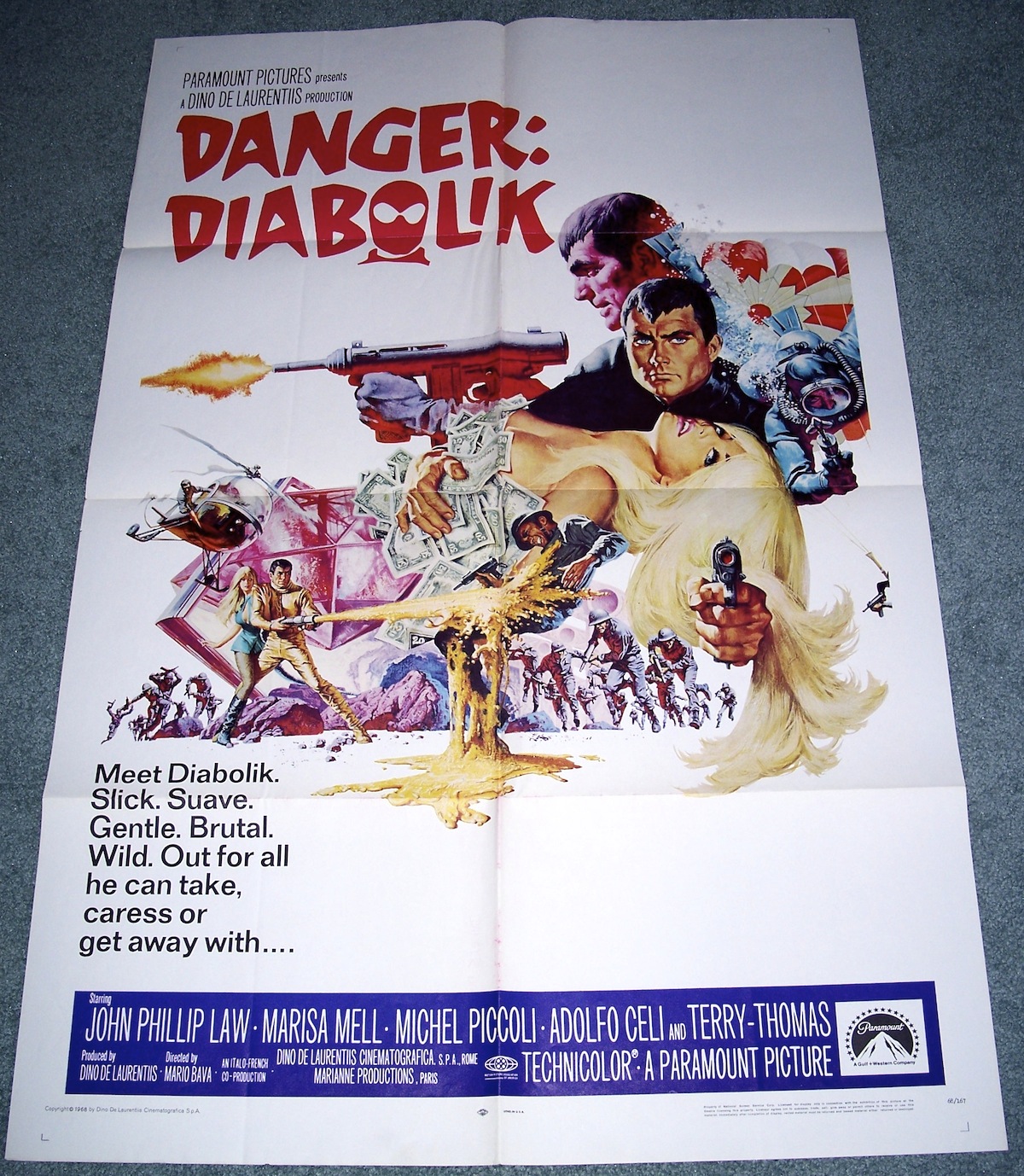
Danger- Diabolik (USA)

I don’t know who is responsible for the painting on this American poster, but there’s no doubt the Bond franchise served as the primary reference point. The costumed Diabolik doesn’t even make an appearance; rather, the character is presented as a ruggedly handsome man of action. As in the art used to advertise the Bond films, the emphasis is on adventure, manly stuff, and sex. I love the tagline: “Out for all he can take, caress or get away with . . .”

Related

  • Fab shoe designer Ruthie Davis is a big fan of “Danger: Diabolik,” and she calls Casaro’s smaller poster her “Bible.”
Posted in Commercial art, Movies | Tagged , , , , , , | Leave a comment

Naked Lady of the Week: Dasha Astafieva

Fabrizio del Wrongo writes:

DashaHospitalGreen_010807_013

I had no idea this model, a favorite from a few years back, had gotten sucked into the Playboy Dimension until I Googled her. Apparently, after rising to fame in Ukraine, she was invited to America to appear in ye olde bunny mag; she even spent some time as Hef’s official piece of arm candy — the rare brunette to hold that office.

Predictably, the Playboy photos make her look like a hot dog that’s been sitting in one of those heaters at the 7-11 for three days over whatever legal limitation is applicable to that sort of thing. The shoots she did for the European art sites are much better. They reveal a girl who is a natural camera subject, one with extravagant piebald skin and stormily romantic hair. You can imagine Courbet or Whistler being pleased at the prospect of capturing her interesting mix of the tasteful and the fulsome. Euro photographer Petter Hegre certainly seems to have been pleased with her: his photos are the best in Dasha’s portfolio precisely because they mine the space where flesh-and-blood playfulness overlaps with the remoteness of the objet d’art.

Several sources claim Dasha idolizes Bettie Page. I guess that makes sense . . .

These scaled-down images derive from MetArt and Hegre Art.

NSFW below. Happy Friday.

Continue reading

Posted in Photography, Sex, The Good Life | Tagged , , , , , | 1 Comment

Recipe Du Jour: Puerto Rican Pernil

Blowhard, Esq. writes:

In response to a reddit post asking for recipes for cheap meals, user electric_sandwich produced one of the best reddit comments I’ve ever read:

Take a lesson from the Puerto Ricans. Millions of us have managed to survive in one of the most expensive cities on earth with recipes like this:

Find a supermarket that has black beans on sale. Buy as much as you can. Then buy 5 or so pounds of Carolina rice, a bag of onions, a few bulbs of garlic, and a box of Goya Sazon.

Set 2 cups of water to boil

Dick around on reddit until the water is boiling

Throw in one cup of rice, turn the heat down to simmer and lid that shit

Slice up a small onion

Smash up a clove of garlic

Throw some olive oil or butter into a HOT pan.

Throw the onions and garlic into the pan and fry them till the onion gets glassy. Throw some salt in there.

Grind some pepper in there for good luck.

Toss in half a packet of Sazon and stir till you get a paste. Now you have a ghetto sofrito.

Dump in your can of beans bean juice and all.

Stir that shit up.

Add a pinch of Cayenne pepper so you remember that you have a set of cojones

Set that shit on simmer

Your rice is done.

Throw the beans on top.

Win

You should get at least 2 meals out of one can of beans, and if your lucky you can get black beans 2 for $1. Adding the cost of the Garlic, Sazon and a small onion and you still eat a tasty, hearty, relatively healthy meal for less than $1.

Now. You are a growing lad. You need MEAT

OK, first of all, fuck eating lips and assholes. There is a much, much tastier option that has kept millions of starving boriquas alive for generations: PORK SHOULDER.

In my neighborhood in Brooklyn, Pork shoulder is 79 cents a pound. That’s right. 79 cents. A package of hot dogs at $2.50 is more than double the price and has offal and all sorts of vile shit inside.

Buy yourself a nice meaty pork shoulder. 5 lbs should do nicely.

Bring that fucker home and get out a long, thin knife.

In a pilon (that’s a mortar and pestle gringo) smash up a few cloves of Garlic, some sazon, some, salt, some pepper, and some oil. Grind it up GOOD. Now you have another ghetto sofrito.

Take your knife and stab some holes in the pig. Twist the knife around so the holes get nice and wide.

Now, take some of your sofrito and stuff it into the holes. Don’t be shy blanco, ram it in there. Use the remainder to roughly coat the outside of the pig. RUB IT. CARESS IT. This pig died so that you may eat. Salt that shit all over the outside and crack some fucking pepper on there.

Set your oven for ~300 degrees

Throw the pork in skin side up and WAIT.

It’s going to take like 45 minutes a pound…

A warning: The smell is going to drive you fucking INSANE. You have to wait this part out. Farm work is the best cure.

After an an hour and a half, jab it with a meat thermometer, but remember to not rest it on the bone, or you will get a bad reading.

You should be at around 150-160 degrees. Now comes the fun part. CRANK the stove up to 400 degrees. This will give you an orgasmic, crispy skin that will make your pork rinds taste like year old carboard comparison.

At 170 ish? Pull that fucker out, but DON’T carve it up. You need to wait at least ten minutes otherwise all those sweet, sweet pig juices will dribble the fuck out. WAIT.

Congratulations. You just made Pernil. A five pound Pernil should give you meat for at least a week. SAVOR IT BROTHER. SAVOR IT

Edit: Forgot the best and cheapest fucking recipe!!!

TOSTONES!!!!!!!!!!!!!!!!!!!!!!!!!!!

Fuck me. Green plaintains are usually like 5 for a fucking dollar!

Here’s my mom’s recipe:

Fry up some bacon. Set the bacon aside and save that lovely, glistening fat.

Take a plantain and run a knife down the side and split the skin off without breaking the plantain. This takes a bit of practice.

Slice up the plantain into ~1/3 inch thick slices. Throw them into a bowl of ice water.

You have a fry daddy? You’re golden papi. No? Pour around half an inch of oil into a frying pan. Corn oil works best, olive oil smokes too easily. Get that shit hot! Throw in your bacon grease.

Take your sliced up plantains out of the ice water and drain them or even pat them with a paper towel till they’re dry.

Fry em up until they just turn golden.

Throw them in the freezer for 10 minutes.

Now, here is where you become a MAN: Get yourself a flat bottom glass and a cutting board or a plate. Throw some flour on there. Smash the plantains with the cup. You may need a spatula to get them off the board…

Fry em AGAIN until they are golden and crispy

Make all three of these things together and you have an incredibly delicious and cheap meal!

*TLDR; Learn the lessons of my people: The Nuyoricans. (New York Puerto Ricans) We have survived for DECADES on no money in one of the most expensive cities on the planet.*

Yesterday I made a pernil based on this recipe and Mark Bittman’s slightly more upscale but still very simple one. The last picture is after about four hours in the oven. The results were good but the rub didn’t get into the meat sufficiently for my liking. No worries, it’s one of those recipes that I’m happy to experiment with until I get it right.

Related

Posted in Food and health | Tagged , , , , , , , | 5 Comments

Fighting Words Links

Fenster writes:

The Garland Texas shoot out has spurred another round of speechifying on free speech, much of it of the yes but variety.  I don’t like a lot of it since while I am not a free speech absolutist I come darn close and I figure it is wise to be vigilant, and suspicious, when people step up their yes butting rhetoric.

I can’t object overly to people grousing about the motivations of the group that held the event.  It’s free speech to not like what they are up to.  It’s free speech, too, to advocate legal (most likely constitutional) changes to make us more like the rest of the world, which some commentators would like to do.

But there is the underlying problem of the “reasonable man” concept that in the end almost all law is premised on.  Culture trumps law as it does politics and most other things, and if the culture shifts massively away from traditional notions of free speech, one way or another the law will move with that change.  So it is wise to keep a close eye on the debate for signs that values are shifting in ways that will prove capable of undermining what we consider to be settled law.

And we do seem to have a rough legal consensus on concepts like “fighting words”.  Since the Texas shooting we have seen another round of arguments that the event itself was a provocation–was designed as a provocation–and as such may cross the “fighting words” boundary.  That sounds good if you are inclined to believe it–but is it a legally sound argument?

I am not a lawyer but I don’t think it is a legally sound argument.  Here is one credible legal analysis, from FIRE.  Here is David Bernstein at The Volokh Conspiracy.  And here is Eugene Volokh.

The concept of “fighting words”, introduced in a Supreme Court case in the 1940s has been progressively (!) whittled down over the years, to the point where Nadine Strossen says it is essentially meaningless.  As the FIRE article points out, in a more recent Supreme Court case that whittled at the idea “(t)he majority held that fighting words were only ‘those personally abusive epithets which, when addressed to the ordinary citizen, are, as a matter of common knowledge, inherently likely to provoke violent reaction.'”

A cartoon show, even one designed to inflame, does not make the cut IMHO.  More the better, too.

Still and all, you’ll note even in the whittling language above that inevitable reliance on the reasonable man–the “ordinary citizen” who would conclude an action is likely to provoke a violent reaction “as a matter of common knowledge.”  Beware those  tendencies.

We tend to think of the left as giving in nowadays to the siren’s song of throttling speech, and it has tended to be the right that has seemed to take up the cause.  Interesting since as Razib has pointed out, the general impulse in favor of unfettered speech is positively correlated with education and political liberalism of the contemporary variety.

Posted in Uncategorized | 27 Comments

Architecture Du Jour

Blowhard, Esq. writes:

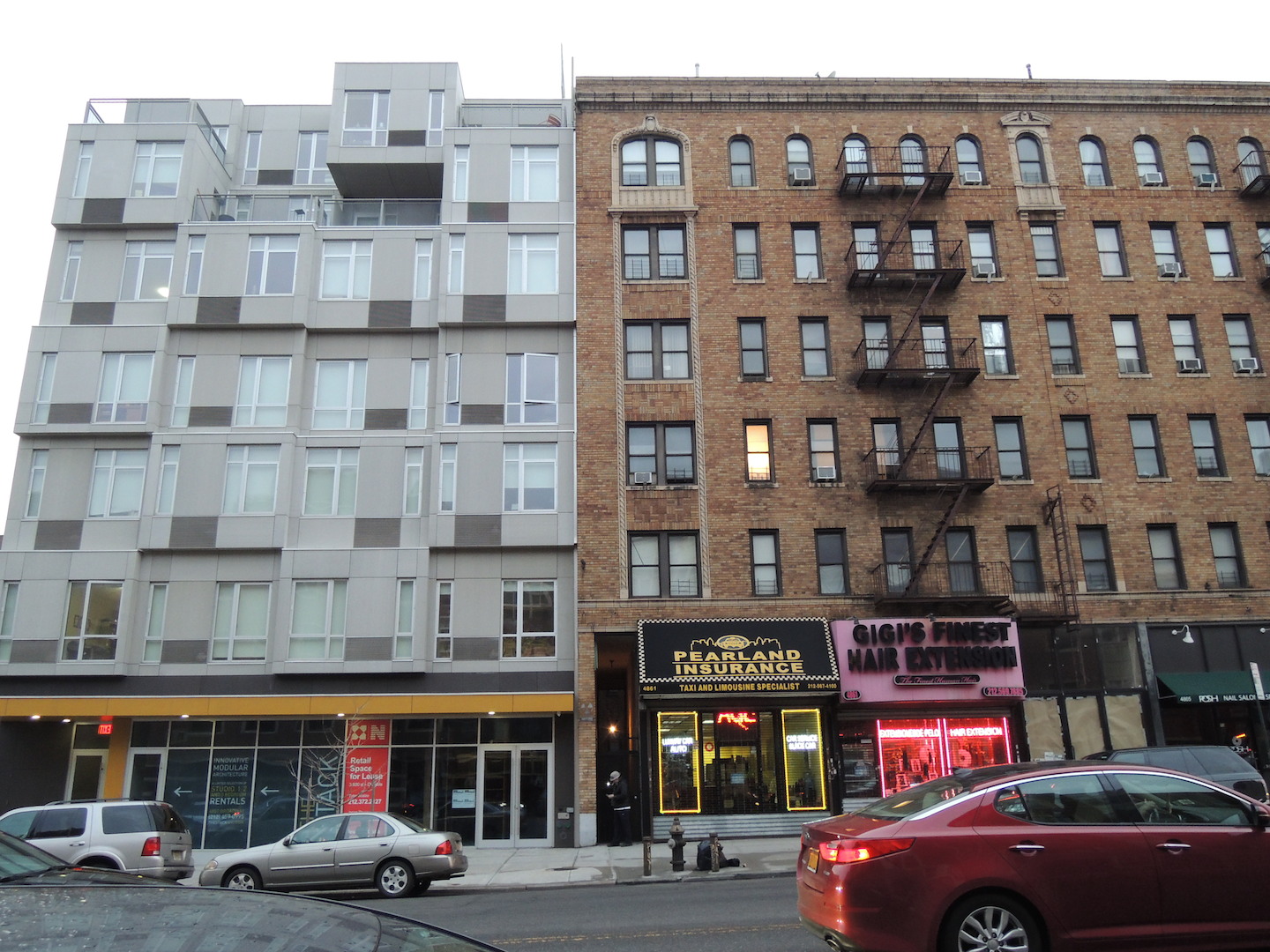
inwoodcontrast

A pic I snapped on Broadway in Inwood, Upper Manhattan. Most of the buildings in the neighborhood are in the style of the one on the right, but someone decided to do something different, I guess.

Click on the image to enlarge.

Posted in Architecture | Tagged , , | 4 Comments