
Fabrizio del Wrongo writes:

Fabrizio del Wrongo writes:
Eddie Pensier writes:
It’s big and lush and swoony and romantic. It’s a guy telling a girl about falling in love at first sight, and not missing out on it when it happens. This is the sort of song that some people find faintly embarrassing in its naked old-fashioned emotionalism. It’s what people who say “I hate musicals” hate about them. They consider it twee and sentimental.
Those people have no heart, just so we’re clear.
From Joshua Logan’s South Pacific (1958), with Rossano Brazzi, Mitzi Gaynor, John Kerr, Ray Walston and Juanita Hall. The voice you hear does not belong to Brazzi but to the magnificent American bass Giorgio Tozzi.
Related
Fabrizio del Wrongo writes:

Buxom Sydney Moon always sort of reminded me of Stella Stevens. As I’m sure you’ll agree once you take a look at the below gallery, she was a versatile model, equally capable of communicating innocent-amateur freshness and glamor-mama haughtiness.
She posed for a bunch of men’s magazines, but it’s her internet work for which she’ll be remembered. Actually, she’s one of the first girls I can remember seeing in naughty animated gifs. This is a particularly memorable one. Perfect the way they pop out like that, isn’t it? Boing-boing. A titty flop of that caliber cannot be planned or repeated. The booby gods have to sanction it.
Sydney’s retired from modeling now. Judging by her Twitter feed, she enjoys weighing in on political discussions. Here she is phoning in to a liberal podcast. I like how the host tries to recover after she calls him “cute.”
These sample images come from Digital Desire, Twistys, Aria Giovanni, New Nude City, and Fetish Nation. I’m sure you can find more (and better quality) at those fine establishments. Sydney operates her own site, but it’s now defunct.
Don’t blame me if you click “continue reading” and end up seeing a whole lot of stuff that isn’t appropriate for work, babysitting, or Sunday school.
Fabrizio del Wrongo writes:
Fabrizio del Wrongo writes:
“Gold Diggers of 1935” is a pretty lame movie. Yet it includes what might be Busby Berkeley’s masterpiece: A musical fantasy sequence scored to “The Lullaby of Broadway.” Is it an exaggeration to call it one of the great short films in history? How about one of the great experimental films? I don’t think so. The sequence runs a little over 13 minutes, and it plays like a nightmare — the dream-time comeuppance of the materialistic party girl so common in ’30s musicals. As in a nightmare there’s a lot of repetition — a sense that the characters are doomed to repeat these events day after day, night after night, until, exhausted, over-burdened, or simply out of room to dance, they collapse into a heap or something worse. The intro, featuring a floating female head that dissolves into a cityscape, sets the tone. Berkeley is bouncing off Surrealism here, Man Ray in particular. He’s also slyly positing the American city — that repository of Hollywood-bred dreams — as a venue rich in sinister undercurrents. (In this he’s a forerunner of David Lynch.) When our girl hits a nightclub with Dick Powell the militarism that’s always just below the surface in Berkeley reveals itself in full. The choreography expresses geometric, mechanical inevitability and an absence of individuality and forethought — it’s like something out of a Nuremberg rally. (Nazism was in the air: Riefenstahl’s “Triumph of the Will” came out the same year.) As in “The Red Shoes” there is a sense that the dance cannot — will not — be stopped. And when the revelers succeed in coaxing the heroine away from Powell, this musical finally becomes a horror film. In fact, it would be hard to write a history of movie zombies without mentioning the dancers who, like tapping automatons, push the girl onto the skyscraper’s ledge and over the precipice . . . at which point the whole thing starts again.
Paleo Retiree writes:
Blowhard, Esq. writes:
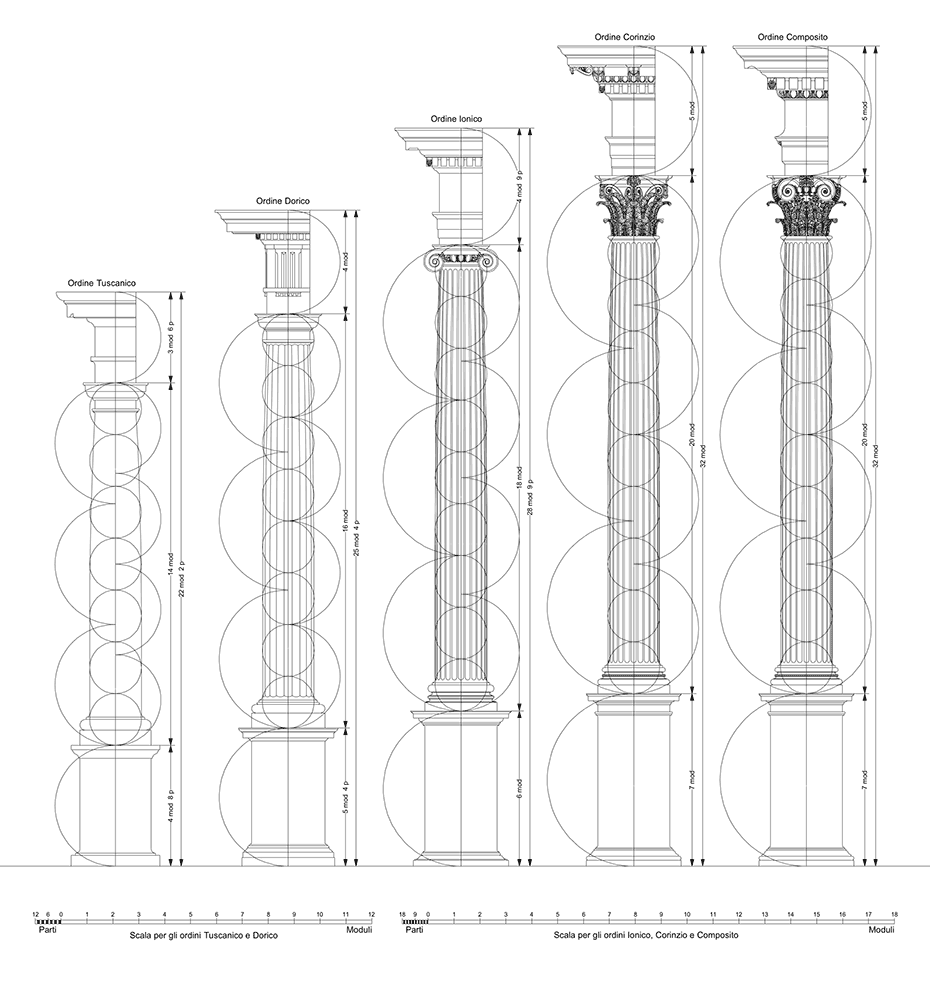
PR recommended this one to me and I found it to be a great little intro to classical building. The book is actually the transcript of six talks that Summerson, an architectural historian, gave on the BBC in the early 60s. In my edition the text is 46 pages long including 63 pictures and a glossary, just the right length for a non-specialist who wants gain a little more insight when looking at classical buildings. The chapters are clearly and logically organized to emphasize continuity and innovation within the classical tradition — from the establishment of the orders (the columns pictured above), their use in antiquity, rediscovery during the Renaissance, and elaboration during during the 17th through 19th centuries. Summerson is a droll tour guide with a historian’s detachment that he doesn’t hesitate to deploy. And, like any British pedagogue, he can be a little eccentric at times. The last chapter on modernism notes that Le Corbusier almost completely inverted architecture as it was known yet also praises him as “one of the most classical minds.”
Related
Fabrizio del Wrongo writes:
Around the time this blog launched, I wrote about enjoyably silly movie theme songs, a thing that mostly disappeared from movies in the ’70s or ’80s. I just love those kitschy tunes.
I need to add a new one to my list: the theme from “The Last Dinosaur.” Produced by Rankin/Bass, and featuring loads of cheesy creature effects, the movie aired on television in 1977.
The plot focuses on the evocatively named Masten Thrust (magma-faced Richard Boone). He’s a wealthy industrialist and big-game hunter who uses women and leaves them wanting more. When Masten runs out of things to shoot and/or hump, he tunnels below the earth’s crust, where, as everyone knows, dinosaurs still thrive.
Among his crew is a woman with a great ass (Joan Van Ark). She falls for another crew member while Masten is busy strategizing against an enormous Tyrannosaurus Rex whom he’s adopted as his nemesis. Ultimately the girl and her keister return to the modern world, leaving Masten to duke it out — alone, Hemingway-style — with the voracious rubbery beast.
It’s at this point you realize that the last dinosaur isn’t the T-Rex at all. It’s Masten Thrust, a man so magnificently manly that modernity can’t sustain him.
It’s a terrifically goofy B-movie concept, and there are a bunch of good things in the picture. Yet it feels padded. It’d be a lot more enjoyable if was about 30 minutes shorter.
Still, its shortcomings are easy to overlook in light of that theme song. It was written by Maury Laws and Jules Bass, and sung by Nancy Wilson.
His time has passed . . . there are no more . . . he is the last dinooosaurrrrr!
Related

 Blowhard, Esq.
 Callowman
 Sherbrooke
 Eddie Pensier
 Enzo Nakamura
 Epaminondas
 Fabrizio del Wrongo
 Fenster
 Brundle Guy
 Glynn Marshes
 Paleo Retiree
 Atypical Neurotic
 Question Lady
 Sax von Stroheim
 Sir Barken Hyena
 The Mistaken
 Uncouth Reflections
