
Blowhard, Esq. writes:
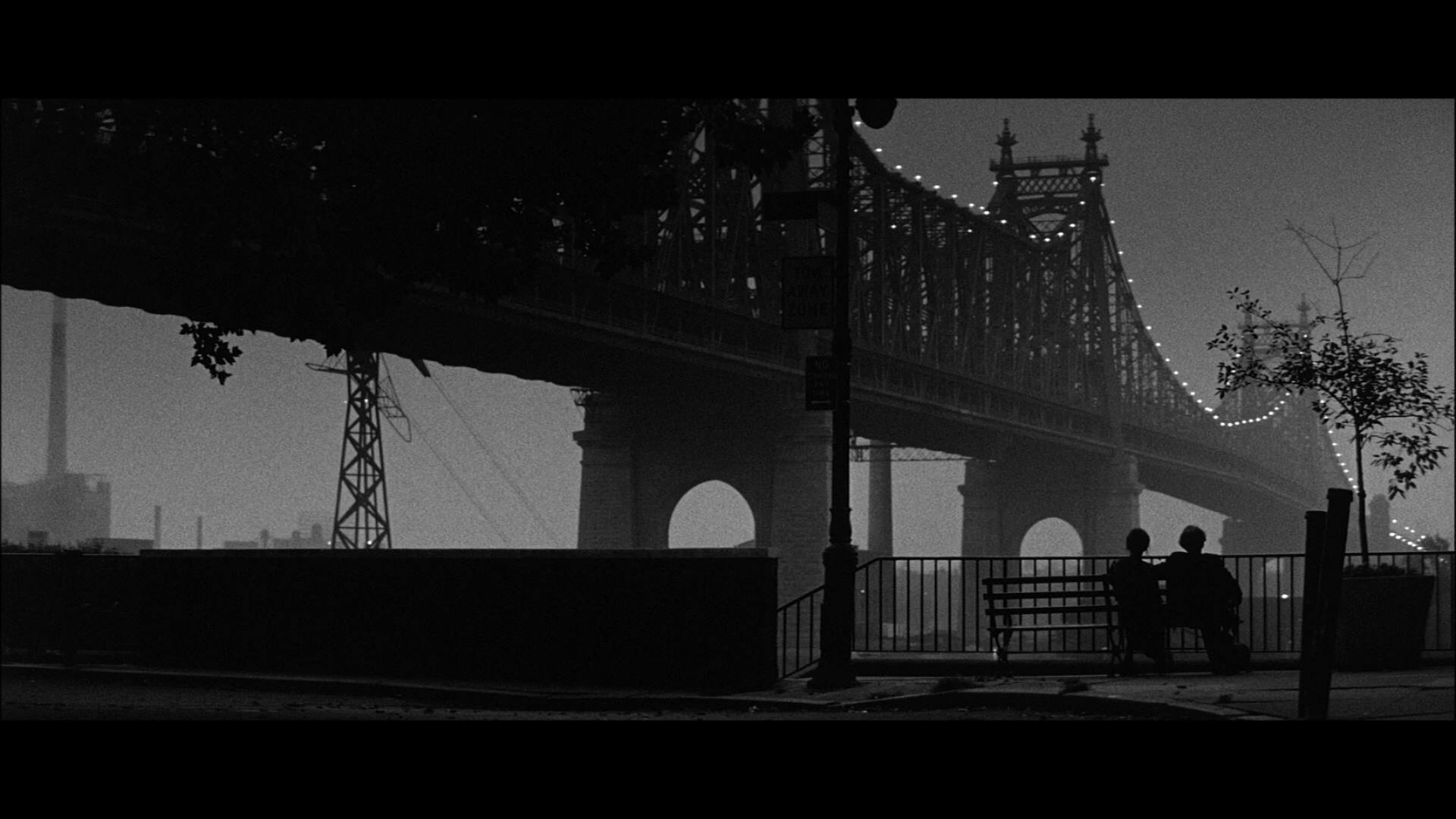
Diane Keaton, Woody Allen, and the Queensboro Bridge in Allen’s MANHATTAN (1979), shot by Gordon Willis, who died yesterday.
Click on the image to enlarge.
Blowhard, Esq. writes:
Diane Keaton, Woody Allen, and the Queensboro Bridge in Allen’s MANHATTAN (1979), shot by Gordon Willis, who died yesterday.
Click on the image to enlarge.
Eddie Pensier writes:

Ray Lawrence’s “Jindabyne” (2006) is a murder drama, not a murder mystery. The identity of the killer is clear from the first scene: creepy electrician Park accosts teenaged Susan O’Connor in her car, murders her, and dumps her body in the Snowy River. Neither the motive for the murder nor the search for its perpetrator have any bearing on what unfolds.
Based on Raymond Carver’s “So Much Water, So Close To Home” (which also formed part of the plotline to Robert Altman’s “Short Cuts”), “Jindabyne” is only Lawrence’s third movie in twenty years. (The last, 2001’s “Lantana”, won a slew of AFI awards and earned Lawrence comparisons to Altman and Paul Thomas Anderson.) It tells the story of how the discovery of Susan’s body by four men during a fishing trip, has explosive effects on the men, their families, and the entire community. Stewart (Gabriel Byrne), Jindabyne’s local mechanic and a former race-car driver, is married to the fragile Claire (Laura Linney), who works for the lecherous local chemist. Claire had a nervous breakdown shortly after giving birth to their son Tom, and left the family for 18 months. She’s back now, but tensions still simmer.
Stewart and his mates Carl (John Howard), Rocco (Stelios Yiakmis) and Billy (Simon Stone) go on their annual fishing trip and stumble across the dead body. Fatefully, they decide to tie her to a rock and continue fishing for another day and night before reporting the crime to the police. The town, the men’s families, and the indigenous community (the dead girl is Aboriginal) shame the men for “fishing over a dead body”, while the men can’t understand what the big deal is, since she was, in Stewart’s words, “beyond help”.
The nexus of the film’s conscience struggles is embodied in Claire. Her desire to know all the facts, talk things through, and deal with everyone’s feelings about the tragedy is (it must be said) very female and (it must also be said) very American. The Aboriginal characters express themselves in bursts of anger or clipped silence, while the white Australian characters just want to move on, if not merely dismiss the entire affair. Claire’s insistence on collecting money for the Susan’s family, attempts to reconcile with the indigenous community, and ultimately crashing her funeral (she tells them she has come to “pay her respects”, and the victim’s furious brother retorts, quite rightly, “What respect?”) is cringe-inducing to the viewer, but very necessary to her. It’s almost painful to watch her, a woman who knows her husband little, herself even less and her adopted country not at all, try to come to grips with a situation that is as foreign to her as the cultures clashing around her.
To make things worse, the film’s climactic scene at the funeral is presented as an opportunity for Claire and the other white folks to purge their guilt. Claire has been watching at a distance when she sees Stewart, Carl, and the others approaching. It’s set up as an Oprahfied moment of “healing” and “closure”, and yet when the Aboriginal elder responds to Stewart’s halting apology by spitting in his face and throwing dirt at him, I wanted to cheer. Not everything can be reconciled.
Linney’s keen performance anchors the film, but Byrne also does a terrific job as Stewart, the former hotshot trying to grasp what peace he can while denying his advancing age (much amusement is taken from a botched, shoe-polish-black home dye job he attempts). Howard and Deborra-Lee Furness are excellent as the laconic Carl and his hard-drinking wife Jude.
Lawrence creates some truly stunning images of the Kosciuszko/Jindabyne/Snowy Mountains area (located about two hours from Rancho Pensier), but the film is too sprawling and uncontained to have the real dramatic thrust it ought to. Screenwriter Beatrix Christian, adapting Carver, can’t resist out-Carvering her source. Feckless men and miserable women aren’t enough: there must also be racial undertones, AND a motherless little girl, AND the girl conspires with Tom to kill a guinea pig and a sparrow, AND hey, how did that girl’s mother die, anyway, AND a meddling Irish mother-in-law, AND the fact that one of the men’s girlfriend was formerly a lesbian (I know this because it was mentioned at least four times), AND lots of close-ups of electrical power lines because the killer is an electrician, and, you know, symbolism, AND other things I surely can’t remember, sprinkled in like pepper for “seasoning”. Unimportant things are mentioned and given lots of screen time, but important things are left out altogether.
“Jindabyne” does have a haunting, eerie feel and look, but despite the great performances I really can’t recommend it. It just gets too bogged down in its own untold stories when it should have been focusing on the important one: the murder and its aftermath.
Related
Fabrizio del Wrongo writes:
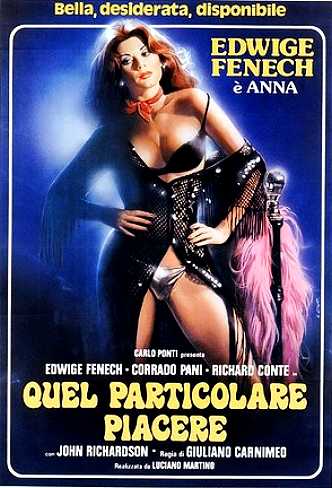
The 1973 “Secrets of a Call Girl” must be the ultimate Edwige Fenech movie. Not necessarily the best one, just the one that shows her from the most angles. In this sense it’s a bit like Antonio Pietrangeli’s 1965 “I Knew Her Well,” starring Stefania Sandrelli – a riff on the various aspects of a movie beauty. (The Italians, eh? When exploiting a female type they leave nothing on the table. Is it any wonder they’re the unofficial mascots of the Madonna-whore complex?) Edwige plays a cashier who becomes attached to a thuggish mafioso. Naturally, he wallops on her, and of course she keeps coming back for more. But when he involves her in his criminal schemes things turn ugly — he starts pimping her out to his marks. (There are more than a few nods to Hitchcock’s “Notorious,” in which Cary Grant’s shepherding of Ingrid Bergman acquires overtones of forced prostitution.) This early section is in the grotty style of the Italian police film, complete with a chugging score composed by Luciano Michelini. But around the movie’s middle point it morphs into something akin to a ’40s woman’s picture, with Edwige occupying the Joan Crawford role. She moves out of Milan, has a child, and begins nursing a romance with a doctor who’s like a purified version of her still-out-there-somewhere former beau. Throughout the picture Edwige looks stunning; she’s got a face that could melt the heart of a snowman. She gets to act a little, too. Directed by Giuliano Carnimeo, who helmed one of Edwige’s most memorable giallo outings, the 1972 “The Case of the Bloody Iris.” Richard Conte turns up for about five seconds.
Related
Fenster writes:
It’s pretty much official now. When you sing the national anthem and you get to “the land of the free”, you have to add that extra high note in to milk it for all it’s worth. For this we can thank an oversupply of melismatic singers for opening day events.
Fabrizio del Wrongo writes:
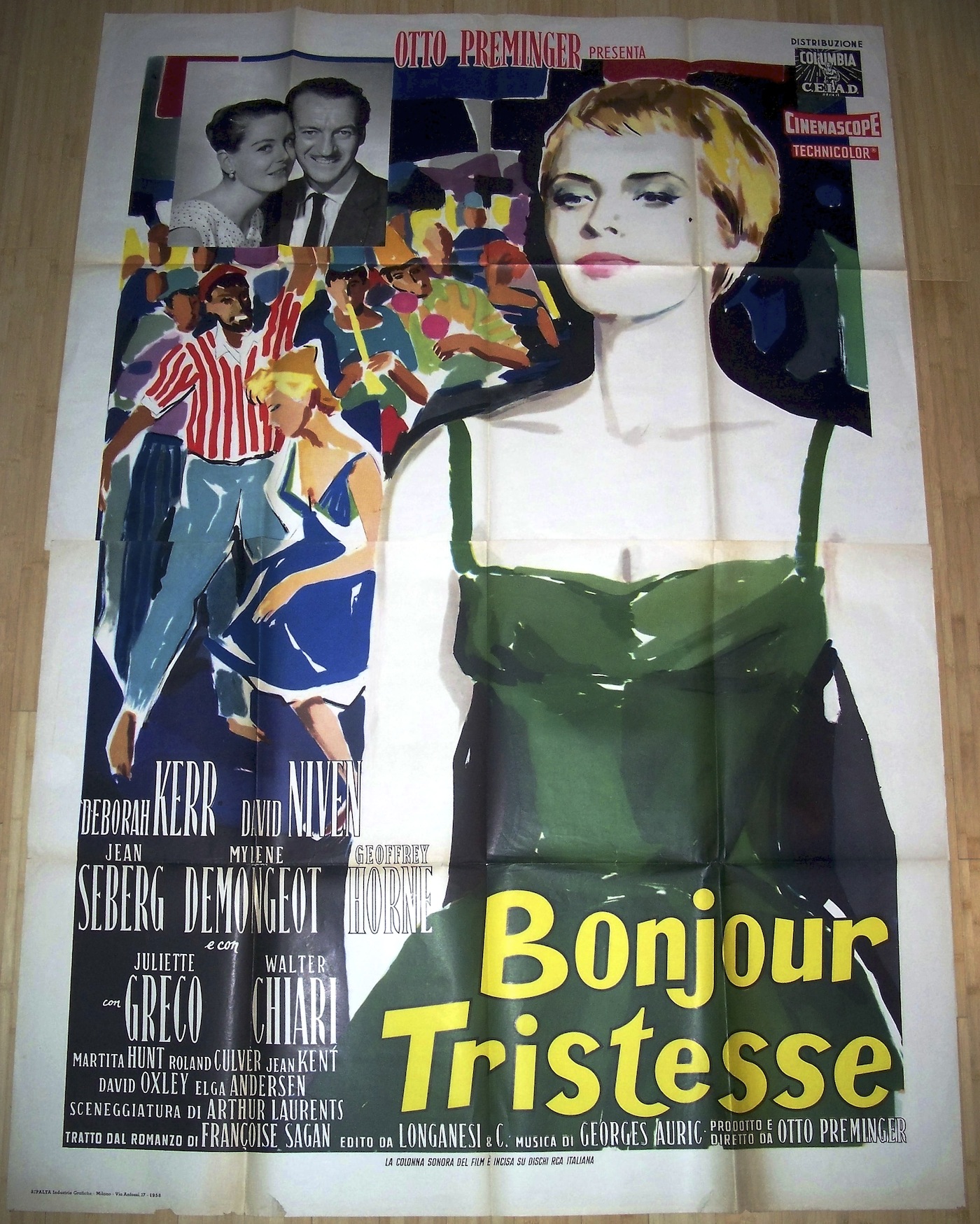
This poster isn’t signed, but I believe it’s by the great Ercole Brini.
Related
Fenster writes:
Miracle of the Fishes, from Native Dancer, Wayne Shorter and Milton Nascimento
Fabrizio del Wrongo writes:
He was happy then, and without a care in the world. A meal together, a walk in the evening on the highroad, a gesture of her hands over her hair, the sight of her straw hat hanging from the window-fastener, and many another thing in which Charles had never dreamed of pleasure, now made up the endless round of his happiness. In bed, in the morning, by her side, on the pillow, he watched the sunlight sinking into the down on her fair cheek, half hidden by the lappets of her nightcap. Seen thus closely, her eyes looked to him enlarged, especially when, on waking up, she opened and shut them rapidly many times. Black in the shade, dark blue in broad daylight, they had, as it were, depths of different colours, that, darker in the centre, grew paler towards the surface of the eye. His own eyes lost themselves in these depths; he saw himself in miniature down to the shoulders, with his handkerchief round his head and the top of his shirt open. He rose. She came to the window to see him off, and stayed leaning on the sill between two pots of geranium, clad in her dressing-gown hanging loosely about her. Charles, in the street, buckled his spurs, his foot on the mounting stone, while she talked to him from above, picking with her mouth some scrap of flower or leaf that she blew out at him. Then this, eddying, floating, described semicircles in the air like a bird, and was caught before it reached the ground in the ill-groomed mane of the old white mare standing motionless at the door. Charles from horseback threw her a kiss; she answered with a nod; she shut the window, and he set off. And then along the highroad, spreading out its long ribbon of dust, along the deep lanes that the trees bent over as in arbours, along paths where the corn reached to the knees, with the sun on his back and the morning air in his nostrils, his heart full of the joys of the past night, his mind at rest, his flesh at ease, he went on, re-chewing his happiness, like those who after dinner taste again the truffles which they are digesting.
Until now what good had he had of his life? His time at school, when he remained shut up within the high walls, alone, in the midst of companions richer than he or cleverer at their work, who laughed at his accent, who jeered at his clothes, and whose mothers came to the school with cakes in their muffs? Later on, when he studied medicine, and never had his purse full enough to treat some little work-girl who would have become his mistress? Afterwards, he had lived fourteen months with the widow, whose feet in bed were cold as icicles. But now he had for life this beautiful woman whom he adored. For him the universe did not extend beyond the circumference of her petticoat, and he reproached himself with not loving her. He wanted to see her again; he turned back quickly, ran up the stairs with a beating heart. Emma, in her room, was dressing; he came up on tiptoe, kissed her back; she gave a cry.
He could not keep from constantly touching her comb, her rings, her fichu; sometimes he gave her great sounding kisses with all his mouth on her cheeks, or else little kisses in a row all along her bare arm from the tip of her fingers up to her shoulder, and she put him away half-smiling, half-vexed, as you do a child who hangs about you.
Before marriage she thought herself in love; but the happiness that should have followed this love not having come, she must, she thought, have been mistaken. And Emma tried to find out what one meant exactly in life by the words felicity, passion, rapture, that had seemed to her so beautiful in books.
— Gustave Flaubert, as translated by Eleanor Marx-Aveling
Related
Eddie Pensier writes:
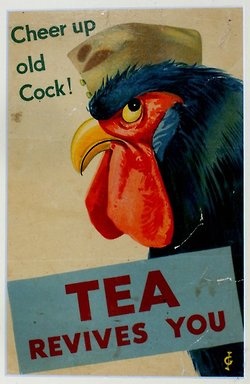
I love flavored tea. There, I said it.
Bona fide tea snobs will shudder at this statement. These days it’s all about the pure, the single-origin, the unadulterated. It’s more sincere and authentic, and as we all know, sincerity and authenticity trumps all nowadays. The rare, the unknown, the hard-to-find are prizes: the common is, well, common, no matter how pleasurable it is. And flavored tea is often seen as a pretender, a faux-tea-product for novices without the refined taste to know any better.
Sure, I can appreciate the brash maltiness of an Assam, or the winey complexity of a Keemun. In fact, if you’re in the beverage racket like I am, you’d better be at least passing familiar with most of the commonest varieties, as well as some of the more esoteric and expensive ones. And I’m certainly the last person to deny the pleasure of the hunt for a little-known delicacy. But I’m probably happiest when I’m consuming a big mug of flavored tea.
It does help to know the basic character of the base tea, in order to determine what tea will take which flavorings best. A strong flavor-bomb tea like Yunnan is best enjoyed alone, and by the same token, a delicate and costly Darjeeling would probably be wasted with flavoring added. But if you’re drinking a garden-variety black or green tea, some flavoring can punch it up and give a bit of variety.
It should also be noted that teas you might not ordinarily like, might become downright delicious with the addition of flavoring. I’ve known confirmed green-tea haters who became passionate devotees after tasting fruit-flavored Senchas dressed up with pineapple, peach or berries. The grassiness that turns many people off green tea can be substantially mitigated, not to say disguised, with a little fruit. Similarly, I’ve never been a fan of rooibos, the South African “red tea” which is all the rage among healthy types. The earthy, wood-chippy flavor always put me off. But chuck a little chocolate or caramel or vanilla in there, and the earthiness becomes your friend: as a base for sweet dessert flavorings, it keeps your rooibos multi-dimensional.
There are two big-daddies of flavored tea: Earl Grey and chai. Earl Grey is simply black tea seasoned with bergamot oil, and if it’s good enough for Captain Picard, it’s good enough for you. “Real” Earl Grey should have bergamot and nothing else, as venerable UK tea merchant Twinings discovered to their detriment when they tried to jazz up their EG. Common EG variants include Lady Grey (also known as Miss Grey or Girlie Grey), which adds lemon and orange, and French Earl Grey, with floral notes to downplay the citrusiness.
It’s said that there are as many recipes for chai as there are people in India. I do have a fondness for the powdered drink mix that comprises most of the “chai” you get at fast-service shops, but I don’t kid myself into thinking it’s real chai. If most of your chai has been of this variety, do yourself a favor and try the real deal. A really skillfully blended chai won’t even need milk, just a drizzle of honey to soften and blend together all the spice notes. Of course, a chai latte is one of the world’s great inventions, so go ahead and milk it if that’s how you like it. (Incidentally, chai is the only tea I drink with milk. All other black teas I drink black, and of course green and white teas should never take milk. Even soy milk, which I normally find repulsive, is usually acceptable in chai.)
If you can’t find flavored teas to suit you at your local/online tea merchant, try making your own. Get some concentrated flavorings such as Capellas or Flavor Apprentice. Start with a small amount of an inexpensive tea, so you’re not out too much if it turns out awful. Try making it two ways:
1) Add one drop of flavoring to a cup of hot tea (this also works excellently with coffee); or
2) Take a large Ziploc bag and add three drops (to start) to the empty bag. Smush it in your hands until the bag is thinly coated with flavoring. Add 6 ounces of your chosen tea, seal the bag, and shakeshakeshake vigorously. Let the flavor continue to seep into the tea for a few weeks, or what the heck, try some right away, so you can see how it changes over time.
You can also add chunks of dried fruit, flower petals, or cocoa hulls to your tea, of course. Some guidelines to heed or disregard as you see fit:
Black teas are fantastic with pretty much any flavor.
Green teas take especially nicely to fruit flavors.
White teas are lovely with florals or fruits, but take care not to overpower them.
Oolong teas are inherently nutty and therefore make excellent bases for dessert/candy flavors.
Blowhard, Esq. writes:

Born in Prague to an Italian father and Czech mother*, Jana Defi aka Maria Swan aka Princessa got her start at Polish Busty but soon migrated to sites like Bettie Ballhaus, MC Nudes, and Pinup Files. Adept and being both imperial and earthy — the Habsburg duchess and the Bohemian gypsy — it must be admitted that she is most notable for her enormous juggs.
Her enormous, pendulous, life-affirming juggs.
What the heck do they put in the water in the Czech Republic? Or, given that we’re a DE-sympathetic site, what the heck is it about those Slavic genes? Sadly, Ms. Defi retired from glamour modeling before doing any hardcore. Surely this is a greater failure of post-Cold War diplomacy than all that insignificant garbage with Putin in Ukraine.
Given the size of Defi’s impressive prow, I felt additional pictures were warranted this week. The gallery below the jump is NSFW, so don’t click at work unless you DGAF. Happy Friday.
Sax von Stroheim writes:
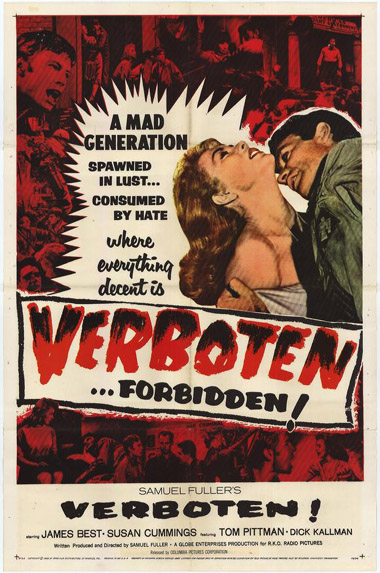
Verboten! is Sam Fuller’s Germany: Year Zero. It’s an astonishing film that surprises at every turn. I love that Fuller doesn’t do anything – in terms both of how he conceives and writes these scenes and of how he shoots them – just because that’s the way other filmmakers would do it. His approach seems to have been worked up from first principles, and so you get drama without all of the built up cruft that usually comes with even the best Hollywood movies.

This image gives us the theme: post-War Germans, haunted by Hitler…
In its first twenty minutes it covers the entire terrain of a standard war movie. It’s very anti-Hollywood in the way it refuses to stick to a genre for more than a few scenes at a time. In that sense, it feels downright European, and you can see why the young French critics at Cahiers du cinéma went gaga over this guy: the movie has the punchy, pulpy vitality of American pop culture at its best, but it has a keen, critical intellect behind it that rejects the pat solutions of American pop culture at its most conventional.
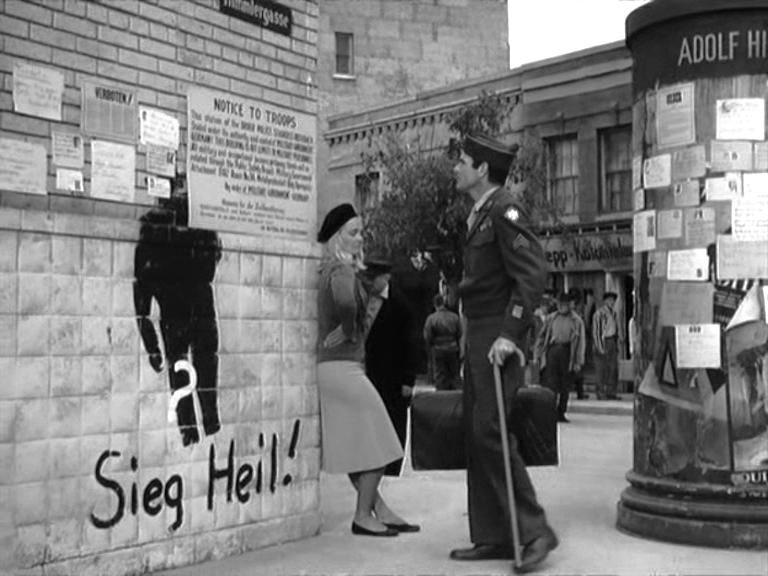
Fuller fills Verboten! with the kind of text-heavy images that would appeal to a guy like Godard.
The opening is as powerful in its stripped down straightforward way as a depiction of what it costs to take ground as is the opening of Saving Private Ryan. But the heart of the movie goes straight to the territory explored by Lars Von Trier in Europa: Nazi hold outs (the terrorist group Werwolf) vs. the occupying American force.
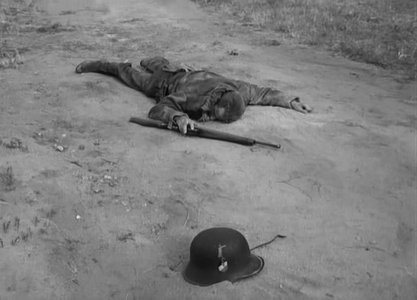
There’s not as much shakey-cam as in the opening of Saving Private Ryan, but the same point is made with a forceful simplicity: taking ground costs lives.
Fuller doesn’t turn this into a thriller, like a lot of the major films dealing with the fate of post-War Europe did (i.e., The Third Man or Berlin Express). Rather: like Rossellini, he wants to show more directly how the war and its aftermath shaped the people of Germany and the American soldiers who defeated the Nazis. Thriller conventions would just get in the way, so he turns to a method that’s closer to a series of slice-of-life vignettes. Albeit, slices from a somewhat feverish, hysterical life.
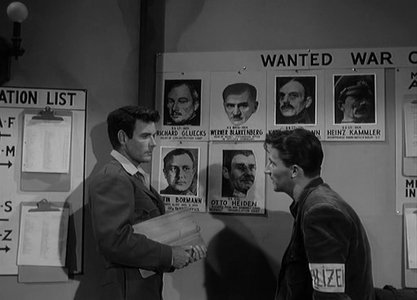
A favorite scene: a relatively quiet one, where the main character (a G.I. who decides to stay behind as a civilian in order to marry a German girl who saved his life during the last days of the fighting) fades into the background, and we see his boss (the head of the American Military Government in a small city) deal with some of the day to day concerns of running a quasi-occupation.
Another great moment: a Werwolf agent provocateur incites a group of starving Germans to riot. When the mob reaches the HQ of the American Military Government, our hero comes out to confront him. The Werwolf guy jeers that the Americans are “Some liberators”, to which our hero replies, seething with anger he can’t control anymore: “Liberators? We’re not here as liberators. We’re here as conquerors, and don’t you forget it!” And then he goes and punches the Werwolf in the mouth.

“We’re conquerors!”
Anyway, it’s a great movie…
Related

 Blowhard, Esq.
 Callowman
 Sherbrooke
 Eddie Pensier
 Enzo Nakamura
 Epaminondas
 Fabrizio del Wrongo
 Fenster
 Brundle Guy
 Glynn Marshes
 Paleo Retiree
 Atypical Neurotic
 Question Lady
 Sax von Stroheim
 Sir Barken Hyena
 The Mistaken
 Uncouth Reflections