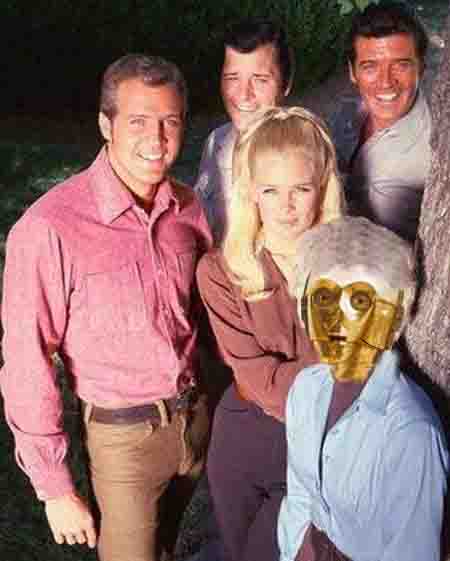
Nonexistent Trend Du Jour

Paleo Retiree writes:

Philadelphia.

Posted in Politics and Economics | Tagged | Leave a comment

Master and Servant, Oligarch and Serf: The New Feudalism is Here

epiminondas writes:

In the irony of ironies, the very people who decried the pin-striped Wall Street banker and industrial captain are now in the driver’s seat. And the yawning chasm between the middle class and the power centers of the ruling knowledge industry is truly frightening. As this chasm grows, the middle class is disappearing rapidly.  And neither party seems to care. Here is an arresting article that gives you a tour of the middle class train wreck.

Posted in Politics and Economics | 2 Comments

Quote of the Day

epiminondas writes:

“Ineptocracy (in-ep-toc’-ra-cy) – a system of government where the least capable to lead are elected by the least capable of producing, and where the members of society least likely to sustain themselves or succeed, are rewarded with goods and services paid for by the confiscated wealth of a diminishing number of producers.” — Anon.

Posted in Politics and Economics | 2 Comments

Linkage

Paleo Retiree writes:

    • More fascinating thinking from HBD*Chick about inbreeding and outbreeding, this time as they pertain to Anglo-Saxon England.
    • Thanks to Twitter, Facebook and Instagram, we’re able to peep at the superdeluxe lifestyles of Mexican drug lords.
    • Will S. shares some revealing and funny Google auto-completes.
    • Camille Paglia on rape culture, Rihanna and Rob Ford.
    • Sasha Castel is hooked on “Boardwalk Empire.”
    • A good introduction to the erotic Japanese visual art form known as Shunga.
    • Do music and DNA share some characteristics? More generally: do language and the arts mimic/reflect/replicate the way genes and evolution work? (Entirely FWIW: I’ve always thought so.)
    • Time to start thinking once again about a Guaranteed Annual Income for everyone?
    • So maybe it’s women who do most of the slut-shaming …
    • Cathy Young reminds us that the Nobel Prize-winning novelist Doris Lessing, who died on November 17, once called Political Correctness a “self-perpetuating machine for dulling thought.”
    • Matt Forney visits NYC’s 9-11 Memorial and finds it a dreary place.
    • Smart stuff from, of all places, the left on how important the issue of immigration is, with some good tips about how best to think about it. More.
    • TechCrunch — in other words, an almost-mainstream outlet — takes some note of the Dark Enlightenment.
    • Give a listen to the magnificent sounds — half calliope, half cello quartet — of an instrument that Leonardo da Vinci designed but never built.
    • Steve Sailer has got me looking forward to Alexander Payne’s new movie. I loved Payne’s “Citizen Ruth” and “Sideways” but wasn’t crazy about “The Descendants” and “About Schmidt.”
    • Nigella Lawson: cokehead?
Posted in Linkathons | Tagged , , , , , , , , , , , | 7 Comments

Knockout Game Roundup

Fabrizio del Wrongo writes:

Last week The New York Times ran a story on “knockout game.” As Chuck Ross at Gucci Little Piggy pointed out, the piece cleverly shifted focus away from the effects of the punching attacks onto a debate about whether or not they constitute an actual “game” or even a trend. As Ross says:

It doesn’t actually really matter to the victims and to the worried public whether or not this is all a game with a set of rules that is discussed and hashed out by its players. What truly matters is whether people are getting beaten up for no reason other than the passing amusement of the perpetrators.

Over the last few days other outlets have joined in what I’m going to call — overstatement or not — an orgy of spin. I thought it’d be fun to take a look at some of the pieces.

Guess what? According to The Daily Beast, this whole thing is a “phony panic.” The gist of the piece, by Jamelle Bouie, is that “knockout game” isn’t worth talking about because it’s just not a trend. And the media should only talk about trends, like, presumably, our long national struggle against receipt hate, or the Klan’s infiltration of Oberlin College. Bouie is generous enough to admit that at least five people have been killed by punches that might have been thrown by partakers of the “game,” but he doesn’t see that as constituting a trend. I dunno. Five people. Seems a little trend-y to me, or at least somewhat newsworthy. The same number of people were killed during the 2001 anthrax attacks. That’s, like, five Trayvon Martins. It’s five times the number of geisha go-go dances performed by Katy Perry. It’s 83% of the total number of Obamacare sign-ups on the website’s first day.

Over at Slate, Matthew Yglesias, who was punched and kicked by a couple of guys, isn’t very curious about the motives of his attackers. He considers the unprovoked assault to be a “random act of criminality,” one of those things that just happens, like pimples or the NSA reading your emails. I’m unclear if Yglesias believes he was not a victim of the “knockout game” or if he simply thinks it’s wrong to see the game as something to be concerned about. His assertion — that since he was not knocked unconscious his attack was not an instance of “knockout game” — is self-evidently absurd. It’s still baseball if you strike out, Matt.

According to Emma Roller, also at Slate, the game is not worth talking about because there is no “hard data” to back it up. What, I wonder, would constitute “hard data”? Presumably it doesn’t include actual videos of the “game” being played and talked about in the communities in which it’s prevalent. Because there are plenty of those. Yglesias would probably call these videos “random evidence,” which, like a random act of criminality, is something barely worth thinking about. In any event, since the government has stopped including race information in the numbers it releases through its Bureau of Justice Statistics website, I’m going to go out on a limb and predict that the kind of data Roller is talking about will not be forthcoming. Actually, I’ll go even farther out on that limb and predict that no data on “knockout game” will be collected at all. And if there’s no data, per Roller there is no “game.” It’s just a fantasy, like leprechauns. So stop talking about it you big racist.

The truly bizarre thing in Roller’s piece is the assertion that Colin Flaherty of WorldNetDaily is almost singlehandedly responsible for spreading the myth of black crime. Also for the black rate of incarceration, which is pretty high. That’s alotta blame to lay on one dude, especially one who is an outsider with little-to-no mainstream pull. (I hadn’t even heard of him prior to a few days ago.) Roller seems to be forgetting that the “knockout game” story, at least as far as mainstream outlets are concerned, traces back to the Times. Prior to that piece the story was comfortably below the radar — and no one was being scolded about it. Besides, if black crime wasn’t a fertile and under-exploited topic, Flaherty wouldn’t have something to write about, would he?

Just for the sake of satisfying Ms. Roller’s yearning for long, hard data, I’ll link to an archived version of the Bureau of Justice’s data on homicide trends by race. As I mentioned, it’s no longer available on the regular site, so thanks are owed to Steve Sailer for pointing it out. Given these numbers, it’s amazing there aren’t more Colin Flaherties out there. More Steve Sailers, too. There’s a story here all right, but it doesn’t concern the truthiness of “knockout game.” It doesn’t even concern its racial aspects. It concerns the systematic way in which the media buries facts and stories contrary to its model, then attacks or discredits anyone who dares to complain about it.

Related

Posted in Books Publishing and Writing, Demographics, Politics and Economics | Tagged , , , , , | 9 Comments

Architecture Du Jour

Blowhard, Esq. writes:

Click on the image to enlarge.

St_Pancras_Renaissance_London_Hotel_2011-06-19The Midland Grand Hotel at St. Pancras Railway Station in London, completed in 1873. Designed by George Gilbert Scott who said, “It is possibly too good for its purpose.”

Posted in Architecture | Tagged , , , , , | 4 Comments

The Uncanny Valley

Fenster writes:

bigv

Maybe y’all knew this one, but it is a new one on me.

I have wondered for a while why kids (adults too) often prefer cartoons that depict characters in highly stylized ways — in some ways the less human the better.

Part of the answer may lie in the concept of the “uncanny valley.”  According to Wikipedia “the uncanny valley is a hypothesis in the field of human aesthetics which holds that when human features look and move almost, but not exactly, like natural human beings, it causes a response of revulsion among human observers.”

The phenomenon can be measured but, as is the case with aspects of behavior with likely roots in our evolutionary history, the ability to measure at present seems to be running ahead of theoretical understanding much beyond conjecture.

A number of theories  put forth to explain the phenomenon.  Just on the basis of surface appeal, and in thinking about my own reactions, this one seems credible:

The uncanny valley may “be symptomatic of entities that elicit a model of a human other but do not measure up to it”. If an entity looks sufficiently nonhuman, its human characteristics will be noticeable, generating empathy. However, if the entity looks almost human, it will elicit our model of a human other and its detailed normative expectations. The nonhuman characteristics will be noticeable, giving the human viewer a sense of strangeness. In other words, a robot stuck inside the uncanny valley is no longer being judged by the standards of a robot doing a passable job at pretending to be human, but is instead being judged by the standards of a human doing a terrible job at acting like a normal person.

Posted in Art | Tagged , | 4 Comments

Art Du Jour

Blowhard, Esq. writes:

Click on the image to enlarge.

!MapForSmallGiclee“Map of the World” by SHAG (aka Josh Agle)

Posted in Art, The Good Life, Travel | Tagged , | 2 Comments

Anyone Really Still Give a Shit What These Guys Think?

Blowhard, Esq. writes:

This is a modified version of the December 2013 cover of Wired that I pulled from the magazine’s website:

cover_2112_best2

Do these guys still sell magazines? Are people clamoring to hear what they have to say? Hey, I’m glad Gates is using the billions he made selling crappy software and Clinton is using his blowjob notoriety to help people in the Third World. I really am. But enough with the BuzzFeed-induced 90s nostalgia. Enough with these Cathedral gargoyles, their falsely-modest smirks, and plans to Save The World.

Posted in Politics and Economics, Technology | Tagged , , , , , , , | 5 Comments

Another Kind of Diversity

Fenster writes:

The left’s ideological blinders have caused it to miss the obvious: that there can be such a thing as “too much” diversity.  Should it really be all that shocking that high levels of difference can result in a fraying of bonds and in hunkering down?  Like all law, policy and social behaviors depends on a kind of reasonable man argument.  When reasonable men differ markedly, and according to group, there is bound to be trouble.

What I find interesting, though, is how the right deals with inequality in almost exactly the same way as the left deals with diversity.  The right may not celebrate inequality in exactly the same way some on the left celebrate diversity: that some is good and that more is always better.  But there is, on the right, seldom any acknowledgement that high levels of inequality can erode bonds as surely as high levels of cultural difference, and for the same reason.

As Pascal-Emmanuel Gobry remarks in a recent Federalist article:

 . . . any collective endeavor, including self-government but also functioning free-market capitalism, cannot be successful for long if some significant number of the people involved in the enterprise feel that they’re getting screwed. Even if you see no value in equality as such and you are a total capitalist red-in-tooth-and-claw you must realize that if too many people feel that capitalism destroys them, at some point they will use the levers of political power to destroy capitalism.

This is hardly a new insight, though it seems to have been a buried one over the last few decades.  Inequality we will always have with us, just as we will be continually faced one way or another with the question of cultural difference.

Is the right capable of questioning the received wisdom of The Market, as Florida has at long last begun to do with vibrancy?  Maybe.  Here’s a recent Weekly Standard article that shows some real concern over the wealth divide.  Of course, it is unwilling to take the issue on whole hog, preferring to poke fun at the digital, green, liberal-voting oligarchy.  But below the obligatory right-side fancy-dancing, there is in the article a lurking concern that we are headed toward a new feudalism, and toward a future (as Tyler Cowen writes) of rice and beans.  I think the raising of that concern is a good sign.

Posted in Personal reflections, Politics and Economics | Tagged , , , | 9 Comments