
Blowhard, Esq. writes:
Here are a few pics I took of the Old Rotunda of the L.A. Central Library in downtown Los Angeles.
Click on the images to enlarge.


Related
- An essay about the 80 year-old murals.
Blowhard, Esq. writes:
Here are a few pics I took of the Old Rotunda of the L.A. Central Library in downtown Los Angeles.
Click on the images to enlarge.
Related
Glynn Marshes writes:
. . . but with a crumble.
 From time to time, scifi writer Sarah Hoyt blogs about The Collapse.
I find her perspective interesting. Hoyt was born and grew up in Portugal; she’s experienced first-hand what it’s like to live in a country in Western-style decline. “I have some experience with revolutions,” she writes in a post titled Sweet Liberty,
I get PTSD at the sound of Green Acres because Porto had one reel in its local broadcast station. Green Acres. When Lisbon got cut off, they played it back to back. This meant that someone had taken over the main broadcasting station in Lisbon.
So what’s her take on the topic?
Atypical Neurotic writes:

When I first heard of this on Monday evening, I was in very little doubt about what had happened, especially about the likely identity of the perpetrator and the reason for the crime. This is also the second time in ten years the same thing happened in the same part of the country. People are hopping mad.
This is yet another case where tragedy and farce need to by plied apart by Occam’s crowbar. But of course they won’t be.
In this particular instance, a South Sudanese national whose application for asylum had been rejected this summer was relocated to a refugee center in the western fjords pending being returned to Spain. Spain was his point of entry into the Schengen Area and where he had first applied for asylum. Under the Dublin II rules, he was required to return to Spain to await the outcome of the application process there. Instead, like so many others, he decided to go “asylum shopping”. What he did not know is that there was virtually no chance that his application for asylum in Norway would be accepted. According to this morning’s Aftenposten, no South Sudanese national has been granted asylum in Norway either this year or in 2012. However, now that this man has been charged with three homicides, he may get to stay indefinitely.
While ordinary Norwegians seethe (just read the comments on the newspaper websites – the ones that still dare to allow people to vent their anger), the usual suspects among the great and good are positioning themselves to declare their unwavering support for the institution of asylum while asking the rhetorical question “How could this happen?” But these days, asylum seekers are not what they used to be.
Marie Simonsen, the political editor of Dagbladet had an op-ed piece in today’s paper that contained a lot of good sense. However, one of her conclusions got stuck in my craw:
Da bør det være statens oppgave å sikre en forsvarlig helsetjeneste av hensyn til pasienten, familien og samfunnet. Regjeringens satsing på psykiatri må også komme denne gruppen til gode. Kunnskapen og forskningen finnes. Det er spørsmål om å ta den i bruk.
Then it should be the government’s task to guarantee a decent health service in the interest of the patient, the family and society. Government initiatives in the area of psychiatry must also benefit this group [war-traumatized asylum seekers]. The knowledge and the research exists. It is a question of putting it to use.
Is it? Is Ms Simonsen aware of the resources that will have to be diverted from an already starving mental health service, which with notable (and wonderful) exceptions, has been “escalated” to the familiar treatment-in-the-community model that focuses on meds instead of beds? Who will have the linguistic and cultural qualifications to screen asylum applicants for trauma and other mental illness? What support networks can the mental health service offer? And, more to the point, who will not be receiving care because resources are being diverted to people who might not even have the right to remain permanently in the country? The Russian émigrés fleeing from the Bolsheviks and the Cold War refugees from Hungary, Czechoslovakia and other former East Bloc countries were never this much of a burden.
I suspect that despite the rational nature of his act (he gets to stay, after all), the perp will be declared mentally ill just like the one in 2003 and sentenced to “treatment” for an indefinite period. The more he protests that he is not crazy, the higher the dose of meds they will insist on giving him. The combination of, say, 40 mg of olanzapine and its metabolic side effects, with the sequelae of vitamin D deficiency will mean that as a sub-Saharan African at 60-odd degrees north, he is not likely to live past 50 (he is in his 30s now). He will no doubt linger as a zombified and diabetic ward of the state for the rest of his life. And if he was not mentally ill when he hijacked that bus and killed the driver and the other passengers, he will be soon. That’s the beauty part of meds. How can you tell the difference between the underlying disease and the side effects? If only he had simply lammed to Oslo, he could have set up shop with his fellow African refuseniks as a “freelance pharmacist“.
Blowhard, Esq. writes:
Click on the image to enlarge.
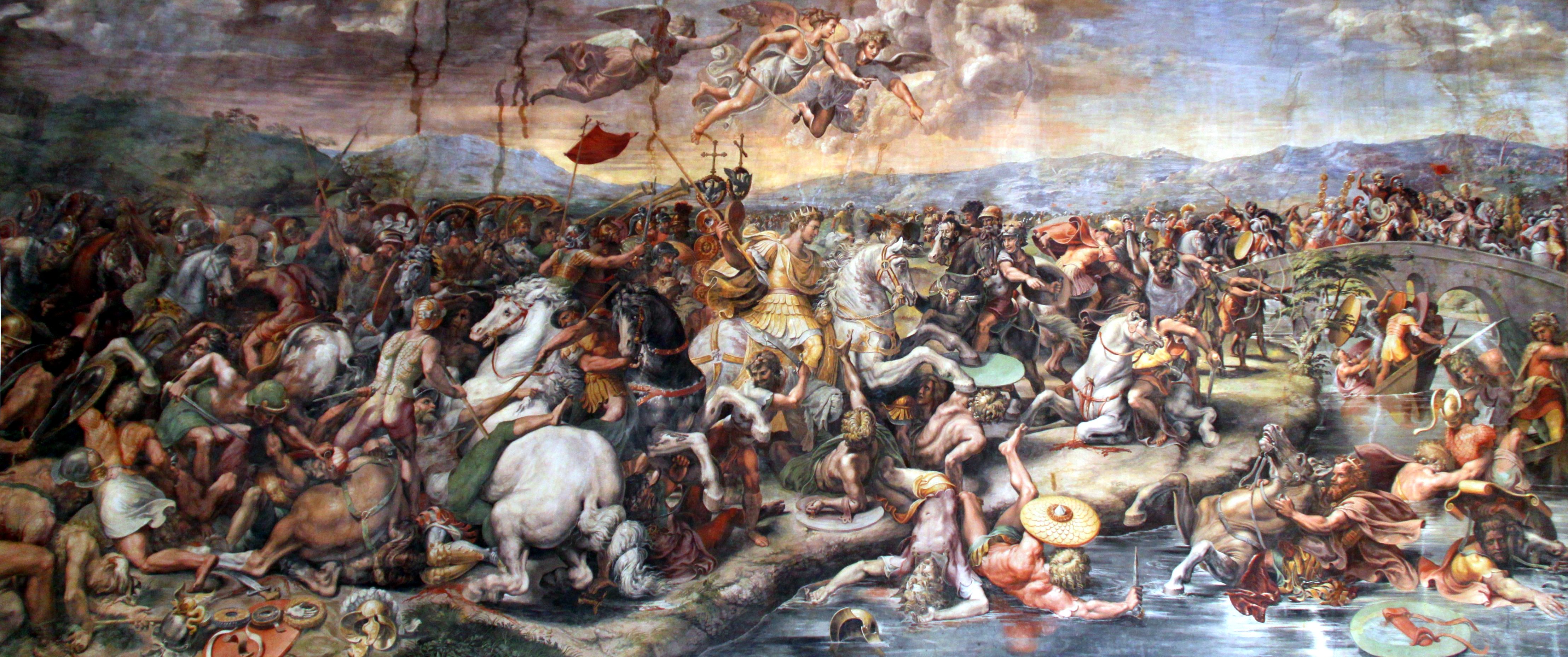 “The Battle of the Milvian Bridge” by Giulio Romano. A key moment in Constantine’s conversion to Christianity, it can be said to mark the beginning of the end of the ancient world and start of the medieval order.
epiminondas writes:
Theodore Dalrymple explores the curse of modern television:
“In my opinion, televisual entertainment is by far the most important cause of boredom in the world, and since the attempt to relieve boredom is a much underestimated cause of social pathology of all kinds, television is ultimately responsible for the squalor in the midst of wealth that is so remarkable a feature of our modern existence.”
Fabrizio del Wrongo writes:
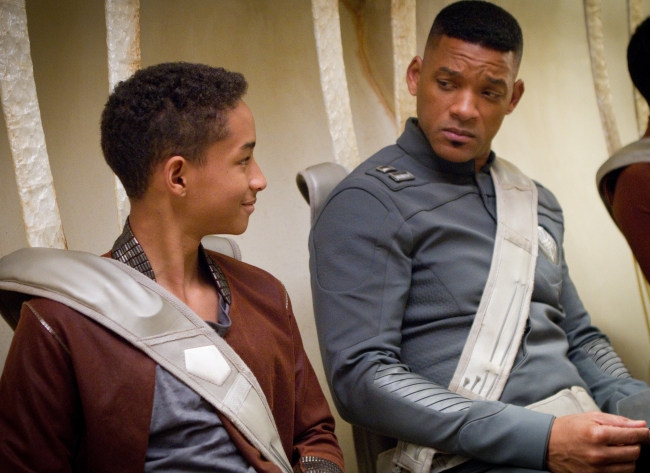
I’ve never been a fan of M. Night Shyamalan’s brand of high-concept solemnity. Yet his latest, the sci-fi fantasy “After Earth,” is so measured — so delicate and quiet and grave — that I found myself rooting for it almost immediately. The plot centers on the family of Cypher Raige, played by Will Smith. He’s a warrior who, as his name suggests, has developed the ability to mask his emotions. He uses this trick to render himself invisible to future humanity’s greatest enemy, a nightmare species of bugaboo that can see only fear. His son Kitai, played by Smith’s son Jaden, is a young teen trying in vain to reach his impervious papa. When the pair are stranded on their ancestral world, now an overgrown wilderness crawling with beasties, it’s up to Kitai to save them — and in the process prove his worth.
The screenplay, by Shyamalan and Gary Whitta, is anything but surprising, but the movie treads so carefully that you may end up appreciating its straightforwardness — it has the clarity and inevitability of a fable. The look is fable-like, too. Veteran cinematographer Peter Suschitzky gives his images a somberness and tactility that is at times almost sensual; like the Ballard-Deschanel “Black Stallion,” it’s a movie you want to touch. There’s plenty here to explore: the design is an evocative combo of future-tech sleakness and organic irregularity. When Kitai leaves his injured father in the crashed ship, the contrast between the floating-touchscreen aesthetic of the cabin and the eerie, verdant growth of the forest gives the theme of transformation a neat visual corollary. (Fittingly, the environments are separated by a valve-like partition, which flaps and pulsates like a biological membrane.)
Smith fils isn’t much of an actor, and his few big emotional scenes are an embarrassment. Fortunately, Shyamalan rarely allows the movie to settle on him. He leans instead on the elder Smith, whose presence in the downed ship is a near constant. The strategy works: the star gives a marvelously controlled performance. Reining in his usually radiant charisma, Smith projects a seriousness that’s just barely breached by his paternal sympathies. These we absorb subconsciously, through the quaver in the deeper registers of his voice and the light at the bottom of his eyes. Smith is so good at playing the movie star game that it’s possible we’ve underrated him as an actor. Here, as in “I Am Legend” and “The Pursuit of Happyness,” he shows himself capable of sustaining a complex blend of emotions, almost without assistance.
For Smith, the film’s conceit may have real-world significance. Stranded inside the wreck, his Cypher is forced to coach his son through dangerous terrain, all the while monitoring the boy’s every move via remote cameras and a panoply of screens. If the story of “After Earth” involves a test of Kitai, the movie’s existence is inseparable from Jaden’s ongoing assessment as a media figure — and it’s hard to imagine that Smith isn’t hip to the possibility of this reading.
“After Earth” is not a great film. The direction and editing sometimes fail to live up to the potential of the action set-pieces. And certain suspense gimmicks — a network of hot spots that Kitai must locate before nightfall, a series of oxygen boosters that he must inhale in order to breathe — have not been satisfyingly worked into the narrative. But these seem like minor quibbles when balanced against the movie’s charms. As corporate-minded fantasy has colonized the multiplex, jumbled franticness and gross gigantism have become the norm in blockbuster filmmaking. The problem is so extreme that even a traditionally staid and character-focused franchise like “Star Trek” has been rejiggered to out-whoosh, out-blam, and out-stupid the competition. “After Earth,” a simple little film by contemporary standards, offers respite to fans of the genre. It’s shelter from the storm.
Related
epiminondas writes:

Photomicrography is an interesting, and growing, field. With the advent of high quality digital photography, we’re able to see small things with never-before-seen clarity and beauty. Click on the main photo, then up top go the “next” button to scan the others. Fascinating stuff here. And a lot of it…over a hundred pics. So take your time.
Paleo Retiree writes:
Fun to see that friend-of-this-blog and expert organizer Jill Duffy has pulled a lot of her tips together into an ebook. It’s also a nice chance for me to share to my own masterly method:

Jill, who’s reliably smart and helpful, writes about about software and organizing for PC Magazine. Here’s her personal blog.

 Blowhard, Esq.
 Callowman
 Sherbrooke
 Eddie Pensier
 Enzo Nakamura
 Epaminondas
 Fabrizio del Wrongo
 Fenster
 Brundle Guy
 Glynn Marshes
 Paleo Retiree
 Atypical Neurotic
 Question Lady
 Sax von Stroheim
 Sir Barken Hyena
 The Mistaken
 Uncouth Reflections