Of Kings, Coinage, and Castration

Fabrizio del Wrongo writes:

Henry_II_Penny

I recently watched the first two seasons of “Monarchy,” a BBC series covering the history of the English kings and queens going back to the late Roman period. Despite the ridiculously affected speech of narrator David Starkey (which is good for a few laughs, at least), I enjoyed it. It provides a good, CliffsNotes-y overview of English history, and it succeeds in making a rather complicated story at least partly comprehensible.

One thing I found myself thinking while making my way through the series: Boy, I’m sure glad I wasn’t a medieval king! The fairy tale image of courtly magnificence and untrammeled power seems like a lot of guff. In fact, being a king was a lot closer to being a don in a modern-day mafioso family. There was always some creep hoping to knock you off, and it was more likely than not that your reign would end in either imprisonment or murder.

Well, fuck that shit. I’d rather be a court musician or something along those lines, gulping down mead and charming the wenches with my mad lute skills. But, then, though I once had a subscription to “Nintendo Power,” I’ve never had much of a thirst for real-world power. The idea of bossing people around — it mostly gives me the heebie jeebies. I don’t even like the idea of being responsible for a bunch of stuff external to my immediate bubble. Other folks’ problems — who wants to deal with ’em? I guess that’s why I’ve never been fascinated by politicians. To me, they seem like . . . borderline sociopaths.

One of the details covered in “Monarchy” that struck me as amusing concerns Henry II. Henry was the first Plantagenet king. Dates: 1154 to 1189. One of the challenges he faced upon being anointed was stabilizing the English currency. You see, the “moneyers” in charge of his mints were clipping the edges off of silver coins, melting down the shavings, and creating new coinage. Instant money! Inevitably, this resulted in rampant inflation, as everyone began to realize that the coins in their purses contained less silver.

Henry’s solution to this problem was pretty novel. In the words of Toby Birch, he:

Summoned the various Mints to Winchester (then the capital of England) in what was called the ‘Assize of Moneyers’. Two thirds of them were found guilty of debasing the currency and either had their right hands cut off or were castrated. History does not record as to whether they were given a choice between the two options.

As Birch points out, we’re dealing with something similar in the 21st century. Only now the activities of “moneyers” like Ben Bernanke aren’t viewed as warranting castration. On the contrary, they’re condoned acts of state. Meanwhile, the Paul Krugmans of the world tell us we’re crazy for being outraged at our savings being devalued so that government can create money in order to pay debts and cajole special interests. Progress, eh?

Related

Posted in Movies, Personal reflections, Politics and Economics | Tagged , , , , , , , , , | 7 Comments

Letter from China: In-flight Rhetoric

Fenster writes:

Sponsored rhetoric will always reflect the interests, and interest, of the sponsor. We get that automatically in the Era of Spin, that you can’t much trust any statement on its face, and that your brain has to automatically and unconsciously cogitate to discern interest in any piece of communication.

When I  am stuck on an airplane without much to read I will often go for the in-flight magazine just to see the words and pictures.  And I really don’t think much of it that such things are written in a kind of corporate-speak.  That only makes sense given the magazine’s sponsorship: the airline itself (directly) and the Chambers of Commerce and Tourism Commissions of the airline’s destination (indirectly).  Twenty-eight pages on the glories of Greenville-Spartanburg, South Carolina when US Air expanded service!  And here is a recent spread on Charlotte leading with the fact that Charlotte is “where business soars”.

No surprise, perhaps, that in-flight magazines in China would read a little differently?  It is, after all, the People’s Republic of China, so rather than glorify corporations, you’d expect it to perhaps glorify labor.

Continue reading →

Posted in Politics and Economics, Travel | Tagged , , , | 2 Comments

A Day at the Ballpark

Blowhard, Esq. writes:

field

Went to a Dodger game this weekend for the first time in many years. A few random observations:

  • The most annoying thing was the constant music/sound efx to keep the crowd amped up. There was dance music before the game during batting practice and music clips between every pitch and inning during the game. We were constantly exhorted to clap, cheer, whatever. Every batter had walk-up music. Rihanna, Daft Punk, The Who, Stone Temple Pilots, Marilyn Manson, The Black Keys — JFC, will someone turn off the goddamn radio? And let the dude working the boards know there’s no Oscar for Major League Sound Effects Editing. It’s like sports fans aren’t happy unless they’re in the middle of a Nike ad. Also, I wonder how Beethoven would’ve felt knowing the four note sound of his imminent death is used whenever someone strikes out?
  • Not all fat guys are loudmouths, but why are all loudmouths fat guys? Do the surplus lipids strengthen their vocal cords and compel them to constantly shout stupid shit?
  • Remember Susan Sarandon in Bull Durham? Yeah, those girls were easy to spot in the stands.
  • Vin Scully will never die, right? I’m still not over Chick Hearn‘s passing.
  • As you can see in the picture below, lots o’ Mexicans in sportscrap! I’d say about 80% of the crowd in our section were Hispanic. Everyone from the kiddies to the grandmas were festooned in Dodger logo-emblazoned blue. But isn’t it great how all the races have their own sport? Mexicans have baseball, whites have football, blacks have basketball, and Asians have classical music.
  • I’m pleased to report that every staff member at the park was exceedingly friendly and helpful. Having the corporate brand tarnished when a fan is nearly beaten to death in the parking lot wonderfully concentrates the front office’s mind. Regardless of why, from the security people at the gate, to the concessions workers, the girls at the souvenir stand, the ushers — all seemed genuinely pleased to be there and wanted you to have a good time. When some dude walking up the steps spilled that disgusting nacho cheese everywhere, I went and asked if they could get someone to clean it up. A worker showed up within three minutes. One other thing: I used a restroom during the 5th inning and it was surprisingly clean. Didn’t Dostoevsky say that you can judge a civilization by the cleanliness of its major league ballpark toilets?
  • But what you’re really wondering is how much this all cost. It was $40 for the ticket, which was in the right field pavilion in a special all-you-can-eat section — unlimited hot dogs, nachos, popcorn, peanuts and soda. (I had four hot dogs over the course of about 6 hours, a bag of peanuts, and water.) I got a hat for $40. Yeah, that’s right, I bought some sportscrap — fuck you guys, I’m losing my hair so it’s a practical necessity, OK? Finally, parking was $10 and a program was $5, for a grand total of $95. Expensive, but if you cut out the souvenirs that halves the bill.

crowd

When was the last time you went to a major sporting event? (Or minor one, for that matter.) What was your experience like?

Posted in Photography, Sports | Tagged , , , , , , , | 16 Comments

Cocktail Du Jour

Paleo Retiree writes:

The “Wry Lemon” cocktail at Greenwich Village’s great Cornelia Street Café: Templeton Rye, Cynar, lemon juice, simple syrup, and Dutchess Colonial bitters. The drink is special to the Cornelia Street Café but it’s so excellent, and in such a self-evident and straightforward-seeming way, that I found myself wondering why it hasn’t already attained classic status. The murky-yet-crisp, sweet/bitter/whiskey thing was most of what was going on, but it was enough to make the whole evening feel like a giddy swirl of funky downtown elegance. Cynar, I learned from our friendly bartender, is a versatile bitter Italian liqueur based on (get this) artichokes. Sipping bliss.

Posted in Food and health, The Good Life | Tagged , , | 6 Comments

Lloyd Fonvielle on “A.I.”

Fenster writes:

A thank you to Lloyd Fonvielle for writing a wonderful and insightful piece on Spielberg’s A.I.  Thanks for the piece itself, which is an excellent read, and for sparing me the trouble of writing at too much length about this film myself.  I have been wrestling for quite a while with A.I., wanting to write about it, but Lloyd’s piece relieves me of that, other than the few comments to his piece that I will make here.

Like Lloyd, I had confused and conflicted feelings about the film the first time I saw it.  But I went back numerous times to see all or parts of it, and have come to a similar place as Lloyd: that if what Spielberg and Kubrick were doing was on purpose,

 then perhaps A.I. does become one of the greatest movies made in our time — an analysis of the narcotic cinema that distracts us from real things. If they did it by accident, then it still might be one of the most important films made in our time.

Lloyd’s first reaction was that the film was “just a kind of philosophical mess”.  Much of his piece represents a kind of working through of that reaction.  For me,  of course it will appear messy at first, since it is a sincere attempt to reconcile Kubrickian aridity with Spielbergian schmaltz.  It doesn’t feel like a marriage that can be made without creating a philosophical mess.  But does it fly?  For Lloyd–me, too–yes it does, and it is all the more powerful for not fully reconciling the competing demands of the two auteurs.

Spielberg retelling Pinocchio?  My God, a project like that would seem a prime candidate for Spielberg’s brand of over-ripeness.  And every bit of that director’s emotional palette is on display.  But so is the “emotional subersiveness” (Lloyd’s term) of Kubrick’s nihilistic tendencies.  Pinocchio is, and remains, a puppet, and there is no magical happy ending.  Well, magical maybe, but not happy.*

Adding Spielberg’s melodramatic and crowd-pleasing skills to the mix, then, heightens the force of the film on the viewer–this viewer, at least.  You are authentically sucked into the parental love but continually reminded that you are not quite seeing and feeling what you think you are in David.

Moreover, the cold Kubrickian intention is, I think, to remind the viewer that humans themselves are perhaps not much different from robots in the first place.  Yes, we are made of meat, with a squishy gray processing center inside our skulls.  But is David’s love for his mother much different, really, from that of his mother for him?  So we start by feeling the tragedy of David–that he feels from the inside out that his love is authentically his when it is “merely” a function of his program.  But we then move on to the tragedy of us–that we are not much different.

Maybe this would have been one of Kubrick’s most devastatingly cold films had he directed it.  Or maybe not.  Kubrick handed the troubled project to Spielberg before his death, so maybe he saw that pessimism is all the more powerful when real love runs right through it.  And maybe Spielberg took the project on for the flip side: to show that true love is real even in a possibly meaningless universe.

osment

There’s so much of this movie that is parental.  I am not sure it would have been nearly as powerful had it not been about a kid, and if I myself were not the parent of a son who was about David’s age when the movie came out. Perhaps the movie was just engineered for my program as a human parent.

Related

  • Here’s Spielberg on the ending to the film, and how it is not a schmaltz set-up but part of Kubrick’s initial vision.  I agree that the ending only looks schmaltzy, and that it is as rigorous as the rest of the film.
  • And here is Lloyd on The Wild Bunch–very much worth reading though this time I find myself on the opposite side, for now at least.
Posted in Computers, Movies | Tagged , , | 7 Comments

“Rust and Bone”

Fabrizio del Wrongo writes:

Rust-and-Bone-2012-movie-poster

This movie might have been something had director Jacques Audiard bothered to give it a shape and some conciseness. I love Marion Cotillard; she reminds me a bit of Nadia Sibirskaia, though there’s a smidge of Gollum in there as well. She would have been great in silents; you’re never not sure what she’s thinking. Matthias Schoenaerts, who plays the thuggish street fighter, is good too. I like how his eyes are too close together, like they’re on the verge of breaching his nose and blobbing into one another; it lends his face a suspenseful quality that’s lacking in more conventionally handsome actors. (Schoenaerts seems destined to star in “The Vladimir Putin Story.”) But his character’s narrative is largely extraneous; I kept wondering why I was being asked to care about his relationship with his son and his involvement in an illegal surveillance scheme. (A scene in which he saves his son from drowning is good but unintegrated — it’s like a little movie unto itself.) Acting aside, the best thing about “Rust and Bone” is its treatment of Cotillard’s baser instincts. She’s a sensualist who finds a sort of erotic solace in her interaction with big, uncontrollable forces (whales, fighters, the ocean), and the movie doesn’t try to explain that away or apologize for it. And bless Audiard for avoiding the claptrap that typically accompanies movies dealing with the disabled. If anything, Cotillard becomes less noble upon losing her legs: precariously perched inside a nightclub, she looks at the slender gamines in their tiny miniskirts, and shades of envy glide across her face.

Posted in Movies, Performers | Tagged , , , , , , | 2 Comments

Linkage

Fabrizio del Wrongo writes:

  • Listen, I’m the last guy to complain about a statue of RoboCop, but isn’t it kind of amusing that Detroit — the postercity for fuckupitude — is getting such a monument? While the city crumbles to the ground, internet denizens around the world are donating to a Kickstarter campaign devoted to memorializing a science fiction character. That’s gotta constitute some new watermark for popcult irony.
  • Next week it’ll be revealed that he was against recycling.
  • There’s the E Ticket and then there’s the Victim Ticket. Hilarious story. Shameless one percenters, eh? But I wonder: Is using your association with a disabled person in order to bypass lines really so different from pretending you’re an Indian in order to get tenure at Harvard?
  • Are women naturally more crazy than men? My totally biased and highly unscientific opinion: yes!
  • Is the age of the hetero movie romance over? If so, why? Seems to me that hetero romance fantasies involving things like vampirism, bondage, and Chechens are thriving. Maybe female tastes have simply changed? Or maybe hetero guys have become too lame?
  • Juggalos go gigolo. (H/T Enzo N.)
  • The most racist countries evah! Maybe we can use this as an excuse to invade and subjugate India?
  • White male privilege: it’s the secret sauce of everything!
  • A concatenation of some of my favorite things: movies, books, and cute girls having orgasms.
Posted in Linkathons, Movies, Politics and Economics, Science, Sex | Tagged , , , , | 3 Comments

“Pain & Gain” and Michael Bay

Sax von Stroheim writes:

I believe in fitness.

I believe in fitness.

Pain & Gain, the new true crime caper movie from Michael Bay: Uncouth Reflections Movie of the Year? Movie of the Decade? Movie of All Time? Its subject is excess, and it’s catching, so forgive the hyperbole, though this is easily one of the best Hollywood movies I’ve seen in a while. More importantly for present purposes, it deals with a number of topics that are probably of interest to UR readers: crime, steroids, the plight of low IQ losers, immigration, sexual economics, bogus self-help gurus, the mania for physical fitness, rageaholics, the porn industry, various forms of addiction, and Florida-as-national-freakshow. The movie sees all of these items through its vision of America as a culture choking on its own excess. Pain & Gain reminds me of the kind of movies William Wellman made for Warner Brothers in the early 1930s: it doesn’t feel like it was put together by people following a how-to-write-a-screenplay guide, but, rather, it’s full of digressions and sidetracks that seem to have come directly from observation of and insight into how we live now, which are conveyed through a playful, expressively cinematic style. It ends up being about a lot more than what it’s about from a strictly “What is the major theme?”-English Lit 101 perspective.

The argument that Michael Bay represents some kind of nadir of contemporary Hollywood filmmaking has always struck me as betraying the sensibility of a hysterical, middlebrow manboob. Yes, his movies are loud, overblown, and juiced on consumerism, but they’re hardly alone in that, and at least Bay has some visual style and a quirky sense of humor that leads him to cast people like John Turturro and Steve Buscemi. Those two qualities combine in one of my favorite Michael Bay moments: when we’re introduced to John Malkovich’s character in Transformers: Dark of the Moon with a shot of Malkovich’s giant, 3D floating head. Trust me, sister: there are films and filmmakers out there far, far worse than Michael Bay.

On the other hand, I’m suspicious of the highbrow defenses of his work, which, even when they use ten dollar words, still strike me as coming down to “Michael Bay is great because teh awesome – hardee, har, har…”

To me, a somewhat more realistic take on Bay’s work is that he’s a talented guy, with a limited, narrow sensibility, who has made some pretty good action blockbusters (The Island, The Rock, and Armageddon), at least one outright terrible movie (Pearl Harbor), and a couple of others that are somewhere in between. All of which is preface to say, No, I’m not surprised that Pain & Gain is such a great film: Bay IS talented, and the material is right up his alley. I liked this movie a lot: see it on as big a screen as possible.

Related

  • Here’s Richard Brody’s very highbrow take on the movie. I agree with most of what Mr. Brody is saying, though I’d probably put it differently. I do agree that part of Michael Bay’s greatness is that as an image-maker he “takes a sudden and even self-surprising pleasure in seeing what he’s filming.”
  • Here’s the tumblr for the Vulgar Auteurist movement: they’re big fans of Bay’s work, although I tend to think they’re being a little condescending. Or maybe just ironically condescending: it can be hard to tell these days. And here’s the original Vulgar Auteurism Guide, from egghead movie site MUBI.
  • Back in the day, Michael Blowhard had nice things to say about Bay’s The Island, which was my favorite Bay flick until this new one came along. (Pain & Gain is the “smaller picture” that Bay has been threatening to make for years.)
Posted in Movies | Tagged , , , , , , | 11 Comments

Diversity Musings

Paleo Retiree writes:

ne_nyc_2013_05_village_diversity_message02

In case you were in any doubt about what our state religion now is: A too-big-to-fail bank has just ordered me, a random ATM user, to “unite behind diversity.” If I’ve got this right, I’m not being urged by a fellow citizen to stand up to the Powers That Be in order to demand our rights. Instead, I’ve been commanded by a top-down soul-crushing part of the Plutocracy to stand WITH the Powers That Be in order to stifle dissent and impose a trendy and unrealistic ideal. Hard to imagine why I wouldn’t want to get on board with that particular program …

FWIW, I enjoy living a life in the genuinely diverse style. I’m based in Greenwich Village, which is bursting with gays and Jews, and which is located in NYC, where only 45% of inhabitants are white. Unlike our betters, though, I’d never dream of imposing diversity on others. (I don’t see my preference for leading a life in the “diverse” style as anything but a personal taste.) Why? Well, for one thing, I recognize that many people prefer to live among people more or less like themselves. Whereas the champions of diversity-as-an ideal see any indication of irregularity as suspicious, if not damning, I see clumping-together as what most humans normally tend to do. Why fight it?

For another, managing a “diverse”-type life is a lot of trouble. Every day involves numerous micro-negotiations that simply don’t crop up when you’re among people with whom you share background, language, assumptions and (who knows?) ethnicity. There can be payoffs — my “diverse” life is a pretty darned entertaining and interesting one. But the cost of it, sheesh … Leading the “diverse” life can be extremely wearying; it can really grate on the nerves even if you’re reasonably sophisticated and prosperous. I can only imagine how dispiriting the diverse life can get to be if you don’t enjoy a bit of spare money, space and time. (If, in other words, you don’t have the resources it takes to enjoy the benefits of diversity.) Why impose additional annoyances on people whose lives are already challenging enough?

For a third: I’m just not into forcing utopian ideals on others. Let people live their lives as they choose to the extent that’s possible (and they’re able), you know? And if, in the normal course of events, one neighborhood (or workplace, or province, or country) winds up being more Asian, and another more black, and another more Mexican, and another more white — and another more gay, and another more straight, and another more female, and another more male — why stress about it? Let people sort their lives out as they see fit. Besides, our rulers really do (IMHO) have more urgent things to give their attention to than bulldozing their way into the arrangements we’ve made for ourselves and disrupting them in the name of a silly ideal that people will be laughing about in a decade or two. Ahhhh — banking — choo!

My final thought about diversity this morning is a defense of diversity itself. If every neighborhood/workplace/country needs to be broken into and then re-made into some bean-counting bureaucrat’s idea of “diverse,” isn’t the overall result going to be about as un-diverse as can be imagined? Isn’t the final result, in fact, inevitably going to be something we might reasonably call “uniformity”?

Besides, if you throw all the ingredients in your fridge into the food processor, what you wind up with is inedibility itself. I’d much prefer that life resemble a tasty meal — a banquet of different (maybe even “diverse”) flavors, textures and experiences — than a pot of uniform green/brown sludge.

Short version: It’s possible to enjoy diversity on a personal level and dislike the way our elites are making use of the concept. It’s also possible — heck, it’s even easy — to use the cause of genuine diversity to undermine our elites’ diversity campaign. (“Diversity”-imposers are like “tolerance”-fanatics — giant targets just begging to be shot full of holes.)

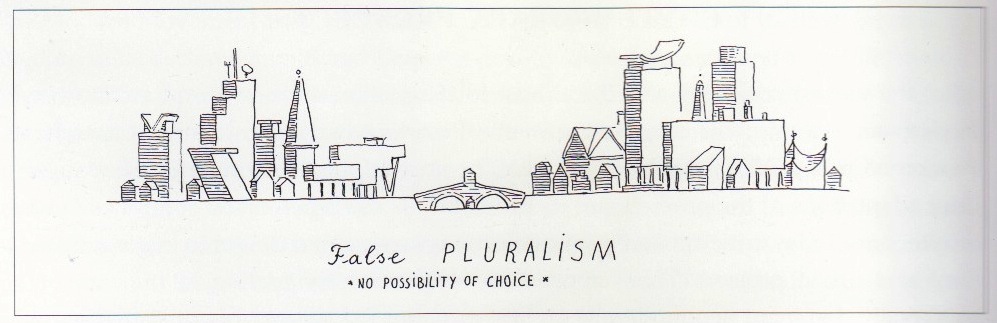
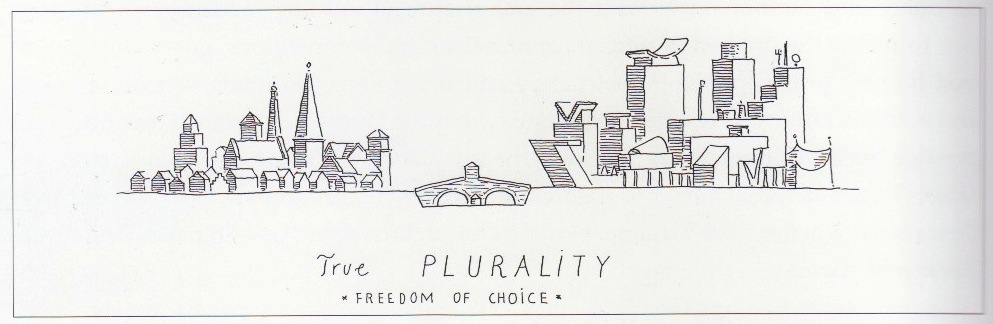
I’m reminded of a pair of cartoons by the great Léon Krier:

krier_cartoon01 krier_cartoon02I found these cartoons in this wonderful book.

Related

Curious to hear what others are making of our masters’ determination to use the ideal of “diversity” to crush real diversity.

Posted in Personal reflections, Politics and Economics | Tagged , , | 20 Comments

“Blue Car”

Paleo Retiree writes:

agnes-bruckner-david-strathairn-miramaxs-blue-car-441000

The Question Lady and I were in giggly, semi-camp heaven watching this solemn exercise in literary-workshop-style hypersensitivity.

Agnes Bruckner stars as a midwestern girl from a sad, broken family who has a knack for poetry; Margaret Colin is the girl’s overwhelmed, trying-not-to-be-bitter, snappish mom; David Strathairn is the handsome high-school English teacher whose interest in his student’s talents may be a little too personal.

The actors are all good, and despite my irreverence I’m also happy to acknowledge that the film is classily done. (It was directed by Karen Moncrieff.) It’s what it is that made me hoot. Divorce; quiet miseries; vague yearnings; misplaced love; “family” as an “issue”; clever-but-not-Hollywood dialogue; loads of indirection; the suburbs portrayed as an inane version of paradise; metaphors-and-coincidences standing in for story structure; the cluelessness of adults whose lives haven’t lived up to their hopes … Every cliche of this inevitably slim, wispy, overbaked, narcissistically-compassionate, never-delicate-enough, estrogen-befogged, microtrauma-lovin’ genre is dotingly dwelt-on and artfully-presented, as though the package had both real literary significance and immense sociological resonance.

Tasteful-indiepic bliss.

Related

  • Don’t miss Blowhard, Esq.’s definitive review of tasteful-indiepic classic “Margot at the Wedding.”
Posted in Movies | Tagged , , , , | 7 Comments