What To Make of All the Colorful Pants?

Paleo Retiree writes:

Out in huge numbers in NYC this spring/summer: women wearing bright, colorful pants. Not all of these pants are variations on red-orange, but I guesstimate that 80% or more of them are. Here are a few shots of street life that I’ve snapped just in the last few days:

colorful_pants_women_collage02

I’m enjoying it. (Of course, I nearly always enjoy the spectacle of women pulling themselves together and putting themselves on display.) Where fashion goes, women can be terrible sheep, god knows. How do so many of them know — and all at the exact same time — to go buy tight red/orange pants? But it’s genuinely fun to see them being playful with their bodies and their adornments, and expressing their joy in the season. Form-fitting bright pants on women are nothing if not a cheery sight, and Manhattan’s gray and dirty streets are in perpetual need of cheering up. You’re rockin’ it, ladies.

Now, here’s another fashion — less in evidence than red-orange-on-women but still unavoidable — that has  me a little more perplexed:

colorful_pants_men_collage01These snapz are all of guys. In other words: This season, it isn’t just the gals who are flaunting the bright and cheery colors. Guys too are wearing flamboyantly hued pants, around 80% of them variations on red or orange. Realistically speaking, a smaller percentage of guys than gals are wearing red-orange pants, and for some reason more guys than gals are exploring the raspberry/cranberry wedge of the spectrum. But it wasn’t as though I had to try real hard to capture a lot of them dressed this way either.

Guys in considerable numbers are out this summer in red/orange/raspberry pants … What to make of this?

Are young guys now mimicking women? It certainly didn’t used to be the case that a significant subset of guys took fashion cues from women. If anything, guys were more likely to define themselves visually in opposition to women. But maybe it’s not that at all. Maybe what’s happening is just that now a lot of guys are, like women, taking cues from the media:

ne_nyc_2013_05_colorful_pants_men11-2

Another hunch: Perhaps guys are now freer to express themselves in their mode of dressing than they used to be. Back in the days of “how to be a man,” bright and expressive colors were largely left to the ladies. The assumption was that women were creatures of emotions, that they were more transparent than men, and that the package equaled “expressiveness.” (Men didn’t compete with the ladies in the expressing-your-feelings sweepstakes; signs of vanity were squashed out of guys at the youngest age possible.) The traditional male was, by contrast, someone who was in charge of his feelings, and that tended to translate clothingwise into classic cuts and a subdued palette. Women were creatures of being where men were creatures of doing.

Back in the Bad Old Days, guys allowed themselves to indulge in color in two main instances. One was plain goofiness — guys being themselves, often in the most unstylish ways imaginable. Golf fashions, anyone? The other was the case of the dandy. There have always been a few guys — rock stars (and rock star wannabes) and other dreamboat types — who worked the narcissism and look-at-me angles. Here’s a guy I ran across in SoHo the other day who’s doing what strikes me as a perfectly good job wearing pink — pink! — pants.

ne_nyc_2013_05_colored_pants_men38

But, pink as those pants indisputably are, watching him go by, I — as a representative troglogyte — didn’t experience a single “What a twerp,” or “He ought to be ashamed of himself,” or “That can’t be allowed to escape unpunished” feeling. Instead I respected him. I thought, “Hmm, he’s getting away with it.” I admired the panache of this modern dandy. But then he’s slim and good-looking, he’s confidently vain, he’s squiring a hot girl … He’s probably European, now that I think of it.

So my question for you is, What are we witnessing? One the one hand, maybe it’s a glorious moment: perhaps men, finally liberated from the rigid requirements of traditional male-ness, are now free to play, to enjoy themselves, to attract attention and to express their feelings. On the other hand, maybe it’s one of the clearest signs we have of Western masculinity’s final decline. Maybe what we have are a few generations of flibbertigibbet, narcissistic young men — dudez who have been rendered as vain, as anxious and as exhibitionistic (and as helpless before the dictates of the fashion biz) as many women have traditionally been.

Liberation has arrived, and it’s terrific? Or masculinity — a once-great and valuable thing — is crumbling into dust before our eyes? Votes, anyone?

Posted in Sex, Women men and fashion | Tagged , , , , | 28 Comments

Swedish Boogie-Woogie

epiminondas writes:

Sweden’s old fashioned rock and roll group, The Refreshments, know how to create that authentic boogie sound.

Posted in Music | 2 Comments

A Bit More on “Midnight”

Fenster writes:

By popular demand, a few more words on Linklater’s Before Midnight.

The rules of drama typically involve things like a protagonist and a structure leading to tension and resolution.  Of course the rules are meant to be toyed with, stretched and sometimes subverted but there they remain: a kind of bedrock for expectations relative to taking in the art.

And life, as they say, imitates art. Life should be so lucky as to have the kind of ordered meaning sometimes found in art.  That’s especially the case with the art of film, given that movies simulate lived human lives more directly than most other art forms.  So life often strives to mimic the art of film as a way of imposing some meaning on what is experienced as the disorder of life-as-lived.

My own favorite film experiences toy with this very convention, and are reluctant to provide meaning in too clear a fashion.  Take Altman’s Nashville and Short Cuts, for instance.  Is there a template of sorts delivered in these films, some sort of design for living?  Sure, but it is a bracing one nonetheless, allowing for some window to meaning while keeping one foot firmly in the relative anarchy that often passes for real life.

But these films are less common.  They probably can’t be dime a dozen.  People–me included–often cannot help but want things to be tidied up somehow.  It’s comforting.  You are invited to be the protagonist and egged on to take that side in love, war, moral issues and all else.  I like that Before Midnight challenged that tendency to take sides.

Continue reading →

Posted in Movies | Tagged , , , , , | 1 Comment

The Neon Museum

Blowhard, Esq. writes:

neonmuseumsign

On a recent trip to Las Vegas, I visited the Neon Museum, where the ghosts of the city’s golden age haunt the Nevada desert. It’s a wonderfully photogenic, melancholy place and an essential stop the next time you’re in the city.

Continue reading →

Posted in Architecture, Art, Commercial art, Photography, Travel | Tagged , , , | 12 Comments

Cocktail Du Jour

Paleo Retiree writes:

nyc_meal_out_favela_cubana_cocktail_mojito07

One of the best mojitos I’ve had recently was served up by this good little Cuban/Brazilian place near New York University. Loads of limey-minty action; a visual delight; enough rum to slow the afternoon down significantly … And not too sugary. I can’t emphasize it enough: the sugar is there in a mojito to highlight the other ingredients, not to be a starring attraction, dammit. I’ve been appalled recently by the number of bartenders who serve up mojitos that are ‘way too fizzy and syrupy. Hey, bartenders: if I want a Sprite, I’ll order a Sprite.

Here’s a recipe for the basic mojito, one of the great party and hot-weather cocktails.

Previous cocktails

Posted in Food and health, The Good Life | Tagged , | 1 Comment

Linkage

Fabrizio del Wrongo writes:

  • Lesbians react to lesbian porn.
  • Dennis Mangan discovers a group of traditionalist French women.
  • Gucci Little Piggy spotlights some amusing (and somewhat phony looking) images of working mothers.
  • Swooshiness! Reflectiveness! Transparency! Please save me from all of it!
  • Related.
  • What are the chances this isn’t a hoax?
  • Reviewing the hook-up apps.
  • Criterion has announced that they’ll be bringing out two terrific films by one of my all-time favorite filmmakers, Satyajit Ray.
  • Chris Marker’s “The Last Bolshevik” is now available to stream via Amazon. It’s probably my favorite film of the last 30 years.
  • Movie Excerpt: Though Mauritz Stiller is rightly known as a Swedish filmmaker, his background was partly Russian. Maybe that’s why this set-piece from his “Gosta Berling’s Saga” feels a bit like something out of a novel by Tolstoy or Dostoyevsky: it’s extravagant but also severe, an aria on the theme of romantic desperation. The sequence is beautifully shot and edited; you get a sense of both the vastness of the icy barrens and the lovers’ shared interior narrative, and like the best silent filmmaking it expands and contracts in a way that’s almost musical. Speaking of music, the score heard on this YouTube clip, by Matti Bye, must be one of the best ever produced for the restoration of a silent classic. It’s not hard to understand why Louis Mayer, upon seeing the movie in 1924, immediately brought Greta Garbo and Lars Hanson to Hollywood. Stiller crossed the ocean too, but he didn’t fare too well, despite producing at least one terrific American movie: the 1927 “Hotel Imperial.”
Posted in Architecture, Linkathons, Movies, Politics and Economics, Sex, Technology | Tagged , , , , , , , , | 3 Comments

“Before Midnight”

(Welcome Marginal Revolution readers.  Feel free to browse.  This is an eclectic blog and you might find something to catch your interest.)

Fenster writes:

Film may be better at war-war than jaw-jaw, but if you love words as I do you are not going to let a mere medium get in the way of that love. Filmed versions of Pinter? Sure. My Dinner with Andre? Love it. I even like talky oddities like Mindwalk.

So despite not being a romance fan, I am a total sucker for love stories if they are verbally compelling, better yet if the dame is brainy. So I fell for Before Sunrise and Before Sunset, Richard Linklater’s bookend films exploring the charged relationship between Jesse (Ethan Hawke) and Celine (Julie Delpy). Which may be another way of saying I fell for the gabby but brainy and charming Delpy.

At least I thought they were bookend films, a couple destined to remain alone and together forever. The symmetry of the titles alone– Sunrise, Sunset–suggest a dyadic relationship. A dyad about a dyad.

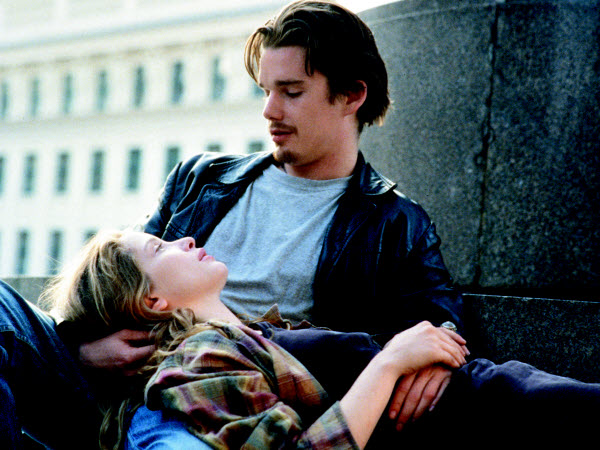
The first (1995) explores Jessy and Celine’s accidental meeting on a train in Europe and the weekend they spend together in Vienna that may or may not be their last. They are 25.

1995 version

1995 version

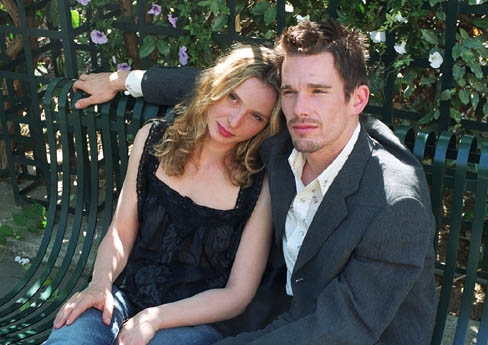
The second (2004), was filmed, and is staged to take place, nine years later, when the actors and the parts they play are in their early to mid 30s. Here, it is revealed that fate separated the lovers before they could meet again, but meet again they do. This time it is a weekend in Paris, and once again the viewer is left hanging about whether they will find happiness. Under movie convention rules, that means stay together as a couple. How little mortals know.

2004 version

2004 version

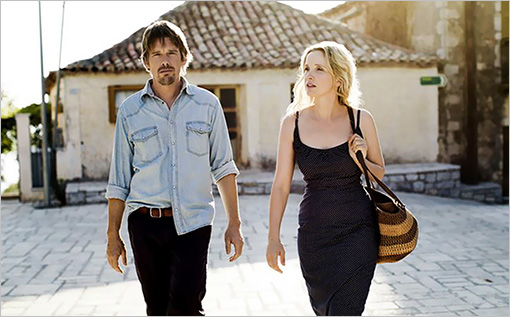
Despite the dyadic symmetry of the two films, the fact that the viewer is left hanging at the end of the second suggested a need to continue. And now after another nine years, Linklater brings us back to Jesse and Celine, and we see the road they have traveled and where they are now, in 2013. Now they are in their early 40s.

2013 version

2013 version

Below the fold spoiler alert

Continue reading →

Posted in Movies | Tagged , , , , , | 13 Comments

“Ask the Dust”

Blowhard, Esq. writes:

askthedust

Written and directed by Robert Towne from the novel by John Fante, you’d never know from watching this film that the source material was one of Charles Bukowski’s primary influences. Set in Depression-era Los Angeles, Fante’s novel is a story of desperate, marginal figures and the wounds they inflict on each other while Towne’s film scrubs all the rough edges clean. A long-time dream project, I get the feeling the script went through a few too many rewrites.

The movie is at times too reverent and not reverent enough. The first three quarters of the film follow the novel pretty closely, but the two leads — Colin Farrell as a first-generation Italian transplant from Colorado and emerging writer, Salma Hayek as the Mexican waitress he falls in love with — never generate much heat or tension as Towne dutifully puts them through their paces. In the last quarter of the film, Towne alters the story considerably for the worse by turning it into a conventional tale of racism and immigrant aspirations, whereas the novel was more ambiguous and existential.

Farrell is terribly miscast. In the novel, the character is an unattractive, guilt-ridden Catholic boy who’s a loser with women. Hey, did the Farrell sex tape — y’know, the one where he bangs a Playboy model — come out before or after this film? The role calls for a young Steve Buscemi or Paul Giamatti type. (Maybe the financing was contingent on Farrell?) Meanwhile, Hayek is asked to play a “fiery,” poor, illiterate, pot-smokin’, TB-infected, victimized Latina who, gee, just wants some nice fella to marry her. You do get to see her boobs a couple times, though, so it’s a not a total loss. Caleb Deschanel’s photography is classy and kudos to the production team for turning South Africa into a believable stand-in for 30s Los Angeles, even though there were a couple shots of some heavily wooded areas that were a bit jarring.

Related

Posted in Movies | Tagged , , , , , , | 5 Comments

Taking Down Krugman

epiminondas writes:

“The Republican party is still defined by a coalition of Church people, Chamber of Commerce people, and Military people. And as anyone who has so much as flipped through an issue of Reason or The American Conservative can report — this is an exercise Krugman seems never once to have tried — there are plenty of each kind of person controlling the GOP who are, despite their identity group, in no important way politically conservative.”

More here.

Posted in Politics and Economics | 1 Comment

“Marked for Death”

Paleo Retiree writes:

Reluctant no longer

Reluctant no longer

Steven Seagal movie from 1990, and — not that I’m a scholar of Seagal’s work, mind you — one of his best, IMHO. It’s slickly directed (by Dwight H. Little), amusingly designed (by Robb Wilson King), and extremely well-lit in a “48 Hrs.” kind of way (by Ric Waite, who I was sad to learn recently died), and it features a lot of terrific supporting players, including a spectacular and terrifying turn by Basil Wallace, a Jamaican-born actor who plays the charismatic, possibly psycho leader of a Jamaican drug gang. (The film makes a big deal out of contrasting the serenity and sweetness of middle-class American life with the nest-of-vipers quality of the brutal, Obeah-believin’ Jamaican thugs.) Plus I really liked “John Crow,” a Jimmy Cliff song that the movie features. 

The Question Lady and I had our usual good time chuckling over Seagal’s portliness and clueless acting, and roaring over action-movie clichés. Has there ever been a more unlikely action hero than Steven Seagal? Or one to whom stuntmen have been more generous? And how long can an audience reasonably be expected to watch a Reluctant Action Hero act out his reluctance before finally, reluctantly, shifting into action gear? 30 minutes? 45? But the film handles some of the conventions ingeniously, it’s genuinely engaging and effective, and it works up a decent amount of excitement and tension.

In this one, Seagal is a fed-up DEA agent who quits his job, then returns to what he’s hoping will be peace and quiet in the paradisal Chicago ‘burbs. But a drug war is happening there, and his skills are needed. With the wonderfully soulful Joanna Pacula — what a pro she is — as a sexy plot device, and Elizabeth Gracen (former Miss America and Clinton bed-partner) as Seagal’s sister. Given that a lot of the movie consists of watching a white dude kick black-guy butt, the filmmakers were probably wise, or at least shrewd, to make both of Seagal’s good-guy sidekicks black.

Related

Posted in Movies | Tagged , , , | 2 Comments