Linkage

Blowhard, Esq. writes:

mangosalsa

Posted in Architecture, Art, Books Publishing and Writing, Food and health, Linkathons, Politics and Economics, The Good Life | Tagged , , , , , , , , , , , , , , | 8 Comments

My Verdict on Vinyl

Sir Barken Hyena writes:

After many years in an all-digital audio world, the one we all inhabit now, from cell phone to DVD, I’ve recently been listening to vinyl again. I’ve got a lot of company too, and it’s a trend that should be well known to any culture follower. New recordings are being released on vinyl again, shops are opening, and they’re even making turntables again.

My nephew, who’s a music freak to humble all music freaks, has become a convert to the vinyl brigade. He’s had me over a lot lately for evenings of record listening, something that used to be common for me and my friends but had gone the way of the dodo with the iPod. It’s been a welcome return for a lot of reasons.

Now, I don’t want to get into tech-audio talk much, but in my opinion it’s not really questionable that digital audio is the more accurate medium. I’ve recorded multi-track music in both formats extensively so there’s just no wiggle room for me in that opinion. But the experience of vinyl listening – and I say experience, not sound – is so distinctly different from digital audio that I believe there are clearly human hearing faculties that are not understood or known to current science, and hence not measured in tech specs. Which brings us to the issue of presence.

It’s a word audio people use a lot, and it refers to the ineffable sense of mass or weight behind a sound. It’s a highly desirable attribute that makes sounds come alive in the room with you. And it’s here, and only here to me, that vinyl wins out. It’s not quite communicable, but when I close my eyes and listen a more concrete, distinct, weighty, and *present* image of the sound forms in my mind than I get with digital sources, no matter how good.

Other issues: why is that I find myself hanging out and listening now when there’s no reason at all that we couldn’t do it with streamed music from, say, Spotify? I think it has partly to do with the above reasons of fidelity, but also perhaps the mechanical nature the sound source is involved, somehow making an impression from actual movement of mass while fizzing bits on a chip are just not really imaginable in any meaningful way. And the physicality of the item must play a role as well.

I think we’re seeing the limits of digital media here, and as sometimes happens, new and old learn to live in a new arrangement, side by side. Electric guitars didn’t replace acoustics, and there are hundreds other similar examples. Things are preserved when they are useful and useful can mean a lot of different things, especially in this age of tech miracles.

So Book People: take note. The music industry went there first, and the example of vinyl might point the way to your future of digital/physical compromise.

Posted in Music, Personal reflections, Technology | 15 Comments

Linkage

Fabrizio dël Wrongo writes:

  • David Chute posts a 2000 piece dealing with film preservation and digitization.
  • What would Friedrich Wilhelm Murnau think? (H/T Michael Castañeda)
  • Was Blue Öyster Cult the first non-German band to use an umlaut in its name? Wikipedia suggests so. What a weird little tradition the “metal umlaut” is. What are the chances it doesn’t derive from beer-loving rock dudes admiring the labels on German brews? Wikipedia says Mötley Crüe got the idea from Löwenbräu.
  • Choose your own adventure. (H/T Reddit.)
  • Lovely vintage train posters by designer Bern Hill.
  • I’ve gotten a kick out of “Radish,” the newsletter put out by The Thomas Carlyle Club for Young Reactionaries. It’s full of sweet, sweet hatethink. Here’s the latest issue, which deals with the topic of colonialism. (H/T Foseti.)
  • Book appraisin’ super honey Rebecca Romney gets interviewed by a heavy metal site.
  • There’s lots of evocative, confessional, girl-type writing at Thought Catalog. I liked this post about bricks.
  • For some reason, I’m fascinated by ruins and abandoned places. Here’s a nice collection of photos.
  • Critic Steve Vineberg touches on a lot of the things that have bothered me about P. T. Anderson’s movies. Terrific piece. I didn’t find “The Master” to be as awful as he did, though. While I can’t say I loved it, I liked it more than “There Will Be Blood,” which struck me as being almost completely empty. Handsome, but empty.
  • Libertarian, hacker, and open source advocate Eric S. Raymond engages in a thought experiment.
  • More from Raymond: What if all the ludicrous crap our ancestors believed in had some basis in reality? I’ve often wondered this myself. Generally speaking, I think it’s nuts when modern folks act like people from past centuries were idiotic buffoons.
Posted in Books Publishing and Writing, Commercial art, Linkathons, Movies, Music, Politics and Economics | Tagged , , , , , , , , , | 3 Comments

“Hara-Kiri: Death of a Samurai”

Fabrizio del Wrongo writes:

harakiri2

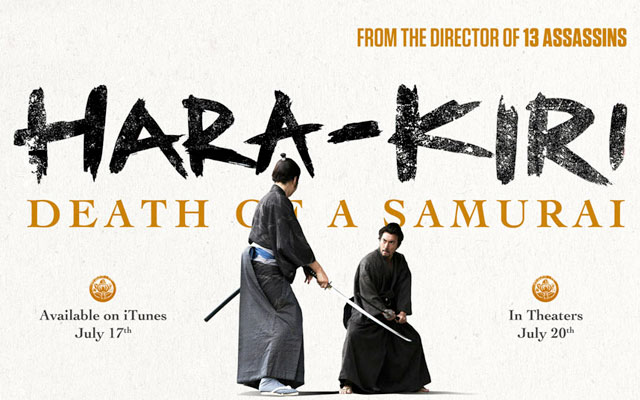
“Hara-Kiri,” the latest from Takashi Miike, has met with tepid reviews, perhaps because it’s 1) a remake of a classic, and 2) defiantly short on action. But I thought it was largely riveting — aside from Bellocchio’s “Bella Addormentata,” it’s probably the most elegantly directed film I’ve seen this year. Miike, the blood-hungry wild man of world cinema, has fashioned the material into a familial drama that has some of the burnish and poise of the first two “Godfather” pictures, and during the long middle section he pulls off a few melodramatic effects that are worthy of D.W. Griffith (it’s much soapier than the Kobayashi version). Sadly, the ending, which eschews the righteous bloodletting of the original, is overly thought out and rather soft-headed. It sacrifices emotional resolution and narrative sense in favor of making a redundant moral point — the picture closes with a discordant clank. Of course, no one registers with the incandescent fury that Nakadai brought to the 1962 film, but I loved watching Koji Yakusho as the head retainer; he gets more out of stasis than just about any actor going. It helps that his face is so sculptural — it often seems as if a torrent is being restrained behind that forehead.

Currently available on Netflix Instant.

Posted in Movies, Performers | Tagged , , , , , , | Leave a comment

The Law Rock

Blowhard, Esq. writes:

Lögberg-Collingwoods

From 930 until 1262, medieval Icelanders lived in a society with no national government — no king, no army, no taxes. Hell, there wasn’t much local government either. The basic unit of organization was the family farmstead. There were no cities or towns. It was a harsh frontier society with population topping out at about 70,000 around the year 1000.

The land was divided into quarters, each with its own thing, a local assembly to mediate disputes and conduct business. The thing was presided over by a godiProfessor Kenneth Harl writes that the godi was:

a district leader who, by his reputation, his knowledge of the law, and his generosity to family and neighbors, was known as a figure to whom others could appeal to settle disputes, mediate blood feuds, and so on.

The godi knew customary law and attended the things and the Althing. The position of godi could be shared simultaneously among several men and was not hereditary. If a godi performed inadequately, he could lose his dependents and thingmenn. Hence, he had to be vigilant in imposing the law equitably and maintaining order in the society.

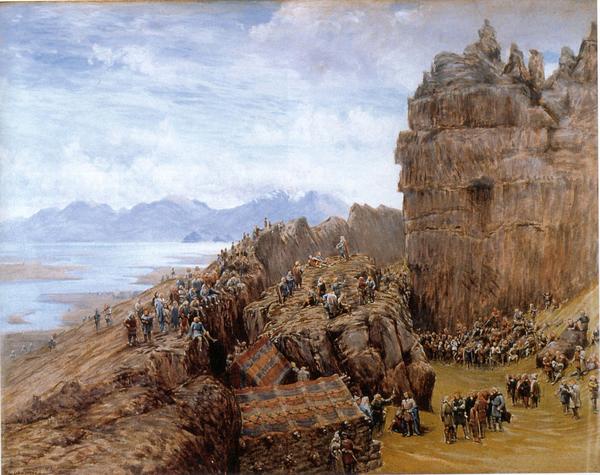
Each local thing sent representatives to the national Althing. There was no formal structure to the meetings. At the Althing was the Law Rock where the law speaker, who was elected to a three-year term, recited the law from memory, a third each year. Other godi listened carefully to make sure the speaker didn’t make any mistakes.

Anyone could speak at the Law Rock. It was the site of any major announcements and also served as the court of last resort where people would bring prosecutions against others for various criminal and civil matters. Mediation would then ensue according to customary law. Medieval Icelandic society was remarkably self-regulating and fiercely proud of its independence such that “the Icelanders saw no real need to set up anything like an army or a fleet,” Harl says.

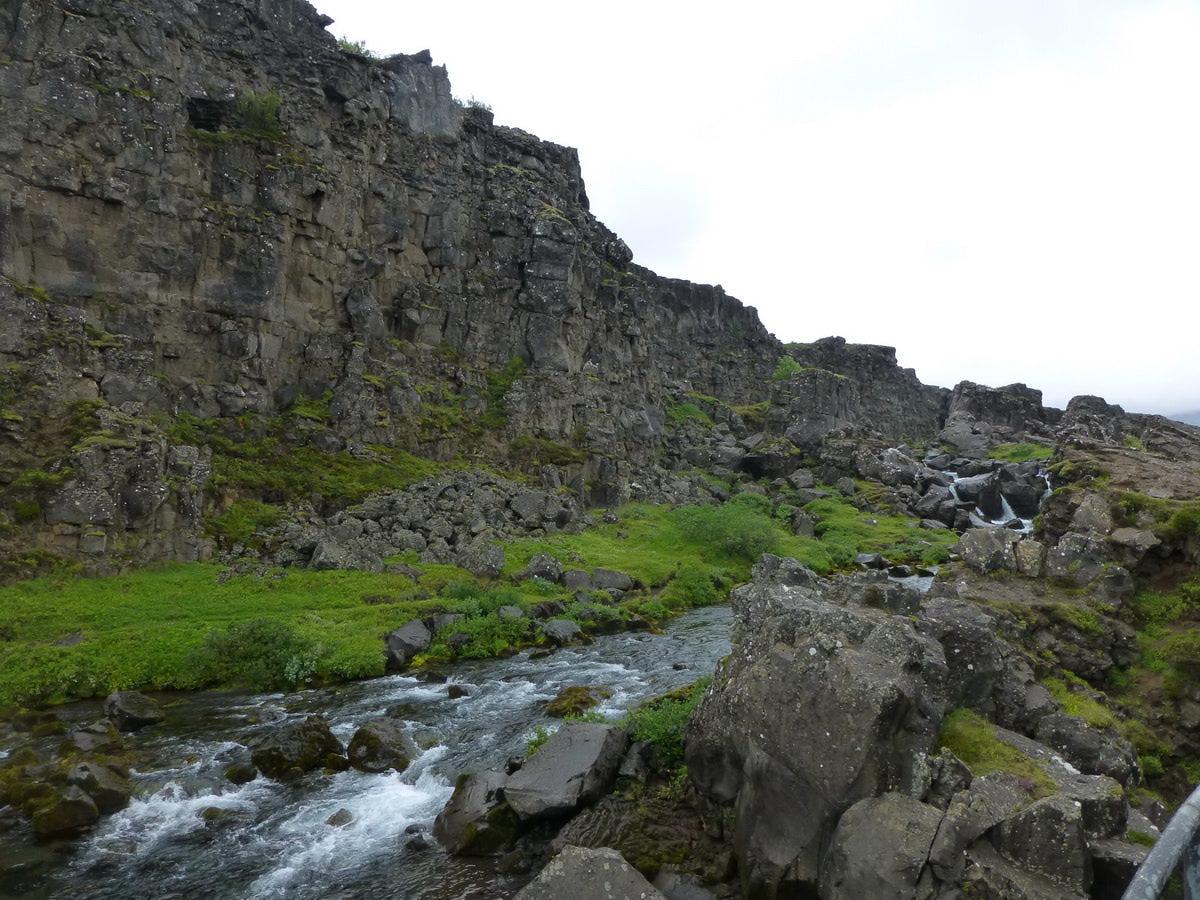
The site of the Althing is now a national park. Due to changes in the geography over the last millenium, no one is quite such where the Law Rock was located.

Iceland-541

More

Posted in History, Law, Politics and Economics | Tagged , , , , , , , , , | 10 Comments

Linkage

Paleo Retiree writes:

  • Secrets of Princeton. As a PU grad, I’ll vouch for the accuracy of this one.
  • Lloyd Fonvielle is inspired by a book about the West by Frederick Law Olmstead, a great American artist best-known as the co-designer of NYC’s Central Park.
  • Primal/Paleo guru Mark Sisson responds to some good questions, as well as to a critique of the Paleo movement.
  • Rant Du Jour. Link tks to Malcolm Ryder.
  • Really looking forward to William Friedkin’s memoir. I wrote about “Killer Joe” here.
  • Martha Esersky Lorden recalls the cake-mix desserts of the 1950s.
  • What’s it like to revisit an Israeli commune where you once spent an idealistic summer?
  • Photos from inside Cass Gilbert’s great Woolworth Building.
  • This fun interview with the guy behind the hot Manhattan cocktail place Pouring Ribbons (which I teased here) offers an interesting snapshot of life in the artisanal food world.
  • Steve Sailer wonders why Mark Zuckerberg has gotten behind the legalize-all-immigrants campaign.
  • Netflix Instant Choice: “Lord Love a Duck.” A black-comedy/satire of teen America (as well as a spoof of American teen movies) circa the early ’60s — think “Dr. Strangelove” meets “How to Stuff a Wild Bikini” — George Axelrod’s comedy holds a special place in many viewers’ hearts.  At its worst, it’s frenetic and scattershot; at its nutty best it’s high comedy of a very dizzy sort. Tuesday Weld is perfectly amazing as the sexy-banal girl at its center.
Posted in Architecture, Books Publishing and Writing, Food and health, Linkathons, Movies, Politics and Economics | Tagged , , , , , , , , , , | 4 Comments

“El Bulli”

Paleo Retiree writes:

elbulli1

A German hagiography-documentary about the last season of creating-and-serving at El Bulli, the famous restaurant on the Costa Brava (outside of Barcelona) that was sometimes said to have been the world’s greatest. The movie is an impressively somber, narration-free art-thing in its own right, designed, machined and tooled to a deep, dark Euro-polish. It’s in the reserved, reverential style of a Mercedes ad. The high-end hush is meant to suggest that we’re in the presence of genius — it’s like an official visit to Pierre Boulez at IRCAM. The genius the film is enshrining is the restaurant’s chef, Ferran Adrià, and as slick as it is, the film is mainly of interest for its subject matter: its look at his innovative approach to food, its exploration of how his restaurant worked, and the glimpses it offers of Adrià himself.

Continue reading

Posted in Food and health, Movies, The Good Life | Tagged , , , , , , , , | 11 Comments

At Least the Two Parties Work Well Together on Some Things

epiminondas writes:

The bipartisan effort to bankrupt our nation.

Posted in Politics and Economics | 2 Comments

Notes on Two Early Films by William Wyler

Fabrizio del Wrongo writes:

hellsheroes

In 1929 William Wyler directed a treatment of Peter B. Kyne’s “Three Godfathers,” a Western story of redemption which has been filmed several times, notably by John Ford in the 1940s. Where Ford emphasizes the spiritual aspects of the material, Wyler focuses on the external ones: his Old West is a land of dust, desperation, and rotgut criminality — the sort of place where even the local preacher is packing a six-shooter. There’s a real bleakness here, one that is matched by the blasted-granite features of head bandit Charles Bickford, and Wyler uses that to bolster his theme of decency sprouting from degeneracy. There’s nothing surprising about the final scene, and yet it feels like an epiphany, perhaps because we sense that the intentions behind it might evaporate at any moment. It’s a shame that most of Wyler’s early work in the Western genre is either lost or unavailable. “Hell’s Heroes” suggests it might be of interest.

Released in 1935, “The Gay Deception” is a pleasant, innocuous romantic comedy that plays like an inversion of Wyler’s later “Roman Holiday.” Wide-eyed working girl Frances Dee wins a $5000 prize; she then rushes to New York to spend it. (The premise looks forward to “Nothing Sacred.”) While staying at the chic Waldorf Plaza she meets Francis Lederer, a European prince hiding out as a bellhop. And as a waiter. And as an elevator operator. (His omnipresence is a joke that quickly wears thin.) Several elements are redolent of Billy Wilder’s signature cuteness; in particular, a trio of silly foreigners seem like cousins of the Soviet emissaries who squire Garbo in the 1939 “Ninotchka.” Nevertheless, Wyler does a clean, efficient job of directing, and there are a few nice bits, including some impressive moving shots through the expansive hotel lobby and a charming scene involving breadsticks in an Italian restaurant (being unable to decipher the menu, Dee orders the headwaiter). Lederer perhaps lacks the magnetism to adequately function as the male half of a romantic comedy duo; his prince is only a step above the second bananas played by Erik Rhodes in the Astaire-Rogers pictures — and he’s not nearly as amusing as the Great Beddini. (The movie could use less of Lederer’s dampness and more of the tonic cynicism that Alan Mowbray brings to his brief turn as a playboy aristocrat.) Wyler tried his hand at a few romantic comedies during this period: 1935 also saw the release of “The Good Fairy,” an impressive screwball contraption starring  Margaret Sullavan, and in 1929 he helped forge the style with the very interesting “The Love Trap.” But I’ve always thought his talents ill-suited to the genre — his tendency to visually and dramatically isolate characters, and to methodically exert pressure on their fault lines, is at odds with the harmonious submission that is so often the animating force of romantic comedy. “Dodsworth” and “These Three” — two major Wyler films of this period — are more amenable to his sensibilities. Keep an eye out for some of the most distinctive character actors of the era, including bugle-voiced Al Bridge, Lionel Stander, Robert Greig, and Akim Tamiroff.

“Hell’s Heroes” is available — along with the Richard Boleslawski-directed version of “Three Godfathers” — on Warner’s Archive Collection series of burn-on-demand DVDs. Buyable here. “The Gay Deception” doesn’t seem to be readily available on video. But if you’re a degenerate with no respect for our legal institutions, you might be able to find a bootleg DVD of it online. Not saying I’ve actually looked for such things, of course.

Posted in Movies, Performers | Tagged , , , , , , , , , , , , | 1 Comment

The L.A. Conservancy’s Art Deco Walking Tour

Blowhard, Esq. writes:

Recently, I attended a walking tour offered by the Los Angeles Conservancy, a charitable organization tasked with “preserving and revitalizing greater Los Angeles’ architectural heritage.” (Don’t laugh.) These tours are offered every weekend of such places as the Victorian homes of Angelino Heights, Union Station, and the Biltmore Hotel. Noir fan that I am, I opted for the Art Deco tour.

Continue reading

Posted in Architecture, Food and health, Photography, Travel | Tagged , , , , , , , , , , , , , , , , , , , , , , , , | 18 Comments