Don’t Call It A Comeback. Now, Let’s Talk Girls

Enzo Nakamura writes:

After months and months of lurking–and enjoying–I’ve decided to get back in the game. I’ve had a nasty case of contributors block.

I’ll keep it short.

My recent pop music crushes are unconventional.

Oakland’s Kreayshawn (Natassia Zolot) and South Africa’s Yo-Landi Vi$$er (Anri du Toit). Kreayshawn’s a solo act. Vi$$er’s a third of Die Antwoord.

They’re both semi-ironic hipster hip-hop acts, though Vi$$er’s much more successful and works a more knowing schtick. Kreay’s an art school type, Vi$$er’s a feral trickster.

You can’t say I don’t have a type. Linda Manz meets Miss Toxic Waste.

Posted in Music | Tagged , , , , , , , , , | 2 Comments

This is Getting Old

Fabrizio del Wrongo writes:

The International movie image Clive Owen

Clive Owen in “The International” (2009)

assassins-creed-revelations-constantinople-artwork-small

“Assassin’s Creed: Revelations” (2011) H/T: Enzo N.

skyfall-motorbike-istanbul

Daniel Craig’s stunt double in “Skyfall” (2012)

Liam Neeson in “Taken 2” (2012)

Posted in Movies | Tagged , , , , , , , , , , | 8 Comments

Lawrence Auster

Fabrizio del Wrongo writes:

I was very sad to learn that Lawrence Auster’s health has taken a turn for the worse. Auster has long been a divisive figure in the blogosphere, but his traditionalist blog, View from the Right, has never failed to be either interesting or erudite. Regardless of where you stand on Auster’s opinions, they’re always clearly argued, and in an age of chronic frivolousness his sobriety can often be invigorating. He’s attracted some great commenters, too: I cannot count the occasions on which I’ve scoffed at one of his opinions only to find myself questioning my position as I plowed through the conversations generated by his posts. His voice is unique, and I don’t think it’ll be replaced. Here’s hoping he’s as comfortable as possible and seeking solace in his loved ones. I’m hoping we’ll still be arguing about him ten years from now.

Posted in Personal reflections | Tagged , | 5 Comments

Yum

Fenster writes:

I recall the time when the impoverished Jughead asked for a glass of water at the diner and added the ketchup on the counter to make a free glass of tomato juice.  I hope by now there’s a Long John Silver’s in his town.

Free Fried Bits at Long John Silver’s

Free upon request
Free upon request
Credits:
HolyTaco.com

Restaurants newsletter

RELATED TOPICS

Advertisement

If you’re out of croutons for a salad, or out of stuffing for your pillow, or just hungry and not just low on cash, but completely broke, this tip is for you.

Upon request, Long John Silver’s will give you a free box of the chunks of fried breading that have fallen off all the shrimp and fish and never made it to other customers’ meals. Just ask for “a side of fried crumbs” and the server should know what you mean.

Now you can enjoy that classic Long John Silver’s taste without any nutrition whatsoever; and for free! Happy crunching!

Posted in Food and health | 2 Comments

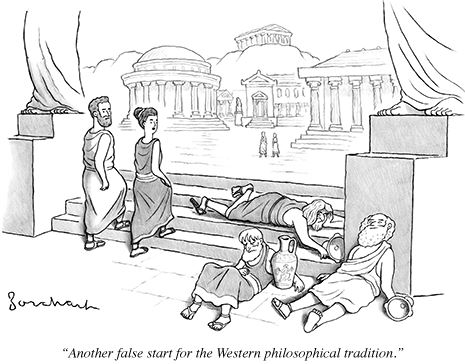
Cartoon of the Day

Blowhard, Esq. writes:

philosophers


Posted in Humor | Tagged , | 1 Comment

Picture Quality

Fenster writes:

That ol’ vampire squid, Goldman Sachs, has for a while been running an ad campaign that attempts to put the firm’s accomplishments in the best possible light.  To paraphrase Dr. Johnson on the subject of a dog walking on two legs, what’s remarkable here is not that it is done well, but that it is done at all.

Goldman has long had a media arm, to be sure (full disclosure: in the 1980s, I was the “talent” on a video produced by Goldman highlighting its international communications capabilities).  But it didn’t really have much in the way of a face to the public at large–there, it was as rarely seen as, well, a giant squid.

At one level, the new ad campaign seems to simply aim at a broader set of insiders.  By stressing things like job creation they are doubtless looking to cast a wider net in search of new kinds of opinion leaders.  But the ads are also crafted to make them look friendly and nice to average Americans–not a bad goal given the heat it has been under.  Will it work?  Who knows–for one, the fabled Jerry Della Femina thinks the approach is laughable, and that no one will really buy the notion that Goldman is suddenly a nice place.

Here’s what I find odd though.  Perhaps it is because I read about finance, but I regularly get Goldman ads looking out from me from various websites that I visit.  You’d think that with all the money they have, they would be attentive to things like visual quality.  Yet a number of their website ads are built around poor quality images.  Why would they do that?

Here is an ad touting their redevelopment expertise.  This is from Goldman’s own website and so it is a good quality image.  This ad is also one that appeared in a lot of print ads, and Goldman probably got mileage out of the fact that the model they used came across as cute and wholesome.

gs2

But this is how it shows up on a web page.

gs

The logo is clear enough but the picture stinks.  Is this a technical thing or are they just being clueless?

Posted in Commercial art, Computers, Technology | Tagged , , | 2 Comments

Getting the Best Out of People: Freedom v. Control

Blowhard, Esq. writes:

Seth Roberts, formerly of Berkeley and now professor at Tsinghua University in Beijing, decided to stop grading his students. He writes:

The more freedom I gave my students, the more difficult it became to grade them. At Tsinghua I teach a required class for freshman psychology majors called Frontiers of Psychology. There are 20-30 students. It covers recent research. For the first few years, I had students write comments on the reading. “Write something only you could write,” I said. The students struggled to figure out what that meant. I struggled to grade their answers.

Before last semester began, I had an idea: no grading. Maybe other sources of motivation, would be enough.

So what were the results?

It was the most pleasant teaching experience of my life. It was also the easiest by far, in contrast to my Berkeley colleagues’ claim that my ideas led to “too much work.”  The hours I had spent every week grading homework in previous versions of the course — the part of the course I liked  least — was gone. At the end of the class, I spent many hours discussing the student projects, but I enjoyed these discussions. They didn’t feel like work. The students had chosen topics they wanted to study and seemed happy to talk about what they had done. Unlike an oral exam, almost nothing was riding on what they told me and they could be proud of what they were talking about, since it was almost entirely their idea.

The students’s work was the highest quality I have ever seen. Two of their final projects might be publishable. (And these are first-semester freshmen.) It’s not my field, so I can’t be sure, but they have great inherent interest and no obvious flaws. The students seemed to like the class, too. On the final day, which happened to be Christmas, they gave me a Christmas card signed by everyone in the class. One student gave me a card separately. “Thank you,” I said. “Why did you give me this?” Among other things, she said I had high standards. Given the absence of grades, that was interesting. Maybe it came from the fact that after every presentation, I would point out something I liked and something I thought could be better. I tried to do that with all of my feedback. Another student told me, after the final class, that what I had said about “the best way to learn is to do” was, in her case, very true. She said she had learned more in my class than in all her other classes put together.

Students who are respected and trusted enough to pursue their own projects, lines of inquiry, and curiosities? A very Montaignian method of education.

Do people give you their best when they’re given the most freedom, at least within certain bounds? In a subsequent post, Seth shared this excerpt from an interview with Steven Soderbergh:

INTERVIEWER You’ve talked at length about giving actors as much freedom as possible. That’s resulted in a number of performances that have launched, revived, and revitalized careers. In the case of Jennifer Lopez in Out of Sight, you’re responsible for her only good film performance.

soderbergh

SODERBERGH It’s not that I never say no; I’m just not trying to control them. I’m looking to amplify and showcase whatever it is about them that I find compelling.

On the other hand, after reading those posts, I came across this interview with Kevin Spacey talking about being directed by David Fincher:

fincher

“Part of what I feel when he’s doing that — and I like working this way — is that, you know, he’s pushing you in a certain direction. He’s having you go in a different direction this way; he’s having you try a new meaning, a new approach to a line of dialogue in this way; and, frankly, the other truth is actors bring a lot of complicated accessories to the set. And some of those accessories are gestures, and some of those accessories are, ‘Oh, I found a kind of cute way of saying a line,’ or ‘I like the way my voice does this,’ or ‘I’m going to use this Coke can to do this.’ And I think sometimes, with David, it feels like [what] he’s looking for is the cleanest, streamlined version of the idea that the character’s trying to express. … And he’s just simply, at a certain point, beating the acting out of you. And I’m quite grateful for that.”

Thoughts? Reactions?

Posted in Education, Movies, Television | Tagged , , , , , , | 4 Comments

Faculty: Head in the Sand Again?

Fenster writes:

Here are the headline and subhead from a recent article at Information Week.

Classroom Technology Faces Skeptics At Research Universities

Professors at research universities prefer teaching with old-fashioned whiteboards, one study says.

Should there be any surprise that faculty would voice skepticism about the possibly disruptive role of technology?  They are after all steel drivin’ men (and women) and in the end the machine can always be beat.  Right?

It depends on what machine.  Some of the faculty quoted in the article seemed content to take potshots at what passed for educational hi-tech maybe a decade or so ago, without giving any particular thought to what is happening  today.  Here’s a passage:

“I went to [a course management software workshop] and came away with the idea that the greatest thing you could do with that is put your syllabus on the Web and that’s an awful lot of technology to hand the students a piece of paper at the start of the semester and say keep track of it,” said one.

What’s wrong with this picture?  For one, the faculty member discusses course management software as though that’s the cutting edge today.  But programs like Blackboard, which are now ubiquitous and commonplace, have been around for well over a decade.  They can do a lot more than house a syllabus, as the faculty member seems to suggest, but no one would mistake course management software for major disruption going forward.  It’s already been mainstreamed.  It’s like arguing in the 1990s that PCs won’t change much since the Commodore 64 isn’t that powerful.

But the next guy quoted is the one who really doesn’t get it.

“What are the gains for students by bringing IT into the class? There isn’t any. You could teach all of chemistry with a whiteboard. I really don’t think you need IT or anything beyond a pencil and a paper,” said another (emphasis mine).

You can, he argues, teach all of chemistry with a whiteboard, and that there is no further need for IT.  But that mistakes some of the more revolutionary aspects of tech in education.  Salman Khan would agree that you don’t need much beyond a whiteboard to teach math, geometry, trig, calculus and a host of other subjects.  And he does, too, online, for free.

Let’s stipulate that if professors could be graded Khan would be an A.  He is certainly gifted as a teacher, perhaps singularly so.  He is a superlative explainer, clear as a bell, and funny to boot.  And that’s just the point.  For classes all about the whiteboard, wouldn’t students prefer Khan’s A performance to one by Professor X that is likely to be inferior?  And wouldn’t administrators prefer using Khan’s free content over the expensive, boots on the ground, whiteboard approach of Professor X, if only they could find a way to make that happen?

“High” technology is causing only some of the disruption in higher education. A good deal of it, though, is being caused by low tech.  Tape a class.  Show the whiteboard.  Deliver the content.

Posted in Computers, Education | 2 Comments

“Premium Rush”

Fabrizio del Wrongo writes:

Premium-Rush[1]

“Premium Rush” is a shallow chase movie that, for the most part, doesn’t ask us to make too much of it. Its plot concerns a New York bike messenger (the ubiquitous Joseph Gordon-Levitt) who is tasked with carrying a valuable MacGuffin; a crooked cop (the wonderfully weird-looking Michael Shannon) tries to stop him. Director David Koepp doesn’t have the poeticizing instincts of a Spielberg or a Peckinpah, nor does he have the talent for exaggeration that can make the action work of a Zemeckis or a Peter Jackson so pleasurably funny. But he has a feeling for space, movement, and pacing, and he gets the enervated, over-burdened aspects of Manhattan in a way that many filmmakers don’t (he doesn’t direct like a tourist). DP Mitchell Amundsen’s camera zips around the jumbled, cacophonous streets, always changing angles and levels, in an effort to bring us into the mindset of the messengers, whose kamikaze daring and live-for-the-moment ethos set them apart from the city’s more rooted rat racers. At select moments Koepp interrupts the flow of the movie to insert temporal switchbacks, Google Mappish representations of Manhattan’s layout, even slowed-down approximations of Gordon-Levitt’s split-second navigation decisions; this keeps us oriented both narratively and geographically, but it also mimics the heightened state of perception enabled and required by contemporary life. (In some ways, the movie’s bike messengers are proxies for today’s young people, who often seem most comfortable when darting through a Manhattan-like maze of mental-technological gewgawry.) As the principal messenger Gordon-Levitt is admirably sleek (he’s about as arrow-straight as Keanu’s buzzed gum chewer from “Speed”), but the picture really belongs to Shannon: his blundering, car-bound frustration in the face of urban chaos in general, and gnatty bikeriders in particular, will seem familiar to anyone who isn’t naturally attuned to the city’s pell mell rhythms. A couple of nitpicks: I wish Koepp had treated the romantic material with a bit more brass (Gordon-Levitt is too eager to win back his fickle girlfriend), and I wish he hadn’t leaned so hard on the MacGuffin’s back story, which involves the efforts of a Chinese immigrant to bring her too-adorable child to America. This tendency towards squishiness, however slight, takes something off the movie’s spin. It’s a spoonful of medicine after the sugar’s already gone down.

Posted in Movies, Performers | Tagged , , , , , | 4 Comments

A bit of the Old West in suburban L.A.

Blowhard, Esq. writes:

Enjoy this montage from my days as a ranch hand visit to see The Question Lady perform her new show.

Stables

Posted in Animals, Photography | Tagged , , , , , | 1 Comment