
The Question Lady writes:
How do you think the internet will change in the next 5 years?
The Question Lady writes:
How do you think the internet will change in the next 5 years?
Glynn Marshes writes:
Trouble on the literary scene!
A couple of Brit writers–RJ Ellory and Stephen Leather–were caught posting sock puppet reviews on Amazon.
Their probable undoing: they didn’t stop at giving their own books 5 stars. They also posted negative reviews of other authors. Heh.
Now a “group of leading British authors” (49 in all) “including bestselling writers Ian Rankin, Lee Child, Susan Hill, Val McDermid and Helen FitzGerald” are mounting a spirited assault against fake book reviews.
Their plan of attack, naturally: write a letter.
“These days more and more books are bought, sold, and recommended online, and the health of this exciting new ecosystem depends entirely on free and honest conversation among readers . . .
“But some writers are misusing these new channels in ways that are fraudulent and damaging to publishing at large.
“Few in publishing believe they are unique. It is likely that other authors are pursuing these underhand tactics as well.”
(According to the article, btw, Ellory has sold over a million books. Can you imagine sitting on those kinds of cumulative sales numbers, and then wasting your time playing sock puppet games on Amazon?)
Paleo Retiree writes:
At my previous place of blogging I often marveled at what I called “nonsense brackets” — the tendency many graphic designers have these days of inserting parenthesis marks or brackets into their work for no grammatical/linguistic reason. (See here and here for examples of my musings.) They do it instead for visual heightening and because, with its overtones of computer code, the move confers coolness on their work.
Fun, if in a dismaying way, to see the trend making its way further into the mainstream. The other day, for instance, I went out to pick up some food and found that Ralphs, a west coast grocery chain, has embraced the trend whole hog.

Hats off, I guess, to the people doing the graphics for Ralphs for succeeding in making what were once edgy tropes seem perky and inane. Such, come to think of it, were probably their marching orders. Middle America likes perky and inane, and if you want to sell to them …
I’ll call attention to four things in the collage above.
I don’t know what to make of this mess except to marvel at how common it’s become for computer-things to be foregrounded in commercial art, and at how for-granted we take this fact. You’ve probably noticed the number of TV ads that imitate/steal-from the iPad with its swipes and its pinching effects, for another example.
As far as I can tell, popular culture these days exists in order to exalt the digital gadgets with which popular culture is now created. Bizarre, and ‘way too self-reflexive and endlessly-recursive for my tastes. But I’m sure I’m missing many things here. What are your theories about what it all signifies?
Blowhard, Esq. writes:
In the comments of my last post, Sir Barken Hyena said that, “SoCal is stupid nice.” Well, parts of it certainly are. On the other hand, some areas are architectural wastelands. This especially seems to be the case with many of our government civic centers that date from the post-WWII era. Here’s a tour of one I know well, the Santa Ana Civic Center.
Sir Barken Hyena writes:
I’m not predicting who will win in November. We’ll see soon enough. I’m making a prediction about what will happen if the Romney/Ryan ticket wins.
So there you are, pretty bold, eh? My assumption is that the current political state of things is so sclerotic that there’s no hope of saving it. What’s required would tax a young system full of energy. What we have is more Grandpa Simpson than Jack LaLanne. Therefore the Ship of State will continue steaming Full Speed Ahead! It’s no more viable than the Ancien Regime was in 1789.
The Question Lady writes:
What’s the most pretentious movie ever made?
Glynn Marshes writes:
So a few days ago, in the comment thread on “What’s wrong with white boys playing the blues,” jr dismissed the LA Weekly article cited as an “exercise in trolling.”
Now comes the New York Times, in a piece titled “Men, Who Needs Them” by Greg Hampikian.
The bait comes in paragraph 5 with the we’re-not-in-Kansas-anymore claim that “women are both necessary and sufficient for reproduction, and men are neither.”
Oh. Hold on! There’s a caveat a little later. It turns out women do need “some very odd tiny cells” that men “shed.” But not to worry. The cells are easy to obtain and store, and we women can impregnate ourselves at our personal discretion and leisure. Using turkey basters. Or straws.
Anyway. Taken together w/ the LA Weekly piece, it makes me wonder: is trolling now an accepted marketing strategy for struggling mainstream papers?
And if so, what are the rules?
“Anything for attention,” maybe?
Or: “If our core readers believe we’re publishing this in good faith, we can pull it off”?
Blowhard, Esq. writes:
A few pics from the city’s lovely downtown.


Fabrizio del Wrongo writes:
Someone recommended this to me a while back. I took a chance on it when I noticed it was available cheap for the Amazon Kindle. (Maybe it still is.) Written by the terrifically-named Elliott Chaze, and published in 1953 by the legendary Gold Medal outfit, it’s a noirish crime tale about an escaped con named Tim Sunblade who’s torn between practical and impractical impulses. On the one hand, he wants to pull off the ultimate bank heist — to die rich and sated, like a retired congressman. On the other, he’s driven, mostly against his will, to satisfy his deepest erotic longings, which stretch all the way back to his small town upbringing — to sleepy tree-lined streets and furtive kisses on the front porch swing. Both impulses find outlets in the figure of Virginia, a fugitive call girl whom he hires between jobs, uses enthusiastically, and then can’t get clean of. Like any good noir dame, Virginia cares only about money. Loves it so much she’s wont to take off her clothes and roll around in it. Tim recognizes this, of course, but he’s so besotted with her that he keeps inventing new exceptions to his “no attachments” policy. He eventually compromises, working Virginia into his crime plan, and for a while the couple plays at aping suburban normalcy. You can probably guess where that leads.
Hey, isn’t this a sensationalized version of the standard male relationship story? “I dreamed of doing this and this and this, but then I met this leggy blonde thing, and now here I am with a potbelly, floral curtains, and three mewling whelps.” It seems to me that mid-century crime writing was uniquely suited to that sort of thing. Noir movies too. Today much of this stuff is considered misogynistic, because — gasp! — the female characters are little more than obstacles thrown into the paths of men. But this is pulp we’re talking about, not Chekhov; it’s all about distillation and tanginess. Besides, why shouldn’t dudes have their own private desecration fables? And what asshole determined that all art is required to present an unbiased and “balanced” image of the Way Life Ought To Be?
Anyway, one of the book’s most notable aspects is Chaze’s use of language, which could be described as hardboiled if it weren’t so damn florid. He loves setting off Roman candles of terse-but-vibrant description. These have an impressionistically immersive effect, but they also tease you out of the narrative — because you can sense Chaze leering over every evocative line.
Here are a few extended quotes:
I hadn’t had a hot-water bath in almost four months. The soap was oily and fragrant and it slid down my chest making little zeros of suds, each filled with the milky-green color of the water. I slumped down in the water so that my chin rested just on the surface of it. I soaped my head and scrubbed it with fingertips and fingernails, then ducked beneath the deep hot water, holding my breath, feeling the dirt of months float loose. I always cut my hair short, so short I can use it for a fingernail brush when I wash my head. I credit this trick to Washington and Lee University. It’s about the only thing they taught me there in that splendid woman-starved nest of culture where students address one another as “gentleman,” where freshmen wear nauseatingly cute beanie caps, where no one walks on the hallowed grass, and everyone is so sporting it hurts.
. . .
Thinking back, I remember the stupidest things; the way there was a taut crease just above her hips, in the small of her back. The way she smelled like a baby’s breath, a sweet barely there smell that retreated and retreated, so that no matter how close you got to it you weren’t sure it was there. The brown speckles in the lavender-gray eyes, floating very close to the surface when I kissed her, the eyes wide open and aware. But not caring. The eyes of a gourmet offered a stale chunk of bread, using it of necessity but not tasting it any more than necessary. I remember getting up and coming back to her, and of throwing a shoe at the light bulb, later, when the whisky was gone. I remember the smell of rain-darkness in the room and her telling me I’d cut my feet on the light-bulb glass on the floor. And how she said I was no better than a tramp myself, that I made love to the cadence of the raingusts on the roof, and it was true I was doing just that, but it seemed the natural thing then. And I felt so marvelously clean and soaped and so in tune with the whole damned universe that I had the feeling I could have clouded up and rained and lightninged myself, and blown that cheese-colored room to smithereens.
. . .
You’ve never heard a siren until you’ve heard one looking for you and you alone. Then you really hear it and know what it is and understand that the man who invented it was no man, but a fiend from hell who patched together certain sounds and blends of sounds in a way that would paralyze and sicken. You sit in your living room and hear a siren and it’s a small and lonesome thing and all it means to you is that you have to listen until it goes away. But when it is after you, it is the texture of the whole world. You will hear it until you die. It tears the guts out of you like a drill against a nerve and it moves into you and expands.
Pretty heady stuff, huh? Pretty show-offy too, but I can forgive that in writing as fun and as sexy as this. Truth be told, I’ll take a pulp show-off over a literary show-off any day of the week. I’m looking at you, David Foster Wallace.
FWIW, Chaze himself was hip to this tendency in his writing. When asked about his motivation as a writer, he said: “If there is any discernible, it’s probably ego and fear of mathematics, with overtones of money. Primarily I have a simple desire to shine my ass — to show off a bit in print.” If only more “serious” writers were so candid, not to mention so willing to make their affectations palatable to the commercial audience.
Anybody got some other Gold Medal recommendations?
Related
Sir Barken Hyena writes:
It pains me to use this title. I adore Eno, he’s been a huge influence on me, both as a teacher of sorts, and as an artist. Another Green World is practically the founding document for the musical territory I’ve played in, and along with his influence on so many other artists, from Bowie to Jon Hassell, well, you just can’t overestimate his importance. And his curiosity and open mind are to be imitated.
And yet, he has let a disease loose on the world that has to be killed.
It’s not a disease of his own concoction, he picked it up in art school in the 50s and 60s, and passed the contagion along, made more virulent by exposure to the bright lights of pop culture, and fame. And I don’t think he actually completely believes in the disease himself, but that’s how his message has been received. The disease goes something like this: “You don’t need anything but you’re own inborn resources to create great art.”
Now, what could be wrong with that? It sounds so positive, so confidence building. It’s your oyster baby, run with it! If art is about individuality, and these days it certainly is, then what do you need others for? What do you need skills and knowledge for, it’s about pure imagination, pure creativity and drinking deeply from your inner spaces.
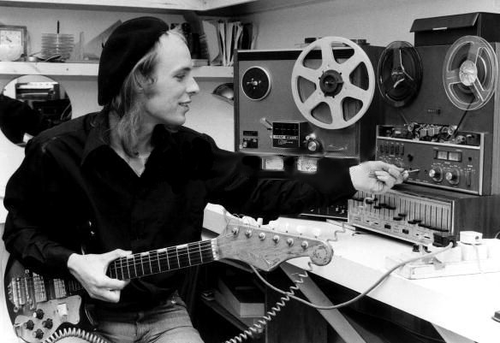
Free at last
The problem is that this is not how Brian Eno actually made his art, nor is it how anyone has ever made art. Artists are born into a cultural scene beyond their making, and their work results from the tensions and attractions between that scene and their own personality. If a style could be simply erected sui generis by the simple expedient of ignoring your surroundings then the whole of art history would have been different.
In fact, what Eno did was not much different from what any creative person, in any time, has done. Leonardo wrote about splattering paint and then looking for familiar things in it to fill out with drawing. He doesn’t seem to have needed to create a fancy term like “aleatoric processes” to get the press excited about it though. Many more examples can be found. Artists have always needed strategies for juicing the creative process. So things like Eno’s Oblique Strategies, though interesting are nothing at all new.
But what’s more is that Eno and his generation drew deeply on the fund of all previous art. In spite of his famous “I am not a musician” pronouncement, I guarantee you that Eno in 1972 knew exactly how to play a C major chord, and could correctly call it that. The musicians he worked with at the time have confirmed this. Really, he was just a producer in the mold of Phil Spector who had his own idiosyncratic methods that got a cool result. Spector never said “I am not a musician” though it would have meant about the same thing if he had.
But all that escapes the tender young mind of a wannabe 16 year old musician. So along with many of my generation I started out thinking “This is what I have to do”. And so I did, and man did I try. But it turns out my inborn resources came up a bit short. I set my sights on Genius and came up with Not Bad. Eventually I tired of this game and just started to do what I really liked doing, which is playing instruments and making quirky little ditties with them. So now in middle age I’m learning to play chords, scales, arpeggios…and I’ve learned some Bach on the piano. This experience of delving into our heritage and making it my own by playing it with my own hands has been the most exciting experience of my artistic life.
And so maybe I can be of some use to the 16 year old wannabes out there who are coming up in a world where the Brian Eno Disease is endemic. By all means be creative and open minded. But be open minded enough to admit that you don’t know anything, and that people before you have done things that you need to know about, to understand, to build on.
Speaking of which, building on the past is the key point. Up until the Disease got the upper hand, art was viewed like a fruit tree. Year after year it gave fruit, and the fruit had it’s own seeds, which hybridized and made the next generation. And so on and on over the centuries a rich orchard grew up.
Then the Disease came along and cut down the trees and used the wood to build things, marvelous things, things we stood around and gaped at. But too late, we found out there weren’t any more seeds, and no more fruit, and all that’s left is to break up the things they built and use the wood for something else, and little by little it’s whittled down to nothing.
We see this with sampling. I’m not getting into the issue of legitimacy, just saying that when an artist uses a loop from a 70s soul record, he’s not leaving anything for the next guy, the way the 70s soul musicians left something for him. What are they going to do, sample his sample, and cut it down further? New stuff has to be injected into the round or it just dries up and blows away.
But the good news is that it’s clear what needs to done now. It’s time to replant the orchard. No need to wait for the complete collapse of civilization to get started.
 Blowhard, Esq.
 Callowman
 Sherbrooke
 Eddie Pensier
 Enzo Nakamura
 Epaminondas
 Fabrizio del Wrongo
 Fenster
 Brundle Guy
 Glynn Marshes
 Paleo Retiree
 Atypical Neurotic
 Question Lady
 Sax von Stroheim
 Sir Barken Hyena
 The Mistaken

