
Blowhard, Esq. writes:
I encountered these cars in the exact same area, 2nd Street in Belmont Shore, just a few nights apart.


Gee, I wonder which candidate each driver is voting for?
Blowhard, Esq. writes:
I encountered these cars in the exact same area, 2nd Street in Belmont Shore, just a few nights apart.
Gee, I wonder which candidate each driver is voting for?
Paleo Retiree writes:
The Question Lady writes:
What’s your favorite way to learn new things and skills?
Blowhard, Esq. writes:
While in Vegas, I was lucky enough to get a guided tour of the downtown area from a long-time resident who works for the Nevada Gaming Commission and I talked with another friend who’s a writer with a great working knowledge of the city. Both got me interested in the area’s history and the latter recommended a few books:
(Sidebar: I wanted to pick one of these up right away, so I pulled out my iPhone to find a book store. Even though I was in the heart of the Strip, near a number of hotels and 100s of shops, there wasn’t a single book store close by. All were out in the suburbs.)
One book that had been on my to-read list for years was Learning from Las Vegas: The Forgotten Symbolism of Architectural Forms by Robert Venturi, Denise Scott Brown, and Steven Izenour. A short book with lots of pictures? Sold!
Fenster writes:
I have long been a fan of William Friedkin’s movies. Sure he has made his share of turkeys, but they are not that great in number. And I have found a lot to like even among the films the critics have tended to beat on, like Jade. And even when he veers from films that have a Friedkin aura into more mainstream projects, like Rules of Engagement, I think he pulls them off quite well.
For some reason I don’t think he ever got the attention he deserved among the rising Young Turk directors of the 70s. He didn’t have Spielberg’s sunny optimism and way with audience affections. He didn’t have the art pretensions of Coppola. And he didn’t quite have the downscale genre affectations that would endear critics like Kael to directors like De Palma (Kael apparently didn’t like Friedkin or many of his films). But there is something of a Friedkin sensibility, and it runs off and on throughout the length of his career.
Here are a few scenes from three of his movies that seem to stick with me, and for similar reasons.
Take this scene from the underappreciated and truly great Sorcerer (1977). The film was a remake of the Clouzot classic The Wages of Fear, and the critics never warmed to even the idea of an American remake of a French classic. But it is a thrilling ride.
Some other director might add heroism and glory to the squalid proceedings but, fully in keeping with The Wages of Fear‘s existential roots, Friedkin makes no such concessions. It’s brutal all the way, with four hardened losers on the run, strangers to one another, running extremely dangerous explosives through the South American jungle to reach a blown-out oil rig. In the scene below, it’s near the end of the film and the harrowing journey, and two of the characters are just, just, just beginning to make human contact with one another. The way their conversation comes to an abrubt end is totally unsentimental and unromantic. Spielberg might have milked a scene like this for all it is worth in emotional terms, and the Bruckheimer version would be all razzle-dazzle, pumping music score and multiple explosions. Here it is cut-cut-boom that’s the way it goes. Scene around 1:41:35.
Link here.
And here is the near-final scene in To Live and Die in LA. William Petersen, the main character, is a detective in LA. In standard genre style, he is a not-so-good guy up against even worse guys. So when he and the bad guys meet, he may learn a lesson but he’ll end up on top, usually in a blaze of glory, high drama and neat-o explosions. Right? Not so fast.
Link here.
Also a very unsentimental, unromantic end. Cut-cut-bang and it’s over. In fact so quick and brutal that whoever put together the YouTube video above felt that need to show the shotgun blast to William Petersen several times over, following movie convention that if one explosion good many explosion better. But the Friedkin version in the film doesn’t feel the need to repeat the shot. Bang.
And think of poor Father Merrin. You’d think when you issue a command from God, it will be obeyed, Harry Potter style. Here, in The Exorcist, the chant “the power of Christ compels you!” does no such thing. Yes, Linda Blair settles eventually to the bed, but it is hard, hard work for the two priests, who cannot be certain what the outcome of their spell is likely to be.
All in all, a lot of good stuff. See Sorcerer if you have not already.
Blowhard, Esq. writes:
 Anne Hathaway is a national treasure.
Thanks to Paleo Retiree for some of the links and Fabrizio del Wrongo for the tags.
Fenster writes:
You may recall the historian Taylor Branch got a lot of attention for his call, in The Atlantic, for college athletes to be paid. His long article was, in my view, longer on sermonizing than it was on financial specifics. I presented my own (long) critique at my now semi-defunct blog here. Those interested in a link to Branch’s article as well as my comments are directed there.
Some months back, Sports Illustrated weighed in with its own article on the subject. It is an interesting counterweight to Branch’s piece. Branch is an advocate on moral grounds, and never really feels the need to get specific about how a plan for payment would work. By contrast, SI maintains it is not actually advocating athletes be paid–merely that it can be done. So in theory you ought to be able to read the two articles together to make a coherent whole: Branch for the moral necessity argument, SI for the how-to.
How does it all add up? SI makes some interesting and provocative arguments but I remain unconvinced that it has come up with the right formula.
SI’s argument consists of two parts. On the revenue side, it favors market forces to enter into the picture in a bigger way. If a star athlete can warrant an endorsement, perhaps there has to be a way to manage that revenue flow in appropriate ways. On the cost side, SI would both trim expenses in the top sports (mandated smaller rosters for football, say) as well as shift a lot of now-varsity sports to club status. The latter would free up the subsidies now flowing from the big-time sports to non-revenue producers like volleyball and golf.
Does the numbers add? Yeah, on paper I think they have done a good job nipping and tucking.
But will it actually work? Now that is another question. It is kind of like someone coming up with a deficit closing plan on paper, expecting Washington DC to take to it. Yes, the numbers can be made to fit, but is there any hope given the power relations in play in the real world?
Here, I am a lot more pessimistic. As SI points out, athletic departments’ financial reports are cooked, cooked, cooked to the point of falling apart sogginess. Why is that? I think one of the main reasons is that–while you would never know it–they are in fact joined at the hip financially to the universities that are supposed to be their homes. Books are cooked in large measure because universities don’t want key constituencies–like the faculty, for instance–to know what the financial relationship actually is.
What we have is an asymmetrical relationship, one in which the university professes to be the senior partner, but which is in most cases the junior one, or at least powerless to manage athletic spending. Given that state of affairs, SI can go on all it wants about cost cutting and new revenues. As long as a mini-NFL is grafted on to the side of an institution of higher education, the books will always be cooked enough to permit silent subsidies to flow from students to the athletic program.
The best one can say about the SI plan: in theory, IT COULD WORK.
But most likely you end up with more of the lumbering monster.

The Question Lady writes:
What’s your preferred way to get some exercise?
Fabrizio del Wrongo writes:
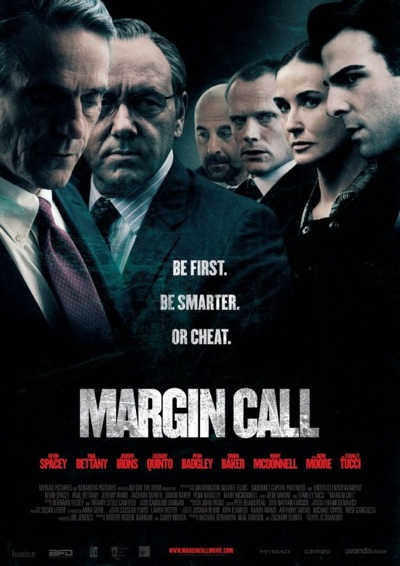
“Margin Call” is an ensemble drama that treats the 2008 financial meltdown as a race-against-time thriller. Written and directed by newcomer J. C. Chandor, the movie takes you behind the hermetic glass sheathing of a prominent Manhattan investment firm. There you’re permitted to eavesdrop on a group of gray-suited Masters of the Universe as they plot to save their collective ass. The crux of their plan? To screw over everyone else. Of course, this is devilish business, yet “Margin Call” is notable for the almost Renoiresque generosity it extends to its characters. It gives the movie a pleasingly paradoxical edge, for the deeper you descend into the Machiavellian workings of the firm the more you identify with its constituents. They have families, consciences, personalities, dogs. More importantly, they have bosses. And these bosses have bosses. This is a vision of finance as a Russian-doll hierarchy of nested pressures and influences, in which even the most odious blackguard is rendered sympathetic via the hectoring of an unscrupulous overlord. At the top of this hierarchy sits John Tuld; he’s played with looming ominousness by a vampiric Jeremy Irons. Tuld alone has no boss. When beckoned, he literally descends from the heavens like the evil Emperor at the start of the third “Star Wars” film, his quasi-mullet haircut offering indisputable proof that, like the honey badger, he just don’t give a shit. Visually, “Margin Call” is not much to speak of, but its tone and pace are impressively controlled: like the people it depicts, the movie registers as both steely and enervated. There are a few bad scenes, scenes in which characters are made to speechify in ways meant to shrink-wrap the movie’s themes, but I found them easy to overlook.
Fenster writes:

James Fallon is a neuroscientist who a few years ago, late in life, figured out from his science he was a sociopath.
Daniel Kahneman, in Thinking Fast and Slow, makes a distinction between System One thinking (what your basic instincts tell you) and System Two thinking (realizations and ideas gleaned for reflection and dispassionate analysis). Imagine having your science telling you something like this. NPR covered it here.
More recently, he told his story for The Moth Radio Hour. That account can be found here, in segment two.
An Irish Roman Catholic, Fallon has more than a touch of Mort Sahl in his delivery. Worth a listen.
 Blowhard, Esq.
 Callowman
 Sherbrooke
 Eddie Pensier
 Enzo Nakamura
 Epaminondas
 Fabrizio del Wrongo
 Fenster
 Brundle Guy
 Glynn Marshes
 Paleo Retiree
 Atypical Neurotic
 Question Lady
 Sax von Stroheim
 Sir Barken Hyena
 The Mistaken
 Uncouth Reflections