Politics

Fenster writes:

Fabrizio has opted out of politics.  That’s a temptation but I remain something of a junkie.  I tell myself it is about good citizenship, and that’s partly true, but how much really?  And how much is it the society of the spectacle?

I am sure it is a lot more the latter than people like to think.  Anything wrong with that?  I mean, if Fabrizio could only warm to politics as a kind of reality show, he might tune in more often.

I admit to letting the news wash over me like a warm bath of cat piss, and liking it for the most part.  But I feel guilty about it too, and not just because it is cat piss.  It’s sort of  like forgetting that you can find the divine in the everyday world all around you . . . maybe, just maybe, there is a bigger meaning to the wash?  Maybe good citizenship remains a possibility?

It is hard to see the forest for the trees–or, in Orwell’s words, to see what is in front of one’s nose requires a constant struggle.  Habit, ideology and groupthink are just oh so tempting.

For years one of my go-to blogs has been Real Clear Politics.  I go there still daily.  Here’s the problem, though.  Now that most pundits are bought and paid for spinners for one side or another, what you mostly get are predigested memes deemed suitable for public persuasion.  The Ryan VP pick?  Check out RCP from yesterday: it is a collection of propaganda from the two “sides” on the Ryan pick.  You will look mostly in vain for non-self serving accounts.

I know the return of middlebrow is not likely, or recommended.  And while highly suspicious of pomo, I am not one to believe in eternal verities, and so I understand the logic of letting Fox be Fox and letting CNN be CNN.  But a little more in the way of intellectual honesty and integrity would be nice.

Posted in Personal reflections, Politics and Economics | Tagged , , | 5 Comments

More Lyons

Fenster writes:

I posted some photos of a Victorian again gracefully in Lyons, NY.

Actually, the photo didn’t do justice, and I mean to the deterioration, which is pretty far advanced when you see it in person.  In truth, a lot of the Erie Canal towns are pretty tired.  Which is a shame since there are some wonderful buildings, mostly going downhill.

Here are some more photos, over-romanticized and gauzified just a bit.

The two hot dog wagons, right on the Erie Canal, are just around the corner from one another.  There is a market for hot dogs upstate.

Posted in Architecture, Travel | Tagged , | 7 Comments

Head, Meet Sand

Fabrizio del Wrongo writes:

Are the Olympics over yet? I overheard a word or two that would seem to indicate that they are. If so — phew! I made it through the entire, agonizingly tacky spectacle without hearing an anthem, digesting an inspirational story, or seeing a single spandex-enhanced wedgie. (Although, now that I think about it, I sort of regret forgoing the wedgies. I’ll make a point of Googling “Sharapova Olympics upskirt” as soon as I finish posting this entry.)

I am, I confess, quite proud of this accomplishment; it’s one of the rosier benefits of my recentish media blackout, which began when election hysteria started ramping up a few months ago. My ultimate goal is to make it all the way through the presidential election without learning anything substantial about the candidates. If I’m lucky, I’ll be even more ignorant by the time election day rolls around than I am now. I will consider this a great victory. Scoff if you must, but I figure I’m better off knowing next to nothing about this stuff. When Chthulu comes knocking at your door, you don’t look him in the face; you turn away and try to pretend you didn’t hear the knock. Your sanity might depend on it.

Some tips on remaining ignorant:

  • Ditch cable and get a Netflix Instant account. Watch cool movies and non-political documentaries instead of Fox News and CNN. Of course, you can keep cable and use it very sparingly, but don’t come crying to me if you accidentally catch a few seconds of Bill O’Reilly and end up ruining your entire day.
  • When in the car, use your iPod rather than listen to the radio. Recently, I’ve been enjoying listening to lectures produced by The Teaching Company. Fellow blogger Paleo Retiree was kind enough to gift me one on religions during the Axial Age, and I enjoyed it thoroughly. I’ve now moved onto one dealing with the Roman Empire. I’m thankful to have avoided hearing Don Imus’ voice for a good three months.
  • If a friend (or even an enemy) tries to strike up a political conversation with you, or even wants to talk about some quasi-political thing, like one of those awful awareness campaigns that are so popular now, just pause for a few seconds, look him straight in the eye, and change the topic to something having to do with ’80s sitcom “Perfect Strangers.” He’ll either engage you in a conversation about Balky Bartokomous or he’ll assume you’re sleep deprived and leave you alone. Either way, you’ve won.

I’m telling you, this works. Since implementing this regimen, I feel as though my soul has been douched.

I do confess to absorbing a fair amount of political information via the internet, especially on Facebook. But on the internet everyone is an information hunter/gatherer; you’re free to linger and absorb as you choose. That’s a lot different than television, which is more of an Alex-in-front-of-the-video-screen-in-A-Clockwork-Orange sort of experience.

So, yeah, I pick up things here and there. For instance, I recently learned that someone named Paul Ryan was chosen as a VP candidate. Judging from what I read about him on Facebook, he’s either Mussolini or Jimmy Stewart in “Mr. Smith Goes to Washington.” Either way, I’m voting for Kodos.

Posted in Personal reflections, Politics and Economics | 11 Comments

Book Notes: My Reading List So Far This Year

Blowhard, Esq. writes:

What books are you guys reading right now? Here’s what I’ve managed so far in 2012:

  • A Renegade History of the United States — Thaddeus Russell
  • What the Dog Saw — Malcolm Gladwell
  • Sin in the Second City: Madams, Ministers, Playboys and the Battle for America’s Soul — Karen Abbott
  • Launching the Innovation Renaissance: A New Path to Bring Smart Ideas to Market Fast — Alex Tabarrok
  • In Praise of Commercial Culture — Tyler Cowen
  • The Hunger Games — Suzanne Collins
  • The Big Con: The Story of the Confidence Man — David W. Maurer
  • The Psychopath Test: A Journey Through The Madness Industry — Jon Ronson
  • Stop Stealing Dreams (What is School Good For?) — Seth Godin
  • Linchpin: Are You Indispensable? — Seth Godin
  • You Are Not So Smart: Why You Have Too Many Friends on Facebook, Why Your Memory Is Mostly Fiction, and 46 Other Ways You’re Deluding Yourself — David McRaney
  • An Economist Gets Lunch: New Rules for Everyday Foodies — Tyler Cowen
  • The Black Swan: The Impact of the Highly Improbable — Nicholas Nassim Taleb
  • Bloodbath (A Tim Holt Adventure #1) — Lloyd Fonvielle
  • Culturematic: How Reality TV, John Cheever, a Pie Lab, Julia Child, Fantasy Football…Will Help You Create and Execute Breakthrough Ideas — Grant McCracken
  • Why We Get Fat: And What To Do About It — Gary Taubes
  • King City — Lee Goldberg
  • Reamde — Neal Stephenson
  • What Are You Laughing At? A Comprehensive Guide to the Comedic Event — Dan O’Shannon
  • The Adventures of Sherlock Holmes — Arthur Conan Doyle

Right now I’m on a Western fiction kick — Elmore Leonard’s Hombre and Valdez is Coming, then Cormac McCarthy’s Blood Meridian.

I’m always looking for recommendations. What have you enjoyed lately?

Posted in Books Publishing and Writing | Tagged | 8 Comments

Cocktail Du Jour

Paleo Retiree writes:

My search for the perfect cocktail continues. (And will continue, I hope, for as long as I live.) The Hendry’s Tonic is a first-class beauty from this chic restaurant in Solvang, CA:

The restaurant describes its concoction this way: “Hendricks Gin, Muddled Blueberries and Basil, Finished With Blueberries, Basil and Tonic, Served On The Rocks.”

OK, so it isn’t exactly a contender in the “Classic Cocktails” division. But it’s a lovably silly summer refreshment. The sweet freshness of the blueberries, the unexpected, whole-other-universe-entirely quality of the basil, and the teeny-tiny / crunchy-melty ice crystals all make for a sparkly and piquant, if maybe a little precious and over-creative (but, hey, precious and over-creative doesn’t always have to be bad), delight.

Posted in Food and health, The Good Life | Tagged , , , , , | 4 Comments

City Sights: New York, NY

Blowhard, Esq. writes:

My favorite of the architecture photos I took while in NYC last month.

Posted in Architecture, Photography | Tagged | 4 Comments

Stoya Storytime

Blowhard, Esq. writes:

She sure knows how to give a spirited reading, doesn’t she?

Posted in Books Publishing and Writing, Sex | Tagged | 3 Comments

A Little Something on Higher Education

I am a recovering college administrator with an interest in, and a love for, education.  So you may have to bear with me if I post from time to time on that topic.  I have a now mostly abandoned site oriented to higher education questions (here) where the pictures have been excised due to some Picasa glitch but where the text remains.  It is still somewhat current though, so if you have an interest check it out.

What piques my interest today is an article by Peter Wood in the Chronicle of Higher Education.  In it he mines one of my favorite themes: that higher education studiously avoids measuring, or coming close to understanding, the things that it has no interest in knowing.  Often these are the most important things, the things that if understood well would cause discomfort.  Why prompt inquiry when experience shows that, to quote Jack Nicholoson in A Few Good Men, you can’t handle the truth?

Here is a cut-and-paste from the other blog on the point:

Over at University Diaries, Margaret Soltan a/k/a “UD” continues the good fight for higher education. UD was blogging when Fenster was a newbie blogger way back in the day and while Fens semi-retired UD kept at it. Good for her, and us.

If you read UD you know that if there’s one topic that is likely to get her . . . ummm . . . animated it is big-time sports, and its baleful effects on the academy. That is something that Fenster knows something about. He doesn’t know about it from the perspective of a sports-hound. Fenster not that, though he is far from hostile to sports. He knows about it more from having served for a number of years as the top finance and administrative official at a rather large state university, one of the ones that gets into the press from time to time on account of a seeming inability to control costs on the athletic side.

So what Fenster knows, I suppose, is that it is a pretty difficult endeavor from a university perspective to put the athletics genie back in the bottle. Fenster, he has plenty of stories, mostly for another time.

What Fenster did not know enough about, and should have known more about, was the exact nature of all the explicit and implicit subsidies to Athletics. Jeez, as the chief financial and administrative officer you’d think he’d know that, right? Well, yes indeed. But in the several years Fenster was on the job he came to realize an important truth about higher education management, a truth that can almost be distilled into a kind of principle. It has to do with management and measurement, about which a number of aphorisms already exist.

Such as:

You Can’t Manage What You Don’t Measure.

Measure What You Want to Manage.

You Manage what You Measure.

OK, but these are all roughly saying the same thing. Fenster would like to add an aphorism taking a somewhat different perspective:

If You are Determined Not to Manage Something, Don’t Measure It.
Time and time again as an administrator in higher education, Fenster has been faced with situations in which this rule is applied in a three step procedure to eliminate a problem:

1. Stop talking about it
2. Don’t keep track of it
3. Problem goes away.

Stalin once remarked “no person, no problem”. To paraphrase in this context: no problem? No problem!

This procedure can be spectacularly effective. Not permanently, of course. The problem doesn’t really go away. But it goes away long enough to satisfy the person undertaking the procedure. And in some ways this willful suppression of facts has its own charms. When facts are buried long enough, it’s like the proverbial buried hatchet. Sometimes people forget where they are buried, and in time people not only ignore the problem’s existence, they forget they had a problem in the first place. The cookie trail gets old. Sooner or later the repressed returns, but that’s for another day.

There’s a lot of this confusion in higher education, and it can definitely be present in the financial relationship between Athletics and the University. Not for nothing that scholars have had to work hard to develop a fair reckoning of that relationship.

Just as Reseach as a function within higher education often thinks of itself as producing a profit to the university because it produces revenue, so also Athletics often characterizes its activities as having the effect of subsidizing the rest of the universities. In most cases this is not true of either Research or Athletics. Whatever else they do, and whatever other benefits they provide, they require, rather than dispense, subsidies.

I’ll regale you with more fun stuff about the topic another day, including the true nature of the so-called higher education bubble.  Signing off for now.

Posted in Education | Leave a comment

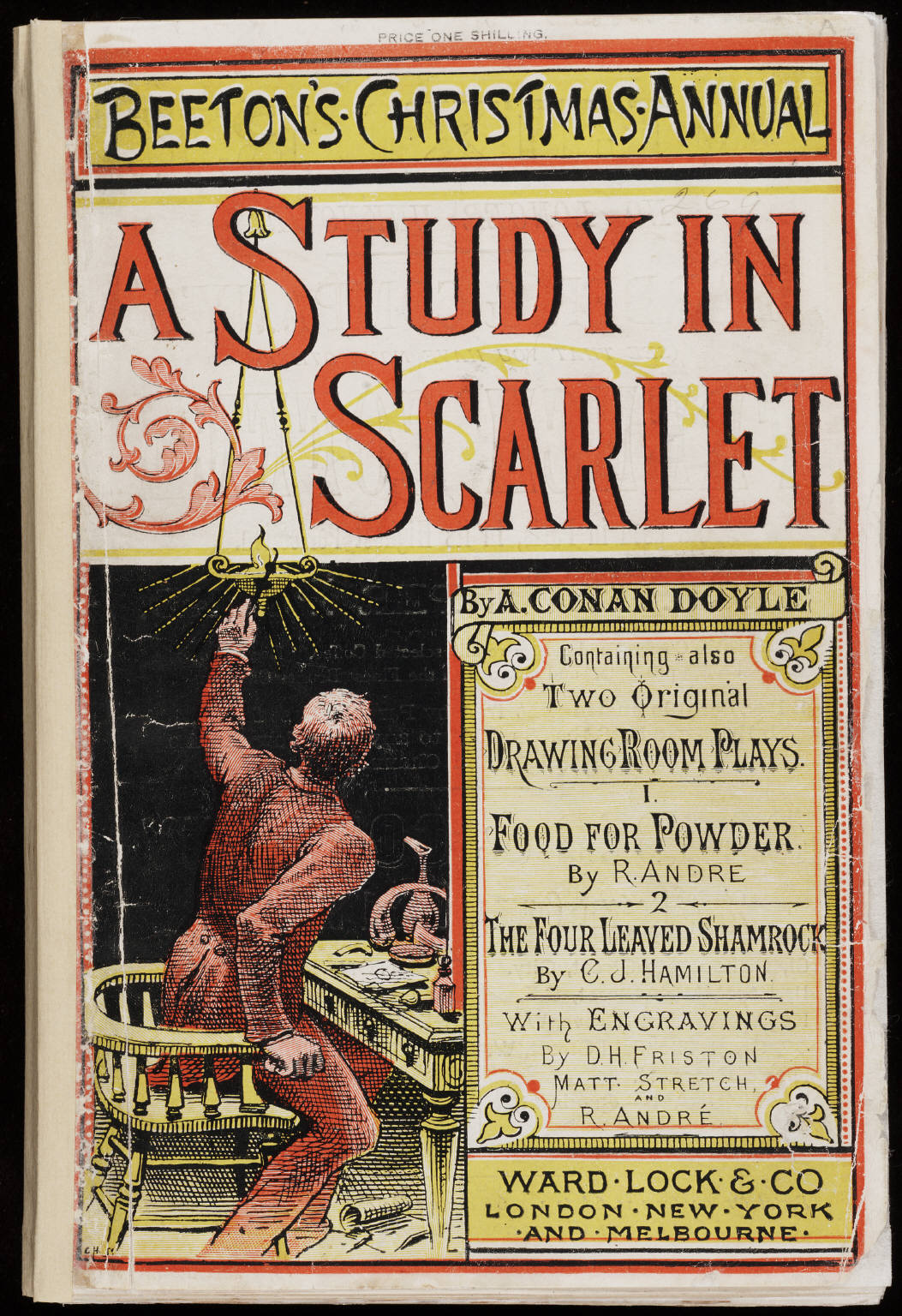
Book Notes: Sherlock Holmes

Blowhard, Esq. writes:

Image

“There’s the scarlet thread of murder running through the colourless skein of life, and our duty is to unravel it, and isolate it, and expose every inch of it.”

Everyone knows the character, but have you ever read any of the Sherlock Holmes stories? Until recently, I hadn’t, but a friend runs a book club and this month’s selection is The Adventures of Sherlock Holmes, Conan Doyle’s first collection of stories, so I finally took a look. Here are a few random observations:

1. Holmes is one of the most influential and popular characters in English literature, right? First, there are the straight adaptations of Conan Doyle’s work like the movies starring Robert Downey Jr, the recent BBC series, and the new American adaptation (with Holmes living in New York and Watson played by Lucy Liu). But then there are all the other eccentric detective shows like The MentalistPsych, and House. Seems like whenever you have a private investigator solving crimes by unorthodox means, you can trace the character back to Holmes. Batman is another obvious successor. Finally, procedurals like CSI and Law & Order are descendants too. Dick Wolf has even explicitly said in interviews that the Sherlock Holmes stories were a key influence on the various Law & Order series. Pretty impressive for stories that are a century and a quarter old.

2. I think one of the reasons the stories remain popular is because they feel pretty modern. When you think of the traditional English murder mystery, like Agatha Christie, you picture the closed world of the great manor house or luxury train car and the cast of a dozen suspects. Holmes, on the other hand, exists in the bustling, global city of London. Indeed, there’s an international connection in almost every story. In the eight I read, New Jersey, Pennsylvania, Cleveland, France, Bohemia, Germany, Afghanistan, Florida, and Switzerland are visited or referenced in some way.

As for the Holmes character himself, he’s an arrogant, pushy, hyperintellectual, sexless, dark loner with an unwavering faith in science who’s an amateur musician and drug addict. That pretty much describes half the users on reddit.

3. That said, I found the stories themselves to be disappointing for the most part. It’s like Conan Doyle constructed this wonderful instrument but didn’t know how to play it. The structure of the short stories is fairly rigid:

  1. Short prologue with Watson
  2. Watson gets a message from Holmes, “I need your help, there’s been a crime.”
  3. Holmes delivers a long monologue during which the mystery is explained.
  4. Holmes and Watson go to the scene of the crime. Incredulity from police that Holmes can be of any help. Holmes demonstrates his superior powers. “Why, I can tell from that footprint that the thief walks with a limp, he has recently come back 5-year tour of the Congo, he has 3 brothers and 2 sisters — however his mother died giving birth to his youngest sibling — he had roast beef for lunch, and his favorite play is Macbeth.”
  5. Holmes solves the mystery, but it’s withheld from the audience.
  6. Holmes confronts and unmasks the wrongdoer. Wrongdoer delivers a monologue about how and why he or she committed the crime.

The main problem is that Holmes is almost never wrong, so there aren’t enough story turns. In Story, Robert McKee talks about “the gap,” i.e. when there’s a disconnect between a character’s expectation of the world and actual reality. When the gap opens up, the character is tested. We, the audience, lean forward at those moments to observe how the character will act. It’s one of the tricks storytellers have to keep us engaged. If a character is always correct, then the gap never opens and stories start to feel flat and lifeless.

There’s one notable exception, though, the story “A Scandal in Bohemia,” in which Holmes is outwitted by the American actress, Irene Adler. (Speaking of Adler, she’s a far better and more interesting nemesis for Holmes than Prof. Moriarty. Moriarty makes one appearance in the Holmes canon and it’s a complete let-down.)

4. One last quick note about A Study in Scarlet, the novella that introduced Holmes to the world. Half the story is a murder investigation in London and the other half is a flashback of what motivated the murders. The flashback takes place in Utah and the villain is no less than Joseph Smith and the Mormons. When the BBC adapted this story for their living-in-modern-London Sherlock series they excised the Utah/Mormon half. Talk about a missed opportunity! They should’ve kept that part intact and made the villain Tom Cruise and Scientologists.

So what do you guys and gals think? And has anyone read Conan Doyle’s Lost World or Brigadier Gerard stories?

Posted in Books Publishing and Writing | Tagged , , , | 6 Comments

“Crosswinds”

Image

Fabrizio del Wrongo writes:

I enjoyed this 1951 film written and directed by Lewis R. Foster. It plays like a run-through of B-movie tropes: bits of aviation films, adventure films, safari films float around in the mix (there’s even some underwater photography, still a novelty in 1951), and the carpet of talky double-crossing is reminiscent of noirish vacation jaunts like “His Kind of Woman.” It’s derivative, but it’s also excellently paced, and the narrative is varied and propulsive enough to mask its essential lumpishness. (It’s like a well-compacted serial.) The plot concerns a hunky schooner pilot played by John Payne. His well-tended boat is a reflection of the uncompromised character of his masculinity, but it’s also the instrument of his abnegation — like so many movie (and Hemingway) men of the era, he’s on the run from some unnamed anguish derived from the war. So is Rhonda Fleming’s Katherine; she arrives in the locale (New Guinea) on a break from her alcoholism but looking just as accomodating as you’d expect. For a while the movie looks to be shaping up as a standoff between cheesecake and beefcake, but Fleming is eventually marginalized as Foster tightens his grip on the ritualism of masculine skullduggery and invents new excuses for Payne to go shirtless. (The movie’s main thrust is male-on-male.) Having used a gold-swiping scheme to build up a “Sierra Madre”-like network of tension, Foster then allows the film to slacken and dissipate without ceremony. Right around the 90-minute mark all of Payne’s competitors are suddenly pierced by arrows or swallowed by crocodiles.

The movie is available on Netflix Instant along with a few of Foster’s other productions.

Posted in Movies | Tagged , , , , , | 4 Comments