
Blowhard, Esq. writes:
The word Fascism has now no meaning except in so far as it signifies ‘something not desirable’.
In the ensuing seventy years, do you think the meaning of “fascism” has become clearer or muddier?
Blowhard, Esq. writes:
The word Fascism has now no meaning except in so far as it signifies ‘something not desirable’.
In the ensuing seventy years, do you think the meaning of “fascism” has become clearer or muddier?
Paleo Retiree writes:
And a collection of architecture-oriented memes that I’ve enjoyed recently. (“Public art” really is a scam, btw. For a taste of the academic absurdity of it, take a look at this page.)


Blowhard, Esq. writes:
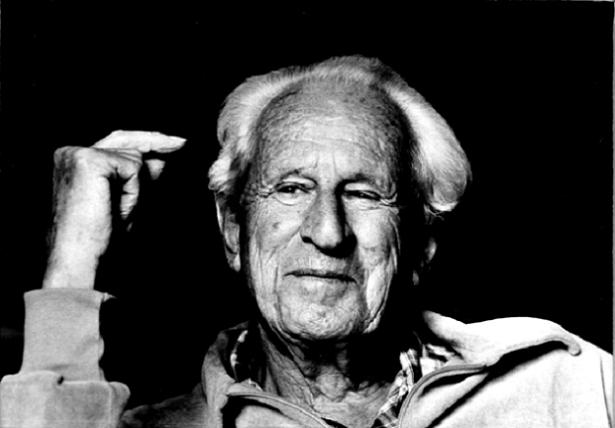
Yesterday, in the comments to this post, I linked to a progressive’s call for censoring “intolerant” speech, something I’ve been hearing increasingly over the past year or so. Although the post quotes Karl Popper, it reminded me of OSS operative Herbert Marcuse’s essay “Repressive Tolerance”:
In his contribution, Marcuse argues that the ideal of tolerance belongs to a liberal, democratic tradition that has become exhausted. Liberal society is based on a form of domination so subtle that the majority accept and even will their servitude. Marcuse believes that under such conditions tolerance as traditionally understood serves the cause of domination and that a new kind of tolerance is therefore needed: tolerance of the Left, subversion, and revolutionary violence, combined with intolerance of the Right, of existing institutions of civil society, and of any opposition to socialism.[1]Marcuse claims that tolerance shown to minority views in industrial societies is a deceit because such expressions cannot be effective. Freedom of speech is not a good in itself because it allows for the propagation of error; Marcuse believes that “The telos of tolerance is truth”. Revolutionary minorities hold the truth and the majority has to be liberated from error by being re-educated in the truth by this minority. The revolutionary minority are entitled, Marcuse claims, to suppress rival and harmful opinions.[2]
That’s the Wikipedia summary, but you can read the complete essay here. Isn’t Marcuse’s idea pretty much the order of the day?
Fabrizio del Wrongo writes:
You, therefore, have not ordered the temples to be shut up, nor forbidden any to frequent them: nor have you driven from the temples or the altars, fire or frankincense, or other honours of incense. But those black-garbed people, who eat more than elephants, and demand a large quantity of liquor from the people who send them drink for their chantings, but who hide their luxury by their pale artificial countenances, — these men, O Emperor, even whilst your law is in force, run to the temples, bringing with them wood, and stones, and iron, and when they have not these, hands and feet. Then follows a Mysian prey, the roofs are uncovered, walls are pulled down, images are carried off, and altars are overturned: the priests all the while must be silent upon pain of death. When they have destroyed one temple they run to another, and a third, and trophies are erected upon trophies: which are all contrary to [your] law. This is the practice in cities, but especially in the countries. And there are many enemies every where. After innumerable mischiefs have been perpetrated, the scattered multitude unites and comes together, and they require of each other an account of what they have done; and he is ashamed who cannot tell of some great injury which he has been guilty of. They, therefore, spread themselves over the country like torrents, wasting the countries together with the temples: for wherever they demolish the temple of a country, at the same time the country itself is blinded, declines, and dies. For, O Emperor, the temples are the soul of the country; they have been the first original of the buildings in the country, and they have subsisted for many ages to this time; and in them are all the husbandman’s hopes, concerning men, and women, and children, and oxen, and the seeds and the plants of the ground. Wherever any country has lost its temples, that country is lost …
— Libanius
Blowhard, Esq. writes:
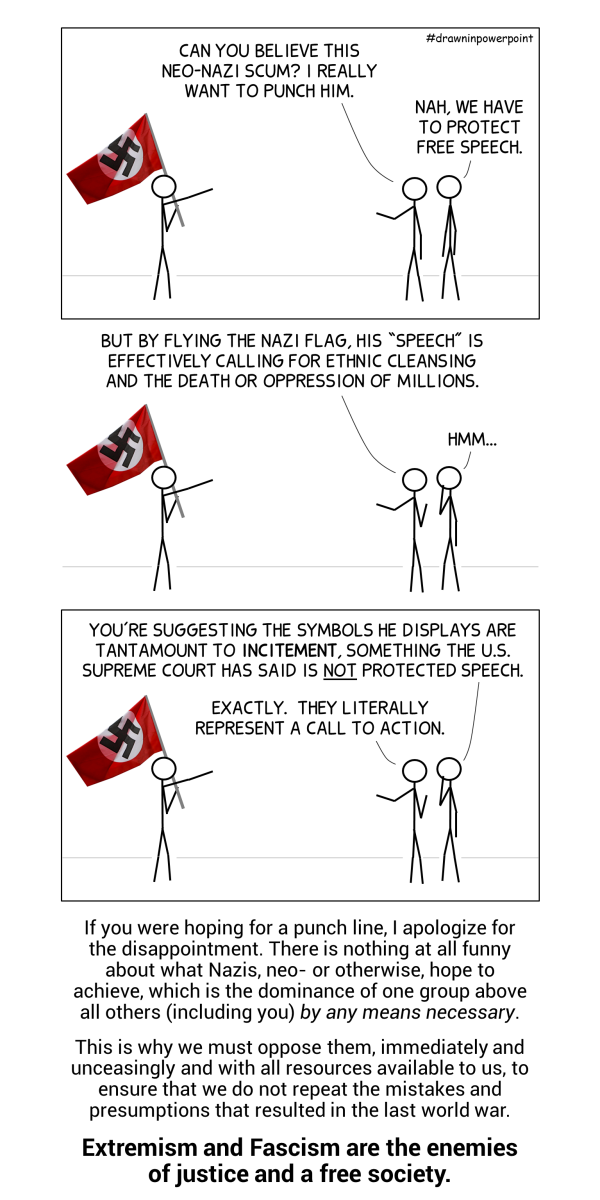
It is useful to consider the three primary arguments set forth by Skokie in support of its effort to forbid the march. First, the village argued that the display of the swastika promoted “hatred against persons of Jewish faith or ancestry” and that speech that promotes racial or religious hatred is unprotected by the First Amendment. The courts rightly rejected this argument, not on the ground that the swastika doesn’t promote religious hatred, but on the ground that that is not a reason for suppressing speech. After all, it the Nazis could be prohibited from marching in Skokie because the swastika incites religious hatred, then presumably they couldn’t march anywhere for the same reason, and movies could not show the swastika, and even documentaries could not show the swastika. And if the swastika can be banned on this basis, then what other symbols or ideas can be suppressed for similar reasons. What about movies showing members of the Ku Klux Klan? News accounts showing Palestinians committing suicide bombings in Israel or showing Israelis attacking civilians?
Second, the village argued that the purpose of the marches was to inflict emotional harm on the Jewish residents of Skokie and, especially, on the survivors. Certainly, some residents would be deeply offended, shocked and terrified to see Nazis marching through the streets of Skokie. But they might also be offended, shocked and terrified to know that Schindler’s List was playing at a movie theatre in Skokie, or in Chicago, or in Illinois, and African-Americans might be offended, shocked and terrified to know that the movie Birth of a Nation was playing in a theatre in their town or nation. And so on. Moreover, it is doubtful that the actual intent of the Nazis was to inflict emotional harm on the residents of Skokie. Initially, the Nazis sought to march in a totally different community in Chicago, one with almost no Jewish population. But they were denied a permit. They then decided to march in Skokie in order to get publicity for their grievance. Indeed, the signs they planned to carry in Skokie did not say “Bring Back the Holocaust,” but “White Free Speech” and “Free Speech for the White Man.” Making First Amendment rights turn on judgments about a speaker’s subjective intent is a dangerous business, because intent is very elusive and police, prosecutors and jurors are very prone to attribute evil intentions to those whose views they despise.
Third, the village argued that if the Nazis were permitted to march there would be uncontrollable violence. But is this a reason to suppress speech? Isn’t the obligation of the government to protect the speaker and to control and punish the lawbreakers, rather than to invite those who would silence the speech to use threats of violence to achieve their ends? If the village of Skokie had won on this point, then southern communities who wanted to prosecute civil rights marchers in Selma, Montgomery and Birmingham could equally do so, on the plea that such demonstrations would trigger “uncontrollable violence.” Moreover, once government gives in to such threats of violence it effectively invites a “heckler’s veto,” empowering any group of people who want to silence others to do so simply by threatening to violate the law.
The outcome of the Skokie controversy was one of the truly great victories for the First Amendment in American history. It proved that the rule of law must and can prevail. Because of our profound commitment to the principle of free expression even in the excruciatingly painful circumstances of Skokie more than thirty years ago, we remain today the international symbol of free speech.
— by Geoffrey R. Stone,
Blowhard, Esq. writes:
Blowhard, Esq. writes:
And we need to recognize that this is not simply a question of whether a fascist government will come to power or not – I’m skeptical that such an explicitly fascist government would come to be – but that those who carry out hate crimes, they feel emboldened when their ideas become mainstream, and so, the idea with anti-fascist politics is to prevent those ideas from having that opportunity.”
Related
Fabrizio del Wrongo writes:
— United Auto Workers, 1946
Groups of idle sailors lay about the decks, “overhauling a range of their memories;” how they had spent the last Christmas-day, in some “Wapping,” or “Wide Water street,” with the brimming goblet in hand, and the merry music of the dance sounding in their ears. Nor were the memories of the officers idle. They clasped in fancy their loved ones, now sad and lonely, to their bosoms once more, and listened to the prattle of the little ones they had left behind. Not the least curious of the changes that had taken place since the last Christmas day, was the change in their own official positions. They were, most of them, on that day, afloat under the “old flag.” That flag now looked to them strange and foreign. They had some of their own countrymen on board; not, as of yore, as welcome visitors, but as prisoners. These, too, wore a changed aspect–enemy, instead of friend, being written upon their faces. The two “rival nations,” spoken of by De Tocqueville, stood face to face. Nature is stronger than man. She will not permit her laws to be violated with impunity, and if this war does not separate these two nations, other wars will. If we succeed in preserving the principle of State sovereignty — the only principle which can save this whole country, North and South, from utter wreck and ruin — all will be well, whatever combinations of particular States may be made, from time to time. The States being free, liberty will be saved, and they will gravitate naturally, like unto like — the Puritan clinging to the Puritan, and the Cavalier to the Cavalier. But if this principle be overthrown, if the mad idea be carried out, that all the American people must be moulded into a common mass, and form one consolidated government, under the rule of a majority — for no constitution will then restrain them — Constitutional liberty will disappear, and no man can predict the future — except in so far, that it is impossible for the Puritan, and the Cavalier to live together in peace.
— Raphael Semmes, 1869
Fabrizio del Wrongo writes:
Blowhard, Esq. writes:

Do people care about free speech? Did they ever really? A recent spate of stories has me wondering.
INB4 some lawyer or lawyer wannabe notes that three of these stories don’t involve state action, therefore the First Amendment isn’t implicated. True, but doesn’t the idea of free speech encompass more than a legal regime, isn’t it a cultural ideal too? Isn’t there something — dare I say? — un-American about firing someone for writing a memo, the point of which was to open up discussion about controversial ideas?
Maybe not, maybe my “cultural ideal” argument is woefully naive. It’s clear people are only too happy to abridge speech when the ideas being attacked are politically unpopular.

 Blowhard, Esq.
 Callowman
 Sherbrooke
 Eddie Pensier
 Enzo Nakamura
 Epaminondas
 Fabrizio del Wrongo
 Fenster
 Brundle Guy
 Glynn Marshes
 Paleo Retiree
 Atypical Neurotic
 Question Lady
 Sax von Stroheim
 Sir Barken Hyena
 The Mistaken
