
Fabrizio del Wrongo writes:


Fabrizio del Wrongo writes:
Fabrizio del Wrongo writes:
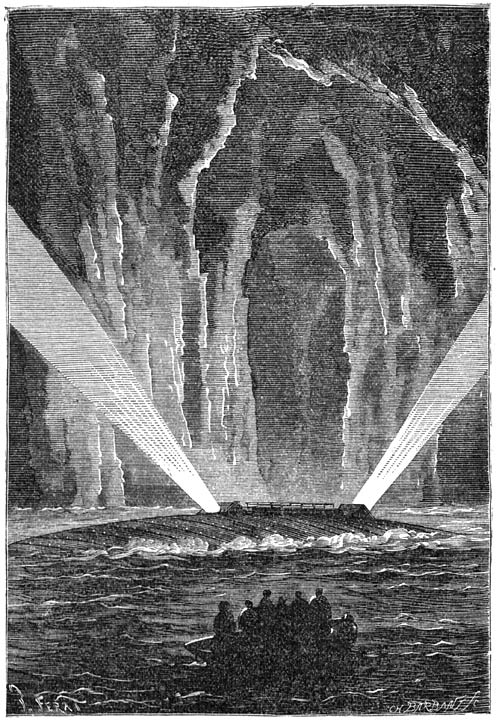
Cyrus Harding and his companions remained an hour at the top of the mountain. The island was displayed under their eyes, like a plan in relief with different tints, green for the forests, yellow for the sand, blue for the water. They viewed it in its tout-ensemble, nothing remained concealed but the ground hidden by verdure, the hollows of the valleys, and the interior of the volcanic chasms.
One important question remained to be solved, and the answer would have a great effect upon the future of the castaways.
Was the island inhabited?
It was the reporter who put this question, to which after the close examination they had just made, the answer seemed to be in the negative.
Nowhere could the work of a human hand be perceived. Not a group of huts, not a solitary cabin, not a fishery on the shore. No smoke curling in the air betrayed the presence of man. It is true, a distance of nearly thirty miles separated the observers from the extreme points, that is, of the tail which extended to the southwest, and it would have been difficult, even to Pencroft’s eyes, to discover a habitation there. Neither could the curtain of verdure, which covered three-quarters of the island, be raised to see if it did not shelter some straggling village. But in general the islanders live on the shores of the narrow spaces which emerge above the waters of the Pacific, and this shore appeared to be an absolute desert.
Until a more complete exploration, it might be admitted that the island was uninhabited. But was it frequented, at least occasionally, by the natives of neighboring islands? It was difficult to reply to this question. No land appeared within a radius of fifty miles. But fifty miles could be easily crossed, either by Malay proas or by the large Polynesian canoes. Everything depended on the position of the island, of its isolation in the Pacific, or of its proximity to archipelagoes. Would Cyrus Harding be able to find out their latitude and longitude without instruments? It would be difficult. Since he was in doubt, it was best to take precautions against a possible descent of neighboring natives.
The exploration of the island was finished, its shape determined, its features made out, its extent calculated, the water and mountain systems ascertained. The disposition of the forests and plains had been marked in a general way on the reporter’s plan. They had now only to descend the mountain slopes again, and explore the soil, in the triple point of view, of its mineral, vegetable, and animal resources.
But before giving his companions the signal for departure, Cyrus Harding said to them in a calm, grave voice,—
“Here, my friends, is the small corner of land upon which the hand of the Almighty has thrown us. We are going to live here; a long time, perhaps. Perhaps, too, unexpected help will arrive, if some ship passes by chance. I say by chance, because this is an unimportant island; there is not even a port in which ships could anchor, and it is to be feared that it is situated out of the route usually followed, that is to say, too much to the south for the ships which frequent the archipelagoes of the Pacific, and too much to the north for those which go to Australia by doubling Cape Horn. I wish to hide nothing of our position from you—”
“And you are right, my dear Cyrus,” replied the reporter, with animation. “You have to deal with men. They have confidence in you, and you can depend upon them. Is it not so, my friends?”
“I will obey you in everything, captain,” said Herbert, seizing the engineer’s hand.
“My master always, and everywhere!” cried Neb.
“As for me,” said the sailor, “if I ever grumble at work, my name’s not Jack Pencroft, and if you like, captain, we will make a little America of this island! We will build towns, we will establish railways, start telegraphs, and one fine day, when it is quite changed, quite put in order and quite civilized, we will go and offer it to the government of the Union. Only, I ask one thing.”
“What is that?” said the reporter.
“It is, that we do not consider ourselves castaways, but colonists, who have come here to settle.” Harding could not help smiling, and the sailor’s idea was adopted. He then thanked his companions, and added, that he would rely on their energy and on the aid of Heaven.
“Well, now let us set off to the Chimneys!” cried Pencroft.
“One minute, my friends,” said the engineer. “It seems to me it would be a good thing to give a name to this island, as well as to, the capes, promontories, and watercourses, which we can see.
“Very good,” said the reporter. “In the future, that will simplify the instructions which we shall have to give and follow.”
“Indeed,” said the sailor, “already it is something to be able to say where one is going, and where one has come from. At least, it looks like somewhere.”
“The Chimneys, for example,” said Herbert.
“Exactly!” replied Pencroft. “That name was the most convenient, and it came to me quite of myself. Shall we keep the name of the Chimneys for our first encampment, captain?”
“Yes, Pencroft, since you have so christened it.”
“Good! as for the others, that will be easy,” returned the sailor, who was in high spirits. “Let us give them names, as the Robinsons did, whose story Herbert has often read to me; Providence Bay, Whale Point, Cape Disappointment!”
“Or, rather, the names of Captain Harding,” said Herbert, “of Mr. Spilett, of Neb!—”
“My name!” cried Neb, showing his sparkling white teeth.
“Why not?” replied Pencroft. “Port Neb, that would do very well! And Cape Gideon—”
“I should prefer borrowing names from our country,” said the reporter, “which would remind us of America.”
“Yes, for the principal ones,” then said Cyrus Harding; “for those of the bays and seas, I admit it willingly. We might give to that vast bay on the east the name of Union Bay, for example; to that large hollow on the south, Washington Bay; to the mountain upon which we are standing, that of Mount Franklin; to that lake which is extended under our eyes, that of Lake Grant; nothing could be better, my friends. These names will recall our country, and those of the great citizens who have honored it; but for the rivers, gulfs, capes, and promontories, which we perceive from the top of this mountain, rather let us choose names which will recall their particular shape. They will impress themselves better on our memory, and at the same time will be more practical. The shape of the island is so strange that we shall not be troubled to imagine what it resembles. As to the streams which we do not know as yet, in different parts of the forest which we shall explore later, the creeks which afterwards will be discovered, we can christen them as we find them. What do you think, my friends?”
The engineer’s proposal was unanimously agreed to by his companions. The island was spread out under their eyes like a map, and they had only to give names to all its angles and points. Gideon Spilett would write them down, and the geographical nomenclature of the island would be definitely adopted. First, they named the two bays and the mountain, Union Bay, Washington Bay, and Mount Franklin, as the engineer had suggested.
“Now,” said the reporter, “to this peninsula at the southwest of the island, I propose to give the name of Serpentine Peninsula, and that of Reptile-end to the bent tail which terminates it, for it is just like a reptile’s tail.”
“Adopted,” said the engineer.
“Now,” said Herbert, pointing to the other extremity of the island, “let us call this gulf which is so singularly like a pair of open jaws, Shark Gulf.”
“Capital!” cried Pencroft, “and we can complete the resemblance by naming the two parts of the jaws Mandible Cape.”
“But there are two capes,” observed the reporter.
“Well,” replied Pencroft, “we can have North Mandible Cape and South Mandible Cape.”
“They are inscribed,” said Spilett.
“There is only the point at the southeastern extremity of the island to be named,” said Pencroft.
“That is, the extremity of Union Bay?” asked Herbert.
“Claw Cape,” cried Neb directly, who also wished to be godfather to some part of his domain.
In truth, Neb had found an excellent name, for this cape was very like the powerful claw of the fantastic animal which this singularly-shaped island represented.
Pencroft was delighted at the turn things had taken, and their imaginations soon gave to the river which furnished the settlers with drinking water and near which the balloon had thrown them, the name of the Mercy, in true gratitude to Providence. To the islet upon which the castaways had first landed, the name of Safety Island; to the plateau which crowned the high granite precipice above the Chimneys, and from whence the gaze could embrace the whole of the vast bay, the name of Prospect Heights.
Lastly, all the masses of impenetrable wood which covered the Serpentine Peninsula were named the forests of the Far West.
The nomenclature of the visible and known parts of the island was thus finished, and later, they would complete it as they made fresh discoveries.
As to the points of the compass, the engineer had roughly fixed them by the height and position of the sun, which placed Union Bay and Prospect Heights to the east. But the next day, by taking the exact hour of the rising and setting of the sun, and by marking its position between this rising and setting, he reckoned to fix the north of the island exactly, for, in consequence of its situation in the Southern Hemisphere, the sun, at the precise moment of its culmination, passed in the north and not in the south, as, in its apparent movement, it seems to do, to those places situated in the Northern Hemisphere.
Everything was finished, and the settlers had only to descend Mount Franklin to return to the Chimneys, when Pencroft cried out,—
“Well! we are preciously stupid!”
“Why?” asked Gideon Spilett, who had closed his notebook and risen to depart.
“Why! our island! we have forgotten to christen it!”
Herbert was going to propose to give it the engineer’s name and all his companions would have applauded him, when Cyrus Harding said simply,—
“Let us give it the name of a great citizen, my friend; of him who now struggles to defend the unity of the American Republic! Let us call it Lincoln Island!”
The engineer’s proposal was replied to by three hurrahs.
And that evening, before sleeping, the new colonists talked of their absent country; they spoke of the terrible war which stained it with blood; they could not doubt that the South would soon be subdued, and that the cause of the North, the cause of justice, would triumph, thanks to Grant, thanks to Lincoln!
Now this happened the 30th of March, 1865. They little knew that sixteen days afterwards a frightful crime would be committed in Washington, and that on Good Friday Abraham Lincoln would fall by the hand of a fanatic.
— Jules Verne (translator unknown)
Fabrizio del Wrongo writes:

There’s something special about the long, slim woman with large breasts. She seems to have been designed by a sculptor, or at least an architect, with maximum drama in mind.
Emily Shaw, sometimes known as Emily Agnes, is such a woman.
According to a feature in the Daily Mail, she grew up in England, where she attended posh boarding schools, and her father owns racehorses. If I didn’t read that in the Daily Mail, I might not believe it, because it’s too perfect. Like all rational people, I believe everything I read in the Daily Mail.
She’s probably most famous for her work for Playboy, but she’s posed for a wide range of photographers. You can peruse some of her work at the subreddit that is devoted to her.
Nudity below. Have a great weekend.
Blowhard, Esq. writes:
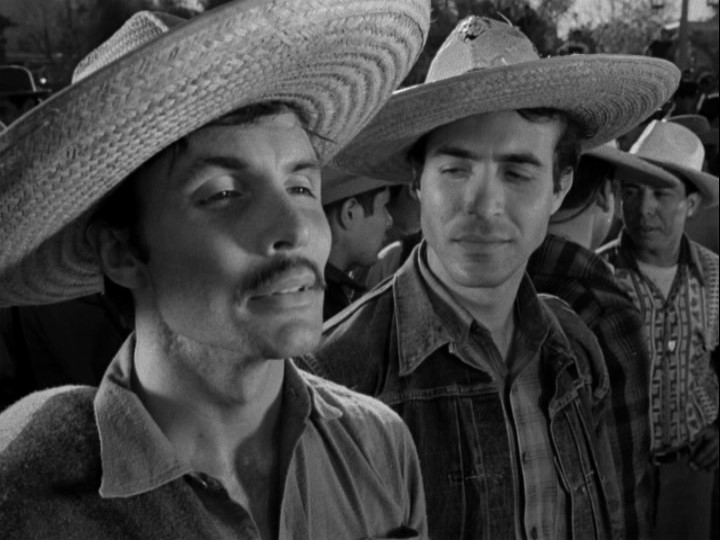
A notable movie if only for the attitudes and assumptions it embodies. Released in the late 40s, it’s a social problem film about illegal immigration shot like a Mexican noir by cinematographer John Alton. Director Anthony Mann, who takes a quasi-documentary approach to the material, lays out the problem in the opening narration: California’s Imperial Valley farms depend on Mexican field labor to operate efficiently, labor that’s carefully regulated by both the Mexican and United States governments. However, some Mexican laborers are so desperate for work that they cross the border illegally without the proper documentation, where they fall prey to unscrupulous American businessmen who don’t pay them a fair wage and Mexican bandits who rob, and sometimes kill, the workers as they cross the border.
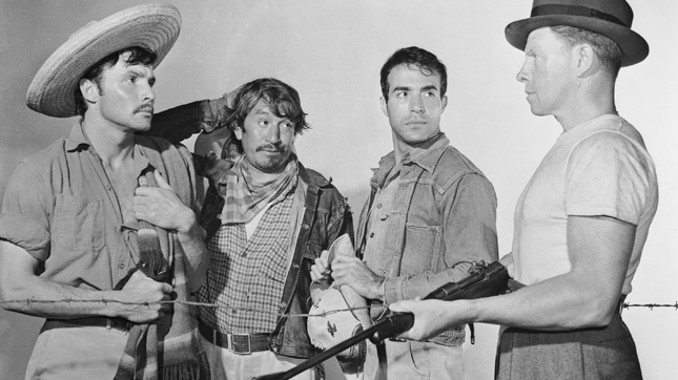
The Mexican and United States governments recognize their shared interest in stopping the illegals, so each sends agents undercover to infiltrate the smuggling network. The Mexican agent, played by a young Ricardo Montalban, pretends to be laborer while the American agent, played by George Murphy, pretends to be thief looking to sell stolen immigration cards. Throughout the movie the Mexican and United States governments — “those two great republics,” the film tells us — are portrayed as complete equals while the illegal immigrants themselves are portrayed sympathetically. At worst, the laborers are foolish and a bit naive because they don’t realize that, even if they get work, they’ll be taken advantage of by the unscrupulous American employers who will pay them 2/3 less than documented immigrants. The fat American landowner who traffics in the illegal labor, played by Howard Da Silva, is the real villain in the story. The film ends with the American agent dead, run over by a tractor in the middle of a lettuce field while sacrificing himself on behalf of laborers, while the Mexican agent receives a medal for his part in bringing the wrongdoers to justice. Has Steve Sailer seen this movie?
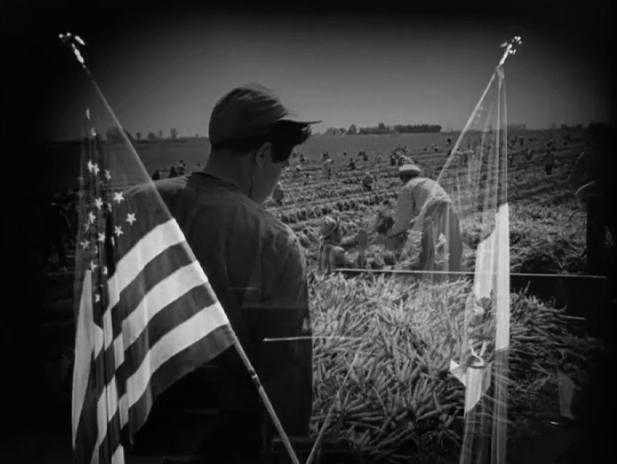
Border Incident is currently streaming on FilmStruck.
Paleo Retiree writes:
Fabrizio del Wrongo writes:

I got to thinking about the Femlin after reading this excellent post at Bandsiusetalike.com about the virtues of ’70s-era Playboy and the culture that created it.
The Femlin was the creation of LeRoy Neiman; presumably the name is a play on “gremlin,” a creature whose mischievous spirit the Femlin shared. For years she adorned the pages of Playboy’s “Party Jokes” feature. Does she still? I almost don’t want to know the answer.
Although minimalist of design and somewhat roughly rendered, the Femlin really stands for something, doesn’t she? Equal parts Bettie Page and Tinkerbell, she embodies the non-maternal traits that men desire in women. She’s sexy (duh), fun, great at making and taking jokes, and helpful. Most importantly, she’s keen to please and take care of her man: Neiman often shows her tending to his wardrobe or toilet, and she is more pleased by these attentions than is their beneficiary (he bemusedly tolerates her).
In the early ’80s Playboy eulogized the Femlin thusly:
From the beginning, the Femlin has retained her basic personality, but she has changed with the times. She started out as nothing more than a party girl, but lately, she has roller-skated and manipulated pocket calculators. She’s also been getting outdoors a lot — carving her initials into trees or picking flowers. As Neiman says, “She’s an all-American girl.” (You mean there’s no Femlin in the Kremlin?) Anyway, many saucy returns to the saucy little lady who proves the adage that good things do come in small packages.
There’s something joyous and comforting about the Femlin. Even as a kid, I loved to see her. Today, I fear most people would take her as an opportunity for a diatribe concerning sexism. What can you do?


Related:
Paleo Retiree writes:

Fabrizio del Wrongo writes:

SUMMER as it was, the east wind set poor Hepzibah’s few remaining teeth chattering in her head, as she and Clifford faced it, on their way up Pyncheon Street, and towards the centre of the town. Not merely was it the shiver which this pitiless blast brought to her frame (although her feet and hands, especially, had never seemed so death-a-cold as now), but there was a moral sensation, mingling itself with the physical chill, and causing her to shake more in spirit than in body. The world’s broad, bleak atmosphere was all so comfortless! Such, indeed, is the impression which it makes on every new adventurer, even if he plunge into it while the warmest tide of life is bubbling through his veins. What, then, must it have been to Hepzibah and Clifford,—so time-stricken as they were, yet so like children in their inexperience,—as they left the doorstep, and passed from beneath the wide shelter of the Pyncheon Elm! They were wandering all abroad, on precisely such a pilgrimage as a child often meditates, to the world’s end, with perhaps a sixpence and a biscuit in his pocket. In Hepzibah’s mind, there was the wretched consciousness of being adrift. She had lost the faculty of self-guidance; but, in view of the difficulties around her, felt it hardly worth an effort to regain it, and was, moreover, incapable of making one.
As they proceeded on their strange expedition, she now and then cast a look sidelong at Clifford, and could not but observe that he was possessed and swayed by a powerful excitement. It was this, indeed, that gave him the control which he had at once, and so irresistibly, established over his movements. It not a little resembled the exhilaration of wine. Or, it might more fancifully be compared to a joyous piece of music, played with wild vivacity, but upon a disordered instrument. As the cracked jarring note might always be heard, and as it jarred loudest amidst the loftiest exultation of the melody, so was there a continual quake through Clifford, causing him most to quiver while he wore a triumphant smile, and seemed almost under a necessity to skip in his gait.
They met few people abroad, even on passing from the retired neighborhood of the House of the Seven Gables into what was ordinarily the more thronged and busier portion of the town. Glistening sidewalks, with little pools of rain, here and there, along their unequal surface; umbrellas displayed ostentatiously in the shop-windows, as if the life of trade had concentrated itself in that one article; wet leaves of the horse-chestnut or elm-trees, torn off untimely by the blast and scattered along the public way; an unsightly, accumulation of mud in the middle of the street, which perversely grew the more unclean for its long and laborious washing,—these were the more definable points of a very sombre picture. In the way of movement and human life, there was the hasty rattle of a cab or coach, its driver protected by a waterproof cap over his head and shoulders; the forlorn figure of an old man, who seemed to have crept out of some subterranean sewer, and was stooping along the kennel, and poking the wet rubbish with a stick, in quest of rusty nails; a merchant or two, at the door of the post-office, together with an editor and a miscellaneous politician, awaiting a dilatory mail; a few visages of retired sea-captains at the window of an insurance office, looking out vacantly at the vacant street, blaspheming at the weather, and fretting at the dearth as well of public news as local gossip. What a treasure-trove to these venerable quidnuncs, could they have guessed the secret which Hepzibah and Clifford were carrying along with them! But their two figures attracted hardly so much notice as that of a young girl, who passed at the same instant, and happened to raise her skirt a trifle too high above her ankles. Had it been a sunny and cheerful day, they could hardly have gone through the streets without making themselves obnoxious to remark. Now, probably, they were felt to be in keeping with the dismal and bitter weather, and therefore did not stand out in strong relief, as if the sun were shining on them, but melted into the gray gloom and were forgotten as soon as gone.
Poor Hepzibah! Could she have understood this fact, it would have brought her some little comfort; for, to all her other troubles,—strange to say!—there was added the womanish and old-maiden-like misery arising from a sense of unseemliness in her attire. Thus, she was fain to shrink deeper into herself, as it were, as if in the hope of making people suppose that here was only a cloak and hood, threadbare and woefully faded, taking an airing in the midst of the storm, without any wearer!
As they went on, the feeling of indistinctness and unreality kept dimly hovering round about her, and so diffusing itself into her system that one of her hands was hardly palpable to the touch of the other. Any certainty would have been preferable to this. She whispered to herself, again and again, “Am I awake?—Am I awake?” and sometimes exposed her face to the chill spatter of the wind, for the sake of its rude assurance that she was. Whether it was Clifford’s purpose, or only chance, had led them thither, they now found themselves passing beneath the arched entrance of a large structure of gray stone. Within, there was a spacious breadth, and an airy height from floor to roof, now partially filled with smoke and steam, which eddied voluminously upward and formed a mimic cloud-region over their heads. A train of cars was just ready for a start; the locomotive was fretting and fuming, like a steed impatient for a headlong rush; and the bell rang out its hasty peal, so well expressing the brief summons which life vouchsafes to us in its hurried career. Without question or delay,—with the irresistible decision, if not rather to be called recklessness, which had so strangely taken possession of him, and through him of Hepzibah,—Clifford impelled her towards the cars, and assisted her to enter. The signal was given; the engine puffed forth its short, quick breaths; the train began its movement; and, along with a hundred other passengers, these two unwonted travellers sped onward like the wind.
At last, therefore, and after so long estrangement from everything that the world acted or enjoyed, they had been drawn into the great current of human life, and were swept away with it, as by the suction of fate itself.
Still haunted with the idea that not one of the past incidents, inclusive of Judge Pyncheon’s visit, could be real, the recluse of the Seven Gables murmured in her brother’s ear,—
“Clifford! Clifford! Is not this a dream?”
“A dream, Hepzibah!” repeated he, almost laughing in her face. “On the contrary, I have never been awake before!”
Meanwhile, looking from the window, they could see the world racing past them. At one moment, they were rattling through a solitude; the next, a village had grown up around them; a few breaths more, and it had vanished, as if swallowed by an earthquake. The spires of meeting-houses seemed set adrift from their foundations; the broad-based hills glided away. Everything was unfixed from its age-long rest, and moving at whirlwind speed in a direction opposite to their own.
Within the car there was the usual interior life of the railroad, offering little to the observation of other passengers, but full of novelty for this pair of strangely enfranchised prisoners. It was novelty enough, indeed, that there were fifty human beings in close relation with them, under one long and narrow roof, and drawn onward by the same mighty influence that had taken their two selves into its grasp. It seemed marvellous how all these people could remain so quietly in their seats, while so much noisy strength was at work in their behalf. Some, with tickets in their hats (long travellers these, before whom lay a hundred miles of railroad), had plunged into the English scenery and adventures of pamphlet novels, and were keeping company with dukes and earls. Others, whose briefer span forbade their devoting themselves to studies so abstruse, beguiled the little tedium of the way with penny-papers. A party of girls, and one young man, on opposite sides of the car, found huge amusement in a game of ball. They tossed it to and fro, with peals of laughter that might be measured by mile-lengths; for, faster than the nimble ball could fly, the merry players fled unconsciously along, leaving the trail of their mirth afar behind, and ending their game under another sky than had witnessed its commencement. Boys, with apples, cakes, candy, and rolls of variously tinctured lozenges,—merchandise that reminded Hepzibah of her deserted shop,—appeared at each momentary stopping-place, doing up their business in a hurry, or breaking it short off, lest the market should ravish them away with it. New people continually entered. Old acquaintances—for such they soon grew to be, in this rapid current of affairs—continually departed. Here and there, amid the rumble and the tumult, sat one asleep. Sleep; sport; business; graver or lighter study; and the common and inevitable movement onward! It was life itself!
Clifford’s naturally poignant sympathies were all aroused. He caught the color of what was passing about him, and threw it back more vividly than he received it, but mixed, nevertheless, with a lurid and portentous hue. Hepzibah, on the other hand, felt herself more apart from human kind than even in the seclusion which she had just quitted.
“You are not happy, Hepzibah!” said Clifford apart, in a tone of approach. “You are thinking of that dismal old house, and of Cousin Jaffrey”—here came the quake through him,—”and of Cousin Jaffrey sitting there, all by himself! Take my advice,—follow my example,—and let such things slip aside. Here we are, in the world, Hepzibah!—in the midst of life!—in the throng of our fellow beings! Let you and I be happy! As happy as that youth and those pretty girls, at their game of ball!”
“Happy—” thought Hepzibah, bitterly conscious, at the word, of her dull and heavy heart, with the frozen pain in it,—”happy. He is mad already; and, if I could once feel myself broad awake, I should go mad too!”
If a fixed idea be madness, she was perhaps not remote from it. Fast and far as they had rattled and clattered along the iron track, they might just as well, as regarded Hepzibah’s mental images, have been passing up and down Pyncheon Street. With miles and miles of varied scenery between, there was no scene for her save the seven old gable-peaks, with their moss, and the tuft of weeds in one of the angles, and the shop-window, and a customer shaking the door, and compelling the little bell to jingle fiercely, but without disturbing Judge Pyncheon! This one old house was everywhere! It transported its great, lumbering bulk with more than railroad speed, and set itself phlegmatically down on whatever spot she glanced at. The quality of Hepzibah’s mind was too unmalleable to take new impressions so readily as Clifford’s. He had a winged nature; she was rather of the vegetable kind, and could hardly be kept long alive, if drawn up by the roots. Thus it happened that the relation heretofore existing between her brother and herself was changed. At home, she was his guardian; here, Clifford had become hers, and seemed to comprehend whatever belonged to their new position with a singular rapidity of intelligence. He had been startled into manhood and intellectual vigor; or, at least, into a condition that resembled them, though it might be both diseased and transitory.
The conductor now applied for their tickets; and Clifford, who had made himself the purse-bearer, put a bank-note into his hand, as he had observed others do.
“For the lady and yourself?” asked the conductor. “And how far?”
“As far as that will carry us,” said Clifford. “It is no great matter. We are riding for pleasure merely.”
“You choose a strange day for it, sir!” remarked a gimlet-eyed old gentleman on the other side of the car, looking at Clifford and his companion, as if curious to make them out. “The best chance of pleasure, in an easterly rain, I take it, is in a man’s own house, with a nice little fire in the chimney.”
“I cannot precisely agree with you,” said Clifford, courteously bowing to the old gentleman, and at once taking up the clew of conversation which the latter had proffered. “It had just occurred to me, on the contrary, that this admirable invention of the railroad—with the vast and inevitable improvements to be looked for, both as to speed and convenience—is destined to do away with those stale ideas of home and fireside, and substitute something better.”
“In the name of common-sense,” asked the old gentleman rather testily, “what can be better for a man than his own parlor and chimney-corner?”
“These things have not the merit which many good people attribute to them,” replied Clifford. “They may be said, in few and pithy words, to have ill served a poor purpose. My impression is, that our wonderfully increased and still increasing facilities of locomotion are destined to bring us around again to the nomadic state. You are aware, my dear sir,—you must have observed it in your own experience,—that all human progress is in a circle; or, to use a more accurate and beautiful figure, in an ascending spiral curve. While we fancy ourselves going straight forward, and attaining, at every step, an entirely new position of affairs, we do actually return to something long ago tried and abandoned, but which we now find etherealized, refined, and perfected to its ideal. The past is but a coarse and sensual prophecy of the present and the future. To apply this truth to the topic now under discussion. In the early epochs of our race, men dwelt in temporary huts, of bowers of branches, as easily constructed as a bird’s-nest, and which they built,—if it should be called building, when such sweet homes of a summer solstice rather grew than were made with hands,—which Nature, we will say, assisted them to rear where fruit abounded, where fish and game were plentiful, or, most especially, where the sense of beauty was to be gratified by a lovelier shade than elsewhere, and a more exquisite arrangement of lake, wood, and hill. This life possessed a charm which, ever since man quitted it, has vanished from existence. And it typified something better than itself. It had its drawbacks; such as hunger and thirst, inclement weather, hot sunshine, and weary and foot-blistering marches over barren and ugly tracts, that lay between the sites desirable for their fertility and beauty. But in our ascending spiral, we escape all this. These railroads—could but the whistle be made musical, and the rumble and the jar got rid of—are positively the greatest blessing that the ages have wrought out for us. They give us wings; they annihilate the toil and dust of pilgrimage; they spiritualize travel! Transition being so facile, what can be any man’s inducement to tarry in one spot? Why, therefore, should he build a more cumbrous habitation than can readily be carried off with him? Why should he make himself a prisoner for life in brick, and stone, and old worm-eaten timber, when he may just as easily dwell, in one sense, nowhere,—in a better sense, wherever the fit and beautiful shall offer him a home?”
Clifford’s countenance glowed, as he divulged this theory; a youthful character shone out from within, converting the wrinkles and pallid duskiness of age into an almost transparent mask. The merry girls let their ball drop upon the floor, and gazed at him. They said to themselves, perhaps, that, before his hair was gray and the crow’s-feet tracked his temples, this now decaying man must have stamped the impress of his features on many a woman’s heart. But, alas! no woman’s eye had seen his face while it was beautiful.
“I should scarcely call it an improved state of things,” observed Clifford’s new acquaintance, “to live everywhere and nowhere!”
— Nathaniel Hawthorne
Fabrizio del Wrongo writes:

Are people still named Patti? I can think of a few ’70s-era Pattis, but I don’t encounter the name a whole lot these days. I suppose it’s short for Patricia. I don’t encounter many Patricias either. My completely made-up-on-the-spot theory: Peppermint Patty ruined the name for generations, perhaps forever. I hate Peppermint Patty, don’t you? I’m not even sure why I hate her, but I do. No, it’s not because she’s a lesbian. Actually, now that I think of it, I hate pretty much every Peanuts character with an undying passion, even the one or two straight ones. I notice that no one is named Lucy either. Coincidence?
Patti McGuire was the Playmate of the Year for 1977. The ’70s were a great era for Playmates. They still tended to be wholesome and somewhat middle-American. Patti definitely fit that type. She looked like a top-shelf version of the Irish-American girls I knew in high school. If only they’d looked at me like Patti looks at the camera…
That’s quite a look, isn’t it? While Patti’s smile made her look fresh and sweet, like a lemon-lime soft-drink, her come-hither look, which involved a slight lowering of the chin and a cobra-like stare, was like a shot of bourbon. A look like that either puts hair on a man’s chest or sends him home to play with mama.
She ended up marrying tennis great Jimmy Connors, who wasn’t in the habit of playing with mama.
I found this interesting statement in an old interview:
When [King] Kong first meets Fay Wray, he peels off her clothes, fondles her and then sniffs his fingers. Later, when he’s climbing the Empire State Building, he reaches through a window and grabs a blonde. He sniffs her and, realizing that she is not his beloved, casually tosses her some 50 stories to her death. That’s my idea of a faithful lover.
The lady demands fealty.
Nudity below. Have a great weekend.
 Blowhard, Esq.
 Callowman
 Sherbrooke
 Eddie Pensier
 Enzo Nakamura
 Epaminondas
 Fabrizio del Wrongo
 Fenster
 Brundle Guy
 Glynn Marshes
 Paleo Retiree
 Atypical Neurotic
 Question Lady
 Sax von Stroheim
 Sir Barken Hyena
 The Mistaken
 Uncouth Reflections