The Return of the Planned Economy?

Fenster writes:

Jack Ma, the Chairman of the Board of the Chinese internet giant Alibaba, suggests that big data may herald the return of the planned economy.

Over the past 100 years, we have always felt that the market economy is excellent, but in my opinion, in the next three decades will be a significant change, the planned economy will become increasingly large. Because we have access to all kinds of data, we may be able to find the invisible hand of the market. … [I]n the age of data, it is like we have an X-ray machine and a CT machine for the world economy, so 30 years later there will be a new theory [on planned economy] out.

Here is the article from the Chinese press.  You’ll need to translate it.  Imperfect but you will get the gist of it.

And here is commentary on the idea from Xiong Yue of the Mises Institute (link courtesy of Zero Hedge).

The notion of a return to a planned economy goes against the grain to be sure.  Capitalism beat communism fair and square and most all agree that the main cause is the simple ineffectiveness of a command economy in comparison to an economy that relies on complex and uncontrollable consumer preferences for its cues relative to investment and capital allocation.

Now comes Ma to suggest big data may change that.  Might is be possible that large technological changes may do a better job than the invisible hand of consumer choices?  After all, technology has disrupted one industry after another.  Might it not disrupt the very system that drove industry disruptions?

Yue argues no.  He argues that any technological approach can never replace the market since 1) data reflects past activity not the dynamic of ongoing real-time preferences and 2) the methods for collecting data, such as questionnaires, do not capture real preference nearly as well as actual consumer behavior.  As result, Yue sees Ma’s argument as just one more flight of fancy of elites who delude themselves into the belief that “seeing like a state” is feasible.

Fenster finds Yue’s argument persuasive but.

In the broadest sense I am suspicious of ideological thinking.  Practice hardens and magically becomes a path.  It hardens further and becomes a doctrine.  It hardens further and becomes some sort of Platonic truth.  Somewhere along the way I part company.  Things work until they do not work any more, something suggested by Steve Sailer when he pointed out that humans are not that well equipped to think in terms of diminishing marginal returns.  We seem built to think more in binary terms: good/bad, true/false, correct/incorrect.

Under this way of thinking, the primacy of the market approach is mostly due to its superior performance in a given period against given opposition .  Is it possible that Mises’ market has now become Mantra?

It is not as though the market is a perfect mechanism.  Even supporters recognize that there are limitations to its working perfectly.  Maybe big data is not an enemy of the market but an ally.  Yue suggests that the futurist view is that it “we can finally achieve a planned economy.”  Maybe some hold to that rigid formulation but Ma himself (in this admittedly bad translation) seems to have a more modest view: that the planned economy will become “increasingly large” and that we will have a “new theory” on it.  That seems compatible with a certain measure of co-existence with human preferences in action.

Consider also Ma’s separate reflections on Asian modes of thought relative to Western modes.

I said, I have read the Bible six times, after reading I understand the difference between the West and the East, the West pay attention to black and white, or black or white, or you believe me or do not believe me, and oriental culture stress integration , Taoist emphasis on the integration of black and white rather confrontation.

In this regard it may make sense to make a distinction between a command economy and what Ma refers to as a planned one.  In our experience there is not much of a distinction.  When you plan you plan from the top.  That suggests command, and command will fail because it is too thin a reed on which to rest large and complex systems.  But does planning need to denote command?

I think Sailer is right that our minds–at least our Western minds–resist marginal thinking.  They also resist being able to embrace the complexity of systems.  We think: what is the cause and what is the effect?  Can I do a statistical analysis that demonstrates the arrow of causality?

Any integrated system is not just bottom-up.  It is, in the words of computing, distributed.  Consumer preferences are a key component to an economic system but the system can nonetheless be envisioned as an integrated (though still inherently unstable and dynamic) system.  Is there a role for big data in there?  Might that role not get appreciably larger as conditions change?

Then there is the always pesky problem of what consumer preferences actually reveal. What they reveal is a pretty narrow thing when you consider the totality of human existence: what purchases to make under conditions of scarcity occasioned by the presence of money.

Maybe that’s as good as it gets.  Yue quotes Mises approvingly:

One cannot add up values or valuations. One can add up prices expressed in terms of money, but not scales of preference.

As Yue comments:

The role of prices in the market economy is unique because money prices offer an indispensable tool in economic calculation.

As Mises’s own comment seems to indicate there is a world of preference out there that goes beyond “prices”.  But they can’t be captured.  Or can they?

Posted in Politics and Economics | Leave a comment

Couldn’t Do It Today

Blowhard, Esq. writes:

Posted in Music | Tagged , | 1 Comment

Primer on Refugee Law

Fenster writes:

No, Fenster is not doing a primer on refugee law.  He can only comment as a rank amateur on what looks like a good primer (thanks to the highly credible Volokh Conspiracy for the link).

The primer, written by Paul Rosenzweig, is here.  Read the whole thing, as the saying goes.   It is a lot more learned than the commentary.  I won’t summarize but I will comment.

My takeaways:

1. 50,000-75,000 refugees (the rough range of our limits) are a drop in the bucket compared with the actual problem.  But it does comprise half of the number processed by UNHCR.   Conclusion:  we do our fair share of UNHCR work but what UNHCR processes is a drop in the bucket in itself.  Most refugees operate outside its scope, with most “resettled through informal mechanisms, or not resettled at all.”

2. Our geographic distance from war zones insulates us from the “informal” problems occasioned by exodus, so most of our discussion on this relates to the finer points of formal UNHCR negotiations of processing our relatively small quota.  We are debating a significant issue, but it is a small one in the scheme of things as regards the totality of the refugee issue, which is being played out on the ground in Europe and elsewhere in other ways.

3. Our law is based on the language of the 1951 UN Convention. In both cases the definition of refugee turns mainly on fear of persecution rather than simple displacement from conflict or desire for a better life given tough conditions in the home country.  So at least from the POV of the definition of the term, many people escaping war zones would not meet the definition of refugee, nor would many escaping a hard life in Mexico or even drug violence in Honduras.  That does not mean we should not be compassionate–only that as far as I see there are limits to our obligations under the Convention and American law.

4.  My guess from this is one can distinguish between the Convention and the US law–which we are bound to follow–and the practices of the UNHCR.  The UNHCR bases its work on the Convention and needs to be mindful of US law.  But I doubt the US is compelled to do what the UNHCR says in the same way it is supposed to follow the Convention and laws.

5. Vetting is very hard to do well under the circumstances.  And the author makes a credible case that we may be doing it as well as it can be done.  And that if one wanted to sneak in to do bad things there are easier ways to do it than by running the gauntlet via UNHCR and US vetting.

Tie this to the fact that there have been zero deaths in the US from admitted refugees.  And that we have a larger problem with domestic Muslims radicalized here than we do with refugees.  That all makes a reasonable case that the problem may have been overblown.

And now, in lawyerly fashion, for the ‘on the other hand’.

While there have been no instances of refugees undertaking fatal attacks there are a good number of instances of refugees “convicted for, or implicated in, terrorism or terrorism-related offenses“–and that’s just convicted.  40, according to Jeff Sessions.  And that is against a relatively small sample, per the above.

Also many radicalized in the US are second generation immigrants, like the San Bernadino and Orlando shooters.  That’s not a strong argument to let the first generation in.

Significant percentages of actual refugees from the Middle East hold sympathetic views of Hamas or Hezbollah or ISIS or al-Qaeda.  That’s quite different from other instances of granting refugee status on the basis of fear or persecution, like the Vietnamese boat people or Iranians running from Khomeini or Russian Jewry.  The enemy of my enemy is not always my friend.

Consider also that while Rosenzweig concludes that the vetting in the rough environment of camps may be as good as it gets he hardly argues that it is foolproof or even close.   Witness the 40 convictions.

So now comes a new Administration.  They are not expert in all the subtleties since they have not been in the driver’s seat.  Like all new administrations they want to take their own measure of things.  Like most new administrations they necessarily trip and fall as they try to figure out how to do it.  Add to that this particular Administration’s peculiar and seemingly ham-handed style–ready, fire, aim.

So they impose a 3 month stay while they take stock.  I don’t find that an unreasonable approach.   And if you step back and look at what has been written about the Executive Order from all corners of the internet it does come across as a significant but not earth-shaking thing.  It is the kind of thing around which reasonable people will disagree as to both substance and legality.  But when I turn on the nightly news why is it all about violins and sweet children with big eyes?


ADDENDUM:  Emerson said it is a luxury to be understood and something of the reverse is true too.  Given that language is a device for ambiguity as well as clarity misunderstanding comes easy.  So at the risk of compounding things let me say that that last sentence above is not meant to minimize the real and serious problems of refugees.  Any snarky note was aimed mainly at the mainstream media.  On this issue (and on many issues where the issue of Trump is central) the press presents one side when the issue is more complicated and worthy of discussion and debate.

Posted in Politics and Economics | Tagged , , , | 18 Comments

Juxtaposin’: Wang Dang Doodle

Blowhard, Esq. writes:

Posted in Music | Tagged , | 1 Comment

Couldn’t Do It Today

Fabrizio del Wrongo writes:

uploads-2016-8-16-abcspatriots_20

uploads-2016-8-16-abcspatriots_21

More here.

Posted in Books Publishing and Writing, History, Politics and Economics | Tagged , , , | 2 Comments

Architecture and Color

Paleo Retiree writes:

Posted in Architecture | Tagged | 1 Comment

Naked Lady of the Week: Dama

Fabrizio del Wrongo writes:

d-cover

Dama here has the sort of dark, doll-like beauty that I associate with Jewish women such as Winona Ryder, Natalie Portman, and the porn star Casey Calvert. The internet claims she’s Russian, which certainly doesn’t rule out Jewishness.

For me, part of the fun of these “Naked Lady” write-ups is musing about the ways in which nationality and ethnicity intersect with appearance. This hasn’t been a favored topic over the last 80 years because, oh, Hitler, but it’s a topic that remains fascinating, particularly in the arena of girl-watching.

In what ways do English girls differ from Irish ones? Does she look more Hungarian, Polish, or Russian? Isn’t it interesting that I associate darkness and delicacy with Austrian women, and lightness and robustness with German ones?

These are the sorts of questions that inevitably occupy the mind of the man who loves looking at women — and I don’t think most of us ever pause to feel guilty about considering them.

Whatever her ethnicity, Dama is a pleasure to look at — serene, lithe, and decorous.

Nudity below. Have a great weekend.

Continue reading

Posted in Photography, Sex, The Good Life | Tagged , , , | Leave a comment

Let Us Now Praise the White Saviors of Black Music

Blowhard, Esq. writes:

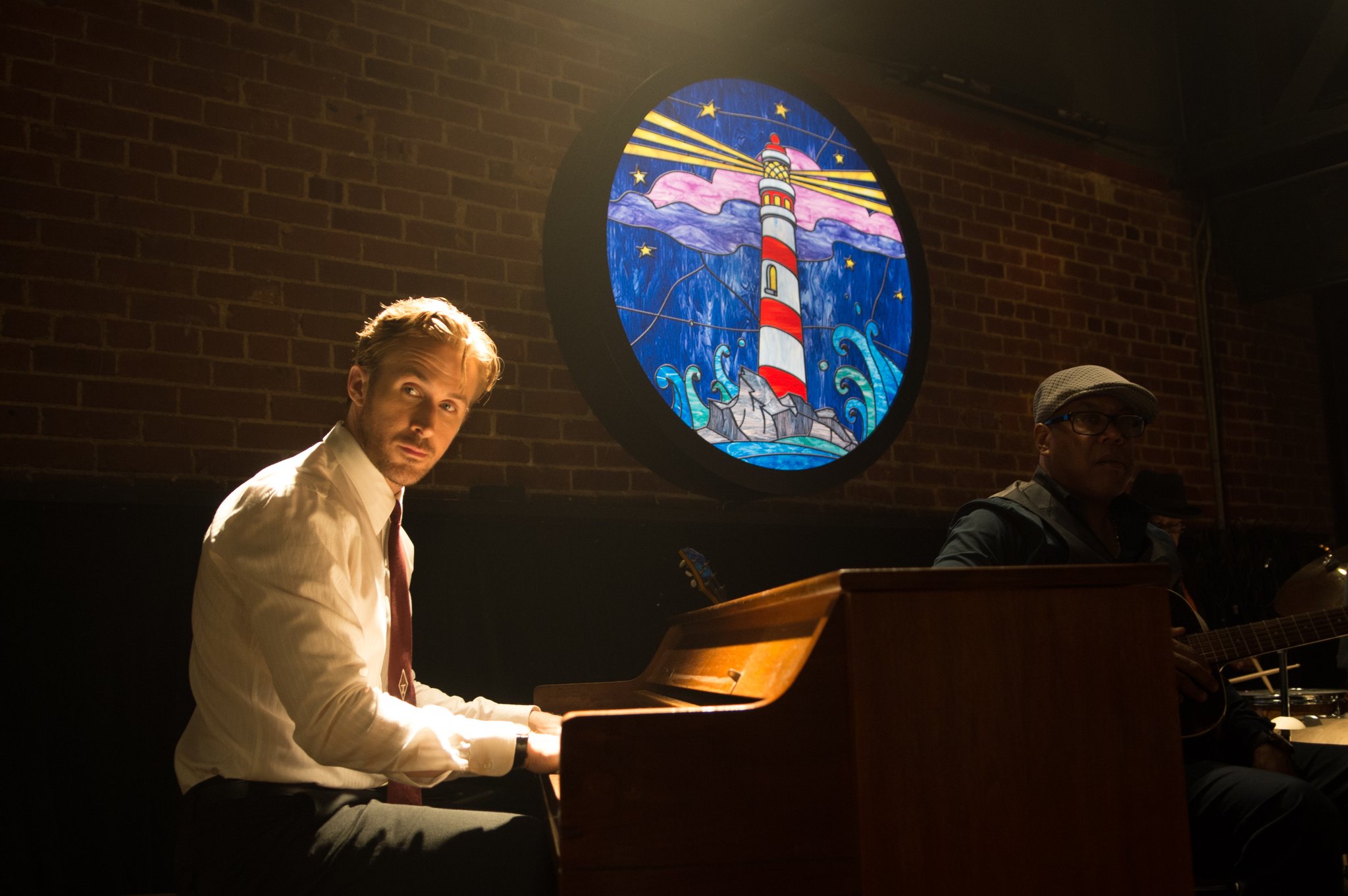
ryangoslingjazz

Hey girl, wanna culturally appropriate the syncopated stylings of African slaves?

In a dialogue with fellow New York Times movie critic A.O. Scott, Manohla Dargis criticized the continuing white-centric nature of most Hollywood films:

“Sully” is about professionalism and expertise, specifically those of a white hero, which is true of many Clint Eastwood movies and, for that matter, those of Howard Hawks. Kenneth Lonergan’s “Manchester by the Sea” is about a working-class white man’s tragedy, and his whiteness is as crucial to his identity as class. Damien Chazelle’s “La La Land” has several black characters, but it also, exasperatingly, positions a white pianist as the savior of jazz and a black musician as its corrupter. Whatever their genres and stories, these movies are all also about race, because race defines our world.

Over at New York magazine, Anna Silman, in the midst of an article about how much she hates it when white men mansplain music, says that “positioning Ryan Gosling as jazz’s white savior while relegating black musicians to the background left a sour taste in [her] mouth.” Culture critic Ira Madison is likewise bothered that white Canadian Ryan Gosling plays a jazz torchbearer:

The wayward side effect of casting Gosling as this jazz whisperer is that La La Land becomes a Trojan horse white-savior film. Much like Matt Damon with ancient China in The Great Wall or Tom Cruise in The Last Samurai, in La La Land, the fate of a minority group depends on the efforts of a well-intentioned white man: Gosling’s character wants to play freestyle jazz instead of the Christmas jingles he’s been hired to perform because, damn it, if the people can’t hear real jazz, then it’s going to cease to exist.

With all due respect to Dargis, Silman, and Madison — and excuse me for phrasing this so delicately, for being so overly polite — but they’re fucking morons who don’t know shit about shit. Or, to be more precise, their “It’s the current year!” racial pandering has virtually no basis in reality. First, I’ll note at the outset that at no point in the movie does Gosling position himself the “savior” of anything nor does the movie argue that anything or anyone will “cease to exist” should he fail in his task of opening a jazz club. These critics are creating strawmen.

But let’s grant their faulty premise and assume that’s exactly what Gosling’s character thinks of himself. Writer/director Damien Chazelle was exactly correct in choosing a white jazz savior because, as anyone who’s spent any significant amount of time in the jazz or blues worlds notices, it’s an interest that’s overwhelmingly dominated by white people. Not the performers — I’m talking about the fans, collectors, concertgoers, label moguls, club owners, impresarios, and other supporters. To the extent that jazz and blues still exist as something other than museum curiosities, it’s because of white saviors.

Traditional jazz and blues, like classical music, are niche pursuits with relatively tiny audiences compared to hip-hop and pop, but there are still a number of record labels that cater to the faithful and they’re largely run by honkeys:

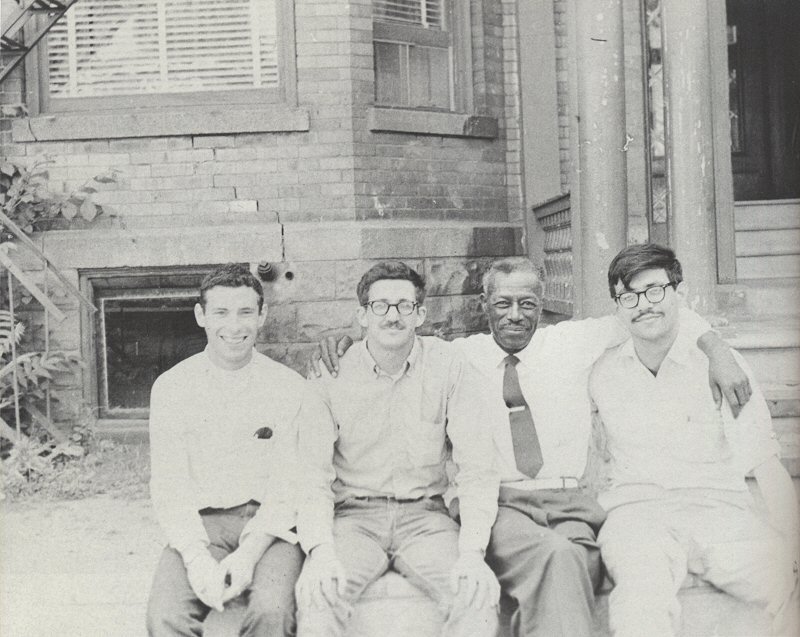
But for the efforts of these privileged crackers, some of the greatest American music would’ve dissipated into the ether a long time ago. When legendary bluesman Son House was rediscovered in 1964 during the folk revival, it wasn’t Berry Gordy, James Brown, Sam Cooke, Aretha Franklin, or LeRoi Jones who drove down to Mississippi on their own dimes to knock on doors. House was found by Nick Perls, Dick Waterman, and Phil Spiro, guys who look like the dictionary definition of “white male nerds.”

nickperls

Son House being oppressed by the white racist power structure.

In her book Do Not Sell At Any Price: The Wild, Obsessive Hunt for the World’s Rarest 78rpm Records, music journalist and frequent New Yorker contributor Amanda Petrusich delves into the subculture of American roots music record collecting. She profiles a number of the major figures who have made careers out of (or at least dedicated all of their free time to) preserving pre-War American blues, jazz, and folk music. People like John Heneghan, John Fahey (who wrote his UCLA masters dissertation on Charley Patton), Pete Whelan, John Tefteller, Marshall Wyatt, James McKune, Harry Smith, Nathan Salsburg, Jonathan Ward, Christopher King, and Joe Bussard.

Here’s a picture of Christopher King, a 78 collector and Grammy-award-winning engineer who has produced a number of acclaimed collections for JSP Records and Tompkins Square Records.

ck_in_studio

Joe Bussard’s collection of vintage 78s — he has over 15,000 — is considered one of the best in the world. A documentary about Bussard, Desperate Man Blues, was released in 2006.

joe-bussard-frederick-md

To be fair, Jay Z and Dr. Dre founded Third Man Records to release beautiful deluxe collections of old Paramount sides — legendary songs recorded by Armstrong, King Oliver, Jelly Roll Morton, Patton, Jefferson, House, Skip James, Ma Rainey, and Ethel Waters, among many other legends — so credit where credit is due. Whoops, wait, did I say Jay Z and Dr. Dre? I meant Jack White.

“But,” you might say, “you’re talking about record labels that primarily release blues and folk music. Dargis and Madison were talking specifically about jazz clubs.” Fair enough, you hair-splitting pedant. Let’s look at some of the most famous jazz clubs in NYC:

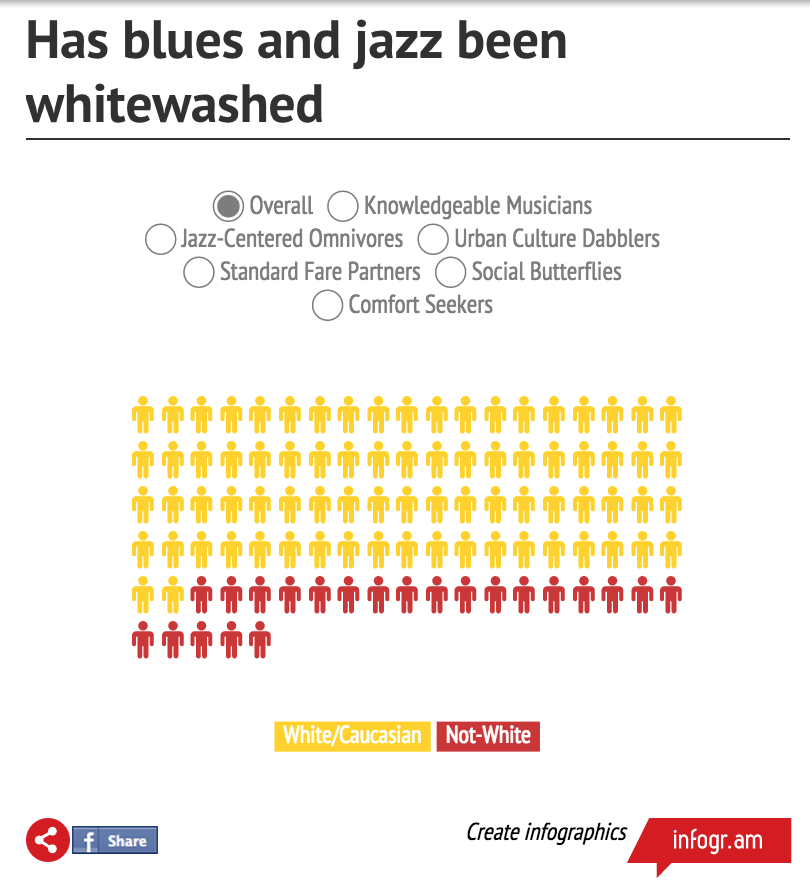
In other words, there’s plenty of precedent for the white jazz impresario stereotype. “But,” you might say, “the only reason whites are so overrepresented in jazz club ownership, trad American musical label ownership, and vintage 78 record collecting is white privilege! It costs a lot of money to do all that! Not to mention they’re racist cultural appropriators!” Yes, perhaps. But that’s not the issue, is it? Dargis and the others were objecting to the notion that there was something unrealistic or “wrong” about a white man saving/preserving/exploiting (feel free to use the word of your choice) black music but that’s entirely contrary to reality. Perhaps in some theoretical-ideal-normative-gosh-golly-wouldn’t-it-be-nice sense blacks “should” be supporting this music, but the plain fact is that they’re not. It’s mainly whites.

newbluesjazzdata4

None of this is to say that there are no blacks championing jazz. Wynton Marsalis tours the world as a jazz ambassador. Marsalis’s friend and mentor Stanley Crouch was a tireless jazz critic and promoter for decades. And hey, nice to see that the Library of America is bringing the great Albert Murray back into print. But despite the efforts of these luminaries, is it that controversial to say that hip-hop has captured the musical imagination of blacks — for decades now at this point — in a way that’s shunted older forms of black music to the sidelines? Remember when Bill Cosby used to drag Dizzy Gillespie and other aging jazz musicians onto The Cosby Show? Didn’t really make much of an impression on 80s black youth, did it? I doubt many ran to their father’s record collections to play Diz and Getz, although surely some were influenced. Sampling in rap songs is nice, but I don’t think that’s enough.

A couple of anecdotes. Paleo Retiree once went to the King Biscuit Blues Festival in the Mississippi Delta. He told me that while the blues performers were about half black and half white, the audience was about 90% white and 10% black. When he went to the local black-owned restaurants to eat, they were all blaring hip-hop, not blues. As for myself, I go to Academy Records, the Jazz Record Center, and Westsider Records every couple of months and I always take stock of who’s shopping. I rarely see black faces browsing the jazz and blues bins but when I do, it’s always an older gentleman who looks 60+ — I’ve yet to see a black dude my age or younger. When I was in Harlem on 125th about a year ago, I came across a guy selling bootleg CDs on the street. He had a huge album that you browsed and if you wanted something, he went to a computer in his van and burned the CD for you on the spot. The album contained tons of hip-hop, dance music, funk, and soul from the 60s until now. I didn’t see a single pre-Civil Rights era record and certainly no blues or jazz.

If arts critics want to decry jazz’s lack of popularity and brainstorm ideas on how to revive interest, I’d gladly join their chorus. But criticizing the color of a self-proclaimed savior of the country’s least popular music because his race doesn’t comport with the politics of the moment is proof they love political correctness more than art. They should be ecstatic that anyone cares at all.

Posted in Movies, Music | Tagged , , , | 10 Comments

Couldn’t Do It Today

Fabrizio del Wrongo writes:


giqjgdy

More.

The documentary about “The National Lampoon” is now on Netflix. It’s called “Drunk Stoned Brilliant Dead: The Story of the National Lampoon.”

Posted in Books Publishing and Writing, Humor | Tagged , , | 3 Comments

“Moonlight” (2016) and “Silence” (2016)

Blowhard, Esq. writes:

moonlight

silencecoverI found the experience of watching these movies to be very similar. In both we’re presented with characters suffering a great deal, the movies demand that we regard them as saints, yet virtually no attempt is made to dramatize their suffering. The filmmakers just take it for granted that we’ll be as moved by the subject matter as they are.

EDIT: It occurs to me that JACKIE belongs in this category, too.

jackie

Posted in Movies | Tagged , , , , | 7 Comments