Along with Blowhard, Esq. and Fabrizio del Wrongo, I’m a big fan of Kenneth Harl, a Tulane professor who has done numerous lecture series about early and medieval history for The Great Courses. He’s smart, he’s fast, he isn’t driven by ideology, he has a big gift for making facts seem like they matter, and he has a wonderfully caustic and lusty horror/appreciation for the egomaniacs and bastards who drive so much of history.
I just finished Harl’s “Barbarian Empires of the Steppes” and am pleased to report that it’s another good one. At 36 half-hour lectures, it may run a little long … but I felt like it flew by. Harl may be more fascinated by battles and conquests than I am … but he does have a genuine respect for culture and, hey, battles and wars and conquests are important. In the case of the barbarian tribes of the Euro-Asian steppes, he may be obliged to rely mainly on reports from the settled civilizations that surrounded them (the barbarians themselves didn’t leave many records) … but he proves great at bringing the tribes and leaders to life anyway.
If that huge stretch between China and Europe is a big blank to you, as it largely was for me, this series will do an excellent job of filling it in. If you’re curious about Attila the Hun and Genghis Khan but are reluctant to commit yourself to reading entire books about them, this is a great introduction. I’ve got a much better grasp on the Turks, the Huns, the Mongols and many other tribes that have come and gone than I did previously. And hats off to Harl for his refreshingly realistic view of history. For him, the ebb and flow of populations over time is a matter of peoples and tribes trying to have their way in the world, and has little or nothing to do with ideals and such.
Related
Harl’s series showed up in an epic posting by Blowhard, Esq. about how to educate yourself without going to college.
Every four or five years, Woody Allen makes a movie that everyone — critics and audiences alike — seems to love. Often, people will talk about these movies using some variation of the phrase “Woody’s return to form.” The aging auteur reclaiming past heights makes for a good, compelling story, but in Woody’s case it’s just a story. The reality is boring: the movies in between the consensus favorites get ignored or dismissed, but they’re almost all just as good, or even better than, the highly-acclaimed ones sandwiching them. That doesn’t provide a very good hook for a review, though. Something I’ve always liked about Woody is that he’s equally apt to make a movie inspired by his love of Ingmar Bergman as he is his love of silly, tossed-off Paramount comedies from the 1930s, but a lot of people don’t seem to know how to take his movies anymore when he’s not signalling that he’s making an important one.
Blue Jasmine was his last “return to form”, but I like the movies he’s made since then better.
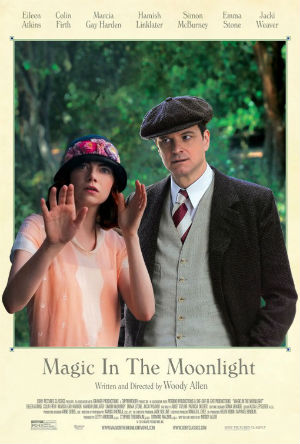
Blue Jasmine, Woody’s riff on Tennessee Williams, was a purposeful, weighty movie. It’s follow-up, Magic in the Moonlight is a purposeful, lightweight movie. Essentially, Magic in the Moonlight is the “Why is life worth living?” line from Manhattan expanded into a George Bernard Shaw-style comedy. This is one of the modes Woody uses in his later work: taking a single idea from one of his earlier, novelistic movies and building a much more theatrical movie around it. Thematically, Magic in the Moonlight is almost relentlessly anti-magic, anti-fantasy, anti-religion, anti-spiritual-but-not-religious, and anti-romance. It’s also extremely charming.
Irrational Man, Woody’s next movie, I like even more than Magic in the Moonlight: everyone else seemed to like it even less, and there was at least one major critic who deemed it Woody’s worst. (I think it ranks up with his best ever). Irrational Man fills the space between Crimes and Misdemeanors and You Will Meet a Tall Dark Stranger — and just as Magic in the Moonlight expanded on Manhattan‘s “Why is life worth living?” line, Irrational Man expands on Manhattan‘s joke about baseball bats being better than op-eds for dealing with certain kinds of problems. Still, for all that it draws on from his earlier work, it isn’t like any movie he’s made before — and not much like any movie anyone else had made before either. It’s a psychological thriller pitched and played as one of those indie romantic comedy/dramas (think 50 Days of Summer) about two special snowflakes meeting cute and falling into quirky, problematic love. This gives the whole movie a push-pull feel: scenes aren’t played for tension or suspense (especially noticeable in those scenes that another director would play for tension or suspense e.g., the Russian roulette scene), and the underlying thriller plot ends up curdling the movie’s charm. On purpose, though.
I can see why that may be a turn-off, but that’s not an especially adventurous reaction. This is one of those movies that deep in its core is very strange, but it seems very familiar on the surface. Audiences and critics both got stuck on the surface, but the surface itself isn’t what’s satisfying about the movie so they came away from it thinking that it didn’t work and, anyway, they had seen it all before, despite the fact that (a) it works perfectly and (b) it isn’t much like any other movie. You Will Meet a Tall Dark Stranger, which is for me, one of the highlights of Woody’s late period and one of the highlights of his career, ran into similar problems: that was a movie that was bleaker and nastier than the highly-acclaimed Match Point, but because it was played lightly people seemed to think Woody had failed at making a charming little comedy.
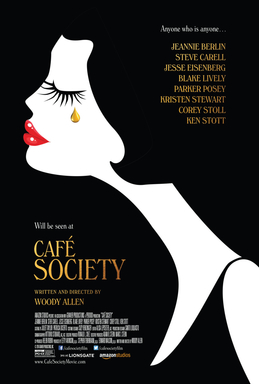
Woody’s latest, Café Society, is also in the same kind of “greatest hits” mode as Irrational Man. He brings in bits and pieces of his other movies — Bullets Over Broadway, Broadway Danny Rose, and Radio Days are the obvious ones, but Crimes and Misdemeanors ends up sneaking in through a back door and overtaking the proceedings — and rearranged them into a dark comedy of ideas that has no fear of being too theatrical or too literary. (Walking out of the theater, it struck me that late Woody is converging with late Resnais). As with a lot of Woody’s late work, it eschews any pretense of sociology or journalism: this has the least Hollywood feel of almost any movie set in the glory days of Hollywood, but that didn’t really bother me. I think what a lot of people loved about Woody’s movies from the 1980s was the way they opened a window on the lives of professional intellectuals and intellectual professionals living on the Upper West Side of Manhattan. After Husbands and Wives, though, Woody stopped making those kinds of movies, moving fully away from novelistic sociology towards theatrical philosophy. (You can draw your own conclusions about why that shift happened at that point in his life). I think a lot of people miss that anthropological aspect of his work, though, which plays a part in why they find the later work less compelling.
Irrational Man is bolder and more inventive than Café Society, but Café Society hit me harder on the way out: the dissolve near the end of the movie between the two leads, united in longing, but separated by missed opportunities, assumptions, and bad timing, had more emotional punch than anything else in his recent work.
I was wandering in the East 40s yesterday when I came across a hipster coffee joint. As I looked at the wooden sign in the window advertising their goods, I had to suppress a snicker: an unfinished wooden sign, the hand-painted lettering, the self-conscious rustic charm. It’s funny how these elements have become design cliches. I was going to snap a picture, but why bother? These places are everywhere and we’re all familiar with the tropes. Just an hour earlier I was enjoying a cold brew at Culture Espresso on West 38th:
In an essay for the American tech website The Verge, I called this style “AirSpace”. It’s marked by an easily recognisable mix of symbols – like reclaimed wood, Edison bulbs, and refurbished industrial lighting – that’s meant to provide familiar, comforting surroundings for a wealthy, mobile elite, who want to feel like they’re visiting somewhere “authentic” while they travel, but who actually just crave more of the same: more rustic interiors and sans-serif logos and splashes of cliche accent colours on rugs and walls.
I googled “hipster coffee shop” and put together this gallery which is very representative of the style:
This aesthetic was hilariously parodied by PORTLANDIA (natch):
Mr. Chayka spends the bulk of his piece lamenting the ubiquity of what he sees as a monotonous and boring style:
You can hop from cookie-cutter bar to office space to apartment building, and be surrounded by those same AirSpace tropes I described above. You’ll be guaranteed fast internet, strong coffee, and a comfortable chair from which to do your telecommuting. What you won’t get is anything interesting or actually unique.
There are several causes of AirSpace. The first is that mobility is increasing: more people move more quickly around the world than ever before, mostly passing through the same urban hotspots (London, New York, Los Angeles, Hong Kong), and carrying their sense of style with them. It’s globalisation, but intensified, made more accessible to a wider economic spectrum of people, more of the time. Mobility is not just for the rich anymore: working remotely is increasingly common; you can take a sabbatical to work from Bali and not miss a beat.
Taste is also becoming globalised, as more people around the world share their aesthetic aspirations on the same massive social media platforms, whether it’s Facebook, Instagram, Pinterest, or Foursquare, with their hundreds of millions or billions of users. As algorithms shape which content we consume on our feeds, we all learn to desire the same things, which often happens to involve austere interiors, reclaimed wood, and Edison bulbs, like a metastasised real-life version of Kinfolk magazine or Monocle.
This got me thinking about another international style of design that maybe we can call “neoliberal globalism.” If handmade hipsterism has taken over the third spaces of New York, Los Angeles, London, and Hong Kong, then neoliberal globalist architecture has taken the spotlight in those same places. All of the projects below have been or are in the process of being built in New York, Los Angeles, London, Paris, or Hong Kong:
Can’t one look at the hipster aesthetic as a reaction against neoliberal globalist architecture? One the one hand: natural materials, roughness and charm, warmth, immediacy, spontaneity, a handmade quality that favors local artisans. On the other hand: machined materials, slick and smooth, cool, remote, rigidly mathematical, software engineered on high-end computers by a cadre of international experts.
Furthermore, didn’t we see this same reaction-counteraction over a 100 years ago when the Arts & Crafts Movement bloomed after the Industrial Revolution? Wikipedia notes:
The Arts and Crafts movement was an international movement in the decorative and fine arts that began in Britain and flourished in Europe and North America between 1880 and 1910,[1] emerging in Japan in the 1920s. It stood for traditional craftsmanship using simple forms, and often used medieval, romantic, or folk styles of decoration. It advocated economic and social reform and was essentially anti-industrial.
…
The movement developed earliest and most fully in the British Isles,[5] and spread across the British Empire and to the rest of Europe and North America.[8] It was largely a reaction against the perceived impoverished state of the decorative arts at the time and the conditions in which they were produced.
The same Wikipedia article includes this quote:
Unlike their counterparts in the United States, most Arts and Crafts practitioners in Britain had strong, slightly incoherent, negative feelings about machinery. They thought of ‘the craftsman’ as free, creative, and working with his hands, ‘the machine’ as soulless, repetitive, and inhuman. These contrasting images derive in part from John Ruskin’s (1819-1900) The Stones of Venice, an architectural history of Venice that contains a powerful denunciation of modern industrialism to which Arts and Crafts designers returned again and again. Distrust for the machine lay behind the many little workshops that turned their backs on the industrial world around 1900, using preindustrial techniques to create what they called ‘crafts.’
I googled “arts and crafts furniture” and “arts and crafts interiors” for the gallery below. Any of these pieces would fit in well in any hipster coffee house:
Is the new hipster aesthetic, like neoliberal globalist architecture, a symbol of a particular class? The preferred style of Williamsburg/Silver Lake strivers and wannabes? Sure, no doubt. But I’ll take a bottom-up design style that is freely chosen by independent businesses, as opposed to one that has been foisted on the public from the top-down by our monied elites.
Last month Cassandra Peterson announced that this may be her last year dressing up as the iconic Elvira for fans at ComicCon. Before she began her decades-long stint as the Mistress of the Dark, Peterson appeared in a Fellini movie, was a Groundling, and posed for a number of men’s magazines. These pics have been on the Internet from Day 1, but it’s always nice to revisit the soft lighting and coy-yet-direct-push-pull sexiness of the 70s.
About a month ago, a Georgian judge and defendant engaged in an epic pissing match during a criminal hearing. The team over at RICK AND MORTY has animated the exchange for us using the court transcript. Watch and be inspired.
I thought this was a not-bad documentary about fashion designer Raf Simons, the Belgian who took over as creative director for the storied House of Dior in 2012. The movie focuses on the beginning of Simons’ tenure, so it’s mainly about an outsider adapting to a company with a strong institutional identity and the inevitable frictions a newcomer causes. Although director Frédéric Tcheng seems initially hooked by the affable Simons, he’s just as intrigued by Dior’s two ateliers, the in-house workshops staffed by master artisans who are tasked with executing Simons’ intricate couture designs. The approach reminded me of the spate of music documentaries that gave equal weight to studio musicians and backup singers.
My one quibble is that the movie is shot in the unobtrusive fly-on-the-wall style favored by “serious” documentary filmmakers, but I think it could’ve used a straightforward expository section explaining the background and economics of how a couture house works. How are they able to keep the lights on and pay for all those remarkable craftsmen, some of whom have been with the company for decades? It could’ve been that the director knew his audience would overwhelmingly be fashion people for whom that information is known, so it didn’t need to be explained.
Hey, it seems like a good time to share some recent-ish finds from my own stash of pix of Hillary-with-her-mouth-wide-open.
What on earth does this mannerism (or tic or reflex) of Hillary’s mean about her? What in the world does she think she’s doing? And why oh why are so many women so prone these days to making mouth-wide-open expressions?
Thanks to Eddie Pensier for pointing Althouse’s posting out to me.



































 Blowhard, Esq.
 Callowman
 Sherbrooke
 Eddie Pensier
 Enzo Nakamura
 Epaminondas
 Fabrizio del Wrongo
 Fenster
 Brundle Guy
 Glynn Marshes
 Paleo Retiree
 Atypical Neurotic
 Question Lady
 Sax von Stroheim
 Sir Barken Hyena
 The Mistaken

