
Blowhard, Esq. writes:

Blowhard, Esq. writes:




Fabrizio del Wrongo writes:

Tess was the merest stray phenomenon to Angel Clare as yet — a rosy, warming apparition which had only just acquired the attribute of persistence in his consciousness. So he allowed his mind to be occupied with her, deeming his preoccupation to be no more than a philosopher’s regard of an exceedingly novel, fresh, and interesting specimen of womankind.
They met continually; they could not help it. They met daily in that strange and solemn interval, the twilight of the morning, in the violet or pink dawn; for it was necessary to rise early, so very early, here. Milking was done betimes; and before the milking came the skimming, which began at a little past three. It usually fell to the lot of some one or other of them to wake the rest, the first being aroused by an alarm-clock; and, as Tess was the latest arrival, and they soon discovered that she could be depended upon not to sleep though the alarm as others did, this task was thrust most frequently upon her. No sooner had the hour of three struck and whizzed, than she left her room and ran to the dairyman’s door; then up the ladder to Angel’s, calling him in a loud whisper; then woke her fellow-milkmaids. By the time that Tess was dressed Clare was downstairs and out in the humid air. The remaining maids and the dairyman usually gave themselves another turn on the pillow, and did not appear till a quarter of an hour later.
The gray half-tones of daybreak are not the gray half-tones of the day’s close, though the degree of their shade may be the same. In the twilight of the morning, light seems active, darkness passive; in the twilight of evening it is the darkness which is active and crescent, and the light which is the drowsy reverse.
Being so often — possibly not always by chance — the first two persons to get up at the dairy-house, they seemed to themselves the first persons up of all the world. In these early days of her residence here Tess did not skim, but went out of doors at once after rising, where he was generally awaiting her. The spectral, half-compounded, aqueous light which pervaded the open mead impressed them with a feeling of isolation, as if they were Adam and Eve. At this dim inceptive stage of the day Tess seemed to Clare to exhibit a dignified largeness both of disposition and physique, an almost regnant power, possibly because he knew that at that preternatural time hardly any woman so well endowed in person as she was likely to be walking in the open air within the boundaries of his horizon; very few in all England. Fair women are usually asleep at mid-summer dawns. She was close at hand, and the rest were nowhere.
The mixed, singular, luminous gloom in which they walked along together to the spot where the cows lay often made him think of the Resurrection hour. He little thought that the Magdalen might be at his side. Whilst all the landscape was in neutral shade his companion’s face, which was the focus of his eyes, rising above the mist stratum, seemed to have a sort of phosphorescence upon it. She looked ghostly, as if she were merely a soul at large. In reality her face, without appearing to do so, had caught the cold gleam of day from the north-east; his own face, though he did not think of it, wore the same aspect to her.
It was then, as has been said, that she impressed him most deeply. She was no longer the milkmaid, but a visionary essence of woman — a whole sex condensed into one typical form. He called her Artemis, Demeter, and other fanciful names half teasingly, which she did not like because she did not understand them.
“Call me Tess,” she would say askance; and he did.
Then it would grow lighter, and her features would become simply feminine; they had changed from those of a divinity who could confer bliss to those of a being who craved it.
At these non-human hours they could get quite close to the waterfowl. Herons came, with a great bold noise as of opening doors and shutters, out of the boughs of a plantation which they frequented at the side of the mead; or, if already on the spot, hardily maintained their standing in the water as the pair walked by, watching them by moving their heads round in a slow, horizontal, passionless wheel, like the turn of puppets by clockwork.
They could then see the faint summer fogs in layers, woolly, level, and apparently no thicker than counterpanes, spread about the meadows in detached remnants of small extent. On the gray moisture of the grass were marks where the cows had lain through the night — dark-green islands of dry herbage the size of their carcasses, in the general sea of dew. From each island proceeded a serpentine trail, by which the cow had rambled away to feed after getting up, at the end of which trail they found her; the snoring puff from her nostrils, when she recognized them, making an intenser little fog of her own amid the prevailing one. Then they drove the animals back to the barton, or sat down to milk them on the spot, as the case might require.
Or perhaps the summer fog was more general, and the meadows lay like a white sea, out of which the scattered trees rose like dangerous rocks. Birds would soar through it into the upper radiance, and hang on the wing sunning themselves, or alight on the wet rails subdividing the mead, which now shone like glass rods. Minute diamonds of moisture from the mist hung, too, upon Tess’s eyelashes, and drops upon her hair, like seed pearls. When the day grew quite strong and commonplace these dried off her; moreover, Tess then lost her strange and ethereal beauty; her teeth, lips, and eyes scintillated in the sunbeams and she was again the dazzlingly fair dairymaid only, who had to hold her own against the other women of the world.
— Thomas Hardy
Fenster writes:
What the hell, another comment on the oddness of the current press moment.
Here are Shields and Brooks, interviewed as they are regularly by Judy Woodruff on PBS. Though staking out left field and right field respectively, the two are gentlemanly to a fault, agree with each other a lot in a charming Alphonse and Gaston sort of way, and are particularly united in their distaste of Trump and Trumpism. Mostly that has involved joint harrumphing and eye rolling, all jovial enough since they have seemed to assume, in the manner of Remainers, that our own version of Leave cannot win. But recent circumstances have resulted in the possibility of a reversal of fortune. How will the mainstream press deal with the need to cover a possible new reality in the polls, and in Trump’s prospects?
S&B provide one answer in the video. They start out cheery enough but by around minute six the clouds darken. They are compelled to provide commentary on vexing issues like Comey’s non-indictment indictment of Clinton, the impact of the Nice attack, the practical selection of Pence as VP, and recent movements in the polls. They are more or less forced to acknowledge that Trump is the beneficiary of events, and is doing . . . . well, well.
Woodruff, hoping to help out with a return to the accepted narrative, chimes in at one point to remind Shields that while the Nice truck driver was Tunisian there has been no evidence presented of a suspect Islamic motivation. But to this Shields remarks ruefully (and accurately) that, look, Trump’s message is one of nationalism and it does not make much difference if the guy was pissed off on account of a bad divorce or whether he was bound for glory. Good for Shields that he is many cuts above the usual TV spinners, and that he, like Pat Buchanan from time to time, is willing to make observations that can be inconvenient from a purely partisan perspective.
Still and all, it can’t be easy. Much simpler to be bought and paid for. And so you can see the effects of the events of the week wearing on the two as they attempt a recap that is not corrupt. The tone of the second half of the interview is . . . what is the word? . . . . elegiac? You get the feeling that all three of them, Woodruff included, sense something is slipping away.
Fenster writes:
The small dust-up over whether the French government suppressed evidence of torture and mutilation at Bataclan is a good case study of the oddness of the current press moment. Heat Street ran a piece saying yes: Snopes has for the moment debunked it fairly effectively IMHO. The story continues to run on right-leaning sites without any mention of the debunking. Some of these are press outlets that are in the business of recycling right-thinking news (see here and here for example). Others, like Fox and the New York Post, are essentially mainstream outlets that tilt right, and profess to actually cover, and not just recycle, the news. And for the record, Drudge has a link up, though where you put Drudge on the news spectrum is up to you.
Meanwhile, the entire kerfuffle is not mentioned at all in the MSM. Arguably that’s because they are persuaded by the Snopes skeptical view. But one way or another, it is fair to consider this story at this point in time to be “news”, though it is news of a particularly interesting variety that suits our moment: a story poised somewhere between being and nothingness, content to inhabit that ambiguous space.
I was a bit put off that The American Thinker blog ran with an uncritical story endorsing the suppression angle. The author is one Rick Moran.

no, not Moranis, Moran. With an “a”.

Kidding aside, I like The American Thinker. It doesn’t always live up to the highfalutin’ promise of its title, but it usually presents interesting and thoughtful commentary, if sometimes inflammatory and more than occasionally doctrinaire.
Moran’s story was just posted a few minutes ago, well after the Snopes debunking’s ready availability on the web. But there is no mention of any critical evaluation of the suppression story. It looks true.
One Fenster Moop wrote in to The American Thinker in response.
I am still in my pajamas. And for now, I side with Snopes. But I welcome Monsieur Moran’s follow-up story, too.
Note:
Fenster commented at The American Thinker around 10AM. It is now noon. The comment was definitely posted because it received a snarky response from an American Thinker who thoughtfully pointed out that Snopes is a left wing shill and not to be trusted. I wrote back that thinking, even American Thinking, involves grappling with the actual issues presented. Meanwhile, I note that at some point in the last hour The American Thinker pulled my comment and it is listed as awaiting “moderation.” Sounds like fun! I look forward to my moderation. Might it involve a summer camp, maybe, with marching and lectures about Hayek and Marx?
But that’s maybe too cynical. Maybe they are having second thoughts about the original post. Stay tuned.
Note 2: Going back over the translations I do now see one reference to a specific mutilation. It is the one I referenced above, where the father was shown his son in the morgue but was not allowed to see the actual wounds on the body. This comes from one of the inquiry’s investigators, who says he has a letter from the father concerning his experience after the event. The best translation I can make of the relevant part of the father’s letter reads as follows:
. . . in the Forensic Institute of Paris, I was told, and this with reservations in the light of the impact that this represented for me at this time, that we (?) had cut off her testes, that they had placed in the mouth, and that he had been gutted.
OK, that’s getting close to a first hand account but it is still not totally convincing. The testimony is not delivered in person by someone who can be identified but is included in a letter sent to one of the investigators, and simply read at the proceedings. It does not appear to be testimony. We don’t know who sent it. We don’t know who the person was who told the father about the mutilation. And the father did not view the body. Still, it is a disturbing tale, and one that might be chased down fairly quickly by an enterprising reporter. If you are still a believer in the suppression angle here’s your chance. Everyone else is parroting the one weak account available. Go get your story.
Bonus! Fenster wrote earlier about the lack of shoe leather in what passes for journalism in the current era. Kids today!
Fabrizio del Wrongo writes:

Emily is thin and small breasted, but she projects an air of semi-tragic lyricism that gives her work a bit of theatricality. A commenter at TheNudeEU claims she has a “quiet fire.” I like that.
Something about her is redolent of the ’70s, no? Is it the wiry bush? The vague facial resemblance to Sylvia Kristel? Actually, I just Googled Sylvia, and she and Emily look nothing alike. Why did I mentally connect the two?
I wonder if Emily’s bush is meant to compensate for her lack of bodacious curves. Nude models tend to exploit their most striking physical assets. The ones with ample gifts are able to capitalize on a greater range of poses. Emily avoids showing her butt, but her bush is often front and center in her photos. “Look at me!” it says.
One of her bios claims she lives in Indiana and eats a lot of Oatmeal.
Nudity below. Have a great weekend.
Fabrizio del Wrongo writes:
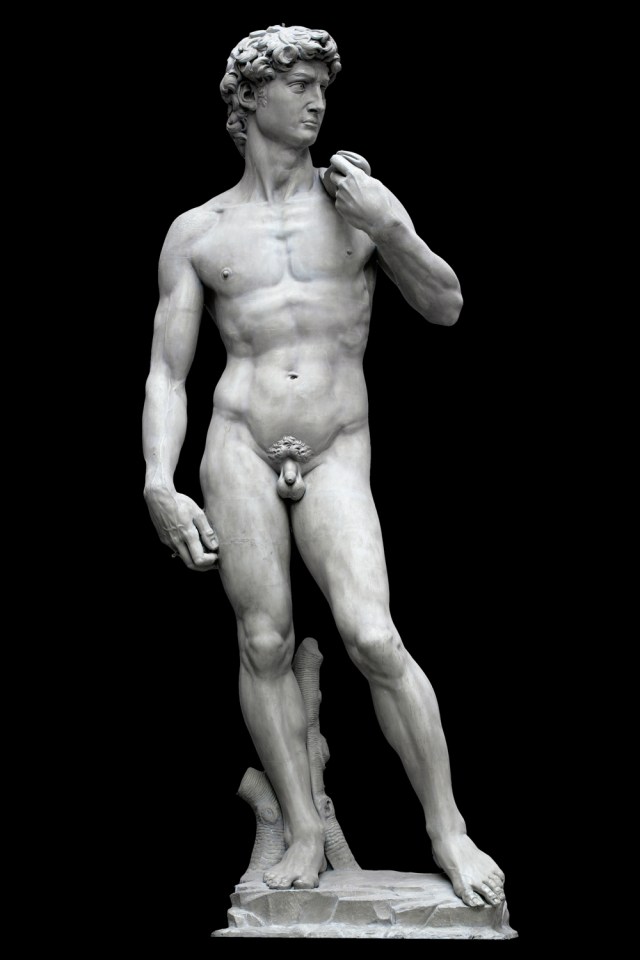
I’ve always preferred Donatello’s twink David to Michelangelo’s angry, rough-trade interpretation.


Fabrizio del Wrongo writes:

In case you haven’t heard, the Criterion Collection will begin streaming content via Filmstruck sometime in the next few months. Presumably, once that happens the company will cease to have a presence on Hulu.
With that in mind, here are some of my favorites among the films available on the Hulu Plus Criterion channel that have not, as far as I know, been released on DVD or Blu-Ray in the States. Get them before they’re gone.
The Neighbor’s Wife and Mine (Gosha, 1931)
Carnival in Flanders (Feyder, 1935)
History is Made at Night (Borzage, 1937)
The Spy in Black (Powell, 1939)
L’Amore (Rossellini, 1948)
Carmen Comes Home (Kinoshita, 1951)
Wild Geese (Toyoda, 1953)
The Crucified Lovers (Mizoguchi, 1954)
Dreams (Bergman, 1955)
Floating Clouds (Naruse, 1955)
Three Cases of Murder, particularly the segment with Orson Welles (O’Ferrall, 1955)
Flowing (Naruse, 1956)
Odd Obsession, aka Kagi (Ichikawa, 1959)
Room at the Top (Clayton, 1959)
Devi (Ray, 1960)
Three Daughters (Ray, 1961)
Black Lizard (Inoue, 1968)
The Cremator (Herz, 1969)
The Ear (Kachyna, 1970)
Milou en Mai (Malle, 1990)
Jacquot de Nantes (Varda, 1991)
Fabrizio del Wrongo writes:
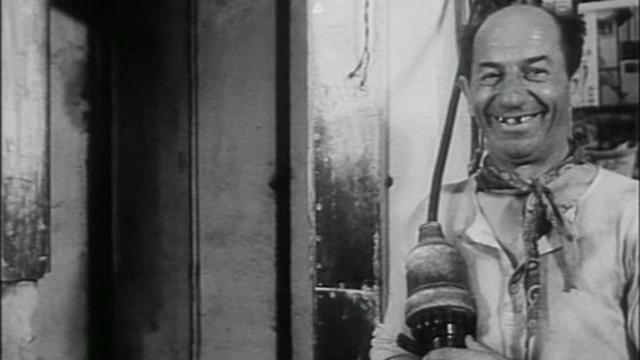
“The Junk Shop,” directed by Czech filmmaker Juraj Herz, and adapted from a story by Bohumil Hrabal, is a funny and inexplicable short film in the best tradition of Slavic surrealism. Based on the evidence of this picture and the 1969 “The Cremator,” a macabre sendup of bourgeoise mores, it may be appropriate to view Herz as one of those artists whose meanings defy conventional analysis. Herz’s vision and his sensibility are what you respond to in these movies, and you may continue to respond even after you’ve given up on trying to parse the director’s message. Indeed, the image of existence presented by “The Junk Shop” is so exuberantly morbid that to require it to yield a pat meaning would be churlish. The titular shop thwarts spatial reckoning; it exists amid a hodgepodge of urban construction, the elements of which arbitrarily slide into and out of comprehension. The primary business of the establishment consists in paper recycling: Its proprietors purchase the old paper of the people occupying the surrounding town, first weighing it on an enormous scale to determine its value. Most of these people accept a lottery ticket in lieu of payment; they’re exchanging waste for a hope, and piles of paper for a single voucher. Mothers lose children among the heaps of refuse. Others lose important letters, meaningful documents, or photos of themselves when young — shades of past lives inadvertently left for pulp. One woman accidentally falls down a hole in the floor, leaving her goose to wander the place for the rest of the movie. (No one wonders what happened to her.) The shop is run by a fat man in a beret and his idiot assistant. The former has artistic pretensions; he finds the junk noble, erotic, inspiring. The latter, whose teeth are as junked as the shop’s inventory, may be mad, yet he’s the only character in the picture whose philosophy, a Marx Brothers-style nihilism, seems reasonable. (Together they suggest Quixote and Sancho Panza.) There are moments that are so dryly subversive they make Bunuel’s work from the period look straight in comparison.
Paleo Retiree writes:
Have you run into Sam Vaknin? He’s quite a phenomenon. Vaknin is a self-described narcissist who has, primarily online, made a name for himself as an expert on narcissism. Hundreds of thousands of people have watched his videos, visited his website, and/or read his book. Academics and credentialed therapists have their beefs with his views, but he has always struck me as pretty darned smart and helpful. Yet how can a genuine narcissist have any kind of sane, trustworthy distance on narcissism? Isn’t that a logical impossibility? And, like that, voilà: you’re caught in the Vaknin web.
My wife and I recently enjoyed “I, Psychopath,” a documentary made for Australian television about Vaknin. It’s a peculiar one in its own right. As Ian Walker, the director, walked Vaknin from expert to expert — for brain scans, tests and diagnoses — he found himself getting drawn into Vaknin’s ego and games-playing, and decided that that experience deserved notice too. So, as it goes on, the doc becomes as much about the frustrations and abuse the filmmaker is enduring from Vaknin as it is about Vaknin himself. Which is a pattern that, if you’ve had many dealings with narcissists, will ring some bells.
The film is a little exasperating, and it’s certainly easy coming up with ways it might have been better. What a movie Werner Herzog might have made of Vaknin! But it’s well worth a watch anyway. On YouTube, the doc is cut up into eight segments, but if you start watching the video that starts off this posting the segments should play straight through.
Watching “I, Psychopath” in fact put us in a mood for a Herzog doc, so we then treated oureselves to “God’s Angry Man,” a relatively early (and relatively short) America-the-Weird film about Dr. Eugene Scott, an oddball L.A. televangelist who was a big deal on public access TV in the ’70s and ’80s. Hipsters of that era loved watching him and marveling at him. You’ll probably want to skim Wikipedia’s entry for the basic facts about Scott — Herzog isn’t big one on supplying the journalistic basics. But Herzog certainly captures what was peculiar and fascinating about him.
Related
Blowhard, Esq. writes:
 Blowhard, Esq.
 Callowman
 Sherbrooke
 Eddie Pensier
 Enzo Nakamura
 Epaminondas
 Fabrizio del Wrongo
 Fenster
 Brundle Guy
 Glynn Marshes
 Paleo Retiree
 Atypical Neurotic
 Question Lady
 Sax von Stroheim
 Sir Barken Hyena
 The Mistaken
 Uncouth Reflections
