A Magnificence Suitable to a People Who Styled Themselves the Masters of the World

Fabrizio del Wrongo writes:
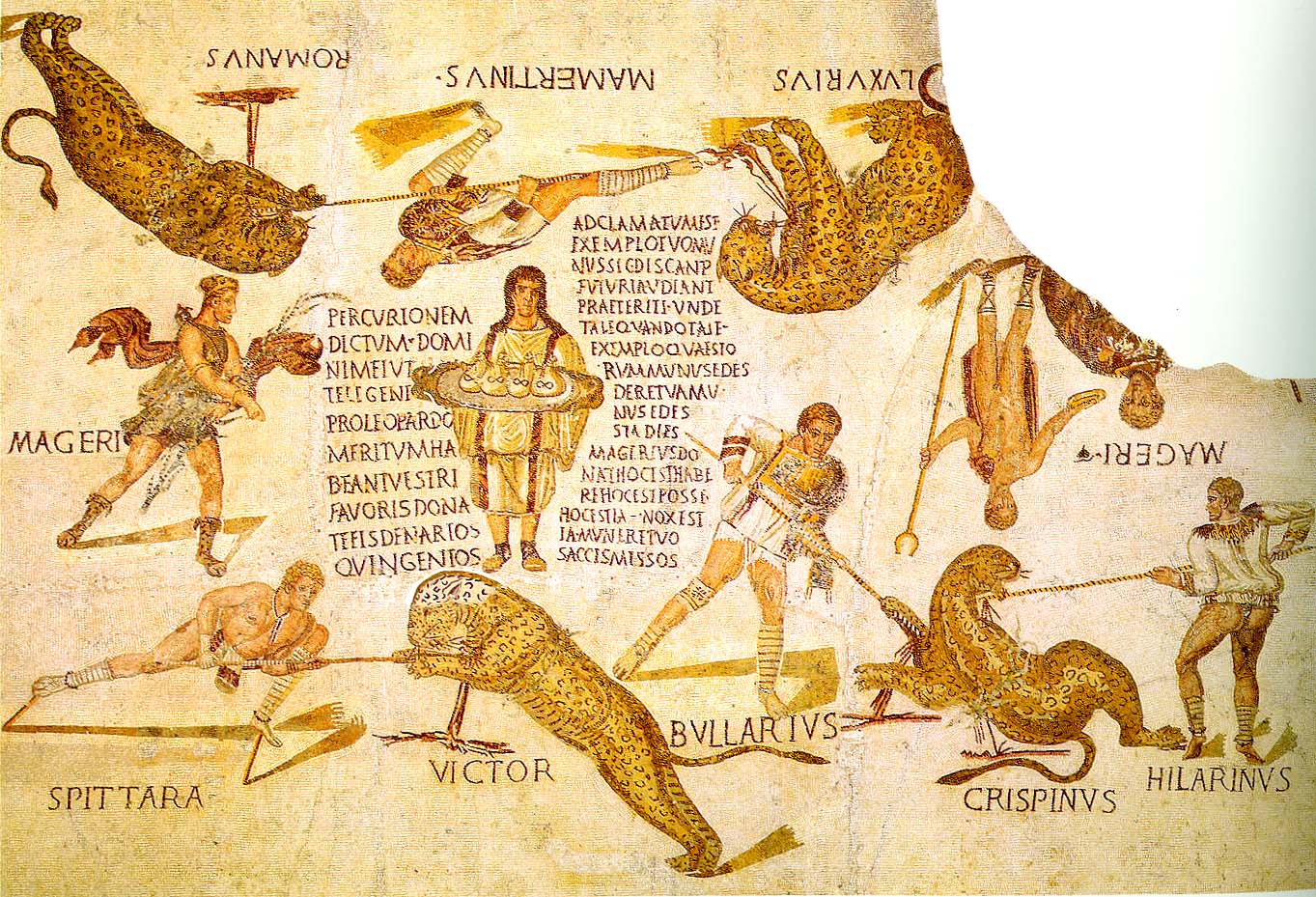
the costly munus

The only merit of the administration of Carinus that history could record, or poetry celebrate, was the uncommon splendor with which, in his own and his brother’s name, he exhibited the Roman games of the theatre, the circus, and the amphitheatre. More than twenty years afterwards, when the courtiers of Diocletian represented to their frugal sovereign the fame and popularity of his munificent predecessor, he acknowledged that the reign of Carinus had indeed been a reign of pleasure. But this vain prodigality, which the prudence of Diocletian might justly despise, was enjoyed with surprise and transport by the Roman people. The oldest of the citizens, recollecting the spectacles of former days, the triumphal pomp of Probus or Aurelian, and the secular games of the emperor Philip, acknowledged that they were all surpassed by the superior magnificence of Carinus.

The spectacles of Carinus may therefore be best illustrated by the observation of some particulars, which history has condescended to relate concerning those of his predecessors. If we confine ourselves solely to the hunting of wild beasts, however we may censure the vanity of the design or the cruelty of the execution, we are obliged to confess that neither before nor since the time of the Romans so much art and expense have ever been lavished for the amusement of the people. By the order of Probus, a great quantity of large trees, torn up by the roots, were transplanted into the midst of the circus. The spacious and shady forest was immediately filled with a thousand ostriches, a thousand stags, a thousand fallow deer, and a thousand wild boars; and all this variety of game was abandoned to the riotous impetuosity of the multitude. The tragedy of the succeeding day consisted in the massacre of a hundred lions, an equal number of lionesses, two hundred leopards, and three hundred bears. The collection prepared by the younger Gordian for his triumph, and which his successor exhibited in the secular games, was less remarkable by the number than by the singularity of the animals. Twenty zebras displayed their elegant forms and variegated beauty to the eyes of the Roman people. Ten elks, and as many camelopards, the loftiest and most harmless creatures that wander over the plains of Sarmatia and Aethiopia, were contrasted with thirty African hyaenas and ten Indian tigers, the most implacable savages of the torrid zone. The unoffending strength with which Nature has endowed the greater quadrupeds was admired in the rhinoceros, the hippopotamus of the Nile, and a majestic troop of thirty-two elephants. While the populace gazed with stupid wonder on the splendid show, the naturalist might indeed observe the figure and properties of so many different species, transported from every part of the ancient world into the amphitheatre of Rome. But this accidental benefit, which science might derive from folly, is surely insufficient to justify such a wanton abuse of the public riches. There occurs, however, a single instance in the first Punic war, in which the senate wisely connected this amusement of the multitude with the interest of the state. A considerable number of elephants, taken in the defeat of the Carthaginian army, were driven through the circus by a few slaves, armed only with blunt javelins The useful spectacle served to impress the Roman soldier with a just contempt for those unwieldy animals; and he no longer dreaded to encounter them in the ranks of war.

The hunting or exhibition of wild beasts was conducted with a magnificence suitable to a people who styled themselves the masters of the world; nor was the edifice appropriated to that entertainment less expressive of Roman greatness. Posterity admires, and will long admire, the awful remains of the amphitheatre of Titus, which so well deserved the epithet of Colossal. It was a building of an elliptic figure, five hundred and sixty-four feet in length, and four hundred and sixty-seven in breadth, founded on fourscore arches, and rising, with four successive orders of architecture, to the height of one hundred and forty feet. The outside of the edifice was encrusted with marble, and decorated with statues. The slopes of the vast concave, which formed the inside, were filled and surrounded with sixty or eighty rows of seats of marble likewise, covered with cushions, and capable of receiving with ease about fourscore thousand spectators. Sixty-four vomitories (for by that name the doors were very aptly distinguished) poured forth the immense multitude; and the entrances, passages, and staircases were contrived with such exquisite skill, that each person, whether of the senatorial, the equestrian, or the plebeian order, arrived at his destined place without trouble or confusion. Nothing was omitted, which, in any respect, could be subservient to the convenience and pleasure of the spectators.

They were protected from the sun and rain by an ample canopy, occasionally drawn over their heads. The air was continually refreshed by the playing of fountains, and profusely impregnated by the grateful scent of aromatics. In the centre of the edifice, the arena, or stage, was strewed with the finest sand, and successively assumed the most different forms. At one moment it seemed to rise out of the earth, like the garden of the Hesperides, and was afterwards broken into the rocks and caverns of Thrace. The subterraneous pipes conveyed an inexhaustible supply of water; and what had just before appeared a level plain, might be suddenly converted into a wide lake, covered with armed vessels, and replenished with the monsters of the deep. In the decoration of these scenes, the Roman emperors displayed their wealth and liberality; and we read on various occasions that the whole furniture of the amphitheatre consisted either of silver, or of gold, or of amber. The poet who describes the games of Carinus, in the character of a shepherd, attracted to the capital by the fame of their magnificence, affirms that the nets designed as a defence against the wild beasts, were of gold wire; that the porticos were gilded; and that the belt or circle which divided the several ranks of spectators from each other was studded with a precious mosaic of beautiful stones.

— Edward Gibbon

Posted in Animals, Books Publishing and Writing, History | Tagged , , , , , , | 5 Comments

A Frog’s Life

Fenster writes:

At first it all seemed to be images, not even a me.

fr1Then things got clearer and I sensed I was here.

fr2But it wasn’t just me after all.  There were a few others too!

fr3

In fact the world got bigger and bigger, and seemed like it might stretch on forever.

fr4

Maybe to infinity!  Then suddenl

fr5Exit stage left

fensgrocer

Posted in Food and health | 1 Comment

Naked Lady of the Week: Narkiss

Fabrizio del Wrongo writes:

n-cover

One of the signature models from the early days of MetArt, the Russian Narkiss (I’m not aware of a last name) seems to have worked exclusively with the photographer known as Slastyonoff. Her coolness and dramatic, verging-on-angularity contours give her an Art Deco quality: she would have made a great subject for Tamara de Lempicka.

Pale and puffy-nippled nudity below the fold. Have a great weekend.

Continue reading

Posted in Photography, Sex, The Good Life | Tagged , , , , | Leave a comment

2,000,000

Blowhard, Esq. writes:

20000000

Thank you to all visitors, commenters, and porn bots.

Posted in Uncategorized | Tagged | 2 Comments

Moody Street Update: All About the Fat

Fenster writes:

I wrote here of a walk down Moody Street in Waltham, Massachusetts.  It was just before Christmas in 2013 and early in the evening, when it was already quite dark, and the life of the place was to be found less in the predominantly low end ethnic restaurants the Moody Street was known for–the restaurant traffic would come a little later in the evening– and more in the hair and nail salons, boutiques and groceries, all brightly lit and colorful.

It is less than two years later but things change.  At the time of Fenster’s visit, there were a few upscale eateries arriving to supplant the old-time ethnic stable of Central American, Indian, barbecue and Thai places.  But they had not yet taken over.  Less than two years later Moody Street is at or past a tipping point, on the way toward an upscale incarnation where food is concerned.

tempredOld cement sidewalks are being ripped up to make way for brick.

sidewalk2 Continue reading

Posted in Food and health | 6 Comments

Notes on “First Blood”

Fabrizio del Wrongo writes:

R-rambo-38216594-1280-544

The 1982 “First Blood” has much in common with the Kirk Douglas vehicle “Lonely Are the Brave,” made 20 years earlier. The heroes of both movies are veterans and pariahs, and they duke it out with the establishment in the backwoods of America. Broadly speaking, both works are anti-authoritarian, but whereas “Lonely” exhibits the self-pleased hopefulness one expects of writer Dalton Trumbo (“I’m Spartacus!”), “Blood” is stewed in indignation. One might say the attitudes of the later film have been curdled by the ’70s.

At the center of “First Blood” is John Rambo, an elite soldier who fought in Vietnam, was tortured by the enemy, and then abandoned to civilian ignominy. He stalks the backroads of the Northwest, his sunken mien rebutting the Albert Bierstadt magnificence of his surroundings. When he alights in a small town, the authorities shoo him off, anxious to be rid of him, as though he were an itinerant character out of a Woody Guthrie song. Rambo, of course, won’t leave easily; he walks back towards the center of town. Like fellow folk hero Tom Joad he has something to communicate, but perhaps not in words. His message is inseparable from his physical presence: he wants our acknowledgement.

“First Blood” occupies an interesting place in the history of American genre movies. In one sense it’s the inheritor of the exploitation tradition of the 1970s, the spiritual successor of down-and-dirty drive-in pictures like “Rolling Thunder” and “A Small Town in Texas.” But it’s also a forerunner of the big-budget action movies that dominated Hollywood in the later ’80s and early ’90s. Many of these movies — “To Live and Die in L.A.,” “Aliens,” “Die Hard” — are among the best American films of that period, superior in terms of craftsmanship to many a prestige-loaded Oscar winner. (Raise your hand if you think “Rain Man” is better than “Die Hard.”)

If “First Blood” doesn’t reach those heights, it isn’t for lack of trying. The movie is a taut piece of work: in the early sections in particular, you can feel the concentration that director Ted Kotcheff and star Sylvester Stallone bring to bear on the material. There’s a seething quality to these scenes, a sense that an explosion is imminent. Kotcheff is similar to his contemporary John McTiernan in that he’s able to impart psychological weight to his visuals. (This can make his movies feel like macho art projects.) And like McTiernan he’s an ace at weaving together action and topography.

The latter talent is on display during the movie’s justifiably famous centerpiece, a long manhunt set in a mountain forest in which Rambo neutralizes several men and a helicopter using nothing but a knife and his wits. (The setting and the hunt-or-be-hunted vibe anticipate McTiernan’s “Predator.”) It’s a terrific sequence, but it doesn’t lead to anything. It’s a climax stranded in the movie’s middle, and afterwards “First Blood” feels bloodless. The screenplay, by Michael Kozoll, William Sackheim, and Stallone (it’s based on a novel by David Morell), has Rambo attack the town, but it fails to provide him with the motivation necessary to maintain narrative drive and suspense. When Rambo blows up a gas station, you wonder: What does he have against gas?

Stallone does a nice job of communicating Rambo’s resentment and disenfranchisement via non-verbal means. Often mocked for his mush-mouthed elocution, Stallone has never been properly appreciated as an actor. His talents are those of a character actor. And, unsurprisingly, his legacy is founded on characters, namely Rocky and Rambo. In this he’s fundamentally different from his counterpart Arnold Schwarzenegger, a born star who executes variations on his outsized personality in role after role. Stallone’s personality is smaller and less twinkling than Schwarzenegger’s, but its modesty has advantages: Schwarzenegger could never pull off the deranged monologue that Stallone gives near the end of “First Blood,” an unnerving howl of despair that wouldn’t be out of place in Greek tragedy.

Brian Dennehy provides Stallone with an apt foil; he brings a lot of exploitation-style juice to his depiction of, in Rambo’s words, a “king-shit cop.” And as a sadistic deputy, drive-in movie legend Jack Starrett is frighteningly physical. The one bad performance belongs to Richard Crenna, whose woodenness and exposition-heavy dialog make him seem as if he’s auditioning for a part in a Zucker-Abrahams spoof. His big moment comes when he says:

You don’t seem to want to accept the fact you’re dealing with an expert in guerrilla warfare, with a man who’s the best, with guns, with knives, with his bare hands. A man who’s been trained to ignore pain, ignore weather, to live off the land, to eat things that would make a billy goat puke.

With lines like that, who needs Leslie Nielsen?

Posted in Movies, Performers | Tagged , , , , , , | 6 Comments

Naked Lady of the Week: Anna Sbitna

Fabrizio del Wrongo writes:

as-cover

Surely one of the most famed erotic models of recent years, Anna Sbitna was at one time the main muse of high-class cheesecake purveyor Petter Hegre. It’s not hard to understand Hegre’s attraction to her: her slim figure has a beautiful line, and as a poser she’s both fearless and uncannily self-possessed. Hegre often shot her like a piece of sculpture, subordinating her nakedness to her placidity and poise.

She later did a lot of work for MetArt, but by then she’d started to age, and the litheness that had once been so alluring had begun to cure into a wan over-thinness. Hey, it’s hard to remain on top in the world of nude modelling.

Of course, she’s Ukrainian. According to several sources she’s no longer working. An impressively exhaustive history and analysis of her career, complete with a chart, can be found here.

Nudity below. Enjoy your weekend.

Continue reading

Posted in Photography, Sex, The Good Life | Tagged , , , , | Leave a comment

21 Underappreciated Movies (From The Last Decade Or So)

Blowhard, Esq. writes:

Tired of looking at stupid arbitrary BuzzFeed lists in Facebook feed all day, I thought it was about time I create my own stupid arbitrary BuzzFeed-style list. I was having a discussion with a friend during which the movie MICHAEL CLAYTON came up and it got me thinking about other films I love that I never hear film geeks talk about. In my ideal alternate universe, these underappreciated/underrated movies are the blockbusters of the last 10 years.

Have you seen any of these? Which movies would you add?

Continue reading

Posted in Movies | Tagged | 2 Comments

The Real Problem of Sexual Assault on Campus?

Fenster writes:

The conservative Jewish publication Commentary has an article running here on the “real problem” with sexual assault on campus.  It’s a neocon mag with something of a Victorian scold temperament on cultural matters so while the readership here, such as it is, may raise an eyebrow at a Commentary take Fenster’s view is that the article is on a right track, so to speak.

Continue reading

Posted in Education, Sex | 8 Comments

Quote o’ th’ Day

Fenster writes:

“The world makes much less sense than you think. The coherence comes mostly from the way your mind works.” 

Daniel Kahneman

tubeWe spend our days looking at a tube.

Posted in Uncategorized | 4 Comments