
Paleo Retiree writes:
Given my background in the media (researcher, reporter, etc), I like to think that I could be a much bigger grammar Nazi than I am. But I tend to swing pretty loose where language goes. Texting, gabbing, blurting, Ebonics … All can be — and often are — sources of inventiveness, energy, new ideas and humor. Besides, what does playing Mr. Prissy really add to the ongoing flowiness of things? I’ll take good nature and ease (even if marred by mistakes) over uptightness, however correct, approximately all the time.
Even so, there are still a few language-things that turn me into a stickler. One of them: the very common misuse of “begs the question.” (Grr: no idea why the typography in that posting has grown wonky over the years.) Quick explanation: “begs the question” does not mean “prompts the question,” as many people seem to think. Instead, it means “assuming what you’ve set out to prove.” When question-begging is going on, what’s being discussed is a logical fallacy, not something along the lines of “Hey, you know, what I just said has got me thinking about something related!” Note that some modern language authorities have caved on this particular issue. For them, the phrase is misused so often these days that the time has come to accept the new usage. Still, although I agree that eventually we all have to roll with change, my heels dig in.
Here’s another: using the word “less” when the word “fewer” would be correct.
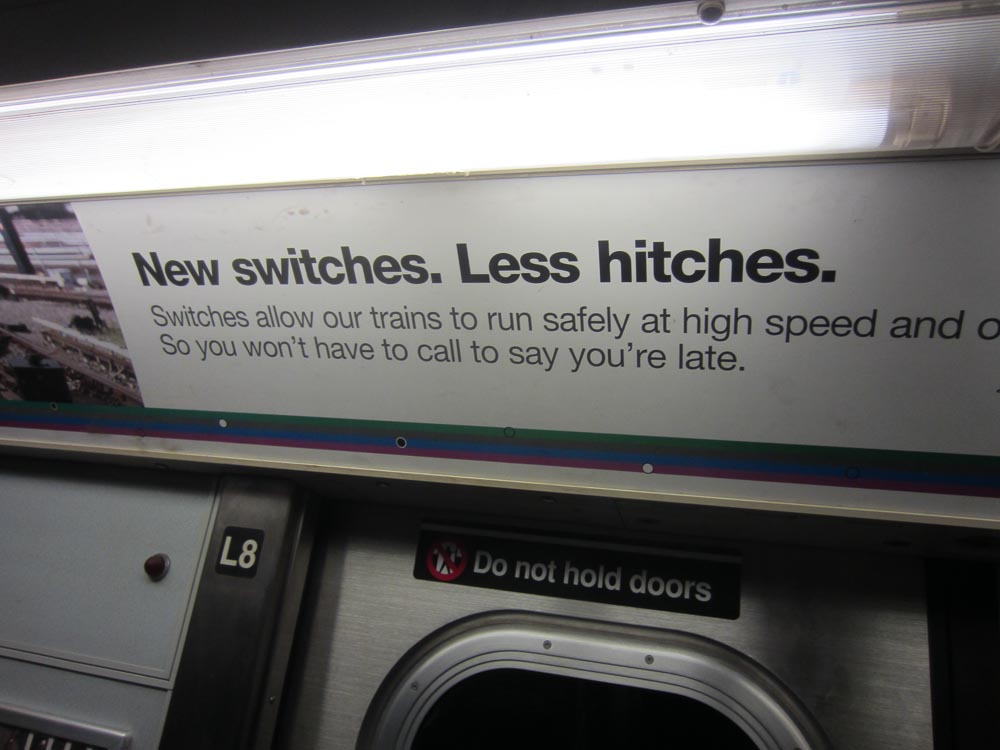
No no no no no. “Less” is used when you’re referring to a mass that has grown smaller: “There’s less water in that bucket than there was ten minutes ago.” “Fewer” should be used when you’re referring to a number that has grown smaller: “There are fewer duplicates in my iPhoto collection now that I’ve gone through and weeded them out.” Less bread … but fewer slices of bread. In the case of my subway snapshot above: can the switches in question be counted, at least in principle? Yes? Then “fewer,” not “less,” is the word that should be used.
Funny how often this particular goof leaps out at you once you’ve awakened to it. Funny too how certain language-usage things can really gripe a person. Which ones tend to seize your attention and switch on your indignation?
Funny as well that the poster in question was created and paid for by a branch of the New York City government. Do we suppose that someone — a designer, editor, writer or boss — OK’d this poster thinking, “Yeah, that’s how real people speak, and we’d do well to address real people in their own language”? Or were its creators just clueless about proper usage?
Related
- A good Ben Yagoda piece about some basic rules of grammar that all of us would do well to keep in mind.

 Blowhard, Esq.
 Callowman
 Sherbrooke
 Eddie Pensier
 Enzo Nakamura
 Epaminondas
 Fabrizio del Wrongo
 Fenster
 Brundle Guy
 Glynn Marshes
 Paleo Retiree
 Atypical Neurotic
 Question Lady
 Sax von Stroheim
 Sir Barken Hyena
 The Mistaken
 Uncouth Reflections
Less is the opposite of more, and there’s nothing you can do about it.
It’s a pity there’s not a “many-er”, to accompany “few-er”. As it is the word fewer is close to extinction.
LikeLike
Is it approaching extinction already? “Fewer” still comes to my mouth very easily, and the “less” goof still strikes me as very recent. I don’t recall people making it as commonly as they do today even back in the ’90s. But history has left me in the dust before.
LikeLike
I saw a sign at the express checkout at a Whole Foods in Seattle: “10 items or fewer”, which tells you something about the demographic of the customers and staff.
For years I wore two hats: as a linguist, I realize that language changes, but I also had strong, even pedantic, notions about correct usage. I didn’t just have one or two pet peeves, I had a whole menagerie. When I became a translator, I decided to open the cages and set all my peeves free. They still come back to visit, though, when I have to write like a lawyer or accountant.
LikeLike
“10 items or fewer” sounds good to my ears and brain.
LikeLike
There’s a common thing I hate that I call a single entendre. It’s like a double entendre but it’s not thought through and doesn’t really work both ways. Sometimes not at all. I see it a lot on those public service billboards and stuff like that
LikeLike
I’d love to see an example. Pull out the digicam (or smartphone) the next time you run across one.
LikeLike
I’m a diacritical mark fascist. I get annoyed whenever I see things like “latté” or “chipotlé”, or “Havaña”. Also, the absence of them where they are needed, as in “voila”, “touche”, or “pate”. The last two have very different meanings without their accents.
#thirdgenerationlanguagepedant
LikeLike
I’ll also add my dad’s biggest pet peeve: “momentarily”, which properly means for a moment, not in a moment. So a flight attendant announcing to a planeload of people “we will be leaving momentarily” is wrong. “We will be delayed momentarily” is correct.
LikeLike
>>whenever I see things like “latté” or “chipotlé”, or “Havaña”
You come across those often? I don’t think I’ve ever seen them in my life.
LikeLike
Start looking for “latté” on coffee menus. It’s everywhere. And right now I am eating a ham sandwich garnished with what the jar tells me is “chipotlé”” pepper chutney.
“Havaña” is less common but “Habañera” (something or someone from Havana, no tilde) is sadly frequent. The program notes for a Metropolitan Opera performance of Carmen referred to the title character’s famous Act 1 aria as such, and I wrote Playbill a scathing letter about it.
LikeLike
It’s disinterested used in place of uninterested that really burns me. I find it emblematic in the sense that it’s not just a word that’s being lost, but perhaps a much broader concept/value, i.e. disinterestedness being forgotten as an ideal for making judgements. But then judgement isn’t really allowed either these days, is it?
LikeLike
Using mass qualifiers for supposed count nouns was common in Shakespeare’s time.
It’s all in the interpretation — are we construing “hitches” by zooming in on the individual, atomized hitches, or zooming out and looking at only a collective of them. If the latter, we don’t need to be all lawyerly and say, “Less [of a tangle of] hitches.” Tangle is a mass noun, and we elide it for brevity and to make hitches rhyme with switches.
That seems like the intended reading — not that the number of separate hitches is going from 10 to 7, or whatever, but that all those hitches are going to diminish in how palpable they are, like a noxious gas fading in concentration (mass noun).
LikeLike
Agnostic, that must be an extremely intellectual comment because I didn’t understand a word of it. 😦
LikeLike
“Using mass qualifiers for supposed count nouns was common in Shakespeare’s time.”
So was saying “fie!” and wearing codpieces. Not sure that I get the point.
LikeLike
A collection of things can be perceived as either a collective (mass noun) or as the many individual things that make it up (count nouns). Thorns, say — are we referring to each individual thorn, or treating them like a thorny mass. “Let’s find a path where there’s less thorns. There’s too much thorns along this path.”
If you are talking about thorns as a thorny mass that gets in your way, you find that sentence OK. If you are analyzing thorns into each individual thorn branch, or thorn on the branch, that sentence sounds bad.
Same thing going on here with “hitches.” If hitches are perceived as a knotty, tangly, prickly, annoying mass that gets in your way, or a kind of sludge on the ground that keeps you from walking fast, then they can be used as a mass noun with “less.”
LikeLike
Unlike saying “fie!” or wearing a codpiece, the mass noun thing tells us about how much more flexible people’s minds used to be.
Not just more comfortable using mass qualifiers for supposed count nouns, but also using a singular verb for a plural count noun (“All these hitches turns me off”). Whether the speaker was construing the thing as a holistic mass or analyzing it into its component parts, went without saying, because the listener understood right away.
Now people are not as good at reading other people’s minds / intentions, so we have to spell things out more.
LikeLike
I have almost but not quite stopped correcting my kids with their use of “me and . . . ” instead of ” . . . and I”, as in “Me and Freddie walked to school”. I think they are flummoxed that I call them on it since it is ubiquitous, and they must assume I don’t know what I am talking about. This is what they hear in one of the best schools in the best state for public education.
LikeLike
Oh, and can I add ‘tap’ instead of ‘tab’, i.e. in the context ‘The Dallas Cowboys tapped their ballboy to start at quarterback this week, due to injuries.’ Gaaaaah!!!!!
I like sports, and this error is rife in sportswriting; the use of ‘tab’ in the sense of designating a player for some role on the team is a long-standing trope. But now I rarely see ‘tab’ used correctly, even though the trope is as common as ever.
Painful!
LikeLike
Pingback: Listing Movies: Horror Since 1980 | Uncouth Reflections