Notes on “Olive Kitteredge”, and Yankee New England

Fenster writes:

olive-kitteridge-poster

Olive Kitteredge is a one-off HBO mini-series, four installments and over and done.  No fuss no bothuh, about which moah below.

It is adapted from the book of the same name by Elizabeth Strout which I have not read but was passed between the members of my wife’s book club and duly noted there.  The book has an unusual structure for a novel: 13 short stories with a narrative thread running between them.  Unusual for a novel, perhaps, but in an interesting way the book is set up like so much television nowadays.  Shows like The Good Wife are structured explicitly in this fashion, with a self-contained story in each episode unfolding against a backdrop of a longer narrative.

But both book and mini-series are unusual in another way: no one pays much attention to New England any more, at least the Yankee side of it.  So fuhst some thoughts on the region, then Olive.

Continue reading

Posted in Movies | 1 Comment

Sir Barken’s Vinyl Review: The Spawn of Minimalism

Sir Barken Hyena writes:

hassell1

Today I listened to some records that all in various ways reflect the influence of 50’s and 60’s minimalism. And by that I mean first the minimalism of the graphic arts but also the later musical minimalism of Terry Riley, LaMonte Young and those who followed. The avant garde art world has influenced pop and rock since the 60’s, with a long list of rock stars coming out of art school and bringing that sensibility to the stage and the studio. These records come from the darker, lesser known corners of this stream of influence.

Trumpeter and Eastman graduate Jon Hassell was there from the beginning, performing with Riley and Young, but ultimately the ascetic coloring left him wanting. Lack of sex appeal earlier sent him fleeing the post war serialism he practiced at Eastman. Miles Davis, just then entering his electric period, had the antidote, but how to combine the best of both? Hassell found the answer via India, studying for years with vocal master Pandit Pran Nath, but taking it to his own instrument, the trumpet.

By yoking the curving trumpet lines to the sinuous dark percussion world below, like a snake charmer Hassell injected a note of tension, of give and take to his minimalistic landscapes. The final ingredient for Hassell’s stunningly original sound came from another scion of the avante garde, Brian Eno. He brought the atmospheric ingredient and uncovered a lyrical side that propeled this new music to escape velocity on Fourth World Vol I, Hassell’s first effort to fully flesh out the future sound of his music.

Through the next decade Hassell fleshed out his sound on a series of important albums. 1983’s Aka Darbari Java was technically innovative: probably the first digital loop based record, it employed the new Fairlight CMI computer instrument to weave a mosaic from Hollywood soundtracks, Yma Sumac records, African singing, Indonesian gongs and god only knows what else, but focused in a shimmering web almost Jackson Pollack like. This has now become a standard method of music production. And the favor was returned, as Hassell himself was often sampled for dance and hip hop. In 1990 he came full circle with the urban grit of City: Works of Fiction, which sampled Public Enemy and god knows what else, proving Hassell’s basic equation: today, any element from any style, time or place can be material for music.

Jon Hassell’s website is worth checking out.


leimer
Kerry Leimer comes from a totally different path, but still the same core influences are there. A self taught amateur, Leimer was a first wave home recordist, taking advantage of the emerging consumer market for recording devices to make an end run around the music establishment. This signaled the re-emergence of a type that had had a big role in the arts since the dawn of time: the devoted non-professional. Swept away by the industrial and commercial modes of the industrial revolution, he was brought ironically back by the same forces, via consumer electronics.

Freedom from an audience to satisfy may not be every artist’s goal but it has let Leimer go where the winds of creative change lead. Part primitive outsider, part sophisticate, his core vision emanates from the same visual arts and musical minimalism as Hassell’s, but the homemade touch rules with Leimer; you know this stuff hasn’t been put out by Capital Records. More the shame for Capital, for Leimer doesn’t just make an end run around the music industry, but the entire soul vacuum of modern “culture” to arrive at a truly personal world.

1983’s Imposed Order is one of the most perfect ambient records ever made. A self-contained soundworld of blurred, distant and faded scraps of colorful tone washes, deep blood rythms and other sonic detritus, it’s never been far from my ears since I first bought it on release. Long one of the most obscure of electronic artists, Leimer is finally getting his due with a retrospective 2 LP set A Period of Review from RVNG. This is truly experimental music, despite it’s appealing surface. Each piece is a one off stab at a singular moment or sound, always imbued with Leimer’s uncanny sense of atmosphere.

Kerry Leimer’s Palace of Lights label has lots of stuff to explore.


buddpartridge
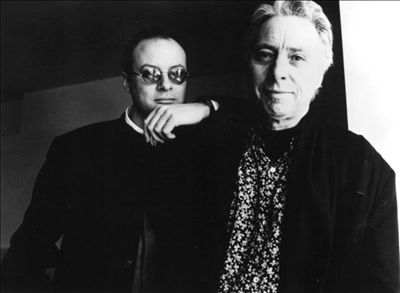
Harold Budd, a music academic by profession, and Andy Partridge, spastic front man for Britpop group XTC make a most unexpected pair, but it’s a successful one. Budd’s minimalist creds are impeccable, as one of the founders and most effective practioners of ambient music. But Partridge has long held a special place in his heart for Reichian ostinatos: Jason and the Argonauts from 1982’s English Settlement is a prime example with it’s endless up and down figures. In fact it’s part of what’s behind XTC’s early reputation as a British Talking Heads.

Here the fusion of personalities is fully achieved. And for two musicians of such strong flavor that’s an accomplishment. Many of Budd’s other collaborations fall prey to the failure to assimilate, like the Cocteau Twins project Moon and the Melodies where it sounds as though the parties were on opposite sides of the studio. What’s better is that Partridge brings out Budd’s eccentric side, mostly evident before from his bizarre stream of consciousness poetry, and together they paint a range of vignettes from a rather magical universe.

Posted in Music | 2 Comments

Three of Us Watch “Pather Panchali” (1955)

Blowhard, Esq. writes:

pather_panchali_1

Satyajit Ray is one of the great filmmakers of world cinema that I have somehow managed to avoid. Not intentionally, mind you, as copies of his movies haven’t been that accessible for the past few decades. My local Tower Records (RIP) video store had “The Apu Trilogy” on VHS sometime in the late ’90s and I think that was the last time I saw Ray’s films in the wild. The always great Criterion Collection has restored a number of Ray’s masterworks, including “The Apu Trilogy,” so I headed off to Film Forum alongside Fabrizio and PR to catch “Pather Panchali,” the first installment in the series.

Although I was eager to see the movie, part of me was anxious too. It can be tough getting into the groove of classic works — the inevitable datedness of the acting and storytelling, the bullying critical weight, the general eat-your-vegetables vibe. But thankfully, despite all of that, the movie delivered for me. Ray’s movie, about a poor rural family living in the Bengali jungle, moves effortlessly from social anthropology to childhood fantasy to family drama, frequently within the same scene, yet never feels confused or rushed. While the plot isn’t strong in the traditional sense and the pace is leisurely, it’s full of moments of incident and observation such that I was never bored. I found all three female performances — by Uma Das Gupta, Karuna Bannerjee, and Chunibala Devi as the young girl, mother, and old auntie respectively — to be particularly affecting. And as my colleagues note below, the Criterion 4K restoration is stunning. I can’t wait to catch up with the other two volumes in the trilogy when they’re released on Blu-ray.

Fabrizio del Wrongo writes:

pather-panchali-2

I find it hard to write about “Pather Panchali.” It’s almost too fine-grained, its effects too integrated, to be picked apart. I think this explains why contemporary viewers tend to have difficulty getting on director Satyajit Ray’s wavelength: His methods are so subtle, and his manner so tranquil, that it’s easy to come away from his movies feeling underwhelmed. Very little in the picture is proffered in the accustomed dramaturgical way. Rather, Ray works on our subconscious understandings of families and communities, coaxing them to the surface using Griffith-style vignettes (they’re like stories unto themselves) and repeated motifs of movement and image. The result is so musically cohesive that it can play tricks with your sense of time: Near the end I couldn’t tell whether I’d been sitting there for thirty minutes or two hours. For Western viewers the rural Indian setting is inordinately foreign, but any hint of exoticism is instantaneously subsumed by the universality of the subjects. Who isn’t familiar with the shirker father, his responsibilities forever subordinated to his crackpot dreams, or the eternally harried mother, her hopes on the verge of curdling into resignation? Though the movie is ostensibly about the family’s youngest member, the boy Apu, his older family members command the proceedings. This may be Ray’s way of suggesting that our earliest years are our least autonomous: that, as very young children, we understand ourselves through our elders. Aside from Apu’s mother, played with supreme sensitivity by Karuna Bannerjee, the most vivid character is his teen sister Durga, portrayed by the glinting-eyed Uma Das Gupta. It’s through the mischievous Durga that Apu gleans an understanding of life outside his home, and it’s in tagging along with her that he receives his first vision of a larger world. In the film’s key set-piece, the only time in the movie that Ray permits his camera outside the family environs, Durga and Apu spot a train. Here Ray uncorks a vision of almost novelistic richness: The black engine barrels across a meadow; the children see it, run up to it, but are not quite able to catch or comprehend it; and then it’s gone almost before it can be fixed into memory. It’s both an intimation of the world’s vastness and a portent of its boundaries. And it has an immediate payoff: During the kids’ return home they find their aged auntie dead in the forest. This strange and beautiful sequence, encompassing the birth of adult consciousness and its final dissolution, is like a miniature of existence.

Paleo Retiree writes:
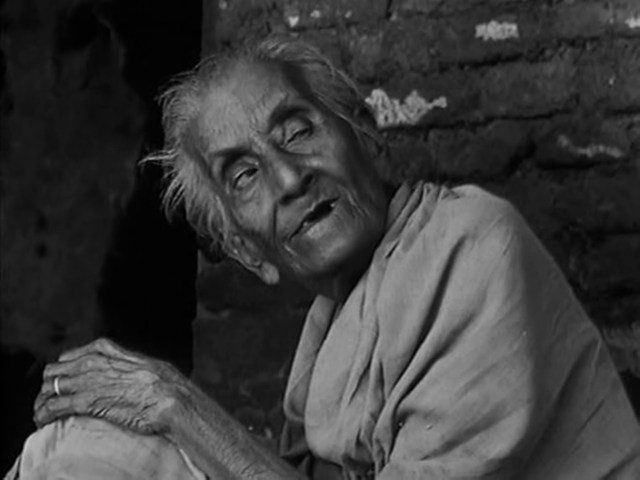
pather-panchali-3

This was viewing #3 for me of “Pather Panchali.” I saw it for the first time in college, on a small screen, projected from a scratchy 16mm print; then a decade or so later in New York City, on a big screen (but from an equally scratchy print). The most startling thing for me about watching the film this time around was how fucking great I thought it was. In my memory I’d slotted it as a good, sensitive little film — the beginnings of an important career, something like Truffaut’s “The 400 Blows,” touching in itself but valuable mostly as a portent of greater things to come. I’d never thought of it as one of my favorites of Ray’s films. But I was near-overwhelmed, on three or four levels, by watching “Pather Panchali” this time. It may have been Ray’s first movie (he made it when he was 33 years old), but it’s amazingly mature, full-bodied and distinctive — quite the equivalent, as far as I’m concerned, of Chekhov’s greatest plays. The Criterion restoration of the print is awesome, by the way. Given my previous experiences with the film I’d always assumed that no such thing as a pristine print of the film existed, or could exist. Maybe Bengali film-processing plants were shitty back in the day, what did I know? But there are very few flaws in the current print, and, although digital, it has some of the crystalline sparkle and richness that filmbuffs associate with the best-looking movies of the late silent era. Seldom has black and white looked so poetic, or so soulful.

Pleased that Blowhard, Esq. was able to find the movie’s wavelength. During a cultural era that’s overfull of effects, blatantness and fantasy, that’s a real accomplishment. We’ll turn him into a pissy, snobby film connoisseur yet. Fabrizio does a fab job above of evoking the film’s shimmering, tranquil-yet-pungent feeling. Watching the film is like looking at a pond and, as your vision both bounces off the surface and penetrates into the depths, and as your thoughts dissolve and become one with the water below and the sky above, finding the entire world there. I’ll add just a few things.

  • “Pather Panchali” is a perfectly amazing fusion of literature, photography, music, drama and film. This used to be one of the dreams of moviemakers, by the way — to bring all of the classical arts together. Today’s films often seem, by contrast, completely disconnected from traditional culture, preoccupied instead with being media blowouts (bouncing off of graphics, ads, TV, sports, magazines). So the film is a great reminder of how powerful the classical arts can be, as well as a reminder of the kinds of dreams that artists and audiences once had for movies.
  • I was awestruck by (among other things) the film’s dramaturgy and construction. The story is, in essence, the tale of a family that has moved from the city to a small village, to occupy the father’s old family house there and to try to make a go of life. How will they manage? Ray deepens and expands nearly every element that comes up along the way, from characters (both major and minor) to motifs: insects, water, paths, a necklace, jars. Elements that seem completely inconsequential, even incidental, on first appearance make cyclical returns, deepening and showing off new dimensions each time ’round. The cumulative impact of all this was, I found, wrenching and moving in the best way. The film gave my emotions and my imagination quite a workout, and man did that feel good.
  • Given that the surface of the picture is anthropological/neorealist — Ray was apparenty inspired to turn to filmmaking by meeting the great Jean Renoir and viewing De Sica’s “Bicycle Thieves” — it’s quite amazing how effectively the film brings the mythological realm into consciousness too. This is a specific family in a specific village facing specific challenges, and the film certainly works well experienced on that level alone. But I found it impossible not to experience the story as one of gods, spirits and natural forces too. There’s a Bollywood/”Mahabharata” dimension to the movie, it just happens to take place more in your brain than it does onscreen. But our experience of consciousness is just as real to us as our experience of the external world, isn’t it?

Related

Posted in Movies | Tagged , , , | 6 Comments

Architecture Du Jour

Paleo Retiree writes:

New York City’s very grand 240 Centre Street.

Police Building

Finished in 1909, it was originally the headquarters of the New York City Police Department. It was converted to luxury condos in 1988, and is now commonly known as the Police Building.

Posted in Architecture | Tagged | Leave a comment

Notes on “The Man from Laramie”

Fabrizio del Wrongo writes:

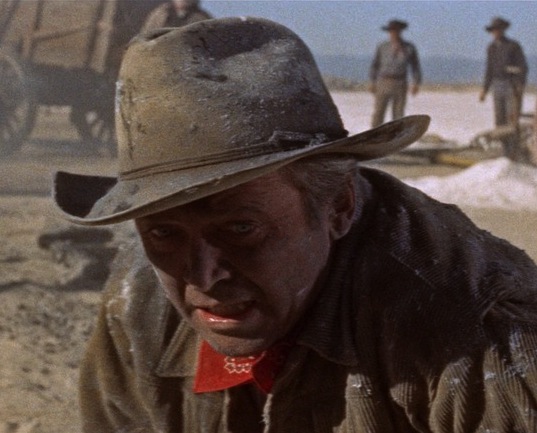
10095_5_largeAs he does in all the Westerns he made with director Anthony Mann, James Stewart stalks through “The Man from Laramie” with wraith-like resoluteness. His Will Lockhart wears a brown, waist-length corduroy jacket, a battered hat, and a red neckerchief. That last accessory, like Stewart’s fragile blue eyes, suggests a courtliness that has been suppressed. As his name implies, Lockhart has removed himself from the world of normal human relations. His brother has been murdered, and he’s out for revenge.

The plot is a Wyatt Earp story laid over a noir-like lattice of interpersonal complication. Lockhart arrives in the town of Coronado, and, like Stewart’s sheriff in “Destry Rides Again” (itself a riff on the Earp legend), you know he’s there to clean things up. Yet the more involved he becomes the less human he seems. The ranchers and townsfolk have roots, stories, relationships. Lockhart, by contrast, is defined by his obsession, and that abstractness makes him seem all the lonelier.

I can’t say enough about the way in which the screenplay, adapted by Philip Yordan and Frank Burt from a story by Thomas T. Flynn, ushers the viewer through subplots, always taking care to elucidate how the various story elements overlap and link up. It’s the kind of picture that would seem a mess if it weren’t so expertly assembled, so distilled. As always, Mann maintains a fierce control over the movie’s tone. The scenes of violence are vivid yet terse, and the settings are expertly fixed to the characters’ mindsets and ordeals. A salt flat is like an anvil on which the wills of men are hammered and misshapen.

If the movie has a failing it’s in the subplot concerning Arthur Kennedy’s genial ranch hand. His third-act emergence as a villain feels perfunctory, and it disrupts the harmony of relationships the screenplay has been working towards. When Donald Crisp’s rancher patriarch is left without an heir, a sour note is struck. And when Lockhart departs the town amid hints of future romance, his vengeance having been enacted through a third party, it’s hard to buy into. It seems a fate too worldly for this dusty specter.

Related

  • Twilight Time has released a lovely Blu-ray of the movie, which is sourced from a 4k scan of the original camera negative. It’s expensive, but worth owning if you like the movie.
Posted in Movies, Performers | Tagged , , , , , | Leave a comment

YouTube Find Du Jour

Paleo Retiree writes:

A fun clip of Professor Longhair, great musician and awesome style icon.

Posted in Music | Tagged , , , | Leave a comment

Bad Trips

Sax von Stroheim writes:

WUSA_(movie_poster)-2

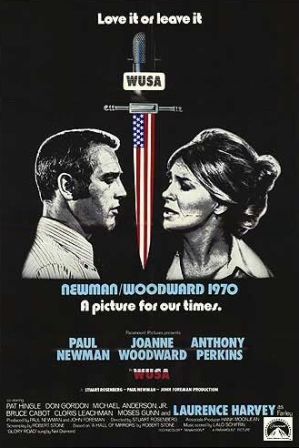
I watched the 1970 Paul Newman movie WUSA the other day. It was directed by Stuart Rosenberg, who had previously worked with Newman on Cool Hand Luke, and written by Robert Stone, who was adapting his own novel, A Hall of Mirrors. I liked it a lot, though it is, admittedly, a downer: a paranoid left-wing fantasy about the paranoid right, it suggests all is going to hell, that only the cynical or deranged will survive, and that the good-hearted will end up being nothing more than patsies or victims.

I’ve never read Stone’s original novel — his first, which he wrote in 1967 — but, assuming his screenplay is a faithful adaptation, it strikes me that WUSA fits nicely into the category of Bad Trip Lit: books from the late 1960’s and early 1970’s that are about how America is falling apart. Other favorites of mine from the genre: Don Delillo’s Americana (parts of which now read like Mad Men avant la lettre), Philip Roth’s The Great American Novel (an underrated book that, for me, is Roth’s best non-Zuckerman novel between Portnoy’s Complaint and Sabbath’s Theater), and Stanley Elkin’s The Dick Gibson Show, which may be my favorite novel of this (made up by me) sub-genre, and also, probably, my favorite novel that I don’t think has a particularly good story to it (it gets by on the strength of the individual scenes). I’d like to see someone try to turn The Dick Gibson show into a movie or a play at some point, though I expect that will never happen.

Unlike those books, though, WUSA (and maybe A Hall of Mirrors, too) doesn’t have much in the way of phantasmagoria, which is to say that the movie doesn’t even offer the escape of a nightmarish imagination.

WUSA didn’t get great reviews when it came out, and I don’t think it’s ever been particularly beloved, though I think it’s beginning to build up a bit of a better reputation. A lot of “meant to be taken seriously” movies from this period have been somewhat unfairly overlooked and underrated for years because they aren’t as fun as the more genre-fixated work of the New American Cinema (or the Hollywood New Wave or whatever you want to call it). My theory is that the war against the idea that the only worthwhile movies are serious movies went too far, leading to the idea that every worthwhile movie should be fun. But the 80’s, 90’s, and 00’s have shown a diminishing return on what we can get out of “fun” movies, and now film buffs are looking back for movies with some substance to them that had been left behind by the zeitgeist. Frank Perry’s movies fall into the same category and are likewise enjoying a well-deserved higher profile now than they have in a while.

Posted in Movies | Tagged | Leave a comment

Cocktail Du Jour

Blowhard, Esq. writes:

goodolboythewren

The Good Old Boy from The Wren in the Bowery. Bacon infused Jim Beam bourbon, tomato juice, HP sauce, brown sugar, and smoked salt served with a slice of thick cut bacon and lemon wedge. Earthy and smoky but not heavy. Delicious.

Bonus trivia: The Wren is located next door to the last remaining flophouse in Manhattan.

boweryflophouse

Posted in Food and health, The Good Life | Tagged , , , | 1 Comment

Architecture Du Jour

Blowhard, Esq. writes:

brillbuildingelevatordoormailbox

The elevator and mailbox in the lobby of the famous Brill Building.

Click on the image to enlarge.

Posted in Architecture, Music | Tagged , | 5 Comments

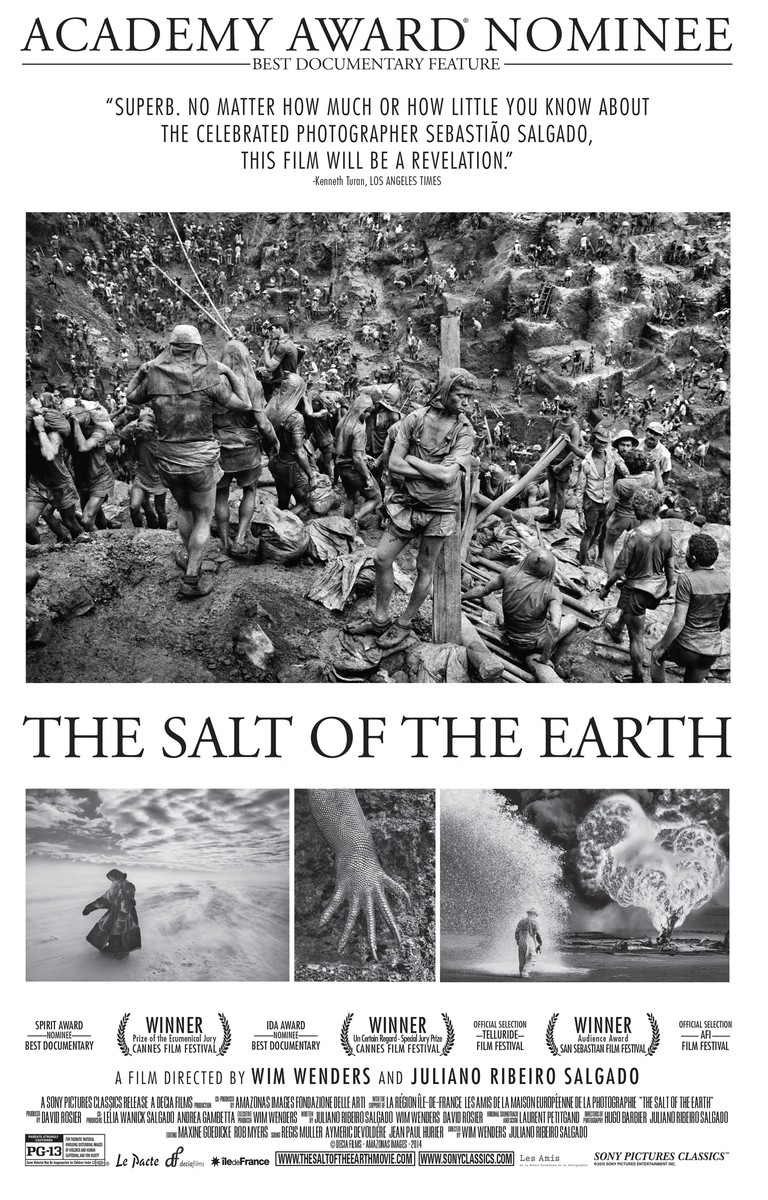
“The Salt of the Earth”

Paleo Retiree writes:

salt

Blowhard, Esq. and I just watched this highly-praised documentary about the Brazilian photographer Sebastião Salgado, which was co-directed by Wim Wenders and Salgado’s son Juliano Ribeiro Salgado. (For the purposes of keeping father and son straight in this posting I’ll refer to them by their first names.) Sebastião is best known for his socially conscious, reportage-style black and white images from war, disaster and refugee zones. He was a hero to many photographers at the magazine where I worked. They viewed him as what they’d like to be: someone bringing important, concerned news back from crisis zones whose work also has “art” status on its own. Sebastião seemed to demonstrate that you could do good, be a bearer of urgent news AND be an uncompromising artist-with-a-vision all at the same time. That combo of things seemed to be an important fantasy of theirs, maybe even the source of much of their own drive. Sebastião’s images are smokey, dramatic, stark, rich experiences — on the one hand visions of hell akin to medieval allegorical paintings and on the other powerful leftie nightmares that often remind me of Eduardo Galeano’s “Memory of Fire” trilogy of novels. (Hey, thanks to Google I just learned that Galeano died recently.) Sebastião was initially trained as an economist and was headed towards a job at the World Bank when he decided to try to make a life as a photographer, and his education seems to have opened his mind to systems-type thinking, as well as to the importance of work and money in the world as we experience it.

Continue reading

Posted in Movies, Photography | Tagged , , , , , , , | 2 Comments