Fabrizio del Wrongo writes:
I usually take a couple of weeks off from work during the summer. One of the things I like to do during those too-brief respites is hike. I don’t know why I like it. Probably because I like walking and I enjoy nature. Also, it’s free. I guess that’s reason enough.
This year I took a trip south to check out High Tor, a rock outcropping bordering the west of the Hudson River and part of southern New York’s famous Palisades. The formation towers over Haverstraw, a small town with roots going all the way back to the 17th century, when the primary influence on the Hudson Valley was Dutch.
High Tor is now part of High Tor State Park in New City, New York. Unfortunately, as I discovered upon arriving at the park’s gate, the facility doesn’t open until June 20th — an odd date considering summer, for most people, starts in late May or early June. So I had to locate a trail-head for the Long Path off South Mountain Road. I found one a little past the junction with Scratchup Road (look for the teal blazes on the telephone poles).
It’s neither a hard nor long hike; you can do it in a couple of hours. Most of it consists of a pleasant walk through the woods, though the final ascent to the peak is pretty steep and rocky. I didn’t run into anyone on the way up aside from some wild turkeys and a single white-tailed deer.
The formation’s peak yields a terrific 360-degree view of the area. To the north are visible the Hudson River and Haverstraw. If you look into the distance you can just make out the twin bulbs of the Indian Point Energy Center, an ever-controversial nuclear power plant constructed in the early ’60s.

To the south of the village is the Haverstraw Quarry. Cut into the surrounding mountainside, it produces asphalt and gravel. During my hike I frequently discerned the sound of explosives being set off within the facility. It’s a wonder that some kind of housing complex sits right beside it. Hope the residents own earplugs.

Quarrying has quite a history in the area. In fact, much of the land surrounding the Hudson was saved due to early conservation efforts spurred by excessive quarrying of the landscape. I was tickled to discover that a ’30s play, called “High Tor,” took these efforts as the basis for what sounds like a fantasy-melodrama with a social conscience. It was written by Maxwell Anderson, who contributed to the screenplays of a number of Hollywood films, including “What Price Glory?” and “All Quiet on the Western Front.”
Occasionally you’ll find a Palisades-like formation in the middle of the forest. All of these were formed some 200-million years ago by magma intrusions, which were later exposed by erosion.
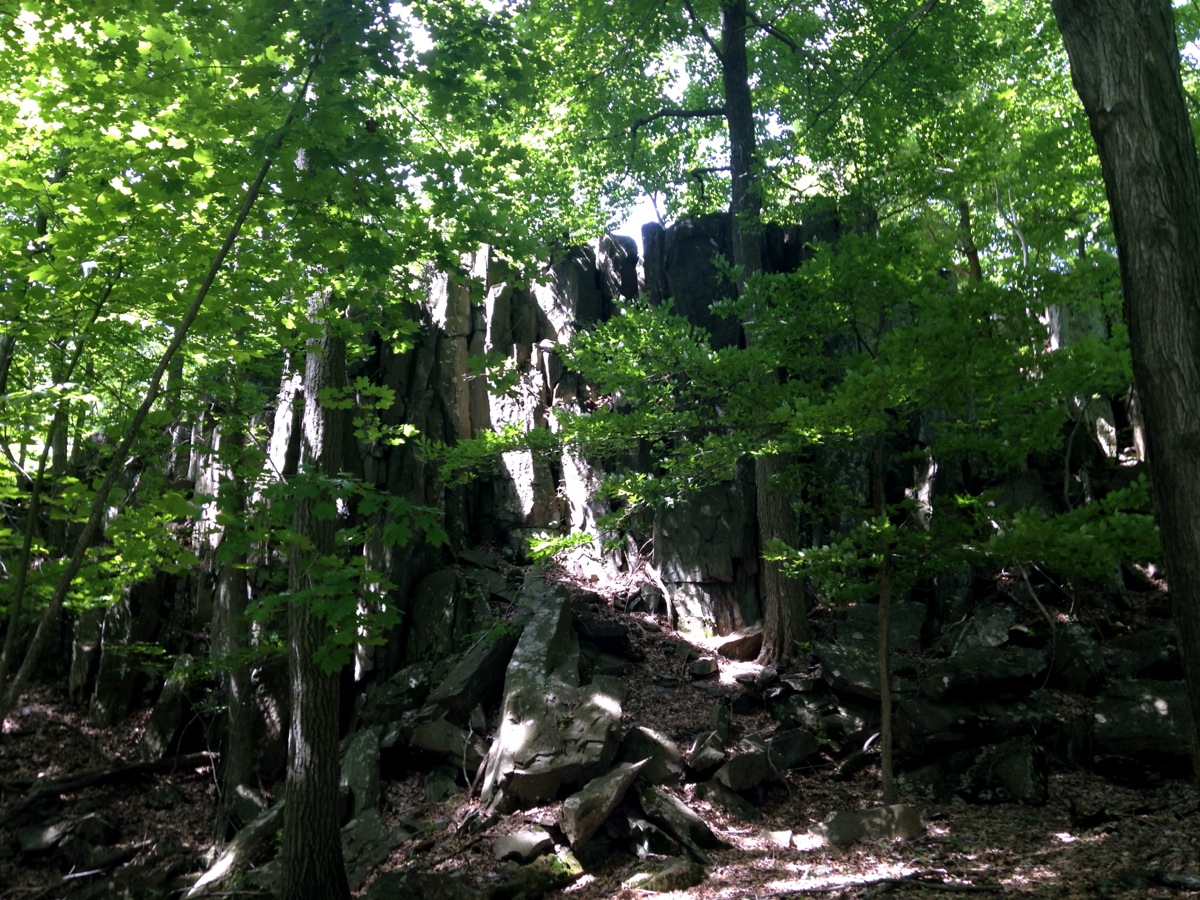
As interesting as all that is, it’s the western view that provides the glamor shot, the Manhattan skyline being visible on the horizon.
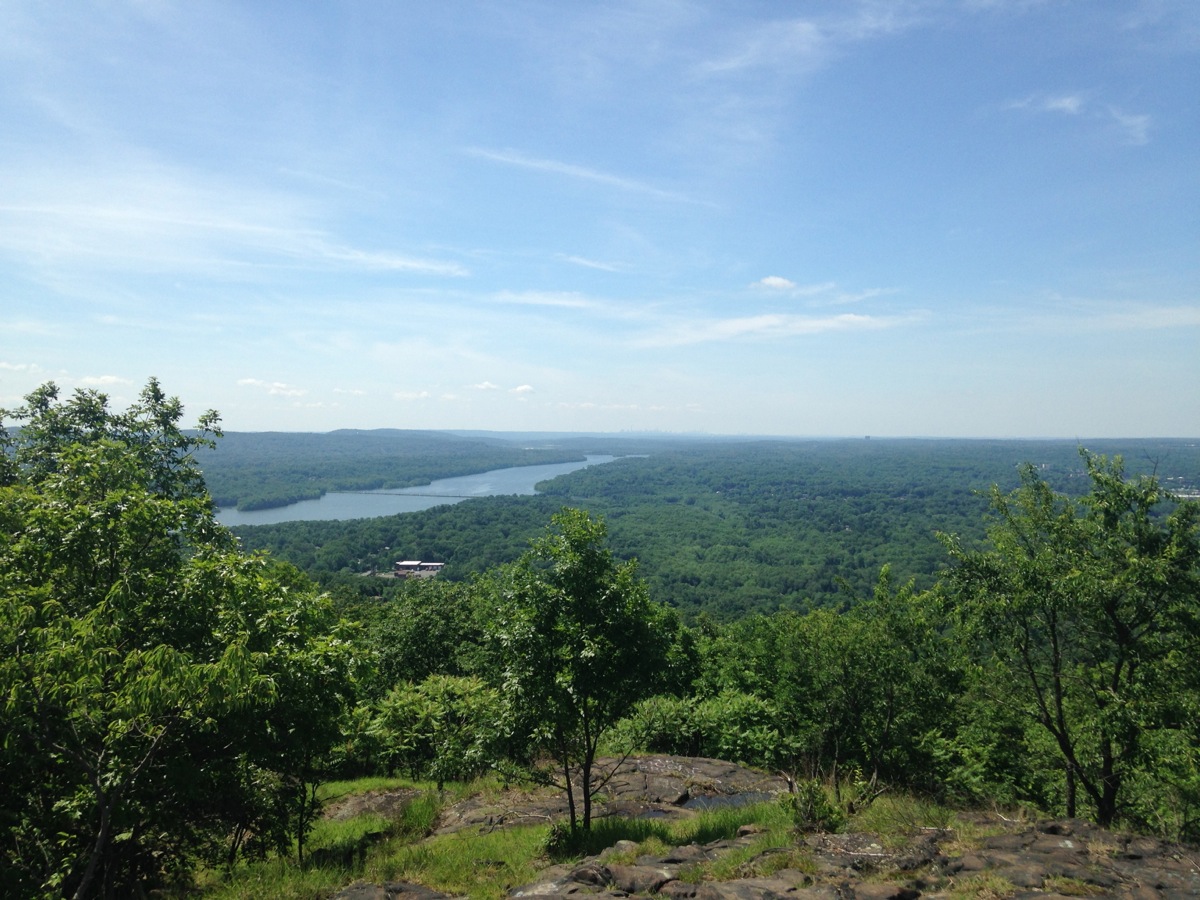
It’s that view that has been drawing people to the top of High Tor for hundreds of years. I got a kick out of perusing the graffiti on the summit. Some is painted and some is carved right into the rock. The earliest markings I found bear dates from the early ’60s. I love the ’80s-era insults directed at Russia and Iran. Hey, we’re back to hating them, aren’t we?


On my way home I took a quick detour through Haverstraw, which retains a quintessentially American-looking main street, complete, in some cases, with vintage signage.


Wikipedia claims that, as of 2000, the town was about 30% Hispanic. I would have guessed 80%.




















 Blowhard, Esq.
 Callowman
 Sherbrooke
 Eddie Pensier
 Enzo Nakamura
 Epaminondas
 Fabrizio del Wrongo
 Fenster
 Brundle Guy
 Glynn Marshes
 Paleo Retiree
 Atypical Neurotic
 Question Lady
 Sax von Stroheim
 Sir Barken Hyena
 The Mistaken
 Uncouth Reflections