Memories of a WWII Soldier

Blowhard, Esq. writes:

grandpa

I was going through some old papers when I came across this, an interview I did with my grandfather (RIP) for a college oral history assignment. Despite my primitive interviewing skills and shameful lack of follow-up questions, there’s some interesting stuff here. At the time of this interview he was 82-years-old. He died six years later from complications caused by Alzheimer’s.

Blowhard, Esq.: Were you drafted or did you enlist?

Private First Class: Drafted.

BE: Where were you living at the time?

PFC: Chicago.

BE: Why did you pick the service branch you joined?

PFC: You couldn’t chose. I was assigned to the army. I had boot camp in Illinois – no, no – I was at Camp Robinson in Arkansas. After boot camp, you were given a test. And for some reason, I did good on the mechanics. How I did good at mechanics, I don’t know.

So six of us were sent to a mechanic’s school in St. Louis, a civilian school. Took the train there. It was a three-year school for civilians, but we spent three months. What we had to do, we had to pair up with a partner, take this huge engine apart – into a million little pieces – then put it back together, and it had to start. We did it, and I passed. I can show you my diploma.

BE: What was boot camp like?

PFC: Bunch of horseshit. Get a good haircut first, y’know, then do everything. Twenty-five mile hikes with big packs on your back. When you’d get a mile from the base you’d do double time, y’know, running. At the camp were these German prisoners of war, so we’d be running by and they’d be playing volleyball! We’d run by and they’d come up to the fence and they’d be “Ha, ha, ha” at us!

BE: What were the drill instructors like?

PFC: I don’t remember much about them. What I do remember is there was a first lieutenant there that was 18-years-old, the youngest in the Army.

BE: After boot camp, after mechanic’s school, where did you go?

PFC: North Carolina, Monroe. A small arms unit. We handled all the small arms. Then to Camp Toccoa – I got transferred to this other outfit. We got there right as the 101st Airborne was leaving.

BE: Why did you transfer?

PFC: When we got to North Carolina we were with all the guys from the South. Bunch of assholes. It was a few of us from the midwest and all the rest Southerners, so I requested a transfer and I was sent to the 236th Quartermaster. The 236th was a new unit. The Army got the idea from the Germans. Whenever they’d take over a town, they’d send these guys in to take everything. So our job was to find anything that could be of use.

quartermasterwwii

From there we went to … I can’t think of the damned name, I can’t remember. Then we got on a train to California, up north. From there we shipped out from San Francisco.

When we went through the Pacific, we went all the way around to avoid the Japanese subs. Went to New Caledonia, in Australia, stayed overnight. Then up to Guadalcanal. That trip was 21 days.

Guadalcanal was secured already. That was the first island the Marines took from the Japs. Then we went to Emira Island, off New Guinea. They took that island in a real short time.

We were on Guadalcanal for 6 months, then Emira. Then we went to Bougainville. In a lot of these islands there was fighting going on, so we were in a combat zone. The Marines had pushed the Japs out and into the hills. On Emira the Australians had an airbase and they would run patrols to Rebaul to make sure the Japs weren’t sending more troops.

From Bougainville we got on an Australian ship and joined a convoy of 1,000 ships in the Marshall Islands. And from there we went to the Philippines. We had to come up – let’s see, we probably came up through – we landed on Luzon at Lingayen Gulf.

The Japs had been pushed back to Dagupan. We were shelling there. We took this road and followed the combat troops to see if there was anything we could use. It was about 100 miles to Manila.

BE: And what did you find?

PFC: We would wait until they gave us the OK and then we’d go in. One time, there was a rope factory with huge stacks, piles and piles of rope. We ended up giving that to the Navy. The Japs had an airplane parts factory. We found a Japanese laundry, filled with all these officer’s uniforms. We took them and gave them to the people. Everyone was walking around in Japanese uniforms! We found a lot of rice that was supposed to go to the Japanese troops and gave them that, too. A brewery! We walked into this brewery that had huge vats of beer that wasn’t ready yet. “Green beer,” they called it. Some of it was good, though, so after they tested it – to make sure it wasn’t poisoned – some of the guys would come by with huge five gallon drums and take it. And you know what? It was pretty good beer!

BE: Did you see combat?

PFC: Oh we were pretty close, I’ll tell you that. We were new to this, y’know? They’d tell you to wear your helmet, but some of the guys didn’t wear their helmet. Or keep your rifle with you at all times.

We were called into a city hall. We were called in to look at this big vault, and then we hear something go off. I look outside on the street and this officer is running towards us, yelling, “You’re drawing fire! You’re drawing fire!” They were firing mortars at us.

In Quezon we’d lay around til they called us. The Japs were in this old walled city built by the Spanish — Intramuros. Fifty thousand Japs in there, on the Pasig river. The Americans were on the other side of the river shelling. A whole lot of Japs slipped out at night and fled to the hills, so the Americans and the Australians would send patrols out there to keep an eye on ‘em or kill ‘em.
hondis

I remember these big pontoon bridges. They had these pontoon bridges because the Japs had destroyed the other ones. There would be these dead Japs in the water, and the bodies would float up to the pontoons and weigh them down, so the bridges would almost be in the water.

We went to Iloilo City in the Panay Gulf for 4 to 5 months. Then back to Manila because we were getting ready to invade Japan. Everyone had to get shots. I remember getting in line and getting two shots: one guy would give you one in one arm, and there’d be another guy on the other side. One, two. They were saying that if we invaded, 250,000 of our guys would get killed. They’d have everyone out there in the streets fighting. Kids, everyone. Even after we dropped the second bomb, the assholes didn’t wanna give up! The Emperor had to talk them into surrender.

We were attacked by kamikazes while on an Australian ship. It was a cruise ship, it was called…the Westralia. Most guys were up on the deck, like I said, it was as cruise ship, and then the alarm goes off. So we took these staircases on either side of the ship down to the lower decks. The officers, with their sidearms, are trying to get us quickly down there. We get there and we hafta put on these damned life preservers. Do you know those pom-pom guns? The Australians fire these big pom-pom guns, BOOM-BOOM, BOOM-BOOM! A wing from one of the planes hit the ship and boy oh boy did it make a racket. The guys wanna get outta there and the officers take out their sidearms, they’re standing on the only two staircases leading up, and they say, “I’ll shoot the first son of a bitch who tries to leave.”

That was scary, though, I tell ya. When we finally got back on the deck they had to push the wing overboard.

I remember on that Australian ship, over the loudspeaker every morning they’d say, “Wakey, wakey, rise and shine, you’ve had yours and I’ve had mine!” Really nice guys, though. I remember they had beans for breakfast!

In the Philippines the locals had the job of cleaning up the dead bodies. They’d walk around and stack the Japs like lumber. Then they’d go and dig a pit and bury them all. Lots of guys would get sick and couldn’t eat, but it never bothered me.

BE: What was the food like?

PFC: All the time we were overseas we didn’t have our own kitchen. We always ate with other outfits. There were always rations around.

BE: How did you entertain yourselves?

PFC: Shoot craps, play cards. Every month we’d get a beer ration. One six-pack. Some of the guys didn’t drink, so they’d sell it for a dollar a bottle. So they’d make six extra bucks, which was a lotta money back then. You get enough beer together, and you had yourself a good time!

There were cigarettes and cigars, too. Most of the guys didn’t smoke cigars, but I did of course, so I always had plenty. Cigarette lighters were tough to come by, so they’d raffle those off.

BE: What about leave?

PFC: You didn’t get no leave. I remember the officers coming by and giving us a deal: three months stateside, but when you got back it was duration plus. So, sure, you got three months but when you got back they could keep you a lot longer. There was a point system. You got so many points for every month stateside, every month overseas, and in combat. You needed something like 67 points.

BE: What did you do after the war?

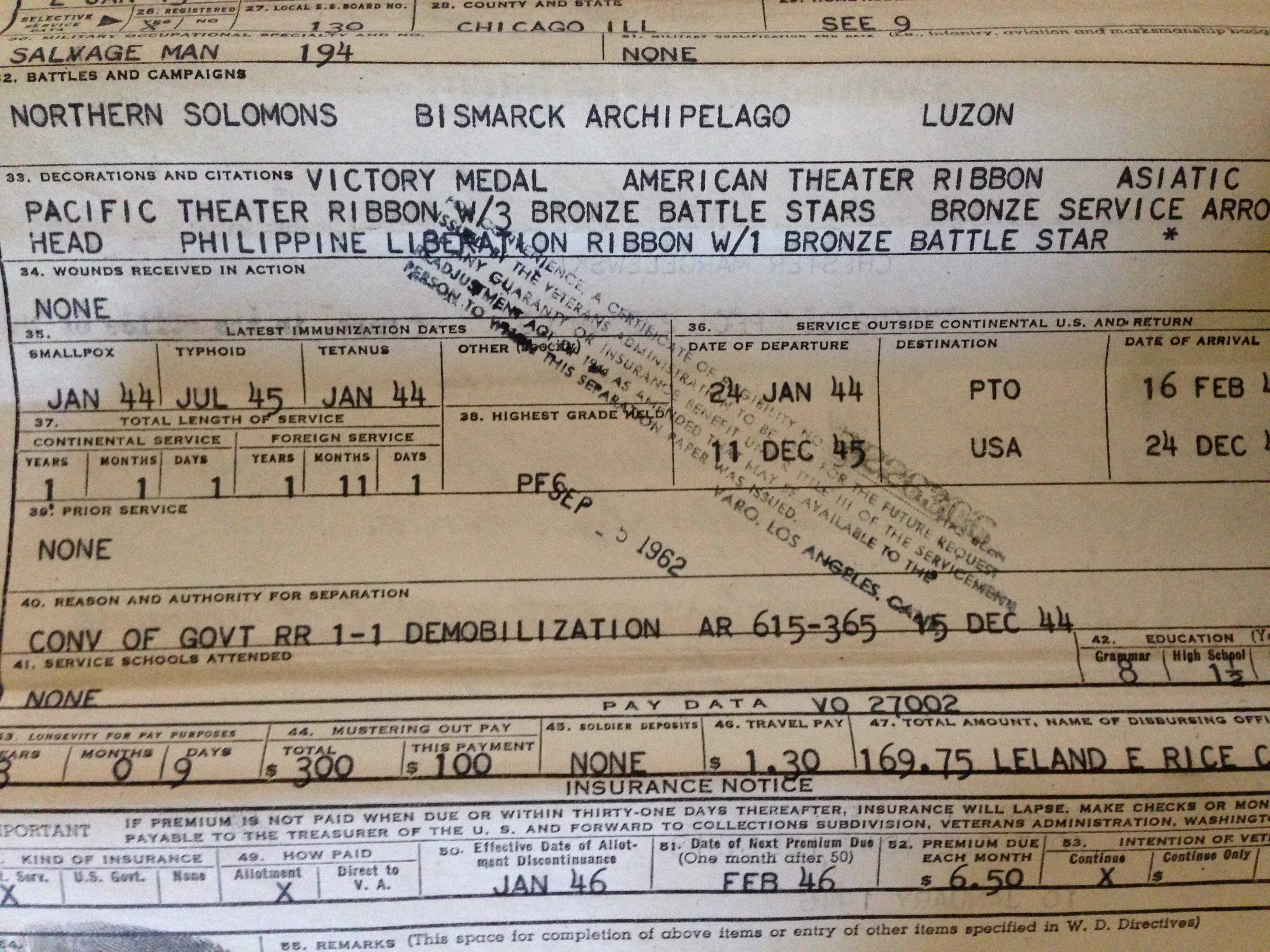
PFC: For a while I didn’t do nothin’. Illinois was one of the few states that gave you a bonus, so I got an extra $300. When they let us go there were all these cabs to take the guys home. I took a streetcar. When I got off, your uncle Frankie was walking right towards me. I didn’t recognize him! It had been, oh, three years and if he didn’t talk I wouldn’t have known who he was. When I got home he was wearing practically all my clothes! That $300 came in real handy.illinoiscert

I went to the doctor one day because I looked in the mirror and noticed my back was all red. The doctor, he said, “Go to work.”

I worked on the railroad. You know, Elmer was an engineer. I was on the extra board, so I only worked on Saturday and Sunday, switching cars. I got sick and tired of that job. When I quit, my uncle, he got real mad, “Stick it out, it’s a good job!”

Then I worked at the union depot in Chicago. The boxcars would come in fully loaded and I’d unload them. The National Tea Company, a chain of food stores in the midwest. My mother worked for them during the war.

BE: Anything else?

PFC: I had malaria, you know. There were lots of mosquitoes over there. I had the sweats, then I’d get really cold. They sent me to the doctor right away. The doctor said, “Happy birthday, you have malaria.” It was my 22nd birthday.

It was terrible, you’d be sweating, sweating and the next minute you’d be all cold. Dizzy, couldn’t sleep. But it didn’t matter anyway, because they’d wake you up every three hours to give you ativirin. Quinine was hard to come by, so they gave you ativirin instead. I was in the hospital for a couple weeks. And that ativirin, it makes your skin yellow, looks like hell.

I was at Hiroshima. We got there about October and they dropped the bomb, when?, in August? We were stationed about 12 miles from there, everyone wanted to see what it looked like, so we got a Jeep and drove down. Boy, to think that one bomb could do so much damage! One building, the outside was still standing but the insides were completely gone. We didn’t stay long. I remember seeing clumps of glass, melted glass, all over the ground.
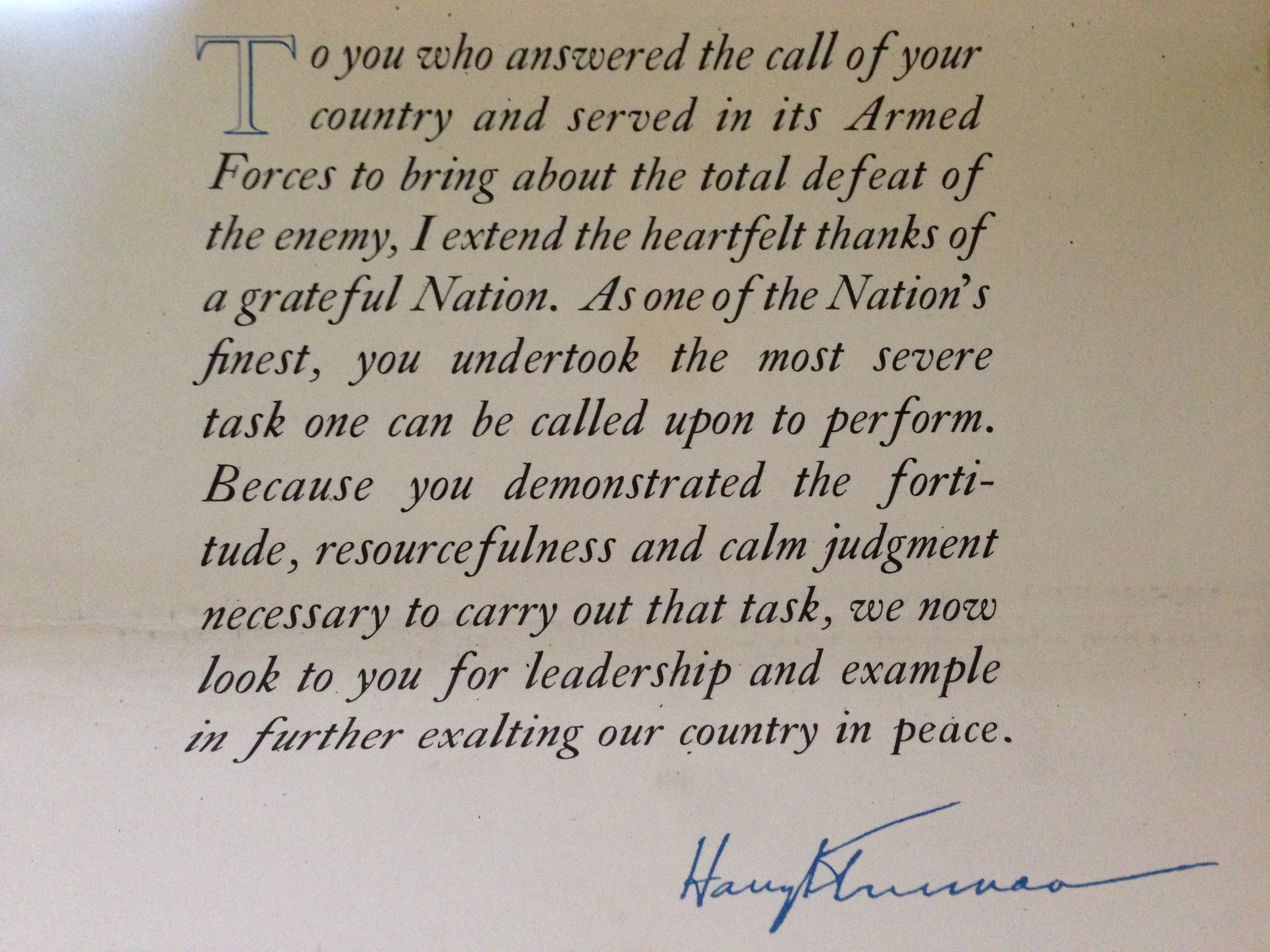
trumanletter

Posted in Interviews | Tagged , , | 6 Comments

Giallo Movie Posters: Estremi Italiani

Fabrizio del Wrongo writes:

Either you like extremes in your art and pop culture, or you don’t. I suspect most fans of the giallo are in the former camp.

The giallo was a peculiarly Italian brand of thriller-cum-horror film that flourished in the later ’60s and ’70s. It heavily influenced the American slasher genre and came to inspire A-list directors like Brian De Palma and Quentin Tarantino. The genre had its roots in pulp crime stories (usually published with yellow covers — “giallo” is Italian for “yellow”), though it’s hard to imagine its development absent the example of Hitchcock. The narrative loop-the-loops and pseudo-psychological motivations of “Psycho” are all over the giallo; sometimes they seem thrown in just to tick a box.

But giallos (I’m going to avoid calling them “gialli,” because I’m not Italian) were more overtly crass and grossly unsubtle than anything Hitchcock ever had a hand in. In fact, if you had to whittle a description of the genre down to just two words, you would almost surely end up with “sex” and “violence.” You go into these films wanting to experience these two things in their purest and most extravagant forms, for the giallo is not a forum for hinting or half-measures. In some ways it’s helpful to view these movies through an art-historical lens: If Lang and Hitchcock are the classicists of the movie thriller, a giallo filmmaker like Argento speaks to us from the decadent throes of its rococco phase. He’s there to test the limits.

The posters used to advertise the giallo in Italy are about as extreme and as to-the-point as the movies they represent. Most feature women being slain or brutalized. And if you didn’t get that sex might be a factor in these acts, the artists often take care to delineate a male presence — typically wielding a knife that’s long, steeled, and ready for the plunge.

The posters, like the movies, are designed to titillate and disturb. And I don’t think I’m wrong in believing they’d provoke an outcry if released today. No doubt an argument could be made that the images exploit women or encourage violence. But is this sort of thing really that different from “sweat” publications of the ’50s, with their covers featuring men being torn apart by animals or skewered by hulking, darker-than-night aboriginals? There’s a frankness in the giallo posters — and in the sweat mags — that I find refreshing, even invigorating. Outré fantasies and unfiltered id, baby! The glee of giving the finger to morals and appropriateness! After all, what’s the point of an exploitation movie if it doesn’t provide a release from decorum? If it’s comfort and tastefulness you’re after, head on over to Etsy and buy some doilies.

Or maybe this sort of thing should be suppressed, and its absence from the contemporary movie scene is a positive? Well, don’t look at me like I have the answer. What’s your take?

PS — I realize that some of the movies represented here are not, strictly speaking, giallos. But more horror-themed films like “Black Sunday” and “Suspiria” share so much in common with their thriller brethren that I don’t see much reason to separate them. Let’s agree not to be pedantic, shall we?

Related

Posted in Commercial art, Movies | Tagged , , , , , | 2 Comments

Linkage: Whiteness is the Worst Edition

Blowhard, Esq. writes:

whitepeople

  • Yesterday The Independent published an anonymous article entitled “White Men Should Never Hold Elected Positions In British Universities Again.” It appears they have taken it down, but someone at reddit helpfully preserved this charming bit lefty self-flagellation:

    University is supposed to be amazing, a transformative experience which is informed by student unions across the country. Yet people don’t give a toss about their student unions, no one cares about the NUS, and activism is dying at all but a few hardcore universities. This generation of students has been pissed on by the government and fees, and privatisation, and all anyone seems to want to do is roll over and let it happen.

    Do you know why this is? It’s because our universities and student unions are too similar to our government; they are too stunted by white men. White men might want to appropriate injustice as theirs, desperate for something to struggle against, but it’s a hobby they’ll pick up and drop as soon as the first comfortable finance job beckons them over.

    We need to ban white men and their activism dilettantism from student unions. We need powerful women and minority ethnic people to bring their passion back to the heart of student politics. Being a student union president should no longer be a place for privileged whiteboys to swing their dicks around before graduating into a world that is in no way affected by what they claim to fight for.

    More importantly, we obviously live in a world that looks favourably on white men. In order to bring about change in our racist and sexist society, it must start in our universities. If women and minority ethnic people were in positions of leadership across all universities in the country, we would have a diverse graduating class of future leaders in every industry.

    “Oh but, it’s racist to ban someone on the basis of their skin colour, and sexist to ban them on their gender,” cry the assembly chorus of confused souls trying to turn the language of progress into a weapon to further entrench the establishment. It’s not. You’re at university, go and ask a humanities professor. Learn something.

    White men have had the last several millennia in charge, and it’s been a s***show from start to finish. A new generation of powerful women and minority ethnic people is ready to lead and change. It is time for you to bow down.

  • More hilarity out of the Emerald Isle. The UK National Union of Students has banned gay white men from “appropriating black female culture.” I’m sure black women have never appropriated any other culture.
  • Finally, this fucking genius over at Pitchfork comments on “The Unbearable Whiteness of Indie” rock. This moron is upset that GOD SAVE THE GIRL, the directorial debut of Belle and Sebastian’s Stuart Murdoch, is “steeped in Whiteness”:

The film itself is an egregious mess that romanticizes a woman’s struggles with an eating disorder for the sake of Murdoch’s self-promotion. The optimistic, happy-go-lucky and painstakingly adorable aesthetic evidenced in every character he created is founded in Whiteness. Whiteness is beauty; Whiteness is what gives the character the ability to dream of fostering a career in music; Whiteness is what enables the audience to empathize with Eve’s character. A recurring filler in the film was a fictitious radio show where two men try to decipher what “real” indie is and every band mentioned is white, enforcing the film’s aspirational Whiteness. While Belle and Sebastian aren’t the only examples of perpetuating Whiteness through indie rock, this movie serves as a microcosmic view of what is wrought by racial exclusivity that is omnipresent in indie rock.

In indie rock, white is the norm. While indie rock and the DIY underground, historically, have been proud to disassociate themselves from popular culture, there is no divorcing a predominantly white scene from systemic ideals ingrained in white Western culture. That status quo creates a barrier in terms of both the sanctioned participation of artists of color and the amount of respect afforded them, all of which sets people of color up to forever be seen as interlopers and outsiders. Whiteness is the very ideal for which art is made in Western culture, be it the cinema of Wes Anderson or, say, the artists on Merge Records.

After complaining about microaggressions and the lack of female Indians in pop music, she concludes by saying:

It’s difficult not to be deterred and alienated by the overwhelming Whiteness of it all, especially when as a person of color, Western society flat out resists the witness of your life. However, it’s important to seize and act on precedents being set by the likes of Heems and M.I.A., paving a way that makes it easier for new artists of color to follow suit and make their mark. Whiteness is a mark of exclusivity that must be broken; to have masses of talent ignored in favor of a select few is not acceptable. Visibility of people of color in independent music is absolutely paramount for the genre to evolve and truly represent those cast away from the scene for too long.

Hmmm, yes, indubitably. Please tell me more about how Western society flat out resists the witness of POC.

Posted in Education, Music, Politics and Economics | Tagged , , , , , , | 11 Comments

Quote Du Jour

Fabrizio del Wrongo writes:

Dino-Risi-622x390-1410708484

I never liked Stalin, I didn’t do sit-ins. No marches against Israel, hunger strikes, or petitions for peace. No shouting ‘Long live Mao,’ or reading dazibao. I never took pleasure cruises, never sacrificed my art to hock my wares — and by that I mean I never took part in panel discussions chaired by ugly blonde women.

— Dino Risi

Posted in Movies, Philosophy and Religion | Tagged , , | Leave a comment

Naked Lady of the Week: Ossana

Fabrizio del Wrongo writes:

o-cover

Every straight guy has an opinion on redheads. And more often than not it’s a strong one.

Here’s mine: I love them.

As you’ll notice while browsing through the below photos, Ossana here is a certified all-natural, 100% authentic redhead. In fact, her bush is so ostentatiously rubicund it rivals the one Julianne Moore so graciously displayed in “Shortcuts.” It’s an ebullient, photogenic bush too, and Ossana seems to enjoy displaying it like a treasure.

According to the ever-helpful TheNudeEU, Ossana, who also goes by Brisa and Oxavia, is Russian. She appears to be a popular cam girl. I’m not going to link to her cam site, because the last time I did something like that WordPress shut down our entire operation for a few hours. But you can find it by Googling “SquirtFoxy.”

I love the last couple of sentences of the bio the popular nude sites append to her photos: “I believe that the world was created for love and pleasure, one of those pleasures is me. I hope you have the same opinion.”

I believe these scaled-down photos derive from Femjoy and DOMAI.

Have a great weekend. Nudity below the fold.

Continue reading

Posted in Photography, Sex, The Good Life | Tagged , , , , | Leave a comment

A Night on the Town in Manhattan: November 1963

Blowhard, Esq. writes:

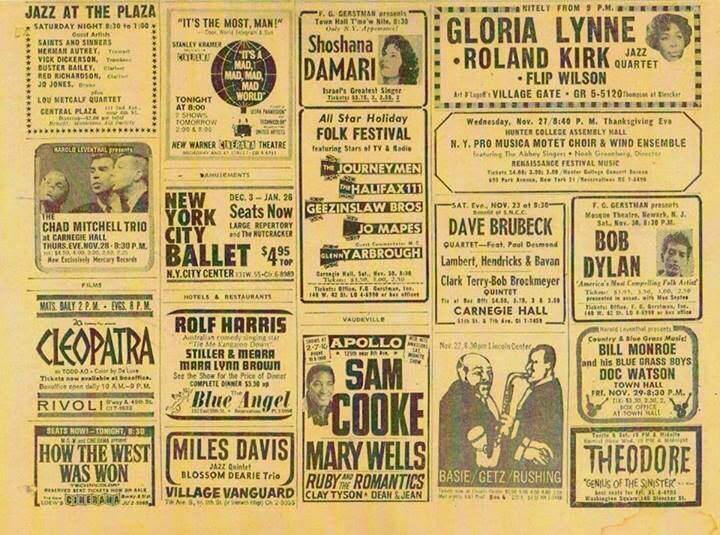
nov1963

Quite a list of choices. Although, as someone pointed out, this occurred the week after Kennedy’s assassination, so I’m sure some of these events were cancelled.

Posted in Art, Movies, Music | 4 Comments

Quote Du Jour

Blowhard, Esq. writes:

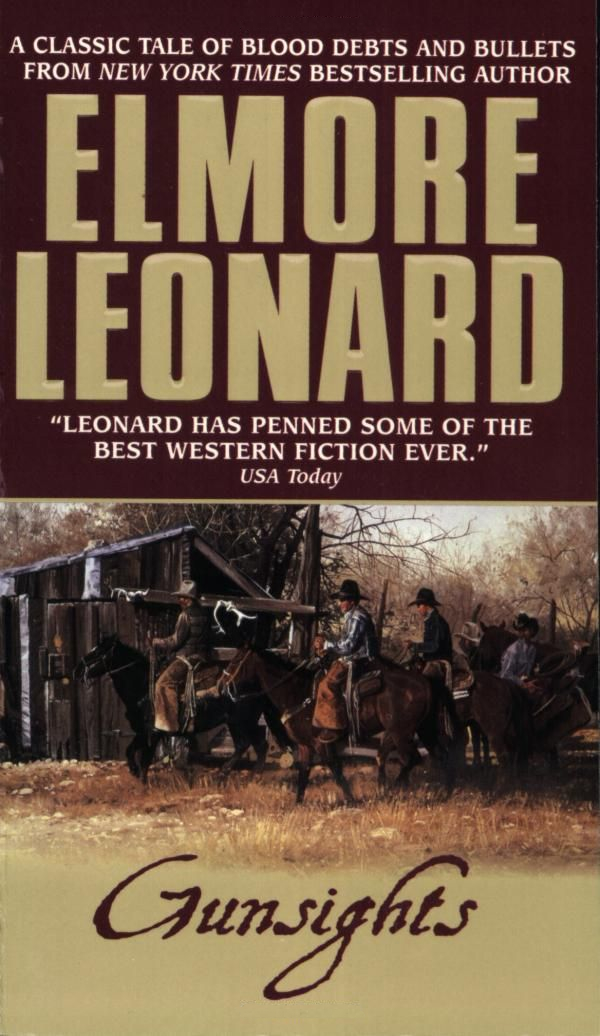
gunsights

In Benson, Ruben Vega had to find the right church first, St. John the Apostle, then had to lie to the priest to get him to come from the priest house to the church to hear his confession.

Kneeling at the small window in the darkness of the confessional, Ruben Vega said, “Bless me father, for I have sinned. It has been…thirty-seven years since my last confession.”

The old priest groaned, head lowered, pinching the bridge of his nose with his eyes closed.

“Since they I have fornicated with many women…maybe eight hundred. No, not that many, considering my work. Maybe six hundred only.”

“Do you mean bad women or good women?” the priest asked.

“They are all good, Father,” Ruben Vega said. “Let me think, I stole about…I don’t know, twenty-thousand head of beeves, but only in that time maybe fifty horses.” He paused for perhaps a full minute.

“Go on.”

“I’m thinking.”

“Have you committed murder?”

“No.”

“All the stealing you’ve done — you’ve never killed anyone?”

“Yes, of course, but it was not to commit murder. You understand the distinction? Not to kill someone, to take a life; but only to save my own.”

The priest was silent, perhaps deciding if he should go further into this question of murder. Finally he said, “Have you made restitution?”

“For what?”

“For all you’ve stolen. I can’t give you absolution unless you make an attempt to repay those you’ve harmed or injured.”

Jesus, Ruben Vega thought. He had forgotten how difficult they could make it when you wanted to unburden yourself.

Gunsights by Elmore Leonard

Posted in Books Publishing and Writing | Tagged , | 3 Comments

Couldn’t Do It Today

Blowhard, Esq. writes:

Doesn’t matter that it’s ultimately complimentary and sympathetic to Ms. Davis, the lyrics and Jagger’s black accent would render it verboten.

Got a sweet black angel,
Got a pin up girl.
Got a sweet black angel,
Up upon my wall.
Well, she ain’t no singer,
And she ain’t no star,
But she sure talk good,
And she move so fast.
But the gal in danger,
Yeah, de gal in chains,
But she keep on pushin’,
Would ya take her place?
She countin’ up de minutes,
She countin’ up de days,
She’s a sweet black angel, woh,
Not a sweet black slave.
Ten little niggers
Sittin’ on de wall,
Her brothers been a-fallin’,
Fallin’ one by one.
For a judge’s murder,
In a judge’s court,
Now de judge he gonna judge her,
For all dat he’s worth.
Well de gal in danger,
De gal in chains,
But she keep on pushin’
Would you do the same?
She countin’ up de minutes,
She countin’ up de days,
She’s a sweet black angel,
Not a gun-toting teacher,
Not a Red-lovin’ school mom,
Ain’t someone gonna free her?
Free de sweet black slave.
Posted in Music | Tagged , , | 2 Comments

Giallo Movie Posters: Edwige Fenech

Fabrizio del Wrongo writes:

I’m fond of referring to Edwige Fenech as the Nefertiti of the Trash Cinema.

Are you all familiar with Edwige? During the ’70s she was one of the premier actresses in European genre movies. Chic and unshamable, no one was better at maintaining a placid, odalisque-like air of eroticism while dodging knives and getting splattered with gore. More often than not Edwige is the calm at the center of her movies’ storms, the anchor within the maelstrom. Yet there’s no fussiness or fear in her performances. She knows she’s there to get mussed — and the more extravagant the mussing, the better.

The peculiar mien that giallo lovers appreciate in Edwige bled into the posters designed to advertise her movies. They tend to feature the actress in attitudes that blur the line separating ecstasy from delirious, heart-pounding terror. (And, yeah, some are pure cheesecake.) Obviously, poster designers recognized Edwige for what she was: something between an objet d’art and a blood-spattered diva.

I’m not sure which of the below posters are my favorites. I love the Italian designs; they’re the frankest and the most ferocious. Yet my eye loves to linger on the Spanish poster for “Your Vice is Locked in a Room and Only I Have the Key.” It’s by legendary designer Jano, and it has a stillness and a coolness that really nail the appeal of la Fenech.

Related

Posted in Commercial art, Movies, Performers | Tagged , , , , , , , , | 1 Comment

Linkage

Blowhard, Esq. writes:

Posted in Linkathons | 2 Comments