Linkage (Deep-Fried Edition)

Eddie Pensier writes:

  • The cronut is so last year. Now there exists a “Ramnut”, a confection made out of ramen noodles. (And don’t tell me you didn’t have one fleeting dirty thought at the sight of the word “Ramnut”, because I won’t believe you.)
  • Have you ever had toasted ravioli? “Toasted”, in this case, is a euphemism for “deep-fried”. They’re delicious.
  • A rundown of all the awesomely unhealthy fried foods you can get at the Texas State Fair, including fried blueberry muffin, fried baked potato, and fried Sriracha.
  • Things that can go wrong when you try to deep-fry a Thanksgiving turkey. If you want a fried bird but you’d rather not risk similar catastrophes, several Pensier family friends enthusiastically recommend mail-ordering from Jive Turkey.
  • Any connoisseur of fried foods will tell you that fresh oil is a must. Now it seems that stale oil is not just icky-tasting, but possibly carcinogenic. Fry safely, friends.
  • According to Michael Krondl’s delightful The Donut: History, Recipes and Lore from Boston to Berlin: 

    …in Hinduism, the very act of frying sanctifies a food, as long as that fat is ghee.

    I don’t know much about Hinduism, but I’m on board with the sacred frying.

  • Donuts are in the Bible. Seriously. Look it up.
  • Even I might draw the line at deep-fried maple leaves, though. Not a pastry, but actual tree leaves. Sold in Japan, where it’s called “momiji tempura,” and unsurprisingly, in Canada.
  • A taxonomy of fried chicken.
  • Vitamin Donuts!
Posted in Food and health, Humor, Linkathons, The Good Life | Tagged , , , , , , , , , | 3 Comments

Art Du Jour

Eddie Pensier writes:

George Washington Lambert, The Sonnet, c.1907

Related

Posted in Art | Tagged , , | Leave a comment

Feature Writing House Style, Cont.

Blowhard, Esq. writes:

Way back here, PR had some fun with the New Yorker’s style when it comes to article ledes, which he summarized thusly:

On a date that’s peculiarly specific, and in a sentence that uses more commas than you’re accustomed to, someone you’ve never heard of did something, or had something done to him/her, of puzzlingly little apparent significance.

I came across a great example of this weirdness in an otherwise very good New York Times Style Magazine piece:

At 10 past 6 on a January morning a couple of winters ago, a 35-year-old man named Matt McCabe stepped out of his house in the town of Kenly, England, got on his Piaggio X8 motor scooter, and started driving north.

Hey, why don’t you tell us how many feet his house is above sea level and the number of miles per gallon his scooter gets too. After that sentence the piece spends five long paragraphs describing in great detail this dude’s commute from the London suburbs into the city. OK, it’s an article about London cabbies learning the city’s geography, so I guess spending almost 700 words describing his route to work is relevant. Or maybe they’re just more unimportant facts.

After all the prefatory nonsense, we get to the article’s sixth paragraph:

McCabe had spent the last three years of his life thinking about London’s roads and landmarks, and how to navigate between them. In the process, he had logged more than 50,000 miles on motorbike and on foot, the equivalent of two circumnavigations of the Earth, nearly all within inner London’s dozen boroughs and the City of London financial district. He was studying to be a London taxi driver, devoting himself full-time to the challenge that would earn him a cabby’s “green badge” and put him behind the wheel of one of the city’s famous boxy black taxis.

Why not start there? Isn’t that a much better opening? Anyway, it’s a fascinating article, check it out.

Posted in Books Publishing and Writing | Tagged , , | Leave a comment

Notes on “The Long Goodbye”

Blowhard, Esq. writes:

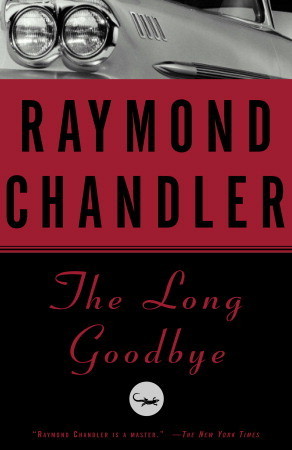
GoodbyeCover

1. What a wonderful book. A sprawling mini-epic with L.A. as a Potemkin paradise that, like “The Big Sleep,” is confusing as hell. More than a few times I stopped short to say, “Wait, how are these people connected again?” There are three rich Valley couples, an elderly and shadowy rich patriarch, various mobsters, cops, quack doctors, district attorneys, and corrupt Mexican officials for Marlowe to navigate through. The novel has been accepted into the Canon — Joyce Carol Oates blurbs my edition and Michael Chabon is a major fan — and I wonder if the plot’s complexity (along with the style, of course) went a long way towards earning that acceptance.

2. All of the dangerous dames — Sylvia Lennox, Eileen Wade, and Linda Loring — are blondes. The book is one long treatise on the icy blonde. The quote below is from Farewell, My Lovely but it could’ve easily been said about Eileen Wade. Sir Barken quoted a key passage here.

quote-it-was-a-blonde

3. I don’t know if the insight originated with him, but James Ellroy has said that, “Chandler wrote about the kind of man he wished he was, Hammett wrote about the kind of man he feared he might be.” Marlowe really is an idealized character. Everyone in the book is corrupt, lying, or hiding something except him. He’s the only one who pursues the truth. Even though the movie is a reinvention, it preserves this aspect of the character. Kael observes her review that Marlowe is “the only one who cares.”

4. This is one of the most alcohol-soaked novels I’ve read all year, and that includes the three Bukowski books I’ve gone through in the past couple of months. Gimlets, anyone?

5. My favorite character was a minor one, one of the cops named Ohls. He only shows up in three or four scenes but each time he comes on stage he gets a cynical, world-weary, paragraph-long rant in Chandlerspeak that always made me laugh out loud.

the-long-goodbye

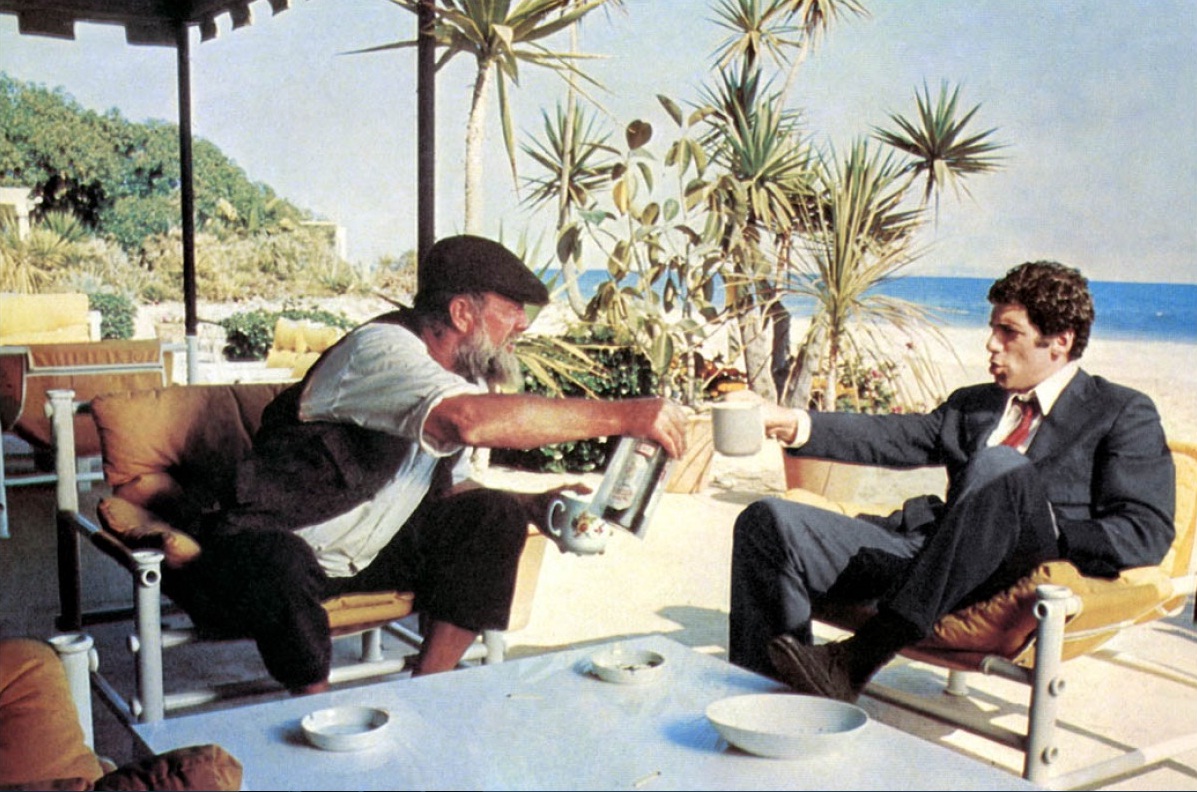
6. The book was published in 1953 and the movie was released in 1973. Only twenty years apart but they feel like completely different worlds.

7. The Coen Brothers sure have ripped this movie off a lot, haven’t they? (Hey, if you’re going to steal, steal from the best.) Sterling Hayden’s riff on Hemingway is like the antecedent to John Mahoney’s take on Faulkner in BARTON FINK. “A shaggy, pot-puffing version of Chandler” is the seed for THE BIG LEBOWSKI. They even reference the cat gag in INSIDE LLEWYN DAVIS.
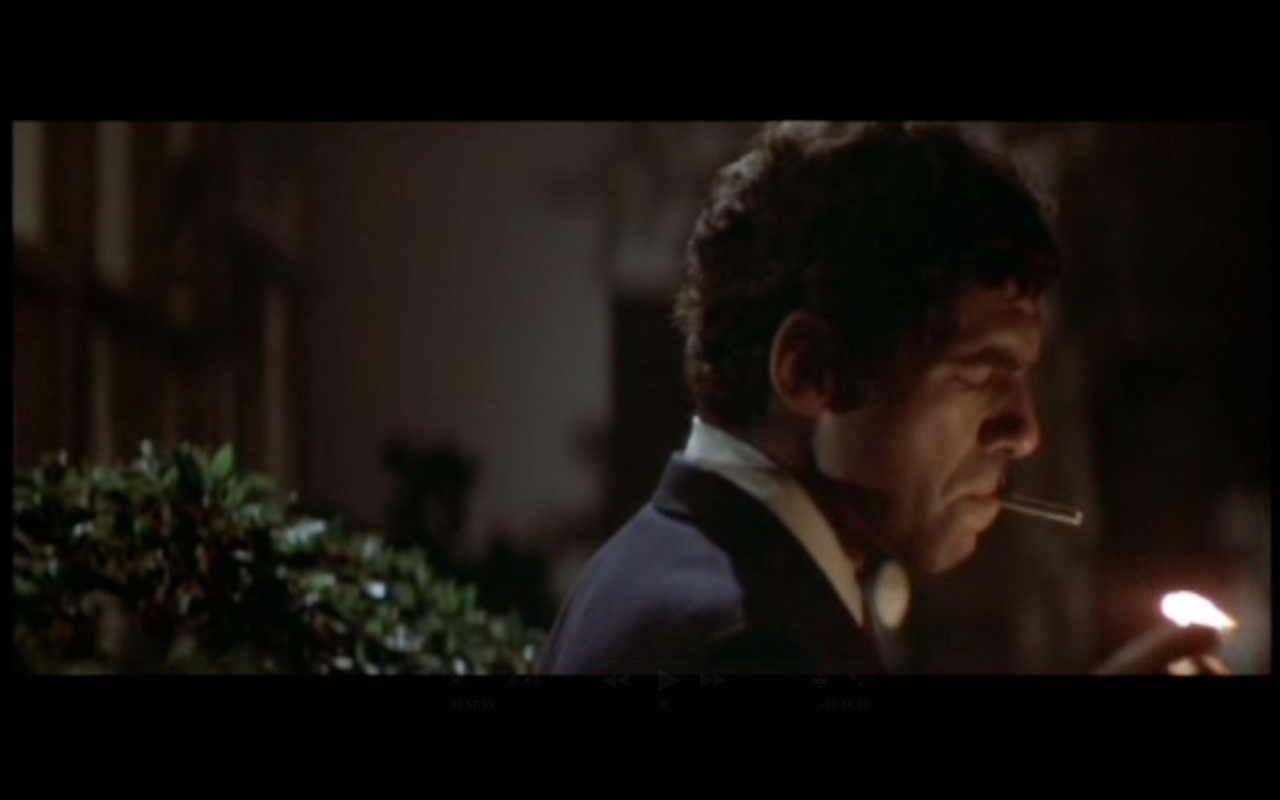
The Long Goodbye 1d

8. Elliott Gould is fantastic and, good Lord, did that guy have a run in the early 70s. In 1970, he’s on the cover of Time magazine. In the span of four years, from 1969 to 1973, he made ten movies including one with Mazursky, two classics with Altman, and Bergman’s first English-language film. Fuckin’ A!

Brackett

9. What an astonishing talent Leigh Brackett was. Does she have a street named for her in Hollywood? She not only co-wrote THE BIG SLEEP with Faulkner (!), she was responsible for Hawks’ RIO BRAVO (a story he liked so much he filmed it three times), this movie, and, shortly before her death, THE EMPIRE STRIKES BACK. A masterpiece in at least three different genres. Brackett’s adaptation preserves the core of Chandler’s novel — it follows the 380-page novel about as well as a 2-hour movie can — but she alters the ending substantially. Altman loved her ending so much he wanted it written into his contract that it could not be changed.

10. “Her I love. You I don’t even like.” Was that in the script or was it an Altman idea?

11. There are two gun battles in the novel, neither of which is that consequential to the plot. In the film a gun is fired once and it’s maybe the best part of Marlowe’s characterization, providing an ironic counterpoint to his mumbling mantra “It’s OK by me.”

12. L.A. in the early 70s was a pretty ugly place, but this is the third film I’ve seen this year — along with Jacques Demy’s MODEL SHOP (1969) and Jacques Deray’s THE OUTSIDE MAN (1972) — in which the movie is a valentine to the city.
Arnold+The+Long+Goodbye

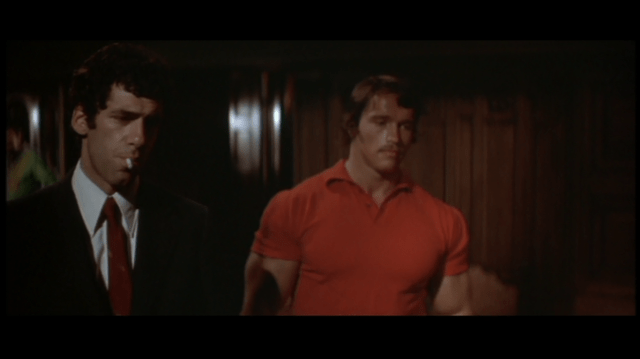
13. There’s a scene where Gould gets pissed off at a cop and threatens to report him to then-governor Ronald Reagan. In the very next scene, Gould has a meeting with a mobster (played by Mark Rydell) and which actor plays one of the mobster’s silent goons? Future governator Ahnold. Truth is stranger than fiction, you guys. Altman noted that “Arnold never talks about this picture.”

14. Sax told me that when the movie played at his local arthouse, he saw it three times in one day. Goddamit, now I have to watch it four times on DVD so I can beat him.

Related

Posted in Books Publishing and Writing, Movies | Tagged , , , , , , , | 12 Comments

Showtune Saturday (encore) “Barcelona”

Eddie Pensier writes:

By popular demand, here’s a repeat of the clip I posted last February of “Barcelona” from Sondheim’s Company. It features Neil Patrick Harris.

Oh and Christina Hendricks too, and did I mention that she takes her clothes off?

Posted in Music, Performers, Sex | Tagged , , , , | 1 Comment

Naked Lady of the Week: Erica Campbell

Blowhard, Esq. writes:

echeader

Although born in New Hampshire, Erica Campbell has the looks of a girl who sprang fully-formed from the Midwestern plains or a Southern hothouse. How did Peter Berg not cast her in FRIDAY NIGHT LIGHTS? I bet she would’ve been a more convincing Lyla Garrity than Minka Kelly.

Campbell emerged in the early 00s as one of the most popular amateur models and was soon featured on all the major glamour and nude sites, eventually making it to Playboy,  and then Penthouse Pet of the Month in 2007. Something about the camera just makes a girl want to open up in all her buxom lushness:

In personal life, outside of modeling, I’m the shyest person you’ve ever seen. My feet stick to the floor, and I’m totally shy. But modeling has given me the opportunity to open up. Oh my goodness. The camera turns on, and it just turns something else on for me. I mean, I’m not that shy little girl anymore.

If we needed further proof that God hates us, in 2008 Campbell declared that she found Jesus and retired from the biz. Knowing that now, the header image contains an evil little bit of foreshadowing, doesn’t it?

The NSFW pics below the jump are lo-res copies from sites like Cosmid, DDF Busty, Pinup Files, and Twistys. Happy Friday.

Continue reading

Posted in Sex | Tagged , , | 3 Comments

Architecture Du Jour

Blowhard, Esq. writes:

Neues_Rathaus_Hannover

New Town Hall in Hannover, Germany.

Click on the image to enlarge.

Posted in Architecture | Tagged , , , | 1 Comment

Quote Du Jour

Blowhard, Esq. writes:

The-Long-Goodbye

“There ain’t no clean way to make a hundred million bucks,” Ohls said. “Maybe the head man thinks his hands are clean but somewhere along the line guys got pushed to the wall, nice little businesses got the ground cut from under them and had to sell out for nickels, decent people lost their jobs, stocks got rigged on the market, proxies got bought up like a pennyweight of old gold, and the five per centers and the big law firms got paid hundred-grand fees for beating some law the people wanted but the rich guys didn’t, on account of it cut into their profits. Big money is big power and big power gets used wrong. It’s the system. Maybe it’s the best we can get, but it still ain’t any Ivory Soap deal.”

“You sound like a Red,” [Marlowe] said, just to needle him.

“I wouldn’t know,” he said contemptuously. “I ain’t been investigated yet.”

— Raymond Chandler, The Long Goodbye

Posted in Books Publishing and Writing, Movies | Tagged , | 8 Comments

“Godzilla”

Fabrizio del Wrongo writes:

The poster's imagery is about as muddled as the movie's plot

The poster’s imagery is about as muddled as the movie’s plot

The disaster film — which I think includes the giant monster film — has long been a venue for plots that encompass multiple characters, motives, and locations. One of the genre’s pleasures lies in our appreciation of how these parts fit together and click. “Godzilla,” though, is a mess of parts in search of a plan, a utility. Nothing connects or adds up, and the screenplay pulls in locations and human interest elements like a drain pulls in bits of stray rubbish. One such bit: A family on whom the picture spends its first 45 minutes. Because their fortunes yield almost no emotional or narrative payoff, both they and the long introduction end up feeling vestigial. Colorful characterizations might have redeemed the opening. But director Gareth Edwards gets a waxen performance from Bryan Cranston in the role of a truth-telling scientist. In the case of Aaron-Taylor Johnson, who plays Cranston’s son, there may be no performance worth getting. Physically, the actor suggests Elijah Wood — if he finally hit puberty.

Continue reading

Posted in Movies | Tagged , , , , , , , | 11 Comments

A Personal Note

Paleo Retiree writes:

I left a mini-memoir-ish comment on a Steve Sailer blogpost about the English writer Julie Burchill and her ex-husband Cosmo Landesman that a few might find interesting. Here it is:

A general question that’s come up a few times in this thread is “Why don’t we in America have more opinionators like Julie Burchill and Cosmo Landesman?” Can I take a swing at, if not an answer, at least some reflections?

Back in the early ’90s I wrote regularly for a magazine Julie and Cosmo were involved with, Toby Young’s Modern Review. I was one of a handful of American contributors. We had loads of fun, even if paychecks were minuscule. Lowbrow for highbrows was the magazine’s motto, I seem to remember, and it was one of the first British publications to deal with popular culture with humor, brains and offhand literary chops. It aimed to be a cross between The New York Review of Books and Spin and did a great job of it. It had a big impact too. A number of the magazine’s contributors went on to land featured gigs at the big daily newspapers, and many of those papers then altered their own cultural coverage (which had been awfully stuffy, as in stuck in the ’50s) to be funnier and to take more note of popular culture.

I never got to know Julie (who was theoretically the magazine’s co-editor) or Cosmo but I became pretty friendly with Toby. I’d had a terrible time placing my stuff in American magazines but Toby dug my ideas and my writing, and once we’d connected he ran something by me nearly every issue, finally giving me a regular column shortly before the magazine imploded. If I remember right, Julie — nothing if not a bundle of talent and willfulness, a real loose cannon — was then moving into her lesbian phase, and was becoming a bit of an angry feminist. I heard third-hand that a couple of pieces I wrote on sexual topics for the magazine really offended her, something I’m still smiling about. She and her g.f. made some sort of power grab and in response Toby torched the magazine. End of a fun moment in magazine publishing.

Anyhoo … And if I can be allowed to assume that my having written for The Modern Review demonstrates that I can do witty/educated literary journalism competently … My pieces at The Modern Review — despite the splash the magazine made — led to nothing whatsoever for me back here in the States. Before The Modern Review, I struggled to get American editors to take note of my ideas and my writing; and after The Modern Review I returned to being the same struggling, mostly-unsuccessful American magazine writer. I placed pieces about books and movies and digital culture here and there. But, despite the notice my writing had gotten in England and despite the fact that I was friendly with Pauline Kael, who put in a good word for me at many outlets, I could never, ever get any momentum going. Toby remained the one and only editor who ever got behind my stuff. Over the years I worked with some great American editors, and I learned a lot from them. But none of them wanted to feature me, or to give me a chance to be a regular.

So my conclusion is that the main reason American has no British-style offhand/casual literary journalism is that American editors don’t want it and won’t permit it even when they’re offered it. We’re too earnest, and we’re too addicted to the idea of what’s important — we take ‘way too seriously what’s hot and what’s successful. If you have a sense of playfulness and perspective, if you like using irony and tone, if you like juggling conflicting ideas, if you’ve got some zip in your prose as well as a decent cultural background … Well, it’s not to your advantage. It should be, but it’s not. When we’re serious, we’re Really Serious. And when we’re pop, we’re nothing but pop. Plus: Americans just don’t have a culture of good-natured jousting and debate. For British readers, opinion journalism is a rowdy blood sport — disagreeing vigorously is considered good entertainment. They *want* you to take extreme positions; they want to be outraged and pissed off. (And then have a beer, laugh it off and move on.) Provocation is fun, right? And British readers don’t get personally hurt just because they disagree with you. Didn’t Robert Hughes once say that American don’t have much of a tradition of intellectual entertainment? He saw his own books and TV series as intellectual entertainment. We could use a lot more of that, IMHO.

The American opinion journalism scene was a source of huge frustration for me. As far as I could tell, there was simply no place for someone who does his own version of irreverent British cultural journalism in the American scene. Arty guy though I was, I was also tuned into computers fairly early on, and I could have had a great ten years covering and discussing the implications for culture (books, movies, music, etc) of the transition to digital technology, had some editor been willing to give me a regular column to do so. But no one would. I’m a good movie critic, and I have an unusual (and informed) take on books and publishing. But I couldn’t swing more than the occasional assignment even to write about books and movies. I spent far more time pitching stories than writing them, which — take it from one who knows — is a situation that really makes a writer want to blow his brains out.

So I was hyper-thrilled when blogging technology came along.  I plunged in as soon as I could. Screw editors: why not try connecting directly with readers? It was great. I had an even better time than I’d had at The Modern Review. As a blogger I could write what I wanted to, at whatever length and from whatever kooky point of view I wanted to. I could say what I had to say, and I could have fun doing it. My writing got looked at by tons of people; I learned a lot from a lot of smart visitors; and I made many new friends, both online and in real life.

Which has left me with two main reflections. 1) American editors are mistaken — there really is a sizable American readership for rowdy, out-there cultural opinionatin’. And 2) the blogosphere is what Americans have as an equivalent of the freewheeling 17th and 18th century British coffeehouse scene. It lets us enjoy lots of Steve Sailer, after all, as well as numerous other smart, offbeat, and original voices — and not just the bloggers. Some of the most remarkable and reliable opinion writers of the last decade and a half have been blog-commenters, it seems to me.

An element I left out of this account of professional failure would complete the picture: the fact that I wasn’t trying very hard. Writing and culture-yak may have come easily to me, but I was never someone who was determined at all costs to make a living as a writer. In truth, my main goal where work was concerned was to earn a middle-class salary in a field I could stand, while slowly over time reducing my work hours. (What can I say? Freedom and free time have always been fantastically important to me.) A determination to put yourself over as what you want to be taken as often seems to me far more important a factor in American success than talent. So, for the record, let’s note that it wan’t just the perversity of American magazines and editors that kept me from becoming a regular culture-commentator somewhere.

The truly masochistic can explore some of the writing I did as a freelancer here.

Posted in Books Publishing and Writing, Personal reflections | Tagged , , , , , | 10 Comments