Naked Lady of the Week: Marta E

Fabrizio del Wrongo writes:

me-cover

In the spirit of staying current, I present to you Marta E, one of newest of the top-rated models featured on the upscale nude site, MetArt. It seems she hasn’t appeared anywhere but Met, and all of her material is shot by the photographer known as Matiss, facts which lend her portfolio a certain sameyness. Also, to my eye, Matiss’ photos look overexposed and/or digitally worked over. This makes me feel a little sad. I liked it when “the new nude” was largely about emphasizing naturalness and irregularity, darn it. Still, given charms as notable as Marta’s, what’s the point of complaining?

She’s a nice combo of babydoll face and super-deluxe bod, isn’t she? And I love that immaculate skin; in some shots it looks so milky, so sweeping, and so maddeningly unperturbed that I can’t help but imagine drowning in it. Here’s to youth and beauty — because they don’t last long enough.

Did I mention she’s Ukrainian? What the hell is Putin feeding the girls over there?

Lovely as it is, content below the drop is NSFW. Fuck work anyway, right?

Continue reading

Posted in Photography, Sex, The Good Life | Tagged , , , , , | 4 Comments

“Lawyer Man” (1933)

Blowhard, Esq. writes:

Lawyer-Man-1

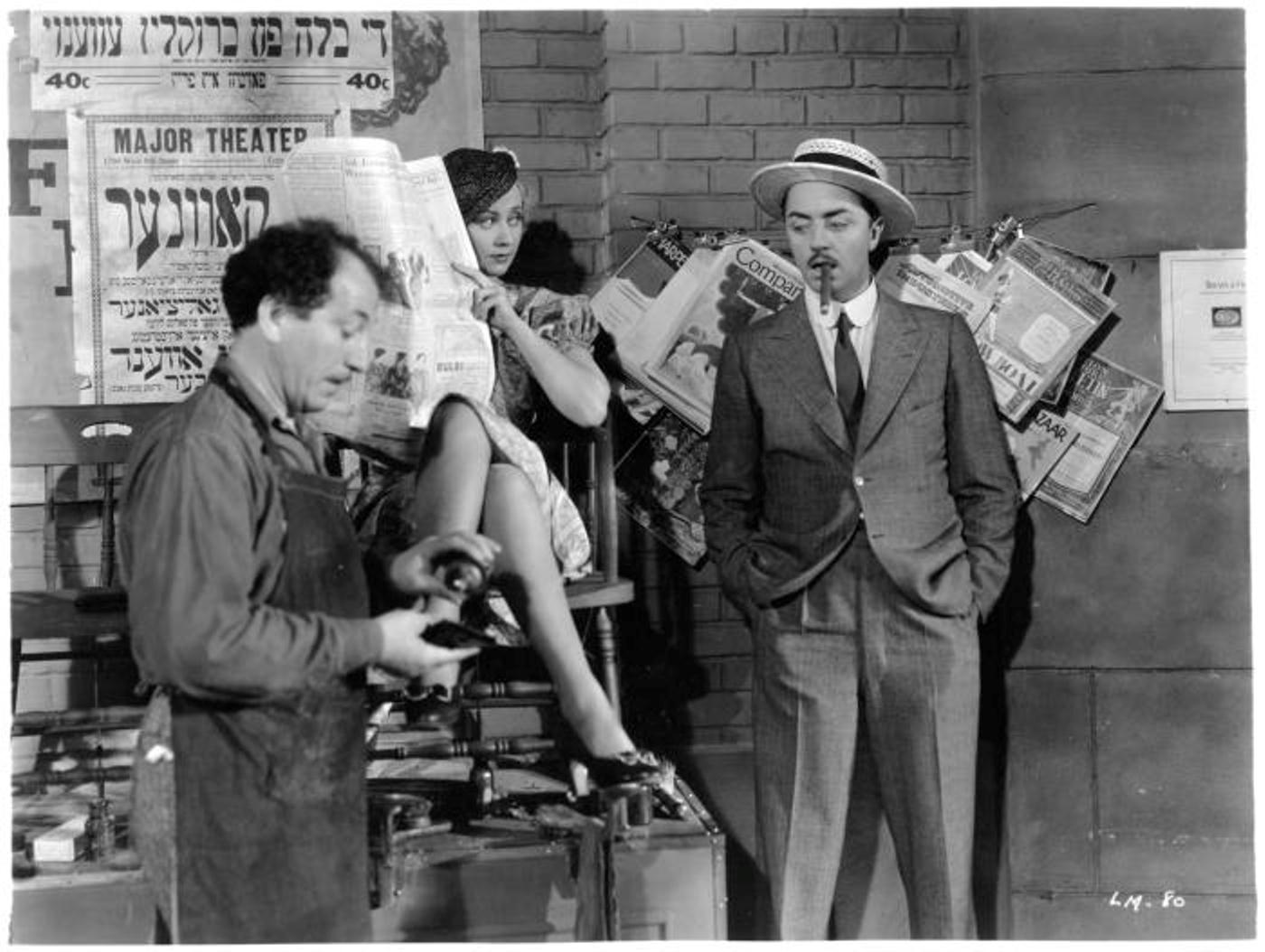
I enjoyed this Pre-Code film directed by William Dieterle starring William Powell as Anton Adam, a lawyer who is “just a small time mouse trying to be a big time rat.” Tired of defending nobodies on the Lower East Side (the opening shots, though brief, look like reference material for THE GODFATHER II), Powell trades in his straw boater for a fedora when he partners with a fancy uptown corporate lawyer. But Adam’s libido, which the film euphemistically indicates at times by the angle of his cigar, soon lands him in trouble with the city’s political machine. Sunk by dames, wiretapping, and a frame-up, Adam employs some dirty tricks against the New York elite in an attempt to claw his way back to the bottom.

Although a film about a lawyer, Dieterle and the script (written by Rian James and James Seymour, based on a book by Max Trell) keep us out of the courtroom for most of the film, a strategy employed by Tony Gilroy in the recent MICHAEL CLAYTON. We’re told Adam is the best in the city in front of a jury and Powell has four speeches in the 68-minute film, each about how the powerful have it in for the little guy, but we as viewers are the intended audience his diatribes, which surely resonated with Depression-era moviegoers. But don’t let me give you the wrong idea that the film is a slog. Far from it. Given that it was made well before the Civil Rights Era it’s not infected with any (OK, much) of the stuffy self-importance that frequently taints so many post-Brown v. Board of Education movies about attorneys. Besides, one of the joys of 30s films, especially Pre-Code ones, are the femmes in their form-fitting silks, satins, and furs. I’d be remiss if I didn’t mention Joan Blondell as Powell’s lovelorn cutiepie secretary who spends the movie trading quips and flashing her anime eyes at him.

LAWYER MAN is available on TCM’s Forbidden Hollywood Vol. 4 along with Dieterle’s JEWEL ROBBERY and MAN WANTED. It’s also available for rental on Amazon. As much as I enjoyed LAWYER MAN, JEWEL ROBBERY is even better because Kay Francis. (Thanks to Sax for tipping me off about JEWEL ROBBERY.)

Related

  • The trailer for LAWYER MAN, which includes one of Powell’s speeches that the film slyly winks at. The New York Times’ original review of the film.
  • Fabrizio on MAN WANTED.
  • I wrote about another Pre-Code film here starring Barbara Stanwyck. And back here I looked at Ridley Scott’s and Cormac McCarthy’s THE COUNSELOR.
  • The American Bar Association picks the 25 best legal movies.
Posted in Law, Movies, Performers | Tagged , , , , , | 4 Comments

Architecture Du Jour

Blowhard, Esq. writes:

pelescastlePeleș Castle, Sinaia, Romania. Source.

Click on the image to enlarge.

Posted in Architecture | Tagged , | 5 Comments

UR Explainer: Kaley v. United States

Blowhard, Esq. writes:

forfeiture1

In the Washington Post, George Will highlights one of the more rotten fruits of this country’s War on Drugs — the government’s use and abuse of civil forfeiture laws. Under these “laws,” the government is authorized to seize the assets of someone merely suspected of certain crimes. No trial, no conviction, no due process needed. Will’s column reminded me of a developing body of Supreme Court case law that has upheld and strengthened this government overreach, the latest decision of which, Kaley v. United States, was handed down three months ago. Because I find this abuse of authority to be extremely alarming, I thought I’d walk you the reasoning that underlies the government’s position.

Before I proceed, I should note that I’m not a criminal lawyer, constitutional lawyer, or any other legal specialist with particular insight into this case. Although I have a law degree I’ve never practiced in any areas implicated, I’m merely providing a case summary with a little editorializing thrown in. For those who are interested, I encourage you to read the opinion for yourself. OK, now that the disclaimers and throat-clearing are out of the way, let’s get on with it.

Continue reading

Posted in Law, Politics and Economics | Tagged , , , , , | 4 Comments

Towards a New Old Architecture

Sir Barken Hyena writes:

Formerly in my post on Antonin Gaudi and Neo-Gothic, I mentioned that some innovative technologies were being used to speed the construction of the Sagrada Familia. Together these new techniques might make possible a revival of masonry artistry in architecture, or artistry in general. Here’s an overview of what they’ve been doing at the Sagrada, which is a virtual laboratory of innovative construction and design techniques:

CNC Stone Milling

The idea is that you send a 3D digital plan to the machine, which then carves a block of stone to that exact shape, but doing it in a fraction of the time. This completely replaces human stone carvers for most uses. Since many thousands of custom shaped stones needed, this is a gigantic breakthrough. When Gaudi began in the late 19th C, he expected the construction to take 300 years. Instead it might be done in half that time. In fact the spectacular interior of the church was completed in less than 15 years with the help of CNC milling.

3D Printing

Not used for parts of the church itself, but for concrete molds and templates. For example the fantastic sunflower hyperboloid ceiling vaults are made this way. First a supporting structure is built, then the plastic 3D forms are placed on top. Rebar is added, then the concrete poured. When dry the supports are removed and the mold peeled off. Some columns are also made this way. 3D printing is also used in modeling designs before final manufacture.

Plastic molds bloom into concrete rooftop sunflowers.

Plastic molds bloom into concrete rooftop sunflowers. Decoration is Venetian glass trencadis for a handmade touch

Pre-Fabricated Columns

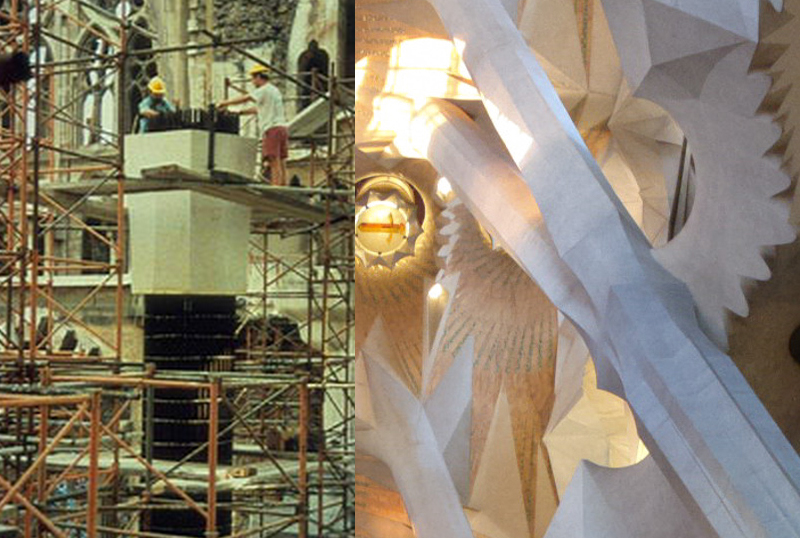
The branching tree columns are one of the most impressive aspects of the building. But how were they built? Stone columns are normally a pile of cylinders, which is strong if vertical, but when angled simply slide apart. We can see that these columns are made of stacked parts, but how does it work?

Like legos. The CNC milled stones are in fact hollow rings that link together. Once fitted, the interior void is threaded with tendons of rebar and pumped full with concrete. So the exterior stone is both veneer and mold. When hardened it forms a column of great strength, but also resilient and flexible for earthquake safety. And it looks completely natural!

Carved by robot, snapped together like Legos

Carved by robot, snapped together like Legos

Custom machines and more

The builders have designed tripod cranes that drop prefabricated parts precisely and delicately in place by remote control, and machines for building spiral staircases and complex columns. There is also a concrete plant on site that churns out all kinds of high tech custom mixtures on demand, and factories for molding prefab elements.

Corbu-B-Gone?

We surely need a new generation of architects to come along and boldly take up these new tools and use them to ram a stake into the heart of the godawful modernist architecture the world has been subjected to by its venal technocratic masters for the last century.

Like I said, a man can dream.

Posted in Architecture | 8 Comments

Sydney Symphony Orchestra: “Elektra”

Eddie Pensier writes:

Possibly the key thing to know about Richard Strauss’ Elektra is that this opera is LOUD. Delightfully, magnificently loud. How loud? Well, most Mozart operas are scored for 50-60 orchestra members, most Verdi calls for 70-80, and even Wagner tends to top out at 90-100. Elektra calls for a whopping 120.

It’s entirely appropriate because Elektra needs loud sounds to go with the loud emotions. Based on Hugo von Hofmansthal’s adaptation of Sophocles and Aeschylus, it might be the purest expression of bloodthirstiness and revenge in the entire standard operatic repertory. I saw the Sydney Symphony Orchestra’s February concert performance at the Opera House.

Christine Goerke as Elektra at the Sydney Opera House, with superfluous dancers.

Christine Goerke as Elektra at the Sydney Opera House, with superfluous dancers.

Strauss was already in hot water with the European public for his earlier Salomé, based on Oscar Wilde’s play and featuring all manner of inappropriate behavior, including necrophilia and implied incest. The combination of eroticism (most notably, but certainly not limited to, the infamous Dance of the Seven Veils) and Biblical themes led to bannings in Vienna, London and New York. Elektra‘s erotic content is much subtler, if it exists at all. One could see an incestuous relationship between Elektra and her dead father, Agamemnon; or with her brother, the presumed-missing Orestes, but the main theme of the opera isn’t sex: it’s blood and death. And hatred, specifically the bitterest kind, that born out of betrayal. (Strauss would redeem himself in polite society with his next opera, Der Rosenkavalier, which ditches the grinding dissonant modernism and harsh violence for an elegant and witty Viennese comedy of manners, complete with waltzes.) Elektra quite literally lives for revenge: once it’s carried out, she dies, because it has consumed her so thoroughly.

The SSO, under the direction of new American music director David Robertson, pulled out all the stops and played like an orchestra posessed. The lyric moments in the score were achingly sweet, and the brutally expressionist moments could be heard across the harbor. Robertson kept the ensemble tight and crisp.

Christine Goerke took on the famously difficult title role: just being heard over 120 players counts as an accomplishment, and Elektra herself is on stage for the entire work. (Full disclosure: Christine is a friend, and provided me with the tickets to the performance.) Her voice is an unusual combination of dramatic power and range with an essentially lyric sound, and it floated up to the highest registers with total ease. Goerke’s repeated cries of “Agamemnon!” took on the qualities of a repeated mantra or prayer, and the climactic scene was as pure an expression of crazed, frenzied (orgasmic?) pleasure as one is likely to hear or see.

Lisa Gasteen, once a notable dramatic soprano herself and now mostly retired from the stage, gave her first performances in the mezzo-soprano role of Klytämnestra, Elektra’s murderous, drug-addicted mother. She may want to rethink her retirement, because she thoroughly rocked this role. Regal haughtiness combined with a potent and undiminished voice gave her appearances dramatic power and weight.

Elektra’s more conventional, some might say bourgeois, sister Chrysothemis (who wants justice, sure, but she’d rather get on with things and marry and have kids like a normal girl), was sung by Cheryl Barker. You may recognize her if you saw Baz Luhrmann’s 1950’s-set La bohème, which was on PBS and later migrated to Broadway. Barker’s mid-weight voice was a tad lighter than I’d hoped but she carried nicely, and projected Chrysothemis’ essential good nature. If Elektra is muddy blackened blood red, Chrysothemis is sunny sky-blue, and that contrast came across well.

Men are reduced to comparative bit players in this opera. Veteran British character tenor Kim Begley made a meal of his few moments as Aegisth, but regrettably Peter Coleman-Wright was not up to the task of singing Orest. His voice sounded weak and shredded, and the power of the turning-point Recognition Scene was diminished as a result. The maids and servants of the Atreus household were all well represented by Opera Australia young artists.

At some point in the planning of this event, it seems to have occurred to someone to say

Hey! Wouldn’t it be a great idea if we brought a troupe of modern dancers along, to run onstage at totally random moments and thrash around in pseudo-Tharp jerky movements, unconstrained by musicality, rhythm, or dramatic context?

Sadly, that idea was not treated with the dismissive contempt it deserves, and said dancers did appear, to provide… I dunno, distraction, or semaphore-signals, or some such. I managed to tune them out and focus on the music.

Related

Posted in Music, Performers | Tagged , , , , , , | 6 Comments

Architecture Du Jour

Blowhard, Esq. writes:

redhouse

Red House, Bexleyheath, London. Source.

Click on the image to enlarge.

Posted in Architecture | Tagged , , , , | 1 Comment

Quote Du Jour

Blowhard, Esq. writes:

clintonbushobama

Against war one can say: It makes the victor stupid, the vanquished malignant. In favor of war: Through both of these effects it barbarizes and thereby makes more natural; it is a sleep for culture, and man emerges from it stronger for good and evil.


On the political sickbed a people is usually rejuvenated and rediscovers its spirit, after having gradually lost it in seeking and preserving power. Culture owes its peak to politically weak ages.

Nietzsche, Human, All-Too-Human

Posted in Politics and Economics | Tagged , | Leave a comment

Linkage (Unhealthy Vices Edition)

Eddie Pensier writes:

Posted in Linkathons | 4 Comments

Ike, Tina, and the Ikettes

Fabrizio del Wrongo writes:

In the recent documentary “20 Feet from Stardom,” which is pretty good, one of the interviewees claims that sexy female backup singers are tools of The Man because they cater to hetero male interests.

This person is an idiot.

Related

Posted in Music, Performers, Sex | Tagged , , , | 1 Comment