Poe’s Law

Blowhard, Esq. writes:

Definition:

Poe’s law, named after its author Nathan Poe, is an Internet adage reflecting the idea that without a clear indication of the author’s intent, it is difficult or impossible to tell the difference between an expression of sincere extremism and a parody of extremism.

Example:

Queer. Genderfucked. Polyromantic. Demisexual. Have social anxiety, aspergers and depression. Unfortunately white, but checking my privilege every day. And yes, I refuse to bathe. Have a problem with that? Then congratulations. This blog is about you.

My filthy body. My fucking business.

This blog is an intolerant of intolerance zone. Check your privilege at the door and realise that oppressive language and thoughts will be mocked. Revolutions were never won with smiles. You have been warned.

Posted in Politics and Economics | Tagged , , , | 3 Comments

Hayek’s Nobel Prize Acceptance Speech

epiminondas writes:

Friedrich Hayek received the Nobel Prize for Economics in 1974.  His acceptance speech contained the following jewel…

“To act on the belief that we possess the knowledge and the power which enable us to shape the processes of society entirely to our liking, knowledge which in fact we do not possess, is likely to make us do much harm. In the physical sciences there may be little objection to trying to do the impossible; one might even feel that one ought not to discourage the over-confident because their experiments may after all produce some new insights. But in the social field the erroneous belief that the exercise of some power would have beneficial consequences is likely to lead to a new power to coerce other men being conferred on some authority.

Even if such power is not in itself bad, its exercise is likely to impede the functioning of those spontaneous ordering forces by which, without understanding them, man is in fact so largely assisted in the pursuit of his aims. We are only beginning to understand on how subtle a communication system the functioning of an advanced industrial society is based—a communications system which we call the market and which turns out to be a more efficient mechanism for digesting dispersed information than any that man has deliberately designed.

If man is not to do more harm than good in his efforts to improve the social order, he will have to learn that in this, as in all other fields where essential complexity of an organized kind prevails, he cannot acquire the full knowledge which would make mastery of the events possible. He will therefore have to use what knowledge he can achieve, not to shape the results as the craftsman shapes his handiwork, but rather to cultivate a growth by providing the appropriate environment, in the manner in which the gardener does this for his plants.

There is danger in the exuberant feeling of ever growing power which the advance of the physical sciences has engendered and which tempts man to try, “dizzy with success,” to use a characteristic phrase of early communism, to subject not only our natural but also our human environment to the control of a human will. The recognition of the insuperable limits to his knowledge ought indeed to teach the student of society a lesson of humility which should guard him against becoming an accomplice in men’s fatal striving to control society—a striving which makes him not only a tyrant over his fellows, but which may well make him the destroyer of a civilization which no brain has designed but which has grown from the free efforts of millions of individuals.”

Posted in Politics and Economics | Tagged | 1 Comment

Mom Jeans Haiku

Fabrizio del Wrongo writes:

Over heart-shaped rear
Denim stretched like blue-hued bliss
No low-rise bullshit

Posted in Personal reflections, The Good Life, Women men and fashion | Tagged , , , | Leave a comment

The Camera Loves…

Blowhard, Esq. writes:

Click on the images to enlarge.

veronicalake veronicalake2…Veronica Lake. Both photos by A.L. “Whitey” Schafer.

Posted in Movies, Sex, Women men and fashion | Tagged , , , | Leave a comment

Crowdsourcing Dietary Science?

Glynn Marshes writes:

After my I posted on Resistant Starch a couple days ago, Richard Nikoley of the blog Free the Animal saw his pingback and dropped by to let me know he’d published a new post on the topic, which you can read here.

What caught my interest, beyond the material on RS, is Nikokey’s suggestion that people experimenting with RS capture data on how consuming RS affects the gut’s bioflora via The American Gut Project [emphasis in the original]:

The Human Microbiome Project and other microbiome projects worldwide have laid an important foundation for understanding the trillions of microbes that inhabits each of our bodies. However, opportunities for the public to get involved in such research has been limited. Now, American Gut gives you an opportunity to participate and to compare the microbes in your gut to those in the guts of thousands of other people in the US and around the world. American Gut is a project built on open-source, open-access principles. Our data are for the good of understanding and will be shared both with participants and with other scientists.

So I’m pinching myself, here: is it possible that the Interwebs & clinical testing technology are converging, such that people can organize their own studies to test the effects of things like diet?

Man, would I like to see more of that . . .

Posted in Food and health | 6 Comments

Carnevino at the Palazzo

Blowhard, Esq. writes:

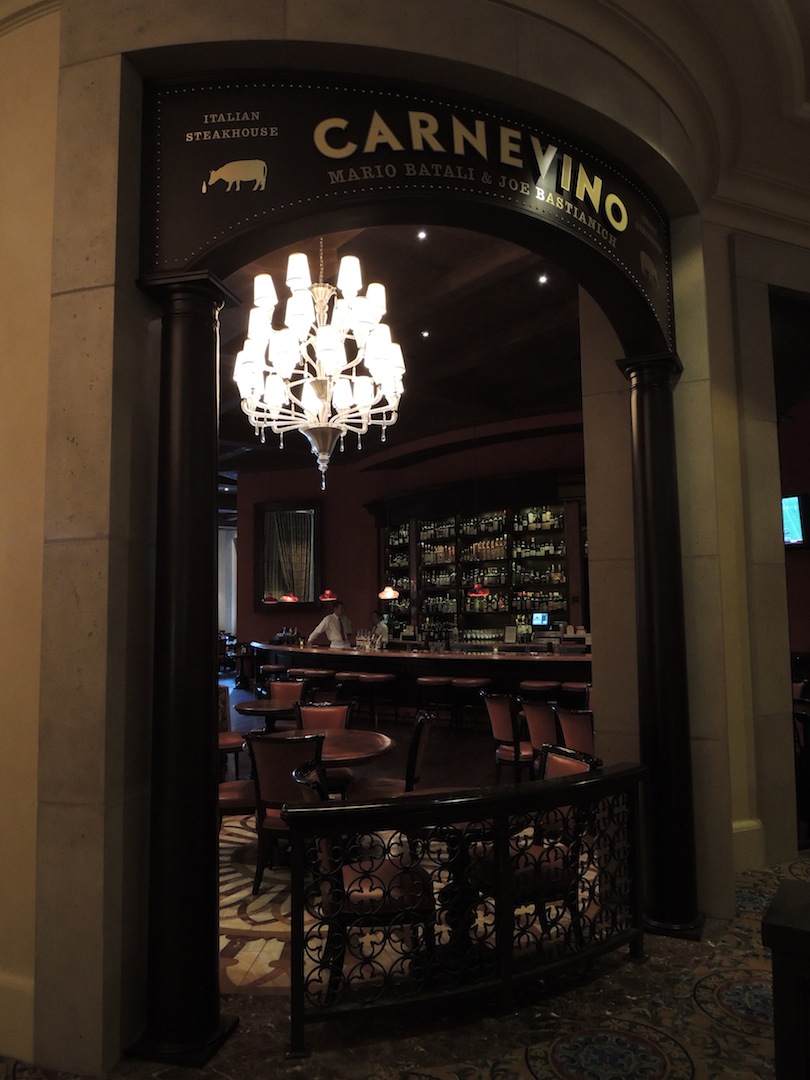
carnevinoApparently it’s Carnivore Weekend here at UR, because along with PR’s post about the dee-licious Umami Burger, I thought I’d share a few shots of one of Vegas’ best steakhouses.

As the picture above shows, Carnevino is the creation of Mario Batali and Joe Bastianich. In a town boasting steakhouses from other celebrity chefs like Jean-Georges, Tom Colicchio, Emeril, and Gordon Ramsay, Batali & Bastianich’s place regularly ranks at the top of the heap, and is even considered one of the best in the nation.

Click on the images to enlarge.

On the left is focaccia bread served with the house butter and lardo. Lardo is whipped pork fat seasoned with a little rosemary. The server said, “It’s Italian butter — healthier than the regular kind.” Earthy and wonderfully unctuous. On the right is the Caprese salad, one of the appetizers recommended by our server. Sure, the burrata and pesto were great, but the tomatoes were so delicious they didn’t need anything else — savory, tart, and sweet. Why do we put up with the shiny red flavorless mush at our grocery stores? And although they’re not pictured here, the roasted Brussels sprouts are bliss.

Their signature steak is the dry aged bone-in ribeye for two. When it’s ready, it’s brought tableside and sliced for you. (I wish I got a shot of the gentleman who prepared the steak for us because he had a white-haired pompadour to give Jim Jarmusch a run for his money.)

steakfortwo

Tender, well-marbled, flavorful with a great crust. What more can you ask for? They leave the bone on the table for you to chew on because some of the best meat remains attached to it. Don’t be shy — indulge your inner caveman!

Related

  • Bill Buford’s 2002 New Yorker profile of Batali.
  • The restaurant’s Yelp page.
  • An interview with Batali about his Vegas empire. Key quote: “There are so many great restaurants in Las Vegas. It’s probably the single-most gastronomic destination outside of New York. I mean in New York there are literally 10,000 restaurants. Here there are probably 2,000 restaurants here, but pound for pound there is nothing better. And I don’t have to go to Queens.”
  • On my first trip to New York City a few years back I ate at Lidia Bastianich’s Becco and thought it was pretty great.
  • Paleo Retiree raves about the eating in Louisville.
  • Fenster wonders what happened to German and Austrian restaurants.

Posted in Food and health, The Good Life | Tagged , , , , , | 7 Comments

Quote Du Jour

Sax von Stroheim writes:

800px-Gaul_Soldiers

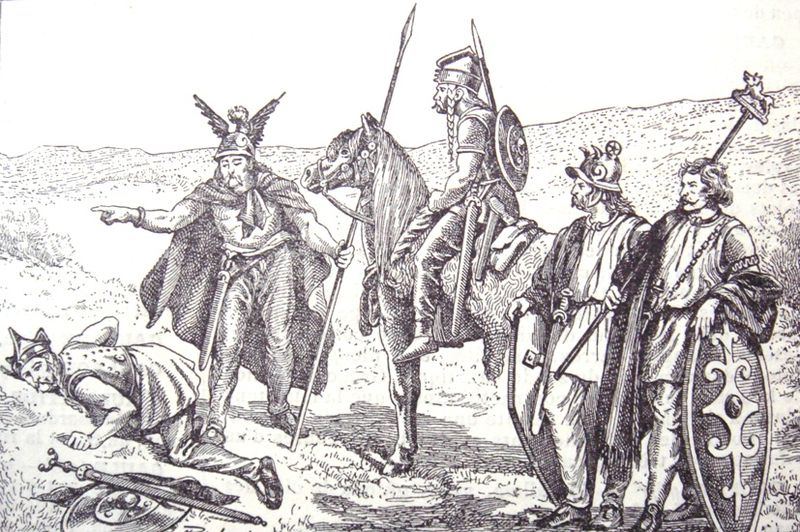
Caesar, when informed of these matters, fearing the fickle disposition of the Gauls, who are easily prompted to take up resolutions, and much addicted to change, considered that nothing was to be entrusted to them; for it is the custom of that people to compel travellers to stop, even against their inclination, and inquire what they may have heard, or may know, respecting any matter; and in towns the common people throng around merchants and force them to state from what countries they come, and what affairs they know of there. They often engage in resolutions concerning the most important matters, induced by these reports and stories alone; of which they must necessarily instantly repent, since they yield to mere unauthorised reports; and since most people give to their questions answers framed agreeably to their wishes.

— Julius Caesar, The Gallic Wars (W. A. McDevitte and W. S. Bohn, trans.)

Posted in Demographics, Politics and Economics | Tagged , , , , | 2 Comments

It’s That Time Of Year!

Eddie Pensier writes:

What time, you ask? The announcement of the winner of the Bulwer-Lytton Fiction Contest, whence entrants compete to come up with the worst first lines of (unwritten) novels.

This year’s victorious entry by Chris Wieloch of Brookfield, WI is a masterpiece of wretched prose:

She strutted into my office wearing a dress that clung to her like Saran Wrap to a sloppily butchered pork knuckle, bone and sinew jutting and lurching asymmetrically beneath its folds, the tightness exaggerating the granularity of the suet and causing what little palatable meat there was to sweat, its transparency the thief of imagination.

Some of the runners-up are pretty terrific too, in their ghastly way:

The day Anthony and Charlotta met was a special one, not merely because of the truly magical first encounter of the would-be lovers – they reached for the same pair of chopsticks at The Lucky Dragon’s all-you-can-eat Chinese food lunch buffet – but also because it was the day the lizard aliens came to earth and destroyed all of mankind with their poison gas bombs and acid catapults. — Krista Holm, Helsinki, Finland

Tex sauntered into the saloon, tipped his hat towards Miss Kitty seated at the bar, and drawled, “I’ve been excogitatin’, and we don’t take kindly to no loquacious sesquipedalians ‘round these parts, lessin’ they be indigenous” – and with that, subsequently shot dead the visiting chatty professor of English standing next to her. — Rick Cheeseman, Waconia, MN

Observing how the corpse’s blood streaked the melting vanilla ice cream, Frank wanted to snap his pen in half and add drops of blue ink to the mix, completing the color trio of the American flag – or the French flag, given that the body had just fallen from the top of the Las Vegas Eiffel Tower onto a crème glacée cart. — Alanna Smith, Wappingers Falls, NY

As the sun dropped below the horizon, the safari guide confirmed the approaching cape buffaloes were herbivores, which calmed everyone in the group, except for Herb, of course. — Ron D Smith, Louisville, KY

Got another favorite? Tell us in the comments.

“It was a dark and stormy night; the rain fell in torrents — except at occasional intervals, when it was checked by a violent gust of wind which swept up the streets (for it is in London that our scene lies), rattling along the housetops, and fiercely agitating the scanty flame of the lamps that struggled against the darkness.”

Edward George Bulwer-Lytton, 1st Baron Lytton.

Posted in Books Publishing and Writing, Humor | Tagged , | 2 Comments

You Can Now “Like” Us on “Facebook” So Please “Do So”

Blowhard, Esq. writes:

Go here for our new Facebook fan page. Now you can get the entertaining, thought-provoking, obscene, Nobel-prize winning content you’ve come to expect right in your Facebook feed to horrify share with your mothers, grandmothers, and spinster aunts.

demonhorrifiedbyvagina

Posted in Personal reflections | Tagged , | Leave a comment

“The Middle of the World”

Fabrizio del Wrongo writes:

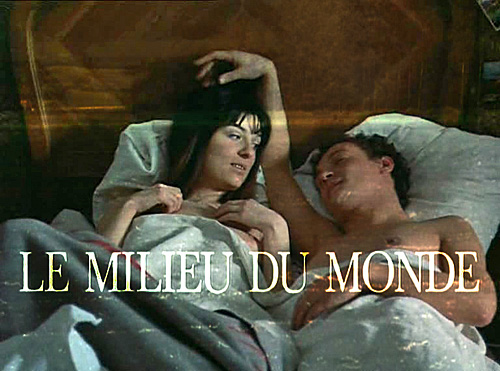
tannerAlain Tanner’s “The Middle of the World,” released in 1974, is a movie about cultures clashing in the most subtle of ways. Maybe it’s more appropriate to say it’s about cultures slipping past each other in the night — it’s the class struggle staged as a sleepy pas de deux. Philippe Leotard plays Paul, a Swiss engineer who’s recently been persuaded to run for office. Paul is a man of the middle class: during a strategy huddle the leaders of his party stress stability and normality, values characteristic of middle classes the world over. These men are also characterized by their benign self-centeredness: Content with their community, they have no need to look outside of it. They’re comfortably normal. The idea of normalization weighs heavily on the movie. Following the opening credits a voice-over explains that transitional forces in Europe have thus far failed to alter the status quo. The movie intends to get at this tug-of-war between change and conventionality.

As is his wont, Tanner emphasizes the cultural fuzziness of Switzerland, that politely unassuming country that on maps is tucked neatly among the larger blots of Italy, France, and Germany. Perhaps he over-emphasizes it: the screenplay, by Tanner and the writer-intellectual John Berger, makes repeated reference to the town’s location on Europe’s continental divide, the point at which water can run into either the Mediterranean or the Atlantic. Further stressing the geographical metaphor, Paul proudly refers to the area as “the middle of the world,” a title we’re meant to take semi-ironically. It’s the middle of his world, anyway.

That world is knocked a bit off center when Paul begins a relationship with Adriana, a northern Italian woman who has come to Switzerland for reasons that are never made clear. Tanner introduces her on a train, one of his favorite symbols of transition. When she arrives in Paul’s area she takes a job at a local pub, whereupon her new boss warns her against getting involved in her patrons’ political discussions. (“Beer,” she says, “has no party.”) Adriana’s becoming sexually involved with an aspiring politician, thereby becoming the subject of everyone’s political discussion, is one of the movie’s several low-key ironies. Olimpia Carlisi, the actress who plays Adriana, is both cool and earthy. Though the character is intended as an avatar of the industrial working class (she comes from a family of factory workers), Carlisi gives her the limpid air of an odalisque — she’s a creature you want to contemplate. (“I could look at you all day,” Paul tells her.) Paul’s intentions are always very clear. He’s smitten, and as he grows closer to Adriana his attachments to his wife and career begin to weaken. Adriana, however, remains remote. It’s possible this dislodged woman is drawn to Paul’s unreflective confidence regarding his place within the community. But we don’t know for sure: she’s as sphinx-like as Paul is garrulous.

Though Paul is married, he vows to see Adriana every day. In a sense “The Middle of the World” is a record of their meetings. These Tanner presents in chunks, mostly composed of unhurried long takes, each prefaced by a title card providing the date. This formalizes their encounters, encourages us to see them as independent bits occurring outside the spooling-film flow of regular life. Possibly, Tanner wants us to experience the relationship as the lovers experience it in their memories: as a series of semi-connected scenes, each with its own set of parameters. There are several references to the shift in frequency that sound waves undergo as objects approach and then recede into the distance. I think we’re meant to understand this relationship in similar terms: as a distortion that has occurred as the trajectory of Adriana has intersected with the fixed point of Paul.

The film is rife with showy, clever-awkward gimmicks of this kind — it’s affected by what my co-blogger Paleo Retiree calls the “Euro-novelist approach to big themes and metaphors.” Your receptiveness to this tactic will inevitably vary, but I think it’s unquestionable that some of this stuff — this arty-intellectual scaffolding — distracts from what’s best in the movie, namely the muted, non-actorly performances and Tanner’s unpushy way with the material, which always feels true to the look and rhythms of an out-of-the-way, semi-rural locale. In particular there are some lovely winter landscapes, some of which have the timeless, standing-for-everything clarity of a miniature by the Limbourg Brothers. Occasionally Tanner will follow one such image with a shot of the same location in summer, a juxtaposition that forces a consideration of the land as a constant — as a bolster against the impermanence of people, weather, and feelings.

The relationship ends when Paul loses an election and Adriana loses her job. Afterwards she moves to the German-speaking part of Switzerland, where she finds employment in a factory. (Pointedly, it looks similar to the one overseen by Paul.) Prior to that we see their meetings grow contentious: more often than not they end in arguments, which Adriana tends to neutralize by offering sex. (She seems to enjoy fucking just as much as he does.) We also see that Adriana is resistant to Paul’s repeated proffers of marriage. She claims that he will never be able to “see” her, to know her.

Here the movie’s refusal to provide us with a sense of Adriana’s motivations is problematic. We know only that she doesn’t want a middle-class life. What she does want remains a mystery, probably even to her. (We’re told as much by the movie’s narrator.) In his contemporaneous review of the film Roger Ebert writes that Adriana can be taken as a symbol of feminism. If so it’s a feminism of a frustratingly aimless sort. Adriana seems destined to roam the back roads of Europe until she finds . . . what? A commune of like-minded undecideds? Ebert blames Paul for Adriana’s vagueness, claiming that his lack of interest in her motives is what keeps her so remote. But since the movie refuses to explain Adriana it seems wrong to blame Paul for failing to figure her out. Besides: If she’s so liberated, why does she need Paul to act as her confessor? It’s possible Adriana is intended to represent an inchoate and wayward leftism. Yet I think it’s equally likely that Tanner and Berger succumb here to the kind of male self-absorption that Ebert ascribes to Paul: they’re so keen for Adriana to stand for something that they don’t bother to make her stand up.

Released nearly ten years later, Tanner’s “In the White City” takes what is best in “The Middle of the World” — the rumpled eroticism, the feel for transience, the unfussy visual poetry — and dispenses with most of the political-conceptual baggage. Where “World” sometimes feels like a treatise, “City” comes off as a memoir — the kind that lingers in your memory long after its overt meanings have faded. I think it’s the better picture.

Related

  • I wrote about “In the White City” back here.
  • An old “Movietone” interview with Tanner in which “The Middle of the World” is discussed. It’s amusing that such a big deal is made of the movie’s use of long takes.
Posted in Demographics, Movies, Politics and Economics, Sex | Tagged , , , , , , , , , | 5 Comments