
Fenster writes:
You may have read about the European Court of Human Rights (ECHR) decision a few days ago which “upheld a conviction against an Austrian woman who called the Islamic prophet Muhammed a ‘pedophile.'”
Fenster writes:
You may have read about the European Court of Human Rights (ECHR) decision a few days ago which “upheld a conviction against an Austrian woman who called the Islamic prophet Muhammed a ‘pedophile.'”
Paleo Retiree writes:
A question I’ve been wondering about for years: As more and more discoveries emerge from the worlds of evo-bio and genetics, how is the PC-opinion class going to contend? When the “blank slate” part of “blank slate progressivism” gets swept away, will anything at all remain of the progressivism? Yet true believers are of course unlikely to simply fold up shop, admit they’ve been wrong all along and embrace race realism and the Alt-Right. People aren’t generally prone to abandoning their faith that straightforwardly, alas. Instead they’ll cling, while trying desperately to control the conversation and/or torture the facts so they fit into their Utopian framework. Or such is my bet anyway. Well, the process is now underway.
Steve Sailer has a lot of droll fun with Amy Harmon’s lame Times piece. As always, Sailer’s commenters are a brainy and funny bunch. One of them writes, “Amy Harmon is a scientist-whisperer. She gets scientists to say what the SJWs want them to say.”
Bonus link: Razib on the San Bushmen.
Fenster writes:
Montaigne shows up here on UR quite a bit. I won’t do links this time. Look ’em up if you want. So permit me to just start in digressing.
In her bio of Montaigne Sarah Bakewell describes the back and forth of attitudes toward Montaigne by philosophers and religious leaders over time. Not all of that was positive.
Fenster writes:
A blog post by the physicist Stephen Hsu on the need to own up to group differences driven by genes. Hsu writes:
We are scientists, seeking truth. We are not slaves to ideological conformity.
True. But I always get a kick out of the fact that it is not enough to defend evidence with evidence; a moral play must be enacted as well. Thus his blog post is entitled “The Truth Shall Make You Free”.
But how can that be true, always? We would not insist on self-deception as much as we do if it did not confer advantage. No society has ever been built on total truth, and never will be, as long as we are gooey and not robotized. We always need a story, even when we pretend it is not about a story.
That’s not to criticize the move to let the evidence speak for itself in this case. The time appears to be up for ignoring the evidence and there will be more conflicts as the scientific view forces itself into a conventional narrative that has had no room for it.
Some perspective is in order, though. One cheer, always, for hypocrisy.
But there I go, moralizing again.
Paleo Retiree writes:
Paleo Retiree writes:

Netflix rec: My wife and I have been enjoying the documentary series “Killer Women with Piers Morgan.” In it, Morgan (a well-known British journalist) talks to convicted and imprisoned American women murderers, while cutting away to the stories of their crimes with news footage, visits to locations, chats with cops and relatives, etc. It’s done in a very sleek, solemn-but-not-slow style, with the director giving his drone-cameras a big workout. Morgan does a perfectly amazing job of being tough yet humane with the killers. He genuinely wants to get to know them a little — he’s the opposite of a prosecutorial showboat, yet he never loses his moral center. And it’s a fascinating experience, of a squirmy, uncomfortable sort, to watch the killers recall their actions and try to persuade themselves and us that they aren’t completely terrible people. Do they really believe themselves or not? And, if so, does it matter? The echoes with current (ah — Christine Blasey Ford — choo!!) events are numerous. “The series is showing you something every woman needs to see,” says my wife.
Paleo Retiree writes:
“There is a vocal minority [on Facebook’s staff] that is belligerent beyond belief in a quest to implement social justice policies … The concerning thing that’s happening here is, I’m not sure Facebook’s leaderhip knows how to push back against them.”
Paleo Retiree writes:
Fabrizio del Wrongo writes:
There are certain objects, to which politicians show a marked partiality, which can be classified as bad ones, to be avoided on all occasions. They include political actions such as freedom, justice and democracy; or, to put it the other way round, the suppression of tyranny, injustice, and autocracy.
It is one thing for nations to fight to defend their own freedom, system of justice, or democratic form of government. In that case, the best description of their political object in so doing is the word security; security to order their national life in their own way. “Crusades” to bring freedom, justice, or democracy into other nations’ lives are quite a different matter. Such crusades have a bad case history. The war to “make the world safe for democracy” of 1914-18 was not a success. In Russia, the Duma, or Parliament, was scrapped and a ruthless dictatorship set up even while the war for democracy was in progress. In Italy, dictatorship sent democracy packing within four years of the end of the democratic crusade, while Germany followed suit not very long after, and Portugal and Spain also joined the authoritarian ranks.
It is not only with individuals that one man’s meat is another man’s poison, reluctant though politicians are to recognise the fact. Having obviously failed to appreciate from the developments of the inter- war period that the accident of being victorious is no sound reason for changing the loser’s political systems to conform with one’s own, the British politicians of the Second World War declared it to be their intention to destroy the German dictatorship and to “re-educate” the Germans in the ways of parliamentary democracy; which, though it may be suited to the British and the Americans, had never made much appeal in Germany, has for years been a bad joke in France, and has now been banished altogether from the whole of eastern Europe except Greece. Even in England professorial voices are being raised to predict that parliamentary government is on its last legs. Moreover, as we saw in the last chapter, the endeavour to impose a political system on a defeated enemy by force is quite enough by itself to make that enemy throw it oft at the first opportunity.
The other crusading aspect of the 1914-18 war, “the war to end war,” was a worse failure than its democratic companion. The armistice of 1918 was not a year old before the British and French were fighting the Bolsheviks in Russia in the vain attempt to stifle the Communist regime at birth. In the following year (1920), the Bolsheviks were invading Poland. In 1921, the British and Irish were locked in bitter strife. In 1922, came the Greco-Turkish war, and in 1923 the French invaded the Ruhr. About 1924 began the long-drawn-out struggles of the various war lords in China; in 1931, the Japanese occupied Manchuria and, in 1932, attacked the Chinese at Shanghai. In 1935, the Italians were at war with Abyssinia; in 1936 the Spanish Civil War broke out; in 1937 the Japanese began their war against China; and in 1938 the Germans marched into Austria, in 1939 into Czechoslovakia, and in the same year into Poland. But the Second World War that came with the last-named event had hardly begun when British politicians started afresh to speak hopefully of permanent peace if only their fellow-countrymen would fight hard enough to overcome the German enemy — as they had said on the previous occasion.
There is little enough hope for crusades to make the world more virtuous, and none at all if they are conducted with unlimited violence and the abandonment of all civilised restraints. The obliteration and atom bombing of open cities and the arming and encouragement of the midnight cut-throats of the underworld masquerading as “resistance movements” are not calculated to inculcate Christian righteousness in mankind. The world is now in a more disturbed and lawless state than it has been for centuries, perhaps than ever before. There is cold war in Europe, hot war in Korea, trouble in Persia and Egypt, brigandage in Malaya, insurrection in Indo-China, Mau-Mau terrorism in East Afiica, racial rioting in South Afiica, anxiety everywhere. In Britain, crimes of violence increased alarmingly after 1945, and have not even yet, eight years later, been got under proper control; while the prisons of the country are crammed to two or three times their designed capacity. In France, M. Jean Giono, the well-known author, told Mr. Warwick Charlton, who was investigating the atrocious Drummond murders on behalfof “Picture Post”:
“During the war and during the liberation the people of the country, who were normally law-abiding and kind, in appearance at least, became beasts: women are known to have torn young boys who could have been their sons into pieces with their bare hands. And a young man I know, who seems quite harmless, after raping a woman, poked her eyes out, cut off her ears, and otherwise mutilated her with a kitchen knife. His excuse was that she spoke with a German accent. She was in fact a French woman from Alsace.”
The British Government’s wartime boast of its intention to bring freedom to the enslaved German people has been a complete failure. All that has happened is that arbitrary government by the Nazi party has been exchanged for arbitrary government by foreign High Commissioners, under whom politically unpopular newspapers are suppressed and politically suspect individuals are summarily arrested and imprisoned just as they were between 1933 and 1939. And should the foreign occupation forces be withdrawn, there would obviously be nothing to prevent a new form of internal despotism being established at once, should the Germans so wish; as the partitioned, despoiled, and weakened state of their country following on Yalta and Potsdam might well make them wish.
It is, moreover, unpleasantly characteristic of crusades that the crusaders seem prone to adopt the very abuses which they go to war to suppress in other people. Thus, the crusade to restore freedom to Germany led to British freedoms being suspended right and left. Freedom of speech was interfered with in order to “prevent the spread of alarm and despondency,” and the liberty of the subject was savaged by the 1 8B Regulation which allowed men and women to be cast into prison without charge or trial and kept there at the Home Secretary’s pleasure, being denied all legal assistance. AU that was necessary was that the Minister should “have reasonable cause to believe” that the detention was desirable in the public interest. There was thus created in Britain a direct counterpart of those German concentration camps which had been so bitterly assailed by British politicians and publicists. These two forms of tyranny reacted on each other, and it became quite a common occurrence for Members of Paliament, who spoke under the protection of privilege, to demand the summary incarceration of anyone who dared to express views that they disliked and could represent as in any way unpatriotic or which could be construed as damaging to the war effort.
Six years of suppression of “dangerous thoughts’ have left their mark on the British people, who nowadays display a noticeable timidity in giving that free expression to their opinions on current, and especially international, affairs which would have been taken for granted at the beginning of the century. “Freedom is in peril,” said the official posters of 1939, “defend it with all your might.” These posters spoke the truth but not all the truth. Freedom was in peril not only from outside the country but from inside it, too.
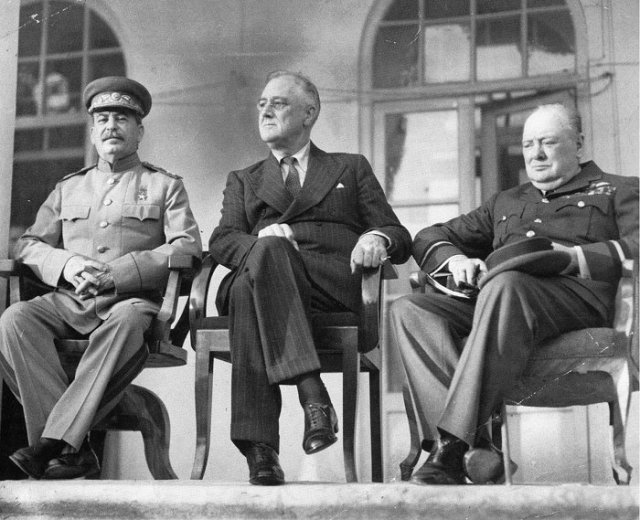
Indeed, the conduct of the war by the democracies themselves was hardly an inspiring example of democracy in practice. The two chief democratic leaders. President Roosevelt and Mr. Churchill, went about the world to top-level conferences where they made Olympian decisions as to how the war was to be fought and how the world was to be carved up after it, how many hundreds of thousands of square miles of territory were to be taken from one country and given to another, and how many millions of wretched refugees were to be driven from their homes in consequence.
The war had to be got on with, and it was clearly impracticable for top-level conferences which involved long journeys by the President of the United States and the Prime Minister of England to be reconvened, perhaps more than once, because objections were raised in Parliament or Congress. But other methods could have been used. If the conferring had been done on a lower level by ambassadors or even Foreign Secretaries, the home Cabinets and Parliaments could have exercised some control over what was agreed. As it was, the decisions reached by the highest men clearly had to be forced through the democratic legislatures as faits accomplis. Thus we find Mr. Churchill, after Yalta, brusquely disposing of Parliamentary criticism by saying that the Soviet leaders were “honourable and trustworthy men” and that he “declined absolutely to embark here on a discussion about Russian good faith.”
Such high-handed procedure cannot be called democratic. Nor can it be justified by the argument that the Prime Minister knew best and that his estimate of the situation was the right one. We know that, in fact, he was disastrously wrong. “The impression I brought back from the Crimea,” Mr. Churchill told the Commons, “and from all other contacts is that Marshal Stalin and the Soviet leaders wish to live in honourable friendship and equality with the western democracies. I know of no Government which stands to its obligations even in its own despite more solidly than the Russian Soviet Government.” This must surely rank as one of the most serious political misjudgments in history.
This danger attending Big Three decisions was not overlooked in America, where Mr. W. R. Burgess, speaking on behalf of the American Bankers’ Association, told the Banking and Currency Committee of the U. S. House of Representatives on March 21, 1945, that:
“The negotiation of international agreements is a double task. They must be negotiated with the representatives of foreign countries; they must also be negotiated with our people at home. It is all too easy to forget the second step … to make an agreement abroad and then to hope to sell it at home. But selling is not negotiation.”
Freedom, justice, civilised conduct and democratic self-government are exceedingly tender plants that grow well only in conditions of peace and order. War, so far from stimulating them, causes them to wilt and wither. “No one could expect Parliamentary democracy,” said the London Times on May 31st, 1952, “to flourish among all the horrors, chaos, and devastation of the (Korean) war that began two years ago.”
The radical unwisdom of fighting for abstract principles is emphasised by the completely negative results of the “finest hour” of 1940. If that was, as Mr. Churchill has it, a period of great glory for Britain by which she put the rest of the non-Axis world in her moral debt, the payment of that debt is long in coming. So far from being treated with honour and respect by other nations for her valiant stand in 1940, Britain has received an unheard-of series of slights, rebuffs, and injuries since 1945. The Albanians mined British warships. The Argentines sent gunboats to seize British islands in the Falklands group. The United States has been rubbing in Britain’s reduced status in the world by demanding and obtaining all the supreme commands of all the U.N. and N.A.T.O. forces. Even Britain’s ancient pride, her Navy, is now for the most part taking its orders from American Admirals; so much so that the British Admiral commanding the coast of (British) Scotland gets his appointment from the other side of the Atlantic. The Indians were so forgetful of the “finest hour” that they took the earliest postwar opportunity to get rid of the British who had governed their country for two centuries. In the Middle East, the heroes of 1940 have received one kick in the face after another; first from the Jews in Palestine, then from the Persians, shortly afterwards from the Egyptians, and then from the Iraqis. In Persia, the finest-hourers were hustled roughly out of their own huge oil properties with threats and imprecations and a loss of £300 millions.
But if there are so many unsound reasons for going to war, what are the sound ones? Again, the Field Service Regulations come to our aid. A nation goes to war, they say, “to protect its vital interests.” Not, be it noted, to protect another nation’s vital interests. It is a point very much to be noted, because democratic politicians frequently overlook it. Judging from their utterances over recent years, many of the British variety believe that British armies should range the world setting other people free from their brutal oppressors — the Czechs (1938) and the Poles (1939) from the wicked Germans, the Finns (1940) from the wicked Russians, the Greeks (1941) from the wicked Germans, the wicked Germans themselves (1940-1945) from the even wickeder Nazi regime, the Spaniards (1945 onwards) from the wicked Franco, and the South Koreans (1950) from their former fellow-countrymen across the artificial frontier of the 38th parallel of latitude.
 Blowhard, Esq.
 Callowman
 Sherbrooke
 Eddie Pensier
 Enzo Nakamura
 Epaminondas
 Fabrizio del Wrongo
 Fenster
 Brundle Guy
 Glynn Marshes
 Paleo Retiree
 Atypical Neurotic
 Question Lady
 Sax von Stroheim
 Sir Barken Hyena
 The Mistaken
