
Blowhard, Esq. writes:
Click on the image to enlarge.
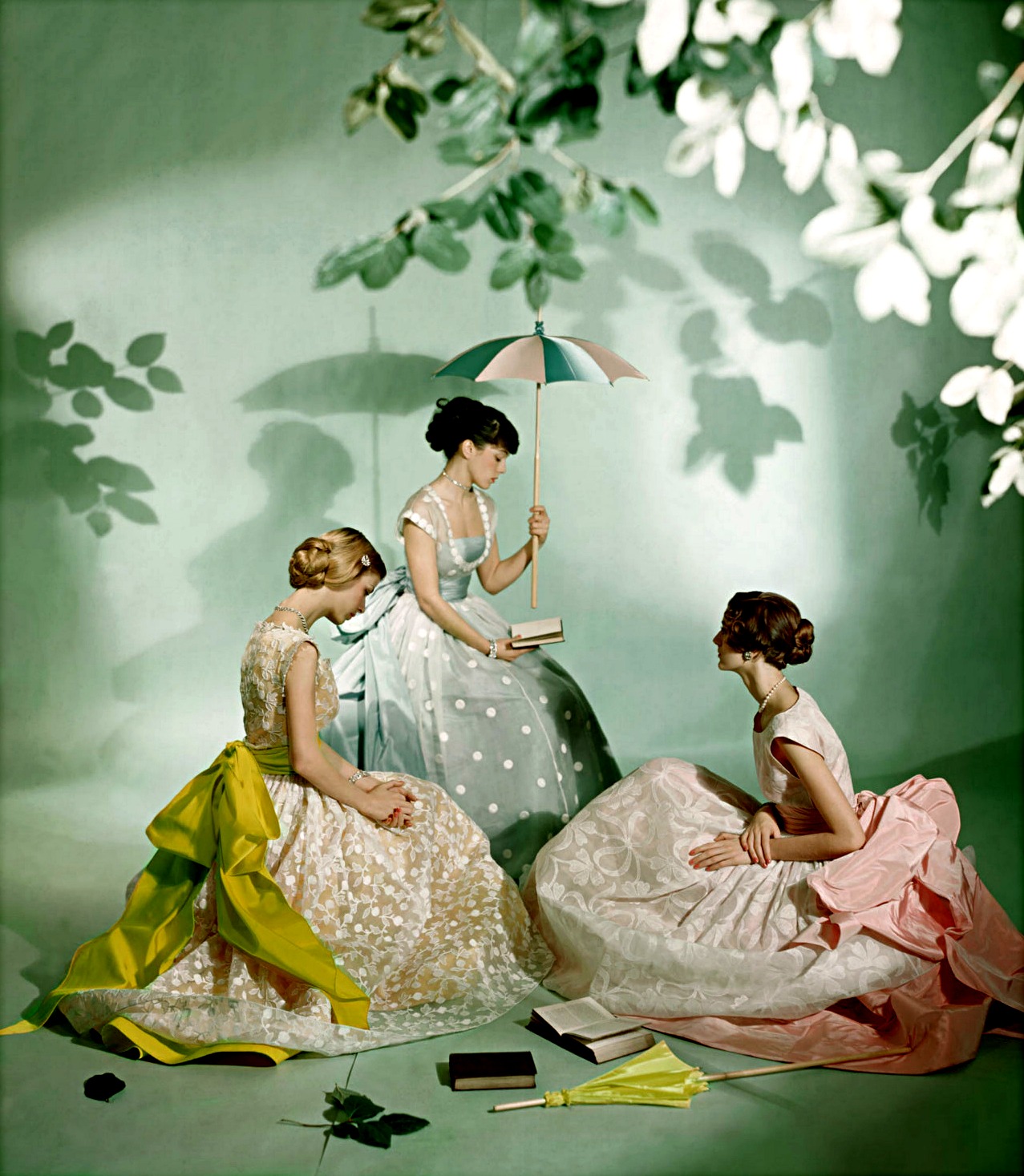 “Three models dressed in Ladurée macaron colours” (1948) by Cecil Beaton
Blowhard, Esq. writes:
Click on the image to enlarge.
“Three models dressed in Ladurée macaron colours” (1948) by Cecil Beaton
Fenster writes:
Another in the series.
Spotlighting The Spongetones, doing Beatles soundalike music for 25 years.
Fabrizio del Wrongo writes:
Fabrizio del Wrongo writes:
Edgar Rice Burroughs (1912):
To Jane the strange apparition of this god-like man was as wine to sick nerves.
From the description which Clayton and her father and Mr. Philander had given her, she knew that it must be the same wonderful creature who had saved them, and she saw in him only a protector and a friend.
But as Terkoz pushed her roughly aside to meet Tarzan’s charge, and she saw the great proportions of the ape and the mighty muscles and the fierce fangs, her heart quailed. How could any vanquish such a mighty antagonist?
Like two charging bulls they came together, and like two wolves sought each other’s throat. Against the long canines of the ape was pitted the thin blade of the man’s knife.
Jane–her lithe, young form flattened against the trunk of a great tree, her hands tight pressed against her rising and falling bosom, and her eyes wide with mingled horror, fascination, fear, and admiration–watched the primordial ape battle with the primeval man for possession of a woman–for her.
As the great muscles of the man’s back and shoulders knotted beneath the tension of his efforts, and the huge biceps and forearm held at bay those mighty tusks, the veil of centuries of civilization and culture was swept from the blurred vision of the Baltimore girl.
When the long knife drank deep a dozen times of Terkoz’ heart’s blood, and the great carcass rolled lifeless upon the ground, it was a primeval woman who sprang forward with outstretched arms toward the primeval man who had fought for her and won her.
And Tarzan?
He did what no red-blooded man needs lessons in doing. He took his woman in his arms and smothered her upturned, panting lips with kisses.
For a moment Jane lay there with half-closed eyes. For a moment–the first in her young life–she knew the meaning of love.
But as suddenly as the veil had been withdrawn it dropped again, and an outraged conscience suffused her face with its scarlet mantle, and a mortified woman thrust Tarzan of the Apes from her and buried her face in her hands.
Tarzan had been surprised when he had found the girl he had learned to love after a vague and abstract manner a willing prisoner in his arms. Now he was surprised that she repulsed him.
He came close to her once more and took hold of her arm. She turned upon him like a tigress, striking his great breast with her tiny hands.
Tarzan could not understand it.
A moment ago and it had been his intention to hasten Jane back to her people, but that little moment was lost now in the dim and distant past of things which were but can never be again, and with it the good intentions had gone to join the impossible.
Since then Tarzan of the Apes had felt a warm, lithe form close pressed to his. Hot, sweet breath against his cheek and mouth had fanned a new flame to life within his breast, and perfect lips had clung to his in burning kisses that had seared a deep brand into his soul–a brand which marked a new Tarzan.
Again he laid his hand upon her arm. Again she repulsed him. And then Tarzan of the Apes did just what his first ancestor would have done.
He took his woman in his arms and carried her into the jungle.
MGM (1934):
Frank Frazetta (c. 1970s):

Fenster writes:
We are often cautioned to make judicious use of metaphors in communicating. It’s good advice. It’s tempting to want to employ metaphor’s coattails as ladders to climb the commanding heights of the mountaintop of ideas. But it is easy to go too far, and to end up with goofy formulations suitable for the New Yorker’s Block That Metaphor sidebars. Out of such concern, the advice to be prudent is typically made on aesthetic grounds.
But there are other reasons to be careful around metaphors. One reason is that they are (metaphor alert!) the umami of communication. They not only contribute flavor as umami does but they also share umami’s ability to hide in plain sight everywhere. Guy Deutscher describes all language as a “reef of dead metaphors.” As R.L.G puts it in an Economist article, “it is literally impossible to be literal.”
Most of the time we do not realise that nearly every word that comes out of our mouths has made some kind of jump from older, concrete meanings to the ones we use today. This process is simple language change. Yesterday’s metaphors become so common that today we don’t process them as metaphors at all.
So we speak figuratively more than we think, and may perhaps evidence a certain overconfidence as a result of the mistaken belief that we are mostly literal. We are unconscious machines for the making of metaphors.
And when we make them we tend to believe them, and to put the metaphor cart before the reality horse. There is the new word, the new idea, and it feels as if it is plainly true as a thing-in-itself. Meanwhile it is just a bundle of meanings that sits atop a scaffolding which may itself be sturdy or not.
That suggests another, related reason to be careful around metaphors. Because we tend to take the figurative literally, they can be incredibly powerful tools for making meaning and persuading. Too powerful, perhaps, since their power derives from the seductive allure of feeling as though one knows. Are they true? That all depends on the underlying situation that the metaphor is hoping to describe. Maybe yes, maybe no.
Here’s an example. A number of years back I saw a debate on the subject of whether Massachusetts voters should endorse a tax limitation package. A prominent tax-cut advocate, Barbara Anderson, made the case for limitation.

The case against limitation was argued by (a younger) Barney Frank.

The argument went back and forth on the facts. It only really heated up, and got to the point where people were prepared to be persuaded, when both debaters got their metaphors in motion.
Frank agreed that of course there was some fat in government spending. But that it was not excessive and, more importantly, efforts to extricate government fat are like trying to cut the fat out of a steak with a knife. The fat is marbelized into the structure of the meat, and efforts to cut it out will result in cutting vital tissue as well.
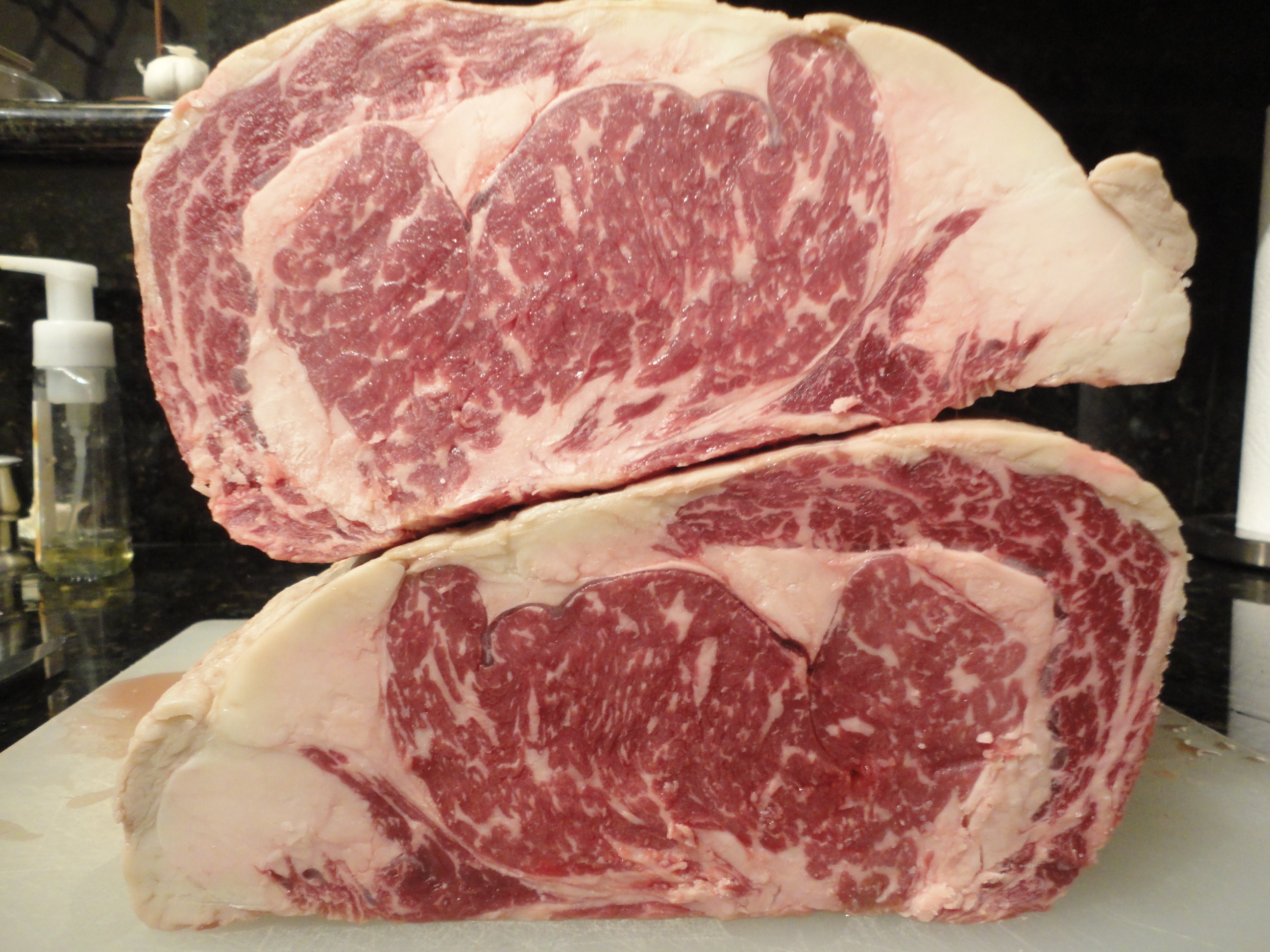
No, no countered Anderson. You don’t need to use a knife. You have only to put the steak on the grill and turn up the heat. The fat melts away.

It was a lovely debate moment. Those watching had their choice of two prime metaphors. But which was most persuasive that night?
There was no immediate answer in the debate. The debaters rolled out their metaphorical cannons at the end and fired and no conclusion was drawn on which one was better.
So, now, which is the most persuasive? Is one better?
Well, I think you have to look beyond the metaphors themselves, with their seductive power to convince you that yes, you’ve got it! You have to look directly at the underlying situation. At that is something that might be known, or knowable.
Is there evidence as to what tends to actually happen when budgets are artificially constrained? Yes, I think so. And on that count, Frank wins the night. The “fat draining away” metaphor is simply unlike most all budget cut situations as they are played out in the real world. Most of the time, it is a matter of wielding a knife and cutting both fat and meat. That’s just how it happens in the all-too-human real world.
That does not mean tax cut limitations are or were a bad idea. It does mean that metaphors are only as good as what they purport to describe, and that people are generally quite willing to consider a metaphor they like to be an explanation when it is just another barnacle on the metaphor reef.
Not for nothing that the Greeks both prized rhetoric and fretted over its tendency to sophistry. Like most lessons from the past, that is something that must be learned and relearned anew.
Eddie Pensier writes:
If that were true, I’d wear it on my ass.
— Biophysicist and fragrance writer Luca Turin, when asked about Gabrielle Chanel’s dictum that perfume should be worn “wherever one wants to be kissed”.*
*It sounds ever so poetic but quickly falls apart in the face of a little logical thought. Who wants to go kiss someone and wind up with a mouthful of perfume? Personally, there are two places on my body where I particularly like to be kissed. One is the lips, and I’m not going to put scented alcohol there.
And I’m not going to put it on the second place either, because OUCH.
Related
Fenster writes:
But is it fair trade?

Eddie Pensier writes:
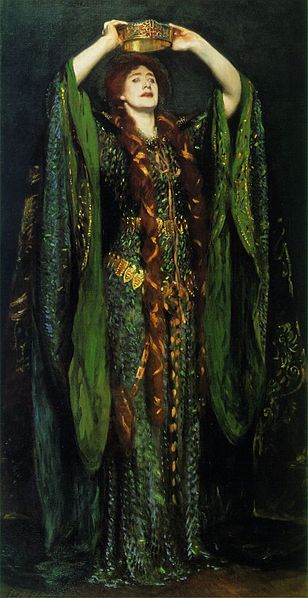
John Singer Sargent, Ellen Terry as Lady Macbeth (1889), oil on canvas
Related
Eddie Pensier writes:
In news that will be welcome to much of the UR crew, turns out that teetotalers don’t have much to live for.
Controlling only for age and gender, compared to moderate drinkers, abstainers had a more than 2 times increased mortality risk, heavy drinkers had 70% increased risk, and light drinkers had 23% increased risk….
A model controlling for former problem drinking status, existing health problems, and key sociodemographic and social-behavioral factors, as well as for age and gender, substantially reduced the mortality effect for abstainers compared to moderate drinkers. However, even after adjusting for all covariates, abstainers and heavy drinkers continued to show increased mortality risks of 51 and 45%, respectively, compared to moderate drinkers.
The study is here. Link via Snowdon of Velvet Glove, Iron Fist.

Drink… it’s good for you!

 Blowhard, Esq.
 Callowman
 Sherbrooke
 Eddie Pensier
 Enzo Nakamura
 Epaminondas
 Fabrizio del Wrongo
 Fenster
 Brundle Guy
 Glynn Marshes
 Paleo Retiree
 Atypical Neurotic
 Question Lady
 Sax von Stroheim
 Sir Barken Hyena
 The Mistaken
 Uncouth Reflections