
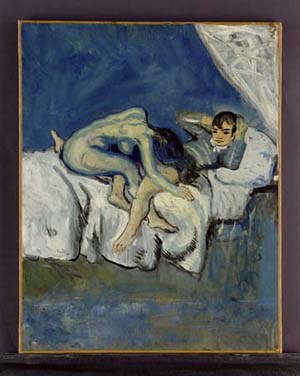
Erotic Scene (La Douleur), attributed to Pablo Picasso. (He denied it.)
1902-3, oil on canvas, Metropolitan Museum of Art
via The Dirty Stuff.
Erotic Scene (La Douleur), attributed to Pablo Picasso. (He denied it.)
1902-3, oil on canvas, Metropolitan Museum of Art
via The Dirty Stuff.
epiminondas writes:
Great Australian bio about legendary actor Errol Flynn narrated by Christopher Lee. His amazing ability to live life to its fullest was his greatest legacy.
Paleo Retiree writes:
Walking around the hipster downtown neighborhood of the Lower East Side the other evening, I ran across a construction site. Here’s a pic of what’s going up:

For context’s sake — and, where architecture and urbanism go, context is almost always a hugely important factor — here’s a sampling of what much of downtown NYC looks and feels like:

The new building really suits its surroundings, doesn’t it?
A couple of questions.
1) Although modernism once marketed itself as innovative and exciting, what could be more tired than the design at the top of this posting? It isn’t as though there aren’t already thousands of “cube-like buildings punctuated by nothing but expanses of featureless glass” in the world, after all. One a-strong-attack-is-the-best-defense ploy the establishment architecture world started employing some years back is the notion of “classic modernism.” It may well be that early modernism’s monomaniacal emphasis on planes, edges and abstraction has been widely recognized to be a problem. (One reason we’re seeing so many wobbly and bulbous buildings going up these days is that their curviness is supposed to be a corrective to earlier modernism’s rectilinearity.) Even so, we’re meant to agree that early modernism was a great thing worthy of memorializing and reviving — hence “classic modernism.” How best to respond to this clever ploy? Would it avail anything at all to point out that many of us were never OK with modernism in the first place?
2) Why do people in neighborhoods like the LES not protest developments like this one? I understand that the aesthetics-averse and those who simply don’t register their environment might not be bugged by the construction of a new boring zilch-zero building. But the LES is full of people with hyper-acute sensibilities — people who, whatever their scenester/hipster annoyingnesses, hate blandness and have the taste to dig funky boutiques, locavore food, scrappy garage bands and vintage clothes. So why don’t they react to this piece of bland nothingness with contempt, anger and mockery? My guess is that a combo of not-noticing and resignation plays a role. But I think it’s also that hipsters and scenesters are defenseless before anything that appears to be progressive. And since modernism, despite all the evidence, still manages to associate itself with chic-ness, style and progressiveness, hipsters pretty much have to go along with this kind of thing despite what an obvious affront it is to a neighborhood they adore.
Your reaction to this small-scale project? I’m going to going to go out on a big dangerous limb here and assert that it looks like a Banana Republic outlet.
Blowhard, Esq. writes:
Click on the image to enlarge.
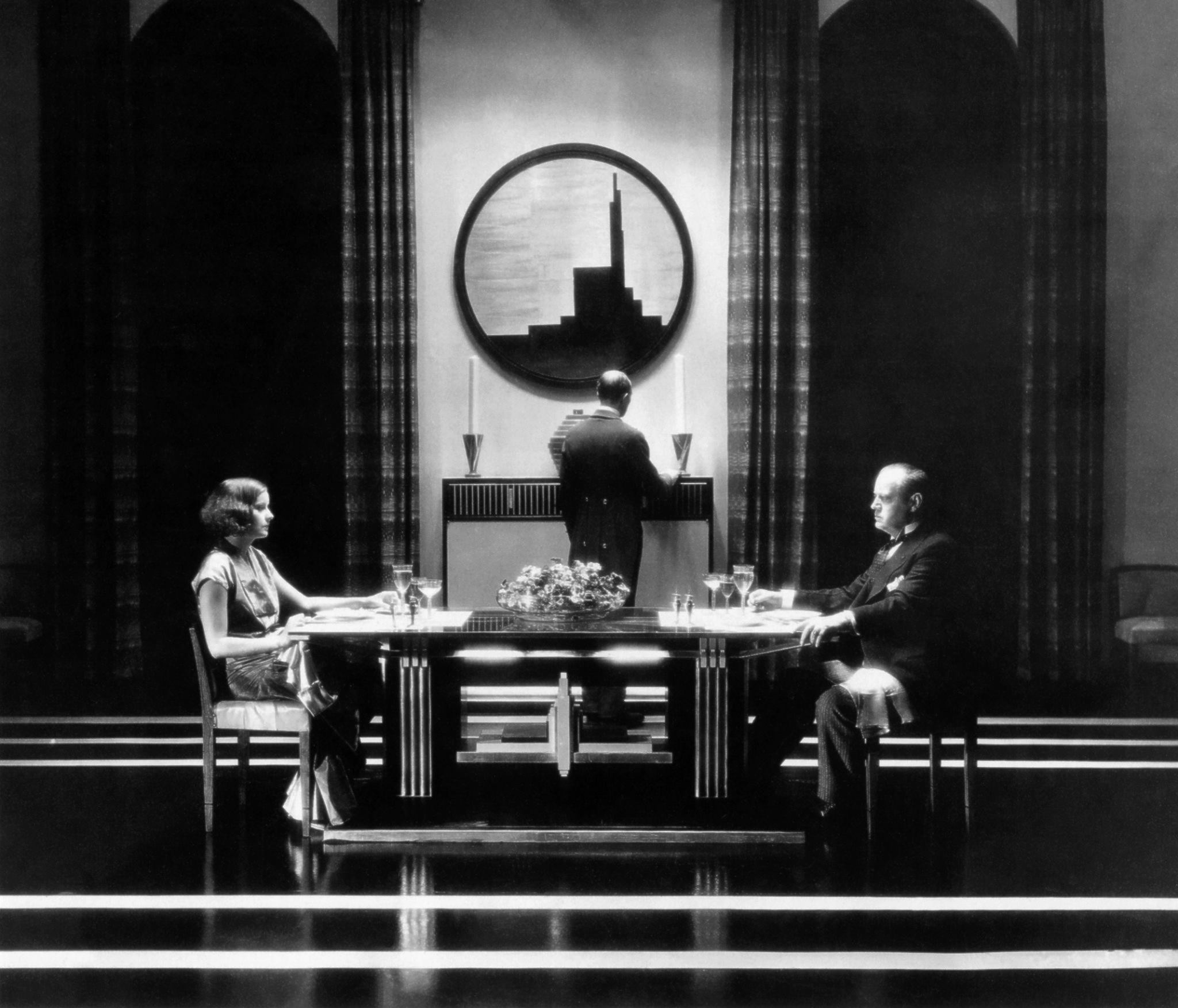 Greta Garbo in THE KISS. Production design by Cedric Gibbons.
Eddie Pensier writes:
John Humphreys of the Australian Libertarian Society starts a whopper of an argument on the ALS’ Facebook page:
There is an apparent contradiction at the heart of objectivism. Ayn Rand said that she opposed the initiation of coercion/violence, but she also rejected anarchism and insisted on having a government… which is defined as an institution that has a geographical monopoly over the initiation of violence/coercion.
That doesn’t add up. Either objectivists accept a government and then they accept the initiation of some violence/coercion. Or they don’t want a government and are anarchists. Those options are mutually exclusive and collectively exhaustive… there is no other option.
Given the vehemence of Rand’s opposition to anarchy, I had previously thought that objectivists accepted government and that they were confused about the whole coercion thing. But in a debate this evening it seemed that my objectivist sparing partner was inadvertently advocating for anarchy… but with the assumption that in anarchy, enough people would voluntarily give money to a security provider that would protect everybody. The idea is that this benevolent non-profit donor-funded security provider would be called “government”, despite not initiating violence or coercion.
If this is accurate, then there are two consequences. First, semantics notwithstanding, a benevolent non-profit donor-funded security provider is totally consistent with anarchy, and so such a position is really just another type of hyphenated anarchy with a particular vision of how a free society might function. Second, it seems to me that the above approach to security provision is very reliant on the benevolence of one organisation and the people who will donate to that organisation… which means it is actually less stable than the system suggested by other market anarchists.
What do you say objectivists… are you secret anarchists living in denial, or are you people who oppose coercion all the time except for when you don’t?
Do you agree with Humphreys’ point or do you, um, object?

Eddie Pensier writes:
I’m a great admirer of good voice acting, but I’m also a fierce critic of it when it’s poorly done. There are some unfortunate occasions when it’s just screwed up beyond belief.
One extreme example: The “Bureaucrat” song from the Futurama season 2 episode, “How Hermes Requisitioned His Groove Back” is jauntily performed by Phil LaMarr as Hermes, along with the rest of the excellent voice cast of the show.
However, what happened when the producers neglected to get competent voice personnel to dub the French-language track? Utter chaos, that’s what.
Watch and listen to this trainwreck. You’ll laugh, once you get over your slack-jawed astonishment that this actually made it into a DVD for sale to the public. (Be sure to watch the original linked above, first.)
Glynn Marshes writes:
Ha.
In addition to rewarding his friends with the crown’s territories [New York governor Benjamin] Fletcher gave them free reign in the piracy business. As Kind William’s War dragged on — it didn’t end until 1697 — both Britain and France bolstered their regular navies by relying on privateers, privately owned warships empowered by “letters of marque” to despoil enemy shipping. The law required that captured ships and cargoes — known as “prizes” — be legally condemned in a proper court of law before they were disposed of. Privateering proved so lucrative that many captains and owners dispensed with the formalities and turned to out-and-out piracy, attacking the vessels of any country, including their own. There were only two details to worry about. One was being caught and hanged. The other was disposing of loot.
Fletcher rolled out the red carpet for pirates, allowing them and their crews to enter New York without fear of arrest, dispose of their treasures, and refit for another voyage — all for a mere one hundred Spanish dollars each. Over the next four or five years he hosted a remarkable collection of villains and cutthroats. When pirate captain Thomas Tew put into port in 1694, the governor invited him to dinner, escorted him around town, and presented him with a gold watch as an inducement to return. Taken aback, the Lords of Trade in London asked for an explanation. Tew was “what they call a very pleasant man,” Fletcher answered serenely. “When the labours of my day were over it was some divertisement as well as information to me, to heare him talke. I wish’d in my mind to make him a sober man, and in particular to reclaime him from a vile habit of swearing.”
That’s from Gotham: A History of New York City to 1898, Edwin G. Burrows and Mike Wallace.
btw, the reference to “rewarding his friends with the crown’s territory” refers to gifts Fletcher made of enormous parcels of land — tens of thousands of acres at a time in northern Manhattan, Westchester, and Long Island (one gift comprised 50 miles — 50 MILES — of northern Long Island shoreline) — in exchange for the “fealty of the colony’s . . . ogligarchs.”
But don’t pick on Fletcher. They were all doing it — his predecessors, his successors. New York was an utterly lawless place, by which I mean that the “laws” were enacted to serve the narrow interests of whoever was in power, only to be overturned a few years later by the next regime. Mix in ongoing tension between the working and merchant classes, more tension between religious factions, and spillovers from European wars, and wow. What a crazy place it was . . .
epiminondas writes:
In this vivid, straight-talk article, Paul Theroux discusses the endless repetition of failed missionary and educational plans for Africa. And they have become repetitive, some having been originally tried almost 200 years ago…many times. And the likes of Bill Gates, Bono, Warren Buffet and many others continue to pour money into programs which are guaranteed to fail. Generally, the more expensive the plans, the more certain the failure. So why doesn’t the past instruct these “telescopic philanthropists”? Read on…
Fenster writes:
One cheer, at best, for Rebecca Shuman’s article in Slate on the issue of budget cuts in the academy. Shuman fairly criticizes the growth of administration relative to academics in the competition for resources. A lot of that critique is indisputable. Where she goes off-track, IMHO, is in her central contention:
What is confounding about these universities’ plans to possibly obliterate nearly half of their departments is why both institutions, faced with budget crises, went straight for the academic jugular. And not just by cutting highfalutin artsy disciplines, but with an eye toward fields of study that are actually valued in today’s cruel and fickle market. Nobody seems to notice that the structure of today’s higher-ed “business” model is backward: It’s far easier to cut academics than it is to cut anything else, so that’s what universities are doing.
Look, criticizing the growth of the administration is fair game. Sometimes that critique is done in a ham-handed way, as with Benjamin Ginsberg’s polemical work, endless anecdotal litanies about administrators with nothing to do making tons of money. But sometimes administrative bloat is handled with a bit more nuance, as in this study. Here, administrative bloat is less a matter of evil leeches and more a matter of ambitious, mission-oriented staff able and anxious to “help”, whether via counseling, residence life “co-curricular programs” or staffing the proverbial rock-climbing wall.
Administrative “bloat” in this sense is much harder to cut than evil leeches. Most of such “bloat” has been added by choice, and often with an eye toward getting the butts inna seats. Cutting such programs may be psychically satisfying for education-first types, but the effects of wholesale cuts of such “bloat” can be hugely negative from a business POV. Parents grouse about tuition, but the arms race continues, a kind of tragedy of the commons.
Then there’s also the fact that while faculty are often weak from an organization point of view, they have huge residual, passive power. They can, and usually do, block change when it come to academic programs.
I was the senior finance person at a well-regarded university a couple of years back. When the sh*t first hit the fan relative to the budget, the first cut was to staff–an almost 10% cut! Academic cuts: zero. Can’t go there.
When the budget pressure continued in year two, the trustees rebelled a bit (which was unusual, and praiseworthy IMHO). They demanded that the faculty step up, so that the brunt of year two cuts were not wholly felt by staff.
What followed was a Keystone Kops version of budget. Impassioned speeches at faculty meetings about the death of a great institution and so forth. Lots of nodding of heads.
Under the surface, many faculty privately knew which departments were good and which not so good–but try to get that articulated, and acted on, in the “collegial” world of the faculty. In that world, we are all excellent, and all administrators suspect.
In the end, the faculty was sent off to a room and told they could not come out until they agreed to share the burden. The result? A series of program changes that looked OK on the surface but amounted to essentially no change on deeper analysis. Essentially, the faculty asked the administration to blink, and blink it did. Only now it had developed a new and powerful myth of academic programs being martyred to a cruel budget ax.
Now, are some institutions actually cutting academic programs? Sure, reality continues to raise its head and in some instances academic programs have gotten to the chopping block. But to argue, as Shuman does, that it is “far easier to cut academics than it is to cut anything else” is just part of the martyr mythology.
Fenster writes:
Here is an article about a college prof getting a reprimand for what for some was a heavy-handed approach to teachable moments about white privilege and racism. This is tricky territory. Here, the administration seemed to be in favor of the idea of such teachable moments, with the reprimand coming down because the prof was viewed as singling out white students for extra correction.
This kind of thing is not uncommon, and it points to a real problem in walking a very fine line.
For instance, here’s an interesting article from a couple of years back with a similar theme. It was written by Jen Graves, a teacher at an art school, and it deals with her attempt to introduce race into the art pedagogy. She had a case for doing so–discussing African-American artists with a class of white students.
Now, art schools tend to be quite white, less because of any inherent bias on the part of admissions counselors (who are under significant pressure to increase minority enrollment) but because expensive art education tends to be a second or third generation college choice, with a lot of students coming from two professional homes willing to spend a small fortune with what is generally viewed as a limited career payoff. And if you are going to be lecturing more or less privileged white kids about artists like James Baldwin, some mention of race, and racism, is warranted.
In this case, the teacher opted for the confrontational mode, asking the students to raise their hands if they considered themselves racist, then pushing them on the question to create a teachable moment. How far she pushed them, and how didactic the moment was, is not entirely clear.
The general arc is fairly clear where social topics are concerned. First, the instructor starts in safe territory, looking to link a subsidiary social topic to the subject of the course. Second, the discussion of the subsidiary topic takes over as the dominant theme. Third, the discussion can become a proselytizing lecture justified as a teachable moment.
Now, I wasn’t there so I don’t know how heavy handed this piece of pedagogy came across in the moment. For the record, one person commenting on the article had this to say:
I was in one of the classes at Cornish where Jen talked about race, and after the class, most of the students were angry- not because she asked if anyone was racist, and admitted to her own “racism” but because she claimed that everyone there was a “racist”.
It was insulting, because most of us know “racism” as “a belief that race is the primary determinant of human traits and capacities and that racial differences produce an inherent superiority of a particular race”.
Many of the students that I talked to were raised not to discriminate or to think of one race as superior to another, so for Jen to come in and tell us all that we’re racist, when we came to learn about art, was off-putting to say the least. I don’t think it was a good way to discuss the work. Instead it just turned out to be distracting, and had us all leaving confused about the relevance of the class.
Whatever happened in the class, Graves found herself in a spot of trouble after the fact when, as it turns out, a white student complained to the administration about the class, claiming that in copping to her own racism Graves’ goal was to promote notions of white superiority! That is truly hard to believe and the charges were dropped.
Would that Donald Hindley have been so lucky! He is the lefty history professor at Brandeis who, in his haste several years back to make the argument that America is intolerant of Mexican immigration, used the term “wetback” in class. That he used it to disparage the attitudes of Anglo Americans proved of no use. Several students complained to the administration and Hindley ended up being disciplined. Shades of The Human Stain!
 Blowhard, Esq.
 Callowman
 Sherbrooke
 Eddie Pensier
 Enzo Nakamura
 Epaminondas
 Fabrizio del Wrongo
 Fenster
 Brundle Guy
 Glynn Marshes
 Paleo Retiree
 Atypical Neurotic
 Question Lady
 Sax von Stroheim
 Sir Barken Hyena
 The Mistaken
 Uncouth Reflections