Sir Barken Hyena writes:
The L.A. visit continued with a walking tour of glorious, or at least much photographed, Downtown Los Angeles. We had some highs and some lows with this one.
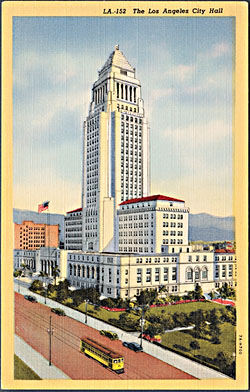
One “high” was certainly the LA City Hall, a 1928 Art Deco skyscraper that rates only lower than the Empire State and Chrysler buildings for instant recognition. Though for different reasons: it’s had many TV and movie appearances, the advantage of the home team I suppose. Still, nothing becomes iconic from mere exposure, it must have that memorable quality, and the LA City Hall certainly has that:

Yep, Sgt Friday and Martian invaders spring to mind, right? But when you get beyond that in the presence of the real building you see a monument that perfectly encapsulates a moment in California’s history. Part of this is in obvious ways, such as the tile mosaics celebrating the young city’s industries: film, oil, aviation, agriculture. This is standard civic architecture stuff, though the vaguely Moorish style is interesting. Part of it is a more subtle symbolism: it’s an Egyptian obelisk topped by a Babylonian ziggurat supported by Greek columns, a kind of sampler of symbols of muscular state power and legitimacy. Modernist architects (we still call them that 100 years later!) would certainly connect that statement with Fascism, and maybe they have a point in a way. As pure art it doesn’t rate with the masterpieces of the style but it’s as expressive as a building can be. It radiates confidence, optimism, power, and most of all, the future.
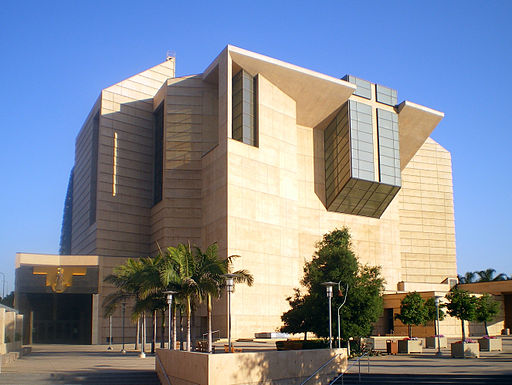
What a gulf that separates this proud optimism from the cynical doubt that is Our Lady Catholic Cathedral just a few blocks and worlds away.
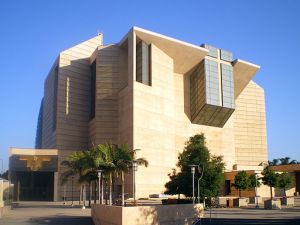
This building expresses, well, not much really besides confusion and a pathetic “me too-ism”. It’s as though the church leaders who green-lighted this impressionistic fertilizer factory were trying to keep up with the hip and in crowd. Never mind that that crowd stands for the opposite of everything that’s central to the religion. Never mind that there’s a 2500 year history of sacred building design that’s at the center of Western culture. Never mind that a building that celebrates timeless truths has no need for innovation. Never mind that the people who are actually supposed to be served by this building have no clue about architecture, or modernism and probably wouldn’t care any way. This building was made for everyone who never will go there. It projects not optimism but a crushing lack of faith, in a building that exists to support faith.
Some redemption is found by entering the building. The space is still dominated by Brutal concrete but manages a semblance of the feeling of a true cathedral. But mostly it’s the tapestries that redeem. These depict a procession of saints portrayed with great realism, all facing to the central crucifix. Here’s one sample:
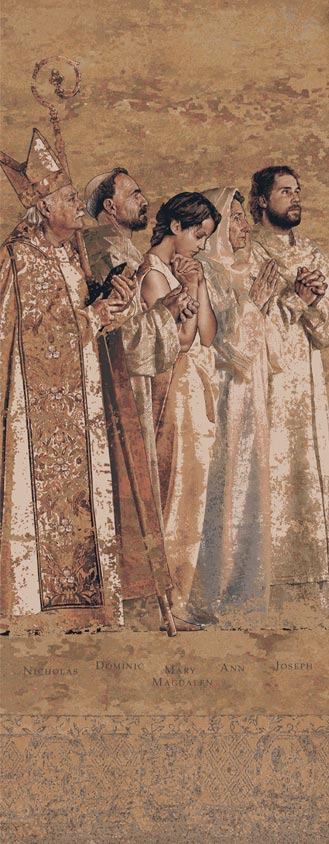
There are about 20 of these, each face has a very distinct personality to it, and a unique expression of reverence. It’s a much needed human touch, perhaps made more powerful by the concrete horror that surrounds, though I doubt that was the intent. Other artworks, particularly the magnificent Italian carved altar and a powerful statue of Mary, only serve to embarrass our modern attempts at sacred art.
Just as futuristic as the City Hall but for different reasons is the Bradbury Building, fixture of Science Fiction. It’s two most famous uses were in Blade Runner as the home of J.F. Sebastian and his toys, and in the Outer Limits episode Demon With the Glass Hand, where Robert Culp hunts aliens in it’s cavernous atrium. In the flesh it’s more gay 90s than LA 2019 but no less spectacular for all that, with the iron work, carved filigree and glazed brick really dominating the space. We could only hang around the ground floor atrium because the building has actual tenants, so we couldn’t go hunting for Pris. Probably better that way…
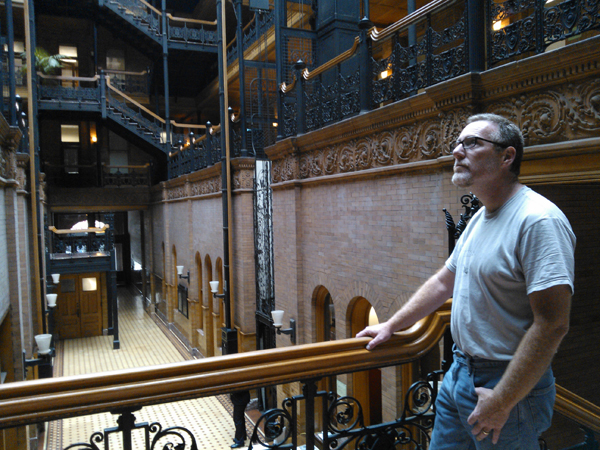
Sir Barken on his way to retiring a few replicants
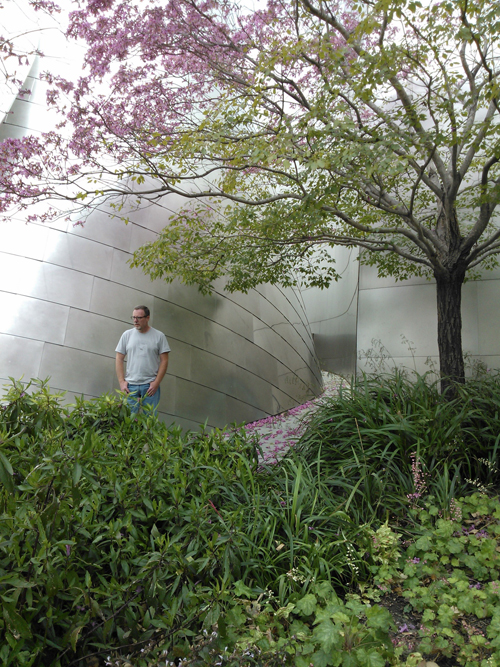
Last on the list was the Walt Disney Concert Hall, by Starchitect Frank Gehry. Blowhard, Esq. advised that we see it in spite of my disparaging remarks from having seen it from a distance, and recommended taking the tour. Sadly we were too late for that but did walk around the building and to my surprise I found it quite a different thing when seen that way. It lost all of it’s “sheet metal shop floor” look and became a kind of trippy funhouse in chrome. Particularly nice was the rooftop garden featuring lots of exotic plants and trees, the colors of the vegetation glowing against the chrome. Here was a fitting contrast: organic against artificial, but also with an odd unity because the Gehry’s artificial shapes defied the grid and t-square for a kind of echo of the organic.

Sir Barken contemplates mortality and evanescence after icing a few miscreant replicants
Related
- Notes on Los Angeles, Part I is here.






 Blowhard, Esq.
 Callowman
 Sherbrooke
 Eddie Pensier
 Enzo Nakamura
 Epaminondas
 Fabrizio del Wrongo
 Fenster
 Brundle Guy
 Glynn Marshes
 Paleo Retiree
 Atypical Neurotic
 Question Lady
 Sax von Stroheim
 Sir Barken Hyena
 The Mistaken
 Uncouth Reflections
