Yesterday I expressed my enthusiasm for ’60s go-go dancing, which I consider to be a majorly underappreciated popular artform. Who doesn’t love the girls who dance behind rock acts? But how much do you know about them? And where are the books and documentaries about them?
Today I have a special treat in store: an interview with De De Mollner, the unofficial leader of the great Gazzarri Dancers, to my mind the best, sexiest and most inspiring of all the go-go troupes of a great era. (The Gazzarri Dancers performed on the show Hollywood A Go Go in 1964 and 1965.) I think you’ll really enjoy meeting De De and hearing her story, which is fascinating both in its own right and for the snapshots it offers of American youth and popular art (LA division) in the early ’60s. De De was very generous with her time and her tales, so — drumroll — without further ado …
As far as giddy, pure-pleasure culture-activities go, there hasn’t been much that’s given me more pleasure over the years than watching go-go dancers. They’re a lot more than just cute, skillful and energizing eye candy — although, god bless them, they’re all that too. They wiggle; they project feeling and personality; they wear costumes and hairdos with enthusiasm … They enhance shows, they keep energy levels up, and they contribute a lot of sex appeal.
Primarily go-go dancers serve decorative and background purposes, of course, but oftentimes (and in effect) they’re more than just decor — in fact, sometimes they’re more worth watching than the featured performers are. In a lot of ways go-go dancers represent the spirit of popular culture itself, and maybe even of the performing arts generally. They’re full of the love of showing off, pitching in, and contributing to fun experiences, and they work hard to deliver blasts of hope, silliness and joy.
I’ve enjoyed the work of a good number of go-go dancers live, but in recent years, thanks to the miracle of YouTube, I’ve also been able to revisit the go-go dancing from my youth and early youth, the real glory days of the form. One of my main responses has been to wonder: “Why on earth doesn’t someone make a documentary about go-go dancers, and about the go-go dancing era more generally? Where’s the priceless, moving, funny, gorgeous, nostalgic movie about them, something along the lines of ‘Standing in the Shadows of Motown,’ Paul Justman’s wonderful 2002 documentary about the musicians in Motown’s house band?”
In the case of go-go dancers: A lot of video footage exists, and many of the people who were participants in the scene are still around and in good shape. The materials are there. Plus: As far as I can tell, today’s world is nothing if not teeming with wannabe filmmakers in search of excuses to start shooting and editing. So: get cracking, filmmakers. It’s a great, not just a good, subject, and it’s ripe for the picking.
A little more discerning now than I was as a kid, as I’ve stared at my computer screen I’ve been able to distinguish one go-go dancing troupe from another. And over and over again, one go-go troupe in particular has stood out: the girls on the TV show Hollywood A Go Go. A little time with Google has revealed that they were known as the Gazzarri Dancers. With their fluidity and their sophisticated sex appeal, they make most of the other pop-music dance troupes of the era look clunky, square and earthbound — more like hard-working girls still earnestly shaking off the ‘40s than young women helping usher in the freedom of the late ‘60s and the experimentation of the ‘70s.
Here’s a number from Shindig …
Cute and fun as can be — no disrespect meant! Still, compare the girls and the dancing in it to this number from Hollywood A Go Go:
The Shindig number: bright and brassy, almost like an early ’60s version of “Boogie Woogie Bugle Boy.” The HAGG number: all cashmere and daring, and reminiscent of the movies of Roger Vadim. Each and every one of the Gazzarri girls strikes me as tigerish — as too much woman, and in the best possible way.
I’m a little wary of rhapsodizing too much, let alone sounding like too much of an old fart. But for me the HAGG numbers aren’t just ‘way more sophisticated than almost anything else from the TV of the era, they’re also much more truly-deeply erotic than contempo pop numbers are. This despite the fact that they’re far less explicit (and, god knows, they’re far less aggressive and polished) than a lot of contemporary pop-music performances. On the one hand they’re as all-American as high school and Playboy magazine; on the other they have some of the assertive-yet-sultry allure of many of the European art movies of that era. In any case, I consider them little jewels of pop poetry.
One of my favorite hobbies on Facebook has been linking to a lot of the Hollywood A Go Go videos and introducing my Friends to the Gazzarri girls. Since many people — even many who have extensive pop-music knowledge banks — seem completely unaware of the various go-go troupes, I see sharing my knowledge and links as doing a major public service.
Snooping around one day on Facebook I was tickled to see that Deanna (De De) Mollner, the best-known of the Gazzarri Dancers, is a FB member. (De De is the knockout blonde behind the singer in the Hollywood A Go Go number above.) I sent De De a Friend request, she Friended me back — yay — and she’s been an online acquaintance ever since. A tall blonde dynamo, De De in the Hollywood A Go Go numbers embodies a bit of Tuesday Weld and a bit of Brigitte Bardot, and the Facebook-offered glimpses I’ve had of her suggest a life very well, indeed exuberantly, lived.
Recently I was ranting to The Question Lady about the above question — Why hasn’t a documentary about go-go dancing been made? She put up a hand and told me I should stop being an idiot and man up. “But I’m not a filmmaker,” I protested. “No, but you’re in touch with De De Mollner,” she said. “You’ve got a blog, and you’re a good interviewer.”
I took her point. So come back tomorrow to enjoy a treat. You’ll have the chance to meet a special person, and you’ll be able to learn a bit about a special time, the glory days of American go-go dancing.
Lady Hyena has been getting restless lately, never a good thing, so I took her and myself for a few days in the Big City: The City of Angels in this case, a place we’ve only seen from the speeding window of the car before. Now, having been up close and personal I can make a surprising admission:
We love L.A.! Yes, the city everybody loves to rag on, butt of endless jokes and object of contempt for every New Yorker. As usual the conventional wisdom is only conventional. Here are a few high points from our trip:
The Museum of Jurassic Technology
What we have here is actually a work of art in the form of a museum. Some paint canvases, others write poems, David Hildebrand Wilson, the museum’s creator, makes fictional (or are they?) exhibits of curiosities, historical figures, social phenomenon and incredible animals. Most of which never existed but if they did you’d want to know about it. Some of the exhibits are: the Deprong Mori, an Amazonian bat that uses radar, a history of the self-built travel trailer, a scientist’s long battle with Mt Wilson observatory, an innovative Armenian violinist, and folk cures treated as objectively verified scientific phenomena.
MJT is part homage to the menageries and Cabinets of Wonders that were the precursors of today’s museum, part sly joke about the nature of knowledge, part indulgence in the mystery of it all (the “jurassic” in the name is never explained), part nothing else you’ve seen. A must see for all fans of the bizarre.
Next up was dinner with the blogging sensation Blowhard, Esq. This was to be our second “Brush With Greatness” in Tinseltown – we had bumped into Ron Perlman in a kabob restaurant earlier that day. We asked him to pick a place to “wow” the ignorant hayseed in us with Big City sophistication. We got it.
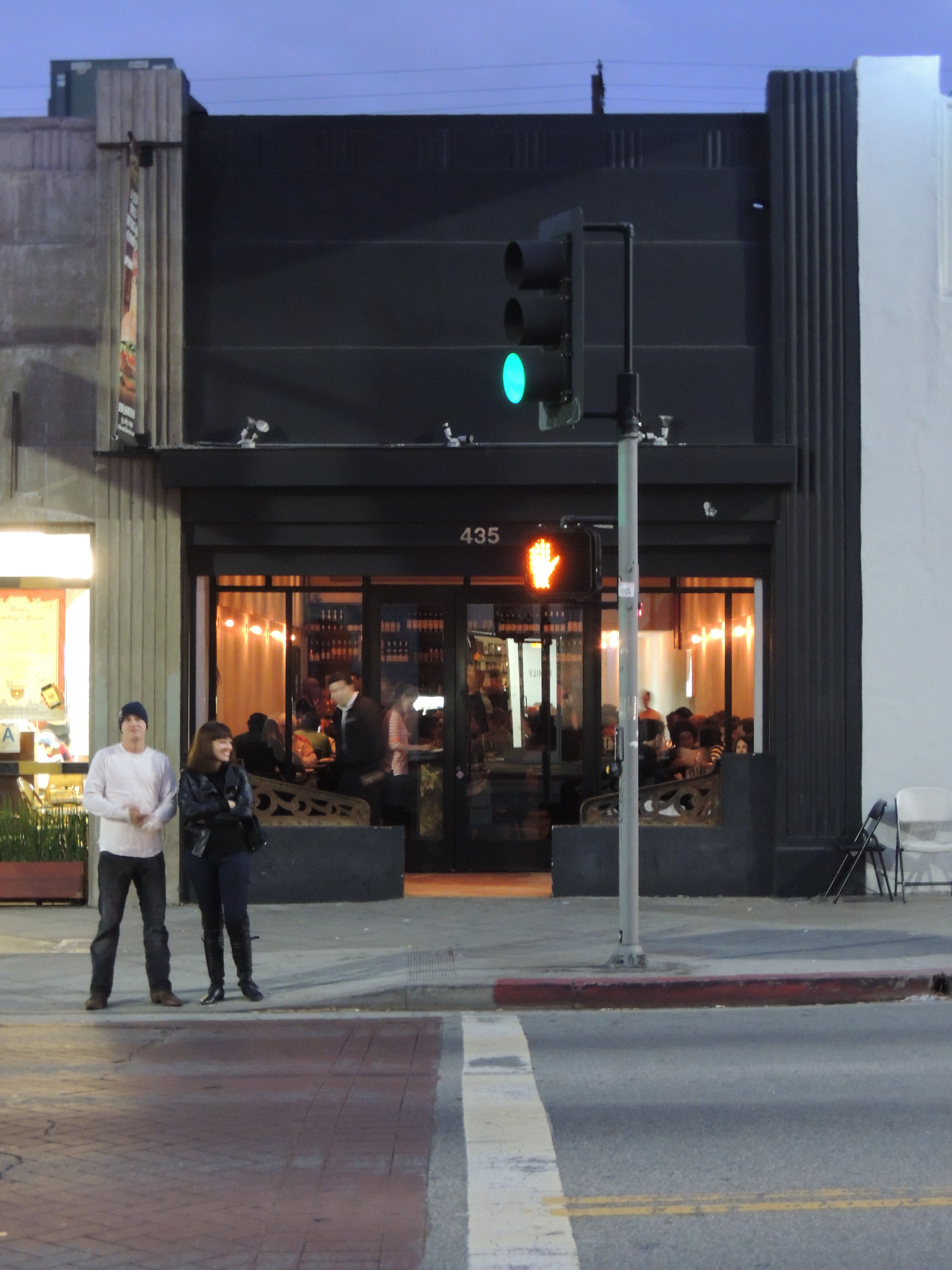
First of all there’s no sign on this restaurant, which I think is hilarious. Atmosphere wise it’s a typical trendoid place, with the usual suspects in place, but thankfully it’s also just too fun to be pretentious. In any case the conversation was too good to notice – highlights were some great stories Blowhard, Esq. shared about writer and raconteur Lloyd Fonvielle.
The food was spectacular, kind of a fusion-tapas thing where you order a bunch of smaller entrees. The stars, we all agreed, were the rabbit-shrimp sausage spring rolls in green curry, the yellowfin sushi tostada, and the black bean ribs. Only the kale was just OK but what do you expect from kale?
Desert was also amazing though the tres leches was a bit too sweet. All in all a spectacular meal and a great time. Highly recommended.
Sometimes at pagan shrines they vowed
offerings to idols, swore oaths
that the killer of souls might come to their aid
and save the people. That was their way,
their heathenish hope; deep in their hearts
they remembered hell.
Given the play it receives in the media and on Facebook, it might surprise you to know that, according to Gallup, around 4% of Americans think gun control is the most important issue facing the country.
Gucci Little Piggy on the inevitable sanctimony that has followed in the wake of the Boston Marathon bombing. For the life of me, I don’t know what people get out of this shit. Or is it really just a feeling of making a difference? I love the comment by Xavier.
The makers of Dove Soap have inaugurated a campaign to eradicate the scourge of women feeling bad about themselves.
David Bordwell shares some info about the life of movie production manager Doc Erickson.
In case you haven’t heard of Science Bros. Will fan fiction turn out to be the great creative platform of the 21st century? Didn’t “Fifty Shades of Grey” start out as fan fiction?
Seems like these kids were getting it on in semi-public places. And somehow they were expecting it not to be filmed by someone? Is that a reasonable expectation? Also: Things sure have changed since I was in school.
We all know how Hollywood and the big publishing houses control the copyright laws and their enforcement. What we didn’t know about was the blowback from that domination…
I hated this very literary 2001 vigilante picture, directed by Todd Field from a story by Andre Dubus. It’s immaculate and meticulous; full of grief, bleakness and quiet; and bristling with mythic overtones and unexpressed (but broadly hinted-at) emotions. Set in a small fishing town on the New England coast and embellished with lots of contrasts between upper-middle-class comfort and working-class harshness, it seemed as overwrought and pretentiously bad (in a tasteful, color-coordinated, upscale way) to me as “Affliction” and “Margot at the Wedding” did. It was a real critic’s darling, though, and many viewers have reported that they love it too. It’s available on Netflix as a DVD, and on Amazon Instant Video for $1.99.
I’ve been arguing for a while (with friends and on Facebook) what John Derbyshire is implicitly semi-arguing in his provocative new piece at Taki’s Magazine — that the alt-Right is today’s counterculture. In the way it quarrels with and tries to subvert the mainstream — and in the way that it has built a world of its own from the ground up with no encouragement (to put it mildly) from our mandarin class — it’s like the Beat movement of the 1950s. The big difference, of course, is that the ’50s mainstream was square. Today’s mainstream is liberal, and pro-diversity and anti-racist above all other things. But if you can overlook that little difference …
The alt-Right seems to me to have some of the vitality, daring and the zip of the Beat movement too. Will the work of its liveliest writers, thinkers and provocateurs ever receive the kind of recognition that the Beats now enjoy?
I see Terrence Malick’s latest emanation is upon us. Call me crazy, but I tend to be less than enthusiastic about Malick’s movies; they often strike me as weird combos of dum-dum ideas and imperious stylization of the kind you might find in whatever litfic masterpiece “The New York Times” is currently praising. His last film, “The Tree of Life,” has been compared to Kubrick’s “2001.” If you saw “Tree” you’ll know what the comparison is meant to imply: that both movies are inscrutable compendiums of Big Ideas. But where Kubrick’s inclination is to reduce man’s evolution to a few basic movements, Malick takes a simple idea — a kid’s Oedipal issues — and inflates it until it has cosmic significance. The movie starts with the Big Bang (yes, that Big Bang!), moves through a prehistoric interlude during which the dinosaurs learn to be excellent to each other, then turns into a dizzyingly edited evocation of youth in the American South. The images are consistently tasteful and well-lit, the way they are in a Crate & Barrel catalog.





 Blowhard, Esq.
 Callowman
 Sherbrooke
 Eddie Pensier
 Enzo Nakamura
 Epaminondas
 Fabrizio del Wrongo
 Fenster
 Brundle Guy
 Glynn Marshes
 Paleo Retiree
 Atypical Neurotic
 Question Lady
 Sax von Stroheim
 Sir Barken Hyena
 The Mistaken
 Uncouth Reflections