
Fenster writes:
Two schools of thought on the current crisis in higher education.
They are not mutually exclusive by any means, but there is a definite tension between the two.
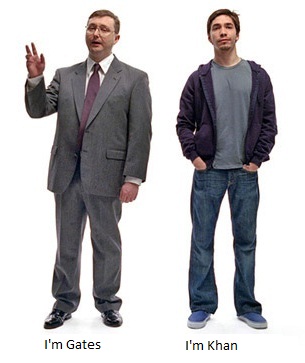
On the one hand, we have Bill Gates. Here is a link to an Atlantic article highlighting a Power Point presentation by Gates on the crisis in higher education. It appears to me to be a conventional, even orthodox, reading of the situation and what to do about it. One delivered via Power Point no less! With all the crazed innovation out there looking for traction, Gates turns the narrative into one of increasing graduation rates. Don’t cut budgets further–we’ve cut enough. And let’s focus on finding ways to increase college completion on time. But . . . .

Then there’s Salman Khan, founder of Khan Academy someone Bill Gates thinks a lot of. Here is his view on the future of credentials.
Here’s what I think it could look like in five years: the learning side will be free, but if and when you want to prove what you know, and get a credential, you would go to a proctoring center [for an exam]. And that would cost something. Let’s say it costs $100 to administer that exam. I could see charging $150 for it. And then you have a $50 margin that you can reinvest on the free-learning side.
I think that is consistent with the mission. You are taking the cost of the credential down from thousands of dollars to hundreds of dollars. And the [software] system would tell them they are ready for it. So no paying tuition for community college and then dropping out, or even finishing the whole thing and saying “Oh, I’m $20,000 in debt and what did I get out of it?”
Now you are like, “Look, there is this micro-credential in basic accounting I can get for $150, and I basically know I am going to pass before I invest that money.” That would be a huge positive for the consumers of education, and it could pay the bills on the learning side.
Note Khan does not equate credentials with graduation and “degree completion on time”. Now don’t get me wrong: degree completion is, all else being equal, a good thing rather than a bad one. But obsessing over completion, especially if it diverts attention from more efficient paths, is a blunderbuss approach to the problem, and one that betrays the POV (and interests) of the large institutions that now comprise the higher education sector industry.
Hmm . . . where have I seen this before?


 Blowhard, Esq.
 Callowman
 Sherbrooke
 Eddie Pensier
 Enzo Nakamura
 Epaminondas
 Fabrizio del Wrongo
 Fenster
 Brundle Guy
 Glynn Marshes
 Paleo Retiree
 Atypical Neurotic
 Question Lady
 Sax von Stroheim
 Sir Barken Hyena
 The Mistaken
 Uncouth Reflections