Arbor Gates, The Saga Continues

Paleo Retiree writes:

The estimable Blowhard, Esq. and I are involved in a quest to direct the attention of architecture fans (and potential architecture fans) to the modest pleasures of what are called “arbor gates” — trellised, usually overgrown, garden gates, that are often to be found in front of Craftsman-style bungalows and cottages. Here’s Blowhard, Esq.’s latest find. Here’s mine:

What a goofy, sweet, lopsided beauty, eh?

I find that the message these structures convey is a pleasing combo of “stay out” and “welcome,” “open” and “contained,” with the tangled-but-shaped vegetation and the hand-hammered wood conveying a nice human/creaturely touch: the structure and rationality of the manmade world interacting generously with the wildness, abundance and irregularity of nature. Something like that, anyway.

FWIW, I feel that I run across these charming micro-structures far more often on the West coast than on the East. I wonder if that’s really the case, and if so, why.

Another question: Who was the genius architect who came up with the arbor gate? That’s a trick question, actually, because the answer is: as with many architectural wonders, we don’t know. The general lesson I’m dying to share: architecture is like cooking, a practical art/craft to which many, many thousands of practitioners, most of them unknown, have made positive contributions. God how I love it when the arts clearly happen in a bottom-up, self-organizing way.

Here’s another, if only half-related, thing I often wonder about. Although I’ve been a fan of architecture and urbanism for decades, I’ve always had a terrible time remembering architectural terms. Even the term “arbor gate” is a tough one for me to recall. I’ll reach for it and come up with something like “trellised arched entryway” instead. Why? Why?

Any idea why it’s so hard to recall architectural terms? Do you have that trouble too?

Posted in Architecture, Photography, The Good Life | Tagged , , , , | 5 Comments

Old California Cars 2: A Sweet VW

Paleo Retiree writes:

I’m still in California, and I continue to get a lot of pleasure out of the well-preserved old cars that abound out here. Back in the northeast, it’d be a rare treat to run across something like this:

Well preserved.

Out here in CA, seeing a nifty old piece of automotive design like this is a daily blast.

Previously.

Posted in Commercial art, Photography | Tagged , , | 1 Comment

Quote of the Day

Blowhard, Esq. writes:

Curiosity is one of the lowest of the human faculties. You will have noticed in daily life that when people are inquisitive they nearly always have bad memories and are usually stupid at bottom. The man who beings by asking you how many brothers and sisters you have, is never a sympathetic character, and if you meet him in a year’s time he will probably ask you how many brothers and sisters you have, his mouth again sagging open, his eyes still bulging from his head. It is difficult to be friends with such a man, and for two inquisitive people to be friends must be impossible. Curiosity by itself takes us very little way, nor does it take us far into the novel — only as far as the story.

— E.M. Forster, Aspects of the Novel

Given that quote, it probably won’t surprise you that Forster isn’t much of a fan of story, either. I’ve been browsing through this collection of lectures Forster gave on fiction and the chapters on “story” and “plot” in particular deserve a takedown.

Posted in Books Publishing and Writing | Tagged , | 5 Comments

What do you look for in a short story?

Brundle Guy writes:

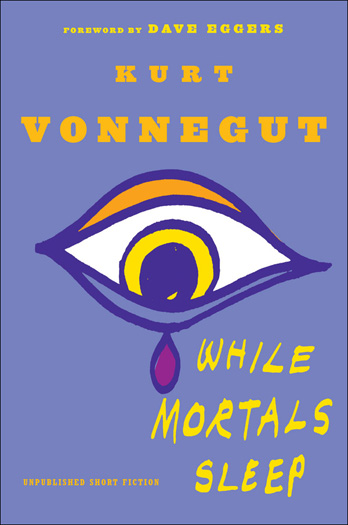
A couple of months ago a good friend of my family’s passed away. I helped partake in a search through her house for her will, and while we didn’t find the legal papers in question, I did find an unread copy of a collection of posthumously published Kurt Vonnegut short stories. I was told the family friend would have loved for me to have, as I am a huge fan of Vonnegut, so I took the book home as a little memento.

The collection, entitled While Mortals Sleep, has a forward by Dave Eggers in which he describes Vonnegut’s early prose as “mousetrap stories”:

A mousetrap story exists to trick or trap the reader. It moves the reader along through the complex (but not too complex) machinery of the story, until the end, when the cage is sprung and the reader is trapped. And so in this kind of story, the characters, the setting, the plot–they’re more or less a means to an end.

This isn’t to say the characters aren’t real-seeming, aren’t believable or sympathetic or any of the other things we might want characters to be. On the contrary, Vonnegut is masterful at quickly sketching a character who you instantly recognize and are immediately willing to follow. But in the end, their routes are determined by the master mousetrap maker, their fates in service to the larger point.

He contrasts this with the current style of literary short fiction:

We’re now in an age of what might be called photorealistic stories. What we have with most contemporary short stories is a realism, a naturalism, that gives us roughly what a photograph gives us. A gifted photographer will frame reality in a way that seems both real and novel. His or her work will “hold a mirror” to our lives, but in such a way that we see ourselves anew. All art forms attempt this mirror-holding, but photography, and the contemporary short story, are particularly well-designed delivery devices for this aim. And thus the contemporary short story gives us characters who breathe, who seem three-dimensional, who live in real places, have real jobs and struggles and pain. The stories are to a great extent in service to these characters. The characters make realistic moves in their lives, realistic choices, and the outcomes are plausible and perhaps even pedestrian.

Is it just me, or does that read more than a little self-aggrandizing, and a bit like talking down to the fairly recently deceased literary heavyweight whose book you’re introducing? Elsewhere in the intro Eggers notes that Vonnegut’s work has something else particularly old-timey and not in fashion about it: a moral point of view. Not moralistic, necessarily, but simply a point of view.

Apparently contemporary short stories have The Two Verboten P’s — Plot and Perspective.

Showing my biases here, I can hardly think of a less-appealing sounding story than the one described in Eggers rundown of contemporary short-story tropes. I’ve never understood why people want capital R Realism, photo or otherwise, in their art. I see plenty of realistic, pedestrian outcomes in my life, if I’m going to devote my time and attention to a piece of art, I feel like it had damn well better take me somewhere, and I’d prefer that be a bit farther than my own backyard.

As I was reading the enjoyable, well-constructed stories that night after my friend’s funeral and letting my mind ruminate on big, important (moral?) questions while also being thoroughly entertained, I remember thanking my lucky stars that my deceased friend wasn’t a Dave Eggers fan.

Posted in Books Publishing and Writing, Personal reflections | Tagged , , , | 5 Comments

Psst . . . . Wanna Buy a Stinkin’ Badge?

Fenster writes:

Sir Barken Hyena’s post on the subject of a video game company hiring without need for candidates to provide resumes is suggestive of some broader themes at play (or at work?) in the world of credentialing.

Credentials come in many shapes and sizes, and are issued by lots of different institutions.  But higher education is a key actor in the credentialing game.  Indeed, credentialing is the better part of what higher education is about nowadays, though many institutions are loath to admit it.

True, many colleges aspire to the old model of character building, good citizenship and absorbing the best civilization has on offer.  But that was only partly true in the good old days when colleges were for an elite.  Now that higher education has been massified, there’s just no way the old model suffices as a guide or even a simple description.

Institutions stamp their graduates in ways that employers are supposed to find helpful.  That stamp may signify intrinsic intellectual firepower irrespective of what is actually learned.  That’s the message sent by the high end universities–“believe you me, this guy is really smart elsewise we would not have accepted him.”  Or the stamp may signify specific skills have been learned, as with a business or engineering degree.  Either way, the credential consists of two things committed to parchment: the name of the degree (e.g., Bachelor’s, Master’s) and the name of the institution (e.g., Harvard, University of Phoenix).

Why does this have to be so?  Other than convention, accreditation rules and sixteen tons of institutional inertia, why is it that institutions are the ones that magically confer the credential?  And for that matter, what is the magic of the degree itself?

If employers could find out what they wanted to find out about prospective employees without the need for an institution to confer a degree, would that not put a crimp in the leverage institutions hold in establishing credentials?

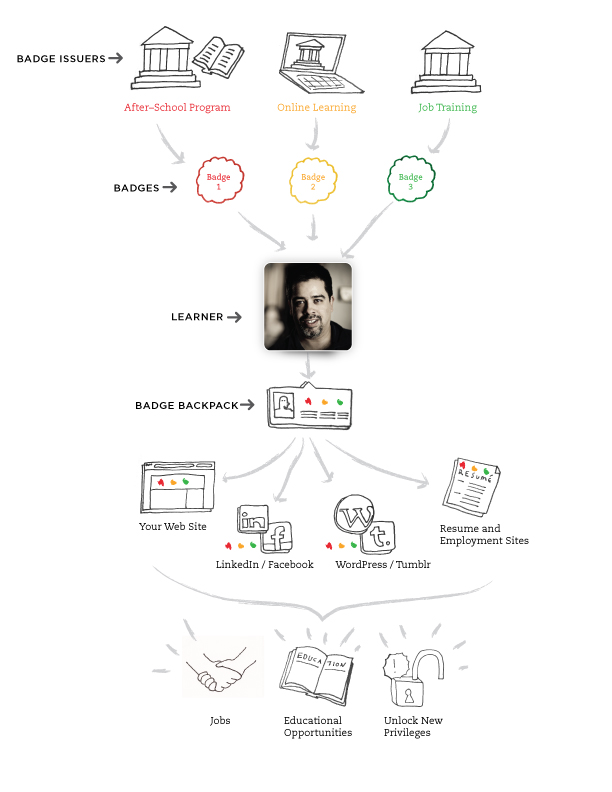
Here is a link to Mozilla’s Open Badge Project.  The idea here is that as technology puts increasing pressure on higher education, one of the results will be an unbundling of services, including those related to reputation and credentialing.I think you can see the logic here.  Skills can be unbundled and expressed via a vehicle like a badge, which is discrete, portable, understandable and able to be picked up at any place good at giving them out.  Under this model, there is no huge need for either of the current givens: one institution and a degree.  Students can pick up badges where they will, and whether they cohere into something called a degree fades in importance.

As Sir BH’s post might suggest, this kind of thing can work quite effectively in areas like software engineering, where unbundled descriptions–if reliable–can be helpful to employers is assessing a candidate’s qualifications.  Yeah yeah it doesn’t work as well in the liberal arts.  We have heard that all-purpose caveat before–e.g., “college is more than skill transfer; it is the whole experience.”  That is true enough, but only for the students for whom the whole experience is suitable and/or affordable.

Posted in Education | 5 Comments

Question Lady Question

The Question Lady writes:

When the temperature is soaring, what do you like to cook — or find you can cook for dinner?

Posted in Personal reflections | 6 Comments

City Sights: Arbor Gate to a Community Garden

Blowhard, Esq. writes:

An impressive specimen that I had to pass along.

Posted in Architecture, Photography | Tagged , | 4 Comments

Vacation, all I ever wanted…

Brundle Guy writes:

First of all, I must apologize. When I was asked to join this ragtag group of misfits and ne’er-do-wells I was frothing at the mouth to get some posts going, make a bunch of comments, start a few polite dust-ups and generally mix it up with you laudable lot. However, you’ll notice that after a couple of weeks being an active member, this is my first post. “What gives?” you may rightly be asking.

You must forgive me. I have sinned. I committed one of the most heinous and unforgivable acts a modern working man can. It shames me so much I can barely type out the words. I… I…

I went on vacation.

Brundle Gal and I spent four days, only two off from work, to go down to New Orleans, indulge in some hot, sticky weather, delectable food, amazing architecture, incredible jazz and generally have ourselves a time. Adding to our horrific societal crimes, we didn’t even bring a computer. There was nary a remote log-in or work email to be had. It was just the two of us, getting away from it all for a few days.

But don’t worry, I’m paying for these transgressions. I’ve had to work even longer and later upon my return, take more home and indulge in that only-half-joking office banter wherein coworkers say, through rictus grins, “Hope you had a good time, we missed you, it was so busy you can NEVER GO ON VACATION AGAIN.” In this world where everyone seems to be overworked, understaffed and pushed to extremes, taking a vacation can make a person feel like the imprisoned revolutionary who becomes the hangman’s assistant for an extra serving of gruel.

I’d like to know, when did “vacation” become a dirty word?

There’s a number of related topics I’d love to get into soon about the rise of management, real versus perceived work, and one of my biggest bugaboos of late, the inability people seem to have regarding assessing the actual value of things. But this post is already going to be WAY too long, and it’s getting late, so what I’d like to do now is put forth some of my own recent brushes with the demonization and eradication of personal time:

Brundle Gal got a promotion very recently, which is exciting and well-deserved. Part of that promotion, however, will be an official, company-issued i-phone so that she can NEVER EVER BE OUT OF REACH EVER. Not only that, it’s international travel capable, so she won’t even be able to duck away from work by escaping the country. She hasn’t been harnessed by that particular corporate yolk yet, but it looms, it looms.

My boss, a man at the top of his admittedly fairly marginalized field, just went on his first week-long vacation in ages a bit ago. We received emails from him every day. Another coworker who has been in the game for a couple decades now talks about vacation like it’s some kind of trap. “You go on vacation for too long, they realize they don’t need you.” And this guy has a kid. That kid may never get to take some awesome, week-long vacation with his dad because the old man is scared out of his mind that he may appear to be a bad worker.

Many of my coworkers get to the end of the year and find they have vacation days to burn, and for some of them that’s exactly what happens. Those days just burn away. They don’t get taken because everyone’s too busy, you can only carry over five days, and they’re certainly not going to put any additional unused days towards any bonuses or incentives. Just burned.

Finally, Fridays are our big work days, and the Friday my boss was on his vacation my coworker and I stayed very late. We put out the work fires that had to be completed, but continued to stay at work a couple hours longer to clean up a few other dilemmas and do some prep work for next week. While we were still there, well into the evening, our boss wrote us an email saying he’d been watching the work flow from his vacation spot. Our big work for the week was completed, he saw, so what were we doing still working in the office that late on a Friday night?

The irony, apparently, was entirely lost on him.

Posted in Personal reflections, Politics and Economics, The Good Life | Tagged , , | 2 Comments

No Resumes Allowed!

Sir Barken Hyena writes:

Media company IGN has a novel hiring practice: they take candidates without looking their resumes at all. This is the second year in a row that they’ve done this.

“The average age someone learns to code is 13.4, so why should we care what credentials they have?  We want to find people who are passionate about us, and look at their actual work – not their resume,” said Roy Bahat, President of IGN.

Many programmers coming straight out of college are surprisingly unready to do productive work. I’ve watched some struggle their first year of employment doing what are pretty simple projects. They get there usually, but one wonders what they did for 4 years getting their degree. You could argue that we need changes in the way it’s taught, but why not just go around the whole system?

IGN kicks off second year of successful Code-Foo Program

Posted in Personal reflections | Tagged | 6 Comments

Quote of the Day

Blowhard, Esq. writes:

Ira Glass on why he hates dream sequences: “I hate symbolism…I’m against symbolism…I feel like symbolism comes out of English-class thinking that has no place in our entertainment.”

Interview is here. Glass’s comments are around the 33:00 mark.

Posted in Movies | Tagged , , | 9 Comments