
The Question Lady writes:
How do you decide what charity/Kickstarter project/social cause to donate to?
The Question Lady writes:
How do you decide what charity/Kickstarter project/social cause to donate to?
Sir Barken Hyena writes:
I heard this report this morning, about statistics for charitable giving derived from IRS filings. The finding is the religious give more than the non-religious. Utah is the most giving state, New Hampshire the least.
But also well established is that Republicans give many times more then Democrats. The NPR story makes no mention at all of the political dimension. The words “Democrat” & “Republican” do not appear in the story. But why should they? Because the study’s author addresses this in the study. So the NPR reporters knew about it, and left it out. I’m going to go out on a limb and suggest this was done for reasons of political bias. All the news you can lose!
Study Reveals The Geography of Charitable Giving
Huffington Post is more honest, at least mentioning this angle before sweeping it under the rug. Huff Post sez:
“The study also found that patterns of charitable giving are colored in political reds and blues.
Of the 10 least generous states, nine voted for Democrat Barack Obama for president in the last election. By contrast, of the 10 most generous states, eight voted for Republican John McCain.”
Religion And Giving: More Religious States Give More To Charity
George Will wrote about it years ago: Conservatives More Liberal Givers
Sir Barken Hyena writes:
Dear Blowhard, Esq.,
I see from your reading list that you read The Black Swan. Interesting book, to say the least. It’s a bit of a mess too. The second, more involved section could have used some pruning. Also, it’s a literary book, as he states, rather than an analytical one, a difference that seems to have tripped up a lot of readers. In this respect it’s also only partly successful, but never mind. He pulls some mighty fat and original rabbits out of his hat, for which I can forgive a lot. So I’d measure it by the areas of the mind it opens up rather than the answers he has.
His overarching points converge on my favorite subject: the increasing harm of technocratic approaches to solving the problems of the world. This is such a broad phenomenon, touching all phases of culture, society and government that it’s importance can hardly be overstated in my mind. Taleb focuses on Finance and Academia but I found resonance with what he said in the arts as well. Technocracy has become a roadblock between us and our future, whatever that might be. Let’s say it together: the world is not a machine!
I’m curious to hear what your thoughts on the book.
The Question Lady writes:
What’s the worst public behavior you’ve recently witnessed?
Paleo Retiree writes:
Blowhard, Esq. writes:
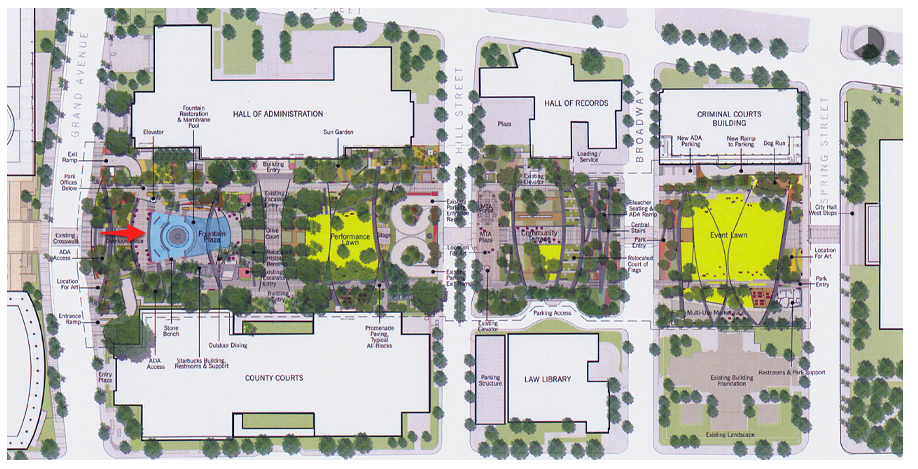
When the guys at the office don’t care if we win or lose, I’m sent downtown to make court appearances. One of the perks of going — besides getting out of the office — is the chance to see L.A.’s new Grand Park.

Here’s a map of the project, with the arrow showing the location where this picture was taken.
 Last time I was there I didn’t have enough time to take many pics, but when I get a chance I’ll put together a montage to give you a better sense of the area.
Blowhard, Esq. writes:
As a follow-up to Paleo Retiree’s post, I put together my own montage of multistage entryways from my neighborhood. As you can see, some are more charming and inviting than others.

A quote from A Pattern Language:
While people are on the street, they adopt a style of “street behavior.” When they come into a house they naturally want to get rid of this street behavior and settle down completely into the more intimate spirit appropriate to the home. But it seems likely that they cannot do this unless there is a transition from one to the other which help them to lose the street behavior. The transition must, in the effect, destroy the momentum of closedness, tension and “distance” which are appropriate to street behavior, before people can relax completely.
Blowhard, Esq. writes:
Looking at the site stats, I couldn’t help but be pleased that we’re getting hits (albeit very, very modest ones) from such far-flung and exotic locals as France, Malaysia, Israel, Belgium, and Denmark. Even more impressive, our Danish readers were nice enough to send along a picture of them waiting in eager anticipation for another of our posts:

UR: Doing our best to foster friendly international relations.
The Question Lady writes:
Is there an athlete you identify with? If so, who and why?
Sir Barken Hyena writes:
This is a post that could go on forever, but I just want to highlight a certain trend I’m seeing: economists arguing like complete retards. I’m talking to you, Bryan Caplan, but you’ve got lots of company.
The argument is over why Americans give so little as charity to the Federal government. Theories are proposed: they’re selfish, or they think it’ll be wasted. It’s all very theoretical and technical. But this point is never made:
Because the government already forcibly takes a third of our incomes. Duh.
There, see how easy that is? It’s called thinking like a normal human who lives in the actual world, instead of being an autistic stuck in an aquarium of your own making.
To be fair, Caplan does have some interesting things to say, but jeez man, get a grip already.
 Blowhard, Esq.
 Callowman
 Sherbrooke
 Eddie Pensier
 Enzo Nakamura
 Epaminondas
 Fabrizio del Wrongo
 Fenster
 Brundle Guy
 Glynn Marshes
 Paleo Retiree
 Atypical Neurotic
 Question Lady
 Sax von Stroheim
 Sir Barken Hyena
 The Mistaken
 Uncouth Reflections