
Paleo Retiree writes:

Fabrizio del Wrongo writes:

Susann’s photographers like to shoot her against mountains, waterfalls, and other natural wonders. Her bod justifies such surroundings: It’s spectacular in a way that’s topographical.
She’s supposedly German, but to my eye she’s got some Czech in her; I wouldn’t be surprised if she’s from the Tyrol. Or maybe my mind’s been polluted by the Alpine associations of her portfolio…
Her nose is a tad severe, no? Somehow that augments her Artemesian affect.
Nudity below. Have a great weekend.
Fabrizio del Wrongo writes:

In “Rocco,” sex performer Rocco Siffredi presents himself as a porno Man of Sorrows. The camera ruefully venerates him, as do the young women he “breaks” on camera. The picture opens with a languorous close-up of Rocco’s flaccid cock. Huge and somehow glowing, the organ has mystical presence, and Rocco talks about it in careful phrases. It’s a cross, an Excalibur — a totem charged with ambivalent meaning. It gets Rocco into trouble, but it saves him, too. When, according to a story he tells on camera, he visited the aged friend of his recently deceased mamma (like all Italian men, Rocco adores his mamma), he was lost for words. Then he pulled out his cock and let her suck it until he climaxed. For Rocco the encounter is a kind of sacrament — a physical act with metaphysical implications. How better to commemorate mamma?
Directors Thierry Demaizière and Alban Teurlai foreground the profane and intentionally muddle it with the sacred. Their Rocco fucks to expiate our sins. By doing so he saves us from the ordeal of acting out our darkest fantasies, perhaps screwing them up in the process. Like Catholic penitents, the featured performers seek absolution through flagellation. One young starlet encourages Rocco to stick his fist into her mouth. He obliges her, then tenderly compliments her on the resulting tears. Another, the doll-like Casey Calvert, proudly shows Rocco a photo of her back; it’s been bloodily marred by a ten-foot bullwhip. She says it was taken before she got into porn. Even then, she yearned to suffer. There’s a canned, reality-TV aspect to all of this, yet that unmediated, putting-yourself-on-display quality is essential to the movie’s impact, perhaps because it’s about the act of offering oneself up for sacrifice.
Rocco himself is a fascinating camera subject. Grave but also serene, his large eyes are sympathetic and all-consuming, like the eyes of an icon. It’s not hard to understand why art-film director Catherine Breillat cast him in two movies. In those movies Breillat, like Demaizière and Teurlai, views the actor through a halo of religiosity. “When I looked at Rocco in the eye,” confesses Breillat, “then I felt that I was looking into my sister’s eye. There was this loss of identity and a transcendence in that identification … I never felt myself transposed as much into a body of a man as I did with Rocco.”
“Rocco” goes a bit sour when it pulls in a British woman whom the directors allow to babble about empowerment (this feels like an attempt to preempt criticism), and I think their decision to literalize the crucifixion theme is more dopey than daring. But for much of its running time “Rocco” is a bracingly physical take on sex, performance, and heightened states like ecstasy and suffering. Let’s hope its subject doesn’t get Weinsteined in the near future.
Fabrizio del Wrongo writes:
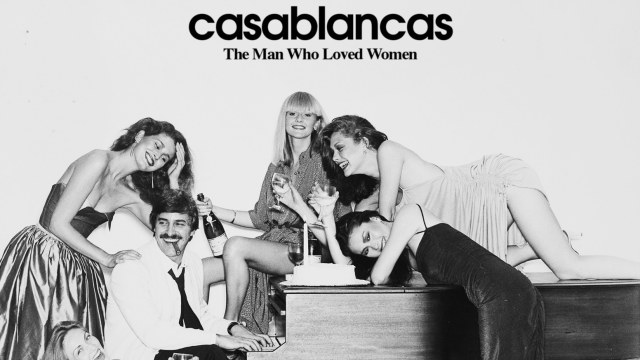
I liked Hubert Woroniecki’s documentary on Elite Modeling kingpin John Casablancas, particularly the subject’s reflections on life, beauty, sex, and leisure. It’s based on voice recordings Casablancas made prior to his death, so it’s a bit like a visual memoir. Casablancas is a public figure of a type that seems to have all but vanished from the culture — the genial European (or quasi-European) roué who loves women, prides himself on knowing and pleasing them, and isn’t ashamed to be frank about it. (He reminds me of filmmaker Roger Vadim.) It’s a measure of either Casablancas’ charm or his good-naturedness that he never comes across as boasting, crude, or insincere; when he talks of having his heart broken by the 15-year-old Stephanie Seymour, you don’t just believe him, you feel bad for him. Of course, it ends with a Strokes song: “Is This It?” It’s called “Casablancas: The Man Who Loved Women.”
I thought of the movie, and of Casablancas, upon reading Camille Paglia’s shrewd thoughts on Hugh Hefner, published by the Hollywood Reporter soon after Hef’s passing. Says Paglia:
Hefner reimagined the American male as a connoisseur in the continental manner, a man who enjoyed all the fine pleasures of life, including sex. Hefner brilliantly put sex into a continuum of appreciative response to jazz, to art, to ideas, to fine food. This was something brand new. Enjoying fine cuisine had always been considered unmanly in America. Hefner updated and revitalized the image of the British gentleman, a man of leisure who is deft at conversation — in which American men have never distinguished themselves — and the art of seduction, which was a sport refined by the French.
I think her comments are spot on. Hefner, like Casablancas, was a man who cultivated a capacity for appreciating the good life. He encouraged others to do likewise. Few callings are more noble.
Paleo Retiree writes:
Fabrizio del Wrongo writes:
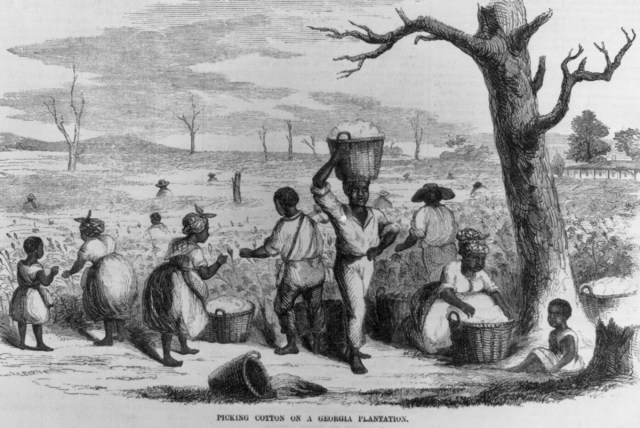
The city of Savannah abounds in parks, as they are called—squares, fenced in, with trees. Young children and infants were there, with very respectable colored nurses—young women, with bandanna and plaid cambric turbans, and superior in genteel appearance to any similar class, as a whole, in any of our cities. They could not be slaves. Are they slaves? “Certainly,” says the friend at your side; “they each belong to some master or mistress.”
In behalf of a score of mothers of my acquaintance, and of some fathers, I looked with covetous feelings upon the relation which I saw existed between these nurses and children. These women seemed not to have the air and manner of hirelings in the care and treatment of the children; their conversation with them, the degree of seemingly maternal feeling which was infused into their whole deportment, could not fail to strike a casual observer.
Then these are slaves. Their care of the children, even if it be slave labor, is certainly equal to that which is free.
“But that was a freeman who just passed us?”
“No; he is Mr. W.’s servant, near us.”
“He a slave?” Such a rhetorical lifting of the arm, such a line of grace as the band described in descending easily from the hat to the side, such a glow of good feeling on recognizing neighbor B., with a supplementary act of respect to the stranger with him, were wholly foreign from my notions of a slave. “Where are your real slaves, such as we read of?”
“These are about a fair sample.”
“But they seem to me like your best quotations of cotton; where are your ‘ord., mid, fair to fair, damaged, and poor’?”
Our fancies with regard to the condition of the slaves proceed from our northern repugnance to slavery, stimulated by many things that we read. The every-day life, the whole picture of society at the south, is not presented to us so frequently—indeed it cannot be, nor can it strike the mind as strongly—as slave auctions and separations of families, fugitives hiding in dismal swamps, and other things which appeal to our sensibilities. Whatever else may be true of slavery, these things, we say, are indisputable; and they furnish materials for the fancy to build into a world of woe.
Without supposing that I had yet seen slavery, it was nevertheless true that a load was lifted from my mind by the first superficial look at the slaves in the city.
It was as though I had been let down by necessity into a cavern which I had peopled with disagreeable sights, and, on reaching bottom, found daylight streaming in, and the place cheerful.
A better-looking, happier, more courteous set of people I had never seen, than those colored men, women, and children whom I met the first few days of my stay in Savannah. It had a singular effect on my spirits. They all seemed glad to see me. I was tempted with some vain feelings, as though they meant to pay me some special respect. It was all the more grateful, because for months sickness and death had covered almost every thing, even the faces of friends at home, with sadness to my eye, and my spirits had drooped. But to be met and accosted with such extremely civil, benevolent looks, to see so many faces break into pleasant smiles in going by, made one feel that he was not alone in the world, even in a land of strangers.
How such unaffected politeness could have been learned under the lash I did not understand. It conflicted with my notions of slavery. I could not have dreamed that these people had been “down trodden,” “their very manhood crushed out of them,” “the galling yoke of slavery breaking every human feeling, and reducing, them to the level of brutes.” It was one of the pleasures of taking a walk to be greeted by all my colored friends. I felt that I had taken a whole new race of my fellow-men by the hand. I took care to notice each of them, and get his full smile and salutation; many a time I would gladly have stopped and paid a good price for a certain “good morning,” courtesy, and bow; it was worth more than gold; its charm consisted in its being unbought, unconstrained, for I was an entire stranger. Timidity, a feeling of necessity, the leer of obliged deference, I nowhere saw; but the artless, free, and easy manner which burdened spirits never wear. It was difficult to pass the colored people in the streets without a smile awakened by the magnetism of their smiles. Let any one at the north, afflicted with depression of spirits, drop down among these negroes, walk these streets, form a passing acquaintance with some of them, and unless he is a hopeless case, he will find himself in moods of cheerfulness never awakened surely by the countenances of the whites in any strange place. Involuntary servitude did not present itself to my eye or thoughts during the two weeks which I spent in Savannah, except as I read advertisements in the papers of slaves for sale.
How the appearance of the colored people in villages and plantation districts would compare with that of city household servants, was a question which was reserved for future observation.
— Nehemiah Adams, 1854
— Gualtiero Jacopetti and Franco Prosperi, 1971
Fabrizio del Wongo writes:

According to internet sources, Czech model Luisa Rossellini waited until she was almost 30 to pose nude. Judging by her roots and certain other details, I believe her natural hair color is lighter than what she typically wears. I wonder if she dyes it in an effort to create a contrast with her blue eyes, which are almost as striking as those of her countrywoman Kyla Cole.
Of course, the boobs are rather striking too — especially on such a slim woman. Shot full-length and wearing heels, she cuts a dramatic figure.
Her real name appears to be Terezka Dvorakova. According to IMDb, she was engaged or married at one time to Czech politician Michael Hvizdala. Here’s a shot of the two together.
Nudity below. Enjoy the weekend.
Fenster writes:
Political types can be classified as either hedgehogs or foxes, with the fox knowing many things and the hedgehog knowing one big thing. Bret Stephens says John McCain is a hedgehog, and admires him for the knowing one big thing: honor. Stephen’s contrasting animal, however, is not a fox but the famed honey badger, the animal that just doesn’t give a sh*t. And according to Stephens Steve Bannon is the honey badger, and he is not a fan.
Well, here’s one thing McCain knows: whether POWs were left behind in Vietnam after the war.
There has long been a belief in some quarters that he was part of a sustained effort by the US government to cover up the fact that POWs remained behind, and to belittle and attack anyone who said otherwise.
Here is a very long piece by Sdney Schanberg supporting that view. It was run at the time McCain ran for president and was re-run recently at the Unz Review. Schanberg, who died in 2016, was no conspiracy nut. He was the New York Times reporter who did the Pulitizer winning story on the killing fields in Cambodia. Left the Times after his column there was cancelled, this following his criticism of the proposed Westway highway project.
This is what happens to great investigative reporters. They get awards until they come across something that is really troublesome and then they find themselves without a regular by-line.
Another: Seymour Hersh is the legendary Times reporter who unearthed the My Lai massacre. There’s a recent recording of him saying that authoritative sources told him that Seth Rich, the DNC staffer who was murdered, tried to pass along emails from the DNC to Wikileaks. These are the emails that Russia allegedly stole, and that form the basis for the collusion charges against Trump. The counter-theory has been that Russia didn’t steal them and the disclosure was an inside job–possibly involving Rich. You would think the press might be curious about a Hersh’s inquiries, to the extent that might shed light on the Russia collusion story. Any interest? No. Hersch no longer works at the Times.
Then there’s Julian Assange at Wikileaks his self. A darling of the left until recently. Hillary and the intelligence community now say he is in bed with the Russians and his stuff can’t be trusted. Congress is trying to designate Wikileaks as a hostile state power when it is in effect acting as an organ of the press, publishing information it gets from others, even if the material was classified. You know, like the Pentagon Papers. People I know on the left now nod their heads in approval: Assange now a very very very bad man.
On the other hand we have Brian Ross, ABC News’ “Chief Investigative Correspondent”. He’s a big success! He was on the news just last night. He started his piece by saying that no, the Russia story has not gone away. I thought maybe that meant he was going to discuss the Clinton/Obama/Mueller uranium deal that is in the news. But no, ABC passed on covering that one. Instead Ross described a rap video that was allegedly funded by a Russian troll farm. The rap artist who did it had no knowledge of the Russian funding and the video he produced had no political edge. It appeared to be the kind of video that ABC News would find unobjectionable, or even laudatory, were it not for the fact that it was allegedly funded by Russians for the purpose of sowing discord.
Ross concluded by pointing out to David Muir that we have elections coming up and incredibly we still have no “national strategy” for how to deal with this Russian threat. The Russians truly were up to no good on the uranium deal but that was Obama and Clinton. But that’s old news. So let’s find someone to blame–I wonder who?–for the fact that we have no “national strategy” for dealing with the rap video menace.
Schanberg dead.
Hersch on the outs.
Assange discredited and in new legal trouble.
Brian Ross on the nightly news.
Suck ups win.
Blowhard, Esq. writes:
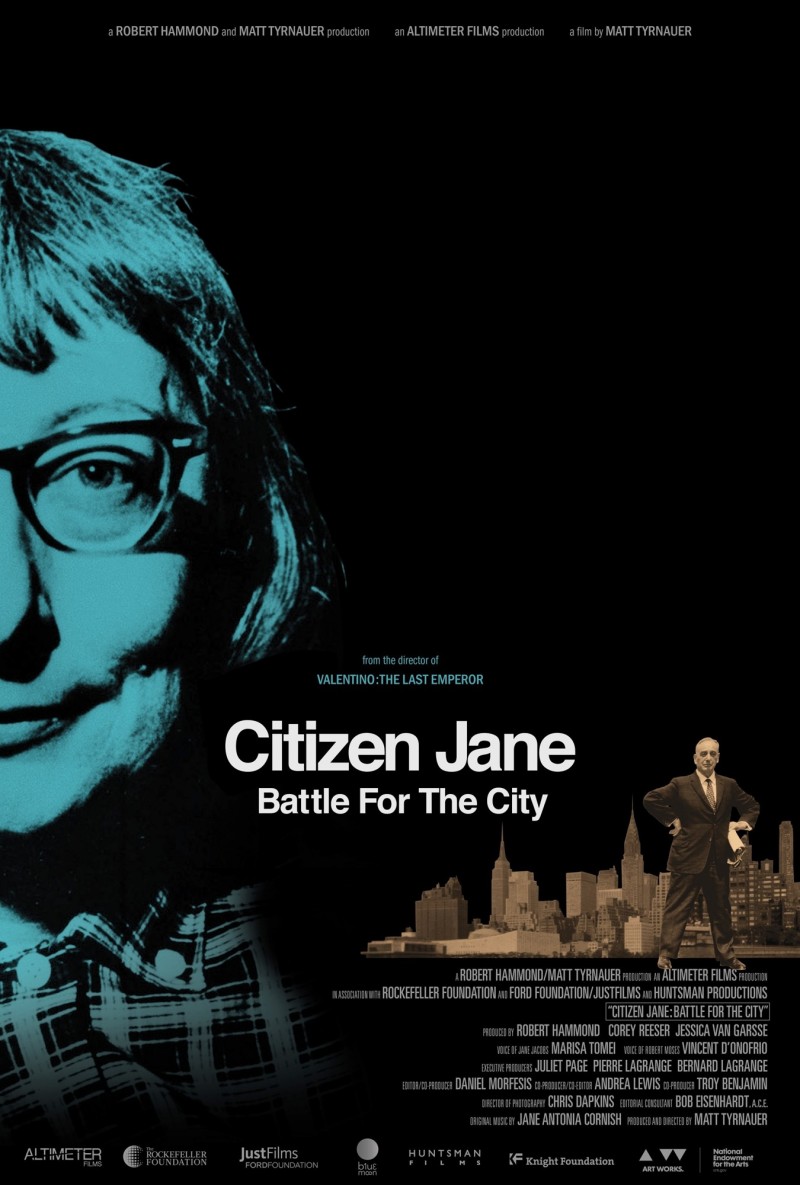 As the full title implies, director Matt Tyrnauer‘s documentary profile of writer and urban theorist Jane Jacobs frames her story in terms of confrontation. In this corner we have politician Robert Moses, the power broker of post-World War II New York City who believed that master planning and audacious engineering could solve the city’s problems. Moses’s projects — including the 1938 and 1964 World’s Fairs, the Cross Bronx Expressway, Jones Beach, Lincoln Center, and Verrazano Bridge — have left an indelible mark on the city. In the other corner, in contrast to Moses’s top-down, colossus-bestriding-the-city modernism, we have the proletarian humanism of Jane Jacobs. Jacobs pulled city planning down to earth by taking a bottom-up, human-centered approach that emphasized the spontaneous order of how every day people interact with and shape the built environment. Not one to shy away from a fight, she famously opened her 1961 masterwork, The Death and Life of Great American Cities, with a shot across the bow at Moses and his ilk: “This book is an attack on current city planning and rebuilding.” The Jacobs v. Moses fight is a great David v. Goliath story but, in bowing to current political trends, Tyrnauer diminishes Jacobs and her ideas.
Tyrnauer’s film sees Jacobs through the lens of political activism. At various times, the documentary touts her as a woman making her way in a man’s world, a champion of diversity, and a feminist/progressive pioneer in line with other contemporaries like Betty Friedan and Rachel Carson. The spine of the movie is Jacobs’s successful protest of two Moses projects: Washington Square Highway, which would’ve connected Fifth Avenue to West Broadway, thereby destroying Washington Square Park by cutting it in half and the Lower Manhattan Expressway, a highway that would’ve connected the Holland Tunnel to the Williamsburg Bridge by plowing through SoHo and Little Italy. Jacobs participated in two grassroots community campaigns that successfully stopped both projects and, sure, those are accomplishments that anyone can be proud of. But protest isn’t what made Jacobs Jacobs. She wasn’t motivated by feminism, a love of racial diversity, or social justice. She was motivated by her urbanist ideas that she wrote about in a 600-page book.
Although some of Jacobs’s ideas are addressed, the movie does so in a predictably perfunctory way. Take the illustration of her famous “eyes on the street” insight. The movie simply asserts that a traditional, mixed-use Manhattan street is safer than a similar space in a public housing high-rise courtyard because more people are present to watch out for one another. But what elements make the traditional Manhattan street more likely to attract people than the high-rise courtyard? After all, don’t plenty of people live in high-rise projects and don’t they have eyes too? Why are people more likely to linger in one area and not another? What precise characteristics distinguish the Jacobs city from the Moses city? Watching this movie, you’d never know that Jacobs spends almost 100 pages of her book talking about sidewalks. (Tyrnauer’s lack of interest in any substantive ideas extends to his talking heads. Paul Goldberger, James Howard Kuntsler, Mike Davis and others appear on screen and all of them end up sounding the same, which is odd, because I’m guessing that Goldberger, Kuntsler, and Davis don’t agree about much.)
In case you think that I’m exaggerating Tyrnauer’s POV, he stated it explicitly:
Jacobs was fearless in speaking truth to power, the model of a citizen soldier. Her story resonates today, as we are faced with a president—an international developer, no less, of luxury towers—who throws around the terms ‘urban renewal’ and ‘American carnage.’ The film can be seen as a playbook for people who want to defend vulnerable minority communities everywhere…
Jacobs was committed to defending diversity, but she had nothing to say about the racial kind. Part Two of Death and Life concerns the “conditions for city diversity” and Jacobs spends over 100 pages spread across six chapters talking about the need for mixed primary uses, the need for small blocks, the need for aged buildings, and the need for a concentration of people. Also, Tyrnauer praising “speaking truth to power” bit is funny when you consider that his film was financed by a grant from the Rockefeller Foundation. After two failures due to Jacobs’s protests, a politically weakened Moses was finally fired by a brave politician. That heroic white knight? Nelson Rockefeller. The documentary respectfully omits that Nelson’s brother David was the guiding force behind the Moses-like World Trade Center project that destroyed a thriving neighborhood of mom-and-pop businesses. When she wrote Death and Life the Rockefeller-backed WTC plan was only a proposal, but Jacobs spent a few pages in Chapter 8 of her book attacking it:
The business and financial interests represented in lower Manhattan have for several years, in cooperation with the city, been working hard at preparing plans and starting work to regenerate this area. They have proceeded according to orthodox planning beliefs and principals. …
Lower Manhattan is in really serious trouble, and the routine reasoning and remedies of orthodox planning merely compound the trouble. What could be done to ameliorate effectively the district’s extreme time imbalance of users, which is the root of its trouble?
…And finally, this new use (or uses) ought to be in accord with the district’s character, certainly not at cross-purposes to it. It is the character of lower Manhattan to be intensive, to be exciting, to be dramatic, and this is one of its greatest assets. What is more dramatic, even romantic, than the tumbled towers of lower Manhattan, rising suddenly to the clouds like a magic castle girded by water. Its very touch of jumbled jaggedness, its towering-sided canyons, are its magnificence. What vandalism it would represent (what vandalism the present project plans represent!) to dilute this magnificent city presence with the humdrum and the regimented.
Far more significant is that Death and Life itself was the product of a Rockefeller Foundation grant. Was Jacobs, who got her career started writing propaganda for the Office of War Information, controlled opposition? And how important were her connections when it came to facing off against Moses?
Whatever the case may be, the movie got me thinking about Jacobs’s legacy. Although Death and Life is revered in architecture and urbanist circles, how much actual impact has it had on our built environment? She certainly influenced the New Urbanist movement, but they’ve had a very limited (and very controversial) effect. Although her object was to take down the architectural orthodoxy, she may have defeated Moses the man but Moses-like thinking still abounds in architecture and city planning. The starchitect — the bold visionary who will transform how the plebs live, if only they’ll conform to his/her vision — is the reigning conception of how we understand architects. If you don’t believe me, just watch the Bjarke Ingels episode of the Netflix series “Abstract,” where every line of fortune cookie gibberish that comes out of Ingels’s mouth is treated like a profound insight.
Jacobs, who died in 2006, was herself incorrect about her legacy. After Death and Life she wrote six more books which mainly focused on economics. “If I were to be remembered as a really important thinker of the century, the most important thing I’ve contributed is my discussion of what makes economic expansion happen. This is something that has puzzled people always. I think I’ve figured out what it is,” she said. Her economic ideas have been discredited across the orthodox spectrum which, depending on your perspective, may or may not be a point in her favor.
Related

 Blowhard, Esq.
 Callowman
 Sherbrooke
 Eddie Pensier
 Enzo Nakamura
 Epaminondas
 Fabrizio del Wrongo
 Fenster
 Brundle Guy
 Glynn Marshes
 Paleo Retiree
 Atypical Neurotic
 Question Lady
 Sax von Stroheim
 Sir Barken Hyena
 The Mistaken
 Uncouth Reflections


