Architecture and Color

Paleo Retiree writes:
Posted in Architecture | Tagged | 1 Comment

Notes on Stephen Hicks’s “Explaining Postmodernism”

The Mistaken writes:

Explaining Postmodernism is the clearest book I’ve read on postmodern theory and how it fits into our current political climate. Stephen Hicks is a professor of philosophy at Rockford University in Illinois, with a PhD in Philosophy from Indiana University. He is or has been affiliated with the Objectivist Center and is currently director of the Center for Ethics and Entrepreneurship at Rockford. He’s pro-business, pro-capitalism, and sympathetic to classical liberalism, the Enlightenment, and modernism.

More importantly, Hicks hates postmodernism. This makes him ideally suited to write a book trying to explain it. Almost every other book on the topic is written either by postmodernists in their typical, obfuscatory, jargon-laden, aren’t-we-clever style or by Marxists, who like some aspects of postmodernism but dislike a lot of it because it isn’t Marxist enough.

Hick’s main thesis is simple, as expressed in this meme:
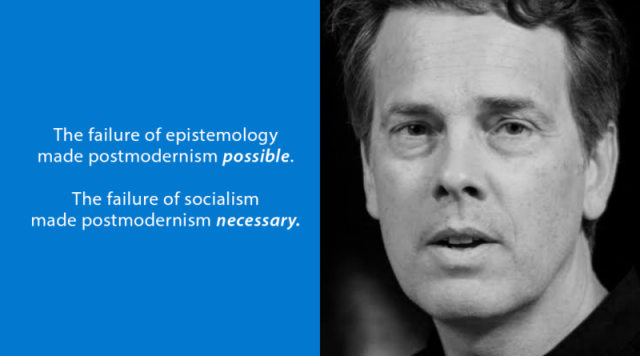
Pomo-meme-800x445
The book is wide ranging. It starts from a description of where we are now and how generally insane postmodernism is, then turns to intellectual history with a discussion of the Counter-Enlightenment and its challenges to realist epistemology. It then discusses post-Enlightenment philosophers from Hegel to Nietzsche to Heidegger and how they built on this Counter-Enlightenment current.

This current is broad and has a number of variants which Hicks describes for a few chapters. He then detours a bit by discussing the overlap between what he calls collectivist right and collectivist left thinkers. He then gets back to his laser focus on leftist intellectual history, which he decimates. Finally he turns to the postmodernists themselves, and their immediate precedents, such as the Frankfurt School, and reduces it all to a smoldering pile of ashes. Intellectually, that is. Because like it or not, the postmodernists are winning, and Hicks knows it.

Though clearly written, his argument is complex, so I’ll take it point by point:
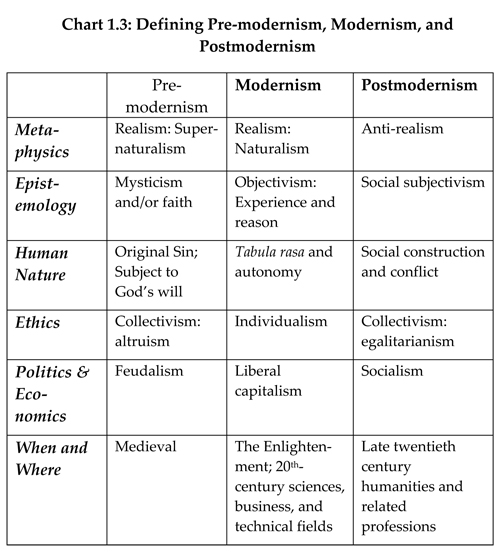
  1. We are in a postmodern age now, because postmodernism is the main intellectual movement of our time, replacing modernism.
  2. Postmodernism is opposed to universal truths and “universal necessities” including Reason, Truth, or Knowledge.
  3. Most postmodernists are expressly political – they “deconstruct reasons, truth, and reality because they believe that in the name of reason, truth, and reality Western civilization has wrought dominance, oppression, and destruction.” They want to “exercise power for the purpose of social change.” Males, whites, and the rich have more power and thus are targets.
  4. Metaphysically, postmodernism is anti-realist, stating that it is impossible to speak about an independently existing reality. (Of course they contradict this all the time by complaining about an independently existing reality of mean old white men who are probably all in the Klan, but I digress.)
  5. Epistemologically, reality is assumed to be socio-linguistically constructed. Reason doesn’t arrive at reality.
  6. Postmodernism is collectivist. Groups are more important than individuals. Individuals are collectively (socially) constructed based on the groups they are part of and these groups are often/usually in conflict.
  7. The ethics and politics of postmodernism side with groups perceived as oppressed, unless they are white, male, etc.
  8. Postmodernism’s essentials are the opposite of modernism (i.e. Enlightenment thought and science) and also differ from pre-modern positions.
  9. Postmodernism has its roots in the battle between the Enlightenment and the Counter-Enlightenment. This starts with Kant. Kant said that objectivity doesn’t work because empiricism goes through our senses and puts an obstacle between reality and reason – our internal representations and concepts. Of course we have senses. But Kant says the existence of senses and their identity means they are obstacles to direct consciousness of reality.  So the blow to the Enlightenment came from two sources: Senses cut off reason from direct access to reality, and concepts seem irrelevant to reality or limited to contingent truths. Long story short – the “reality” we can study is merely in our brains. This is the Kantian position.  Much of modern philosophy stems from this. (My apologies if I’ve oversimplified this part. Hicks writes an entire chapter about it, but I’m not a philosopher, and am fine with just dismissing Kant and moving on.)
  10. After Kant the Counter-Enlightenment continued with philosophical approaches such as structuralism – a linguistic version in which everything (and thus reality) is about language. Another Counter-Enlightenment stream would be phenomenology, in which we try to avoid assumptions and describe reality as objectively as possible or bracket our opinions to “get to the thing itself” as Husserl might say.
  11. There is a fairly long discussion of Hegel, which seemed somewhat unnecessary. Essentially Hicks describes Hegel as stating that the subject doesn’t respond to external reality, the whole of reality is created by the subject. Furthermore, for Hegel, there are always contradictions in reality, which makes truth relative to time and place. The collective, rather than the individual, is what is important.
  12. Then came Nietzsche and the irrationalists who agree with Kant that reason is unable to know reality, agree with Hegel that reality is conflicted/absurd, conclude that reason is trumped by claims based on feeling, instinct, or leaps of faith. The non-rational and irrational yield deep truths about reality.
  13. With Heidegger we reach metaphysical nihilism. Hicks says Heidegger prefigures postmodernism by integrating speculative metaphysical conjecture with irrational epistemological streams. For Heidegger, the entire Western tradition – whether Platonic, Aristotelian, Lockean, or Cartesian – is based on subject/objection distinction and non-contradiction and must be overcome.
  14. Getting back to the postmodernists, they later adopted much of Heidegger but removed the metaphysics and mysticism (the best part) from Heidegger’s philosophy. Postmodernists are anti-realist: they say it is meaningless to speak of truth. Postmodernists then compromise between Heidegger and Nietzsche by incorporating Heidegger’s epistemological rejection of reason while elevating Nietzsche’s power struggle over Heidegger’s metaphysical quest for Being.
  15. This leads finally to Hicks’s FIRST THESIS: Postmodernism is the end result of Kantian epistemology and its Counter-Enlightenment. Postmodernism is the first synthesis of these trends: metaphysical antirealism, epistemological subjectivity, feeling as the root value of all ethics, relativism, and devaluing of science. From this, postmodernists just follow their feelings, as pre-moderns followed their traditions (and religions). But postmodern feelings are primarily rage, power, guilt, lust, and dread.
  16. Because of the dominant importance of social constructionism, independent individuals are not in charge of these feelings. Identities are the result of group membership: racial, sexual, economic, ethnic. And all will be in conflict.
  17. There is an enormous problem, which leads to Hicks’s SECOND THESIS: Postmodernism can’t only be about epistemology and anti-realism, because postmodernists are always Leftists. Also postmodern rhetoric is very harsh, melds with political correctness, and currently is best exemplified by the non-stop effort to call everyone they don’t like a “racist”, “sexist”, “bigot”, “white nationalist”, and eventually “Nazi.” The final argument is basically just ad hominem. Why?
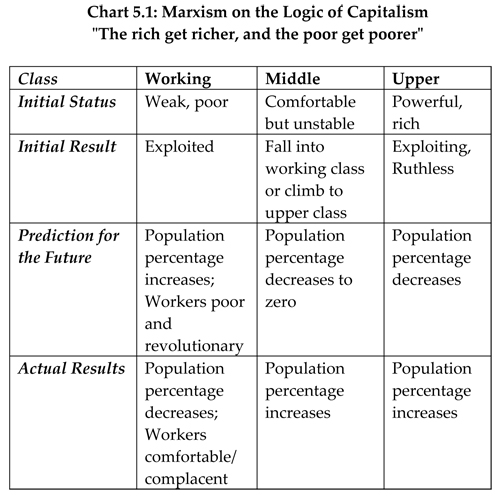
  18. Hicks’s explanation is this: Marxism was initially modernist and made four main testable scientific claims about how capitalism would collapse and be replaced with communism. Each was eventually refuted. In real countries with real economies, classical liberalism (or some variant of it) won. This chart shows the Marxist predictions v. the actual results.
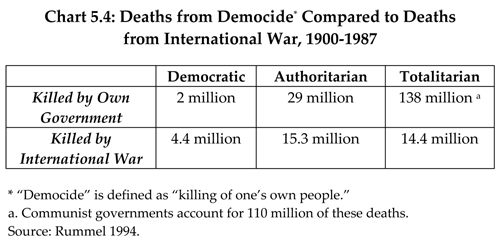
  19. Hicks states that the empirical evidence is strongly against socialism working anywhere with any kind of good long-term results. Capitalism led to better living conditions while no socialist experiment has worked, and most or all have been totalitarian and include widespread slaughter of their own population, as depicted in this chart.
  20. This leads to Hicks’s MAJOR HYPOTHESIS: “Postmodernism is the academic far left’s epistemological strategy for responding to the crisis caused by the failures of socialism in theory and practice.” Basically, the Left wanted socialism to work. It didn’t. Because of that they abandoned facts and went with feelings. Sound familiar?
  21. Hicks goes on a long tangent against collectivism in all of its forms, which he traces to Rousseau, then to left and right branches. The right branch is primarily German and goes through Herder eventually into National Socialism. This part of the book was interesting in making explicit links between socialism and Nazism, and people who like to argue about whether Nazism is leftist or rightist should read it, but I found it mainly irrelevant to the major theses of the book. I think it is clear that Hicks is not a fan of nationalism. But if you are, don’t let that deter you since his absolutely savage attack on the Left is worth reading no matter what.
  22. Hicks demolishes socialism in Chapter 5 which is, quite frankly, fantastic. Marxism’s main two arguments were: 1) Economically, capitalism would eventually fall apart because socialism was more efficient. It turns out it wasn’t and Hicks presents a bit of data to prove it. 2) Morally, capitalism is evil and socialism is good. Marxists thought capitalism would collapse because of exploitation and oppression of workers would lead to revolution. But it didn’t. Because capitalism isn’t inherently evil, and socialism isn’t inherently good. Duh.
  23. By the 1950s, Lenin’s theory of imperialism – that the misery of capitalism and oppression would essentially be off-shored to the Third World, one of the more reasonable parts of Marxist theory in my view – also started looking wrong. Third World countries that had adopted capitalism earliest seemed to be doing better than those that hadn’t.
  24. By 1956, socialism only had the moral case left because the economic case has been destroyed by facts. Then the USSR crushed the Hungarian revolution and Stalin’s crimes were exposed. Now, much of the moral case was destroyed too.
  25. In reaction, communists and socialists then put their faith in Mao, but soon his crimes surfaced as well.
  26. So the Left was in a profound crisis.
  27. Since the Left had now utterly failed in practice everywhere, they tried anew. Their new strategies split them into camps and changed some basic underlying Marxist assumptions in four ways: First, they shifted from a focus on need to a focus on equality. The original idea had been not to leave people in dire need. Now it was to “make everyone equal.” For instance, the socialist German government began splitting large businesses up to make them “more equal” in size. Also, rather than focusing on absolute poverty, Leftists began focusing on relative poverty, i.e. making sure rich people didn’t get too rich. Second, the growth of identity politics. Instead of focusing on “the poor” or working class, focus shifted to minorities, women, homosexuals, etc. Again, Leftists refocused not on absolute conditions, but relative conditions. This is still all about equality, i.e. gay marriage is based on a relative equalization of conditions, rather than an absolute need. Third, a change in ethos from “wealth is good” to “wealth is bad” and concomitant focus on how consumerism is making the proletariat non-revolutionary. This stems mainly from Marcuse and the Frankfurt School. Fourth, radical left environmentalism. From this viewpoint capitalism has both oppressed nature and alienated man from nature.  The solution is radical egalitarianism between species, best expressed in philosophies like Deep Ecology and animal rights.
  28. Hicks states that this all happened because the Left started with the concept of a universal proletarian which is an idea based on reason, so when they gave up on reason they gave up on this concept. Also, Leftists, increasingly academics, realized that the masses aren’t smart enough to understand these abstractions and generalizations, but they can understand identity politics, because any simpleton can. “My group is oppressed by the majority!” doesn’t require any further analysis or intellectual heft, thus its ubiquity today.
  29. Also Maoism’s influence became more important: Revolution anywhere, by anyone, by any means.
  30. Hicks focuses on the role of Marcuse and the Frankfurt School. They added psychology, especially Freudianism, to Marxism, to justify the psychological basis for the lack of the predicted but not-ever-happening proletarian revolution. Then they tied Freudian notions of repression to capitalism.
  31. This repression may create its own destruction by bursting out in violence, the marginalized revolting, and criminality. Marcuse said they should look to the marginalized to fight back. This ring any bells for anyone recently?
  32. The blend of “The marginalized are our hope” and “Violence is OK” led to a strong turn towards irrationality and violence among leftists in the 1970s.
  33. To recap, at this point in Leftist intellectual thought: 1) Reason is out, passion is in; 2) Away from theorizing, decisive action now; 3) Moral disappointment in socialism, rage at the failure and betrayal of the utopian dream; 4) Psychological blow of seeing capitalism winning and smirking; and 5) Political justification of violence in theories of Frankfurt School.
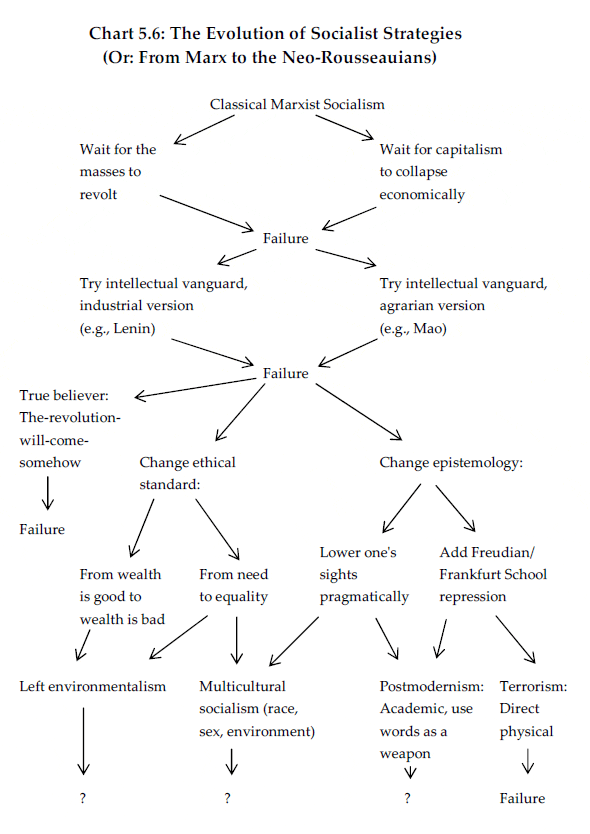
  34. This led to the explosion of Leftist terrorism of the 1970s, but that was easily crushed by the capitalist state. Yet another Leftist failure. See the chart below.
  35. At this point we have the total collapse of the New Left. But, largely undeterred, Marcuse shrugged and said the Left will go to the universities and regroup. This then became postmodernism. Hicks focuses primarily on four of its main representatives: Foucault, Derrida, Lyotard, and Rorty.
  36. These and other postmodernists were best suited to carry on the fight from the Left. Because they were academics, their main weapon was words. (And they don’t hesitate to overwhelm the reader with them. Ever try to actually read Derrida?). And because their epistemology held that words aren’t about reality, words must be a rhetorical weapon. Here Hicks presents the best chart in the book, a flow chart of failed Leftist strategies over the years that stands on its own as a minor masterpiece.
  37. In the final chapter Hicks is able to answer his first question: Why has a leading segment of the Left embraced skeptical and relativist epistemological positions? Well, because for a modernist, words link to real-world meanings. But for a postmodernist, words link only to other words because we cannot get outside language. Therefore, words can just be used rhetorically, as a weapon. There’s no need to correlate one’s words with anything like “reality”, since “reality” doesn’t exist and is just a socio-linguistic construction. Meanwhile, there are conflicts raging between groups, and given postmodern ethics, that’s really all that matters, so words should be used as weapons. This explains the harsh rhetoric, ad hominem, straw men, always trying to silence people whom you disagree with by saying they are using “violence” by speaking, and the rest of the bullshit that has affected public debate about almost anything.
  38. See, if you’re a postmodernist, you don’t worry about truth. You worry about emotions and winning.
  39. Postmodernism, says Hicks, is like the religious challenge to the Enlightenment. Adopt an epistemology that tells you that facts and reason doesn’t matter. “Feelings and passions are better guides.” And because you believe in the importance and inescapability of contradiction, use contradictory discourse as a political strategy.
  40. Hicks gives some examples: postmodernism is relativist, but it is at the same time is correct; all cultures are equal of respect except Western culture which is uniquely bad; values are subjective but racism and sexism are extremely terrible.
  41. OK, still with me? At this point Hicks concludes his polemic by stating that there are three possible reasons why postmodernism has these contradictions between its absolute and relativist positions: Reason 1) Relativism is primary and absolutism is secondary. But this can’t be true because they largely all agree on absolutes (politics). So forget this reason. Reason 2) The absolutes (politics) are primary, so the relativism is a rhetorical strategy to push those positions. Reason 3) Postmodernism is ultimately contradictory but postmodernists don’t care because they are essentially anti-social, destructive nihilists. (Sort of James Burnham’s position in his masterful Suicide of the West).
  42. Because R1 is ruled out, R2 or R3 must be true. Both are Machiavellian positions.
  43. With postmodernism, you can always divert from arguing about facts into arguments about epistemology. So if the facts don’t support you, for instance, just say there is no truth and your opponent is arguing from a position of privilege.
  44. Or, rather than reading the Western canon in a way that explains and justifies capitalism, individualism and liberalism, you can just say those books were written by white men and nobody should be forced to read them. That way rather than having to actually debate and disprove ideas, you can just dismiss them.
  45. This ends in nihilism. Postmodernists attack the Enlightenment on moral grounds, without moral grounds, or without referring to real facts or arguments. In this way you can undermine people’s confidence in science, technology, our economic system, social relations, individualism, themselves, etc.
  46. Fin.

Some concluding remarks. These are my opinions, not Hicks’s:

In the last 20-30 years, academic postmodernism indoctrinated an enormous number of people who now hold influential positions in the media, entertainment, and tech companies. It infected law schools and the social sciences, resulting in numerous people in government also holding these positions, whether in the US or Western Europe.

The speed with which postmodern ideas have become “common sense,” particularly to cultural and media elites, the professoriate, and urban young people is breathtaking. Social media companies and the new Internet media, largely run by people subjected to postmodernist indoctrination in the universities play an enormous role here. Whatever the reason, in the last 25 years postmodernism has gone from a minor academic oddity to the fundamental thought matrix of our age.

Most of our contemporary popular debates about race, sexuality, etc. are based on the tactics and nihilistic philosophy of postmodernism. Unable to address conventional Marxist or Leftist politics, they have turned to the cultural and social sphere. But they also have invaded legal and policy spheres and are, essentially, on a mission to destroy the West and its traditions. This is indeed nihilism. But it is targeted nihilism – focused on its enemy. And while Hicks thinks the target is modernism, it also includes anything left of pre-modernism or tradition. It includes not just the individual, but the family. Not just rich people, but the middle class. Not just white elites, but white proletarians. Not just parts of the West, but the entire thing.

To save the West and its traditions, whether pre-modern or modern, postmodernism is going to have to be stopped. It is the dangerous ideology fundamentally underlying all of the lunacy and insanity we see on a daily basis today.

Hicks does a masterful job showing us how, and why this has happened. While I disagree with his dismissal of pre-modern tradition and his statements that the collectivist right is dead and gone, his main points are solid and on target. (To be fair the book is a few years old, before the most recent collectivist right resurgence.)

This is an important, vital book for our time. Particularly if you have children of or near college age, it is important that they read this to counter the postmodern brainwashing that passes for education in our institutions of higher education and increasingly even elementary and secondary schools.

Postmodernism is the worst thing the Left has come up with since the fall of the major communist states. Its enemies are logic, realism, and calm, rational, empirically-based argument. It can and will be defeated. To go back to Hick’s chart, it must end, as all other Leftist attempts prior have ended, as failures.

Related

Posted in Books Publishing and Writing, Philosophy and Religion, Politics and Economics | Tagged , | 23 Comments

“Wonder Woman” (2017)

Blowhard, Esq. writes:

Wonder Woman has always been a second-tier character for reasons largely having to do with her incoherent, if interesting, origins. Created by psychologist William Marston specifically to be the opposite of too-violent heroes like Batman and Superman, to be “psychological propaganda for the new type of woman who should rule the world,” she is a princess from a fabled tribe of mythic warriors “who would triumph not with fists or firepower, but with love.” While an anti-war warrior, particularly one created in the midst of World War II, has a certain subversive appeal, a superhero who disdains violence and implores that “Bullets never solved a human problem yet!” is not one that will enthrall teenage boys, bustier and thigh-high boots aside. The character has languished for most of her life as the token girl even as one writer after another has tried to inject some life into her, although friends who are far more knowledgeable than I about the history of superhero comics say there have been a couple of decent Wonder Woman story arcs. Her lack of a famous antagonist — Superman has Lex Luthor, Batman has The Joker — is also telling. Fighting inequality may be the noblest of pursuits in the real world, but a comic book hero needs something more concrete.

Screenwriter Allan Heinberg, working from a story that he co-wrote with Zach Snyder and Jason Fuchs, attempts to address these two fundamental issues, but doesn’t have much success. First, he wisely shifts the action from World War II to World War I. If you’re going to have a character who believes that violence never solved anything, you probably don’t want her espousing such things in the middle of the only war that most Westerners believe was entirely necessary and justified. Second, he recasts Wonder Woman’s Greek mythological origins into a Christian framework. In the movie’s telling, Zeus functions less like the inveterate lech that he is and more like the Christian God, Ares is the Devil, and Wonder Woman is the result of a virgin birth who exists to redeem mankind. During her climactic battle with Ares, she even has a Garden of Gethsemane moment where Ares tries to tempt her into destroying mankind. “I believe in love,” she replies. (It’s almost too perfect that Wonder Woman is played by Gal Gadot, an Israeli Jew.) A tribe of separatist pagan female fighters lead by a princess modeled on Athena — one who contrasts to the untamed bloodlust of Ares by emphasizing wisdom and deliberation in pursuit of a just war — seems like a more fruitful direction for the character, but hey, what do I know? Maybe the near universal praise of the movie by Buzzfeed SJW types really is proof that they’re motivated by a quasi-religious fervor.

Director Patty Jenkins hits the requisite rah-rah grrlpower beats but she’s also canny enough to emphasize some opposites-on-the-run/fish-out-of-water moments with heartthrob Chris Pine, who plays intelligence officer Steve Trevor, that vaguely recall the romantic comedies of the thirties. (I can’t help wondering if Jenkins didn’t pattern their relationship after her working relationship with Zach Snyder. CGI filmmaking is a peculiar beast that Jenkins had no previous experience in, so it’s only natural that she needed someone to show her the ways of that world.) Jenkins does her best to give Wonder Woman a fighting style that comports with the character’s nonviolent philosophy by emphasizing defensive maneuvers with her shield and deflecting bracelets, but the action scenes overall are uninspired. A major reason why they scenes don’t work is that, like Rey in Star Wars: The Force Awakens, Wonder Woman is so adroit and capable that you never get the feeling she’s encountering any real obstacles. We never really see her thwarted, forced to adjust, or thinking. The movie is the sports equivalent of a baseball or football game where the home team routs the visitors.

The lack of a strong villain severely hampers the action. We’re given three baddies — a mad female scientist, a roided-out general, and Ares himself — but instead of making the movie feel more epic, they steal focus from one another. (Star Wars: Rogue One had the same problem.) Similarly, Wonder Woman is surrounded by the requisite ragtag, but unnecessary, supporting cast. (Yet again, Star Wars: Rogue One had the same problem.) Reducing the number of characters would’ve gone a long way towards trimming the movie’s way-too-long 2:21 run time. Gadot herself carries the picture adequately but, aside from the few brief moments mentioned above, she doesn’t have much do apart from looking fabulously fierce in her costume. Maybe now that the filmmakers have got the clunky backstory out of the way and demonstrated their respect for Wonder Woman’s origins, in the sequel they’ll give Gadot and audiences not what they want, but what they need.

Related

Posted in Movies | Tagged , , , | 7 Comments

Architecture and Color

Paleo Retiree writes:

Posted in Architecture | Tagged | 3 Comments

Naked Lady of the Week: Marie Harper

Fabrizio del Wrongo writes:

mh-cover

Marie Harper was a pretty popular internet model during the late ’90s. Consequently, most of her extant photos are formally disappointing. They’re frustratingly tiny things that fail to do justice to her impressively large things.

Boobs aside, her primary asset is her sweet-and-innocent affect. What is its source? What is the likelihood that it corresponds to her personality? So abiding is that affect that when she’s fancied up with makeup and lingerie the effect is almost grating.

Nudity below. Have a good weekend.

Continue reading

Posted in Photography, Sex, The Good Life | Tagged , , , | 2 Comments

Book Notes: “The Whig Interpretation of History”

Blowhard, Esq. writes:

This short essay — which can be easily read in a weekend or even a single sitting — is a useful rejoinder to the idea that there exists a “right side of history.” Butterfield, a Cambridge don, takes umbrage with the Whig interpretation of history, that is, the idea that history has a direction or telos. History has no direction, Butterfield argues, and the point of reading history isn’t to find the present in the past — it’s to understand the past on its own terms thereby entering into a new way of thinking. Some other thoughts and quotes:

  • “Precisely because of his unlikeness to ourselves Aquinas is the more enticing subject for the historical imagination; for the chief aim of the historian is the elucidation of the unlikeness between past and present and his chief function is to act in this way as the mediator between other generations and our own.”
  • “On this view he comes to his labor conscious of the fact that he is trying to understand the past for the sake of the past, and though it is true that he can never entirely abstract himself from his own age, it is none the less certain that this consciousness of his purpose if very different one from that of the whig historian, who tells himself that he is studying the past for the sake of the present. Real historical understanding is not achieved by the subordination of the past to the present, but rather by our making the past our present and attempting to see life with the eyes of another century than our own. It is not reached by assuming that our age is the absolute to which Luther and Calvin and their generation are only relative; it is only reached by fully accepting the fact that their generation was as valid as our generation, their issues as momentous as our issues and their day as full and vital to them as our day is to us.”
  • “It is in this sense that [the non-whig historian] is always forgiving sins by the mere fact that he is finding out why they happened.”
  • “We may believe in some providence that guides the destiny of men and we may if we like read this into our history; but what our history brings to us is not the proof of providence but rather the realization of how mysterious are its ways, how strange its caprices — the knowledge that this providence uses any means to get to its and works often at cross-purposes with itself and is curiously wayward. Our assumptions do not matter of we are conscious that they are assumptions, but the most fallacious thing in the world is to organize our historical knowledge upon an assumption without realizing what we are doing, and then to make inferences from that organization and claim that these are the voice of history. It is at this point that we tend to fall into what I have nicknamed the whig fallacy.”
  • “Behind all the fallacies of the whig historian there lies the passionate desire to come to a judgment of values, to make history answer questions and decide issues and to give the historian the last word in a controversy.”
  • “[The whig historian] wishes to come to a general proposition that can be held as a truth demonstrated by history, a lesson that can be taken away and pondered apart from the accidents of a particular historical episode; and unless he can attain to something like this he feels that he has been wasting himself upon mere processes, he has been watching complication and change for the mere sake of complication and change. Yet this, which he seems to disparage, is precisely the function of the historian. The eliciting of general truths or of propositions claiming universal validity is the one kind of consummation which it is beyond the competence of history to achieve.”
  • The Great Man theory of history has been discredited among serious historians for decades, but is Whig history that much of an improvement? Instead of individuals pushing history, it’s a disembodied abstract force called “progress.”
  • Butterfield, a Christian Tory, is reacting against those 19th and early 20th century historians who see Luther and the Protestant Reformation as ushering in the modern era of religious liberty. In the Whig interpretation, the modern world is the result of the progressive Luther triumphing over the reactionary Catholic Church. Butterfield argues that it’s more accurate to say that the modern world is a the result of the interactions between Luther and the Catholic Church.
  • “He is back in his proper place when he takes us away from simple and absolute judgments and by returning to the historical context entangles everything up again. He is back in his proper place when he tells us that a thing is good or harmful according to circumstances, according to the interactions that are produced. If history can do anything it is to remind us of those complications that undermine our certainties, and to show us that all our judgments are merely relative to time and circumstance. There is one argument against the whig interpretation of history history which is paradoxical and is in conflict with all our habits of mind, for it takes away what many might feel to be the virtue and and the utility of history, and it robs the historian of his most trenchant attitudes and his grandest note of finality. It lies in the fact that we can never assert that history has proved any man right in the long run.”
  • “The case against the whig historian lies in the fact that he brings the effort of understanding to a halt. He stops the work of imaginative sympathy at a point that could almost be fixed by a formula. It would not be untrue to say that, apart from specialist work of recent date, much greater ingenuity and a much higher imaginative endeavor have been brought into play upon whigs, progressives and even revolutionaries of the past, than have been exercised upon the elucidation of tories and conservatives and reactionaries. The whig historian withdraws the effort in the case of the men who are most in need of it.” Maybe the whig historian doesn’t really intend to be a historian at all.
  • “The truth is that the historian, whose art is a descriptive one, does not move in this world of moral ideas. His materials and his processes, and all his apparatus exist to enable him to show how a given event came to take place. Who is he to jump out of his true office and merely announce to us that it ought never to have happened at all?”
  • “The historian ministers to the economist, the politician, the diplomat, the musician; he is equally at the service of the strategist and the ecclesiastic and the administrator. He must learn a great deal from all of these before he can begin even his own work of historical explanation; and he never has the right to dictate to any one of them. He is neither judge nor jury; he is in the position of a man called upon to give evidence; and even so he may abuse his office and he requires the closest cross-examination, for he is one of these ‘expert witnesses’ who persist in offering opinions concealed within their evidence. Perhaps all history-books hold a danger for those who do not know a great deal of history already. In any case, it is never safe to forget the truth which really underlies historical research: the truth that all history perpetually requires to be corrected by more history. When everything has been said, if we have not understanding, the history of all the ages may bring us no benefit; for it may only give us a larger canvas for our smudging, a wider world for our willfulness. History is all things to all men. She is at the service of good causes and bad. In other words she is a harlot and a hireling, and for this reason she best serves those who suspect her most. Therefore, we must beware even of saying, ‘History says […]’ or ‘History proves […]’, as though she herself were the oracle; as though indeed history, once she spoken, had put the matter beyond the range of mere human inquiry. Rather we must say to ourselves: ‘She will lie to us till the very end of the last cross-examination.’ This is the goddess the whig worships when he claims to make her the arbiter of controversy. She cheats us with optical illusion, sleight-of-hand, equivocal phraseology. If we must confuse counsel by personifying history at all, it is best to treat her as an old reprobate, whose tricks and juggleries are things to be guarded against. In other words the truth of history is no simple matter, all packed and parcelled ready for handling in the market-place. And the understanding of the past is not so easy as it is sometimes made to appear.”
Posted in Books Publishing and Writing, History | Tagged , , , , | 4 Comments

Architecture and Color

Paleo Retiree writes:


Posted in Architecture | Tagged | 3 Comments

Notes on “The True History of the American Revolution”

Fabrizio del Wrongo writes:

R-20100120-0010.jpg

If, like me, you’ve always had a hard time squaring the narrative of the American Revolution with the requirements of common sense, you might get something out of Sydney George Fisher’s “The True History of the American Revolution.” Writing around 1900 (i.e. before the establishment of the American Imperium), Fisher tackles the conflict by going back to the original sources, and divesting himself of the bullshit. In Fisher’s telling, the Revolution was an extension into the New World of Whig-Tory political jockeying, one which allowed the Patriot colonists to opportunistically impose their will on their countrymen. In this version of the Revolution the Patriots come off not as noble idealists, but as proto-SJWs. They can’t be appeased, because they don’t want to be appeased, and all of their spoutings about the Rights of Man are resorts to the most self-serving kind of sophistry. Fisher:

Before I discovered the omissions of our standard histories I always felt as though I were reading about something that had never happened, and that was contrary to the ordinary experience of human nature. I could not understand how a movement which was supposed to have been such a deep uprooting of settled thought and custom – a movement which is supposed to have been one of the great epochs of history – could have happened like an occurrence in a fairy-tale.

Some notes, quotes, and observations:

  • According to Fisher, the Revolution wasn’t a response to the imposition of draconian policies; it was a response to an attempt by the Tory government in England to — finally — treat the colonies as colonies. For years the colonies had been treated as protectorates; they contributed some money to the Crown, but to a great extent they acted as they chose to act. This liberal state affairs existed largely because the French presence in North America prevented Parliament from imposing protection laws, levying taxes, and so forth. But once the French were out of the way, it was decided that the colonies should be required to obey British law. The conduct of the French and Indian War had entailed huge expenditures, and it was seen as just that the colonists contribute, through the paying of minimal taxes, to the replenishment of national funds.
  • “The more we consider the conditions at that time, the more it becomes evident that the English-speaking communities in America were not colonies in the modern acceptance of the term. England had never fully reduced them to possession, had never really established her sovereignty among them. She had encouraged them in the beginning with liberal grants for the sake of persuading them to occupy the country, and after that she was unable to repress their steady and aggressive increase of privileges so long as France hung as a menace in the snow-bound north. The lucky colonists were ridden with a loose rein and given their heads until a large section of them began to believe that their heads were their own.”
  • So liberal were the charters of Connecticut and Rhode Island that those colonies elected their own governors. Massachusetts had a governor appointed by the Crown, but mostly did as she wished. In Pennsylvania, the legislature was elected by the colonists, but the governor was imposed by Parliament. This resulted in a weird system of public bribery: The legislature would refuse to pay the governor’s salary, until he did what the colonists wanted him to do. This would appear to be an extension of the Whig idea that public leaders ought to be beholden to their constituents. Suffice it to say that Parliament expected the governor to rule as Parliament saw fit.
  • “To-day there is no colony of the British empire that has so much freedom as Connecticut and Rhode Island always had, or as Massachusetts had down to 1685. Connecticut and Rhode Island elected their own legislatures and governors, and did not even have to send their laws to England for approval.”
  • “The British government, only too glad to be rid of rebellious Puritans, Quakers, and Roman Catholics, willingly gave them liberal charters. This explains that freedom in many of the old charters which has surprised so many students of our colonial history.”
  • “Some thirty years before that time Massachusetts had obtained a liberal charter. It was possibly intended that the governing body under this charter should remain in England; but the Puritans who had obtained it moved the whole governing body out to Massachusetts, elected their own legislature and governor, and did not submit their laws to England for approval. They assumed several of the attributes of sovereignty. They coined their own money, and issued the famous pine-tree shilling. They established by law a form of religion, sometimes called Congregationalism, which was not recognized by the laws of England. They ceased to issue writs in the king’s name. They dropped the English oath of allegiance and adopted a new oath in which public officers and the people swore allegiance, not to England, but to Massachusetts.”
  • In the shipping colonies of New England, English protection laws were rarely obeyed. England saw the colonies as existing to benefit the Empire. Therefore, she expected commerce with the colonies to benefit England rather than Holland or some other state. The colonists — adopting an early form of the American doctrine of free trade — traded with whomever they wished. Indeed, Americans had come to see this as their right. But from a British perspective, American trade during the period was one huge resort to smuggling. It was common practice to dupe British consuls about the nature and destination of shipped goods. So prevalent was smuggling that the Brits had to try smuggling cases in admiralty court, as it was well established that juries comprised of colonists would refuse to convict a man of smuggling.
  • “The desire to share profits with ‘dear old England’ was not very ardent. In 1676 Edward Randolph was sent out to Massachusetts as an agent to look into its condition. He reported the navigation laws unexecuted and smuggling so universal that commerce was free; and the governor of Massachusetts, he said, ‘would make the world believe they were a free state.'”
  • “It is hardly worth while to discuss what has sometimes been called the excessive restraint or tyranny of these trade laws, because the American colonists promptly disposed of any element of severity there was in them, by disobeying them.”
  • Though the colonists cried “no taxation without representation!” they never pushed for representation (which may have been granted), because to do so would ruin their argument for freedom from taxes. In other words — at least in Fisher’s view — “no taxation without representation” was an empty slogan, a political talking point. There seems to have been no intention on the part of the colonists to be represented in Parliament. It was the American Loyalist faction that wanted representation in Parliament. Such representation would tend to making America more British. That was the last thing the Patriots wanted.
  • The taxes imposed on the colonists were quite minimal. People in England paid 25 shillings a head in taxes; Americans were asked to pay six pence per head. Also, many commoners in Great Britain didn’t have direct Parliamentary representation, so the colonists weren’t disadvantaged in any particular way.
  • “In the year 1765 scarcely any of the great towns in England had representatives in Parliament and yet they were taxed. London, Birmingham, Manchester, Liverpool, Leeds, and Halifax paid their taxes every year, and sent not a single member to Parliament. In fact, out of the eight million people in England there were not above three hundred thousand represented.”
  • The absurdity of the colonists’ argument regarding taxation becomes clear when one considers that Parliament had the authority to impose the death penalty on a colonist for breaking the law, but — according to the radical colonists — no authority to levy taxes.
  • In the end, the Patriots claimed that Parliament could not “internally regulate” the colonies. Yet Parliament regulated and paid for the colonial Post Office, of which Ben Franklin was the head. So on the one hand Franklin heads a body regulated and funded (through a kind of taxation) by Parliament, and on the other hand he is agitating against internal regulation by Parliament.
  • In response to the Stamp Act, hugely effective boycotts of English goods were organized by the Patriot colonists. Non-radicals who weren’t down with the boycott — possibly the majority of colonists — were threatened with violence. In Boston (the cradle of the Revolution), the stamp distributors were hung in effigy, and the house of the Lieutenant Governor was sacked. The colonists simply refused to abide by the Act.
  • “It would be difficult to find in all history another instance of such complete and thorough disobedience of a well-considered law which one of the most powerful nations of the world had made elaborate preparations to enforce.”
  • “Boston seemed to be the worst place in America. It had always been so. It needed curbing. Massachusetts was the only colony which had persistently, from her foundation, shown a disloyal spirit to the English government and the English church. Her people seemed to be naturally riotous.”
  • “It certainly amazed Englishmen to read that the mob in Boston, not content with hanging in effigy the proposed stamp distributers, levelled the office of one of them to the ground and smashed the windows and furniture of his private house; that they destroyed the papers and records of the court of admiralty, sacked the house of the comptroller of customs, and drank themselves drunk with his wines; and, finally, actually proceeded to the house of Lieutenant-Governor Hutchinson, who was compelled to flee to save his life. They completely gutted his house, stamped upon the chairs and mahogany tables until they were wrecked, smashed the large, gilt- framed pictures, and tore up all the fruit-trees in his garden. Governor Hutchinson was a native of the province, was its historian, and with his library perished many invaluable historical manuscripts which he had been thirty years collecting. The mob cut open the beds and let the feathers out, which they scattered with his clothes, linen, smashed furniture, and pictures in the street.”
  • When Parliament finally caved in and repealed the Stamp Act, the action proved to the colonists that they were right in being inflexible assholes.
  • Because the colonists had argued — successfully, it seems — that only internal taxation of the colonies was prohibited, Parliament imposed taxes on external goods, like glass and paper. The colonists now argued that all taxes were inappropriate absent representation. This is where the argument concerning natural rights came in. Realizing the weakness of the internal-external distinction, the colonists claimed that some natural right existed, and was inherent in the British Constitution, which prevented taxation without representation. However, they still didn’t push for actual representation.
  • “The colonists were being driven crazy, it was reported, by certain books about the rights of man, books written by men called Burlamaqui, Beccaria, Montesquieu, Grotius, and Puffendorf, which told them that all men were politically equal and entitled to self-government; and the Englishman, John Locke, who was exiled and driven from Great Britain, had written a mad book to the same effect.”
  • “The English who came out to America were largely of one of these parties, which has been successively called roundhead, whig, or liberal. They have at times claimed as part of the British Constitution doctrines which were advocated by liberals in England, and which Americans also thought ought to be part of the British Constitution, but which were never fully accepted or adopted.”
  • “The consequences [of the perceived right to pursue happiness] have certainly been vast, – vaster far than [anyone] dreamed of. Millions of people now live their daily life under the shadow of this doctrine. Millions have fled to us from Europe to seek its protection. Not only the whole American system of laws, but whole philosophies and codes of conduct have grown up under it. The abolitionists appealed to it, and freed six millions of slaves. The transcendental philosophy of New England, that extreme and beautiful attempt to develop conscience, nobility, and character from within; that call of the great writers like Lowell to every humble individual to stand by his own personality, fear it not, advance it by its own lines; even our education, the elective system of our colleges, – all these things have followed under that ‘pursuit of happiness’ which the rebel colonists seized upon so gladly in 1765 and enshrined in their Declaration of Independence in 1776.”
  • Parliament again relented, and didn’t enforce the glass and paper taxes. The infamous tea tax was the one tax they left in place. So, to recap: The colonists refused internal taxation (e.g. the Stamp Act) on the basis that only external regulation was allowed. So Parliament gave in and levied a few external taxes. The colonists then refused all taxation on the basis of some nebulous natural right. Parliament then gave in and got rid of all external taxation aside from a modest one concerning tea. The colonists’ stand doesn’t sound very heroic, doesn’t it?
  • The British stationed soldiers in Boston because they were necessary to protect the lives of their customs officials, who were trying to obtain control over the smuggling operations of Boston merchants. The customs officials were threatened constantly by mob violence.
  • The British government had been so conciliatory that, around the time of the Boston Tea Party, the colonies were run pretty much as they had been before the war with the French. In other words, there was nothing to complain about.
  • The tea tax was countered by a boycott of English tea. Therefore, the law resulting in the tax was seen as a dead letter, a non-issue. However, the radicals in Boston endeavored to use the tax as leverage to start a war. Though the shipments of tea to New York and Philadelphia were peaceably refused, the Boston SJWs illegally boarded British vessels and destroyed the tea. In Fisher’s view, radicals like Sam Adams and Paul Revere wanted a war. War was their goal.
  • “Samuel Adams was not a merchant, was seldom well dressed, was not at all proud, and never rich. He was always poor. He failed in his malting business, was unthrifty and careless with money, and had, in fact, no liking for, or ability in, any business except politics. He lived with his family in a dilapidated house on Purchase Street, and when in 1774 he was elected a delegate to the Continental Congress at Philadelphia, his admirers had to furnish the money to make him look respectable.”
  • With war imminent, the crackdown on Loyalists began. In 1774 Patriots in New England began a program of disarming Loyalists. Additionally, Loyalists were routinely tarred and feathered, tied to trees, and imprisoned without trial. Freedom of the press was squelched, and Loyalist writers were threatened with violence until they recanted. (This was the origin of American Lynch Law.) As always seems to be the case, this revolution ostensibly aimed at protecting the Rights of Man resulted in severely limiting the rights of men.
  • At the Continental Congress a group of conservative representatives proposed a branch of Parliament in Philadelphia to represent the colonies. This solution, if adopted, would have solved most of the supposed problems. However, the Patriots denied it, and then moved to erase all suggestion of it from the record.
  • Though the Continental Congress had no legislative power, it demanded that the colonies boycott British goods, and determined that individuals who did not follow this instruction be ostracized and punished without trial. Committees of Patriots in various localities were authorized by the Congress to enforce these rules, making the colonies something like a police state run by a self-appointed gestapo. The Patriot action in this instance might be seen as an early expression of Americans’ sacred right to punch Nazis.
  • Though the Continental Congress objected to the use of British admiralty courts on the grounds that they amounted to tyranny, it had no problem authorizing mob tribunals. Though it objected to taxation on the grounds that it amounted to theft, it authorized the taking of private property when that property happened to be a shipment of English goods. Loyalists who drew attention to these inconsistencies risked being tarred and feathered.
  • Fisher estimates that some 25,000 Loyalists enlisted in the British army. They appear to outnumber by a fair margin the Americans that Washington had in his army.
  • So disliked were the radicals by normal Americans that, when Washington’s army was starving at Valley Forge, the locals refused to give them food, preferring to give it to the British instead.
  • The New England troops were obsessed with “leveling,” i.e. the obliteration of social distinctions. This disgusted the Patriots from the South, who were natural aristocrats. It also bothered the Southerners that Northerners allowed blacks in the army.
  • “The New Englanders of that time, and more especially the lower classes, were full of what the colonists farther south called ‘the levelling spirit.’ Their horrible manners are described by Mrs. Knight in her diary of 1704, and at a much later date in Mrs. Grant’s ‘Memoirs of an American Lady.’ The rank, crude, and unpleasant side of democracy seems to have had its first foothold in New England. Mrs. Grant describes the disgust of the New Yorkers when they were first invaded by the Yankees, whose insolent and brutal abuse of rank and titles was as revolting as their nasal, drawling voices and their uncouth phrases and slang. They would fasten themselves upon you, pressing you with their drawling questions about your most private affairs, railing in the mean time against aristocrats and orating on liberty and the ‘eternal rights of man.’ They were the beginning of a class which, becoming inflated by the success of independence, spread over the country to the horror of all well- educated people and in fulfilment of loyalist prophecies. They gave Grant the material for his famous speech in Parliament, and many years afterwards they furnished the stock material for Dickens and other Englishmen who found profit in ridiculing the Americans.”
  • John Paul Jones was so disgusted by the Gadsden Flag that he refused to fly it on his ship. It was seen by many as an undignified, crude flag.
  • “A flag for the patriot cause had been designed about this time, and was used soon afterwards. It had on it a pinetree and a coiled rattlesnake about to strike, with the motto? ‘Don’t tread on me.’ It was a good enough pirate’s or smuggler’s flag, the loyalists said; a very proper red rag of rebellion, undignified, crude, with the snake as the emblem of low cunning, ingratitude, and treachery. Paul Jones was so disgusted with it that he was hardly willing to hoist it on his ship.”
  • The Brits’ Commander-in-Chief during the early part of the war, Lord Howe, was a Whig MP who supported the Patriot cause. (Fisher refers to him as something less than an Englishman.) Cornwallis was another. If you’ve always been confused by the British strategy during the war, don’t feel ashamed: Washington didn’t understand it either. Judging by Howe’s conduct of the war, one can make one of three conclusions about him: 1) That he was incompetent, 2) That he took it easy on the colonists as part of a strategy for brokering peace, or 3) That he conspired with his party to lose the war, because a loss in the war would benefit the Whigs politically.
  • “[Howe] allowed his enemy’s force to be disbanded under his eyes and sent to their homes while others came to take their places. Washington was amazed. ‘Search the volumes of history through and I much question whether a case similar to ours is to be found, – namely, to maintain a post against the flower of the British troops for six months together, without – , and then to have one army disbanded and another to be raised within the same distance of a reinforced enemy.’ – Ford, Writings of Washington,” vol. iii. p. 318.”
  • “Both [Howe] and his brother, the admiral, were so extremely liberal in their views that they could scarcely be called Englishmen. Had they been consistent they would have emigrated to America, for they belonged to the party that had largely peopled America.”
  • “When asked why he did not commission loyalist privateers to destroy American merchantmen, the admiral is said to have replied, ‘Will you never have done oppressing these poor people? Will you never give them an opportunity of seeing their error?’ He was a most ardent believer in conciliation.”
  • “At the close of the letter Howe and his brother, the admiral, are directed to make such an attack upon the New England coast as will destroy the rebel privateers and incapacitate the people from fitting out others. This expedition against New England Howe declined to make, giving as his reason that it was too hazardous, because of the fogs, ‘flatness of the coast,’ together with other very peculiar excuses.”
  • After the peace settlement there was a hearing in Parliament (then under a Whig administration) regarding the conduct of the war. Cornwallis made the vague statement that Howe had conducted the war as he did for “political reasons.” He declined to expand on this comment. Howe and prominent Loyalist engaged in public arguments, via pamphlets, regarding Howe’s apparently terrible strategy. Cornwallis and Clinton engaged in a similar argument. I haven’t read this, but it seems interesting.
  • While fighting in America Howe mostly engaged in limited actions, refusing to follow up on obvious victories, and then retreated to colonial cities to enjoy the winters in luxury while his men got rich on running things. (Apparently, in the 18th century, militarily occupying a city amounted to quite a racket. Maybe it still does.) While Washington was at Valley Forge, Howe’s forces were a mere 20 miles away, yet no attempt at engagement was made. Howe’s failure to move north from New York to join Burgoyne is hard to figure. (Certainly, it was hard for Burgoyne to figure.) I’m not sure the conflict during this period deserves to be called a war, to be honest.
  • “Cornwallis, who was a Whig member of Parliament and Howe’s most trusted and confidential officer, had been sent into New Jersey with 5000 men, apparently to capture Washington. But although Washington moved slowly Cornwallis never came up with him. A Hessian officer entered in his diary that Cornwallis had been instructed to follow until the patriots should make a stand, and then not to molest them. Cornwallis admitted before the committee of inquiry that Howe had instructed him to stop at New Brunswick. He could, he said, have disregarded this order; but saw no opportunity to pursue, and his troops were too tired. They must have been very tired, for, reaching New Brunswick December 1, they did not reach Trenton until December 7. They rested seventeen hours in Princeton, and took seven hours to march the twelve miles from there to Trenton, where Washington crossed the river just ahead of them, taking all the boats.”
  • “Many people believed that the whole question [of the war] depended on the patriots holding out long enough to let the Whigs get into power, and that if the Whigs were successful for only a few months the whole difficulty would be settled.”
  • “The situation expressed in figures is the most extraordinary one ever recorded, – a victorious army of 34,000 declining to end a rebellion represented by only 3300 wandering, half-armed guerillas. No great nation, no general representing a great nation, has ever before or since accomplished such a feat as that.”
  • “When we think of the measures of relentless severity and slaughter, the persistent and steady hunting down of the men, the concentration camps for the gradual destruction of the women and children, which we have known England use in our time to destroy all hope of independence, the extraordinary conduct of Howe is difficult to explain except by the method which his loyalist critics adopted.”
  • Fisher presents Washington as a noble but somewhat overrated figure. Honestly, he doesn’t do a whole lot until the end of the war, when he shows his tactical brilliance in the Yorktown campaign.
  • Once the French came into the war, the whole thing changed, as the Brits were obligated to spread their forces over a larger area. Howe was removed from command, and his replacement, Clinton (not a Whig), opened up a large can of whoop-ass. But it was largely too late. Cornwallis’ defeat in the South — which Clinton suspected was purposeful, and done for political reasons — was the final nail in the coffin.
  • As soon as the Whigs regained power, they ended the war, and acted as though the British loss was proof that the Whigs had always been right in believing the rebellion was justified and the war against the colonies unwinnable. That view became official history.

Related

Posted in Books Publishing and Writing, History | Tagged , , | 5 Comments

Quote Du Jour: The Most Useless and Unproductive of All Forms of Reflection

Blowhard, Esq. writes:

It is the natural result of the whig historian’s habits of mind and his attitude to history — though it is not a necessary consequence of his actual method — that he should be interested in the promulgation of moral judgements and should count this as an important part of his office. His preoccupation is not difficult to understand when it is remembered that he regards himself as something more than an inquirer. By the very finality and absoluteness with which he was endowed the present he has heightened his own position. For him the voice of posterity is the voice of God and the historian is the voice of posterity. And it is typical of him that he tends to regard himself as the judge when by his methods and his equipment he is fitted only to be the detective. His concerns with the sphere of morality forms in fact the extreme point in his desire to make judgments of value, and to count them as the verdict of history. By a curious example of the transference of ideas he, like many other people, has come to confuse the importance which courts of legal justice must hold, and the finality they must have for practical reasons in society, with the most useless and unproductive of all forms of reflection — the dispensing of moral judgements upon people or upon actions in retrospect.

Herbert ButterfieldThe Whig Interpretation of History

Posted in Books Publishing and Writing, History | Tagged , , , | 1 Comment

Naked Lady of the Week: Emma Sweet

Fabrizio del Wrongo writes:

es-cover

Whatever Emma Sweet’s real name might be, it can’t be more appropriate than Emma Sweet. She seems guileless even when putting on airs.

She’s from Ukraine, land of wars, famines, and incredibly hot chicks.

Nudity below. Have a great weekend.

Continue reading

Posted in Photography, Sex, The Good Life | Tagged , , , , | 1 Comment