
Blowhard, Esq. writes:
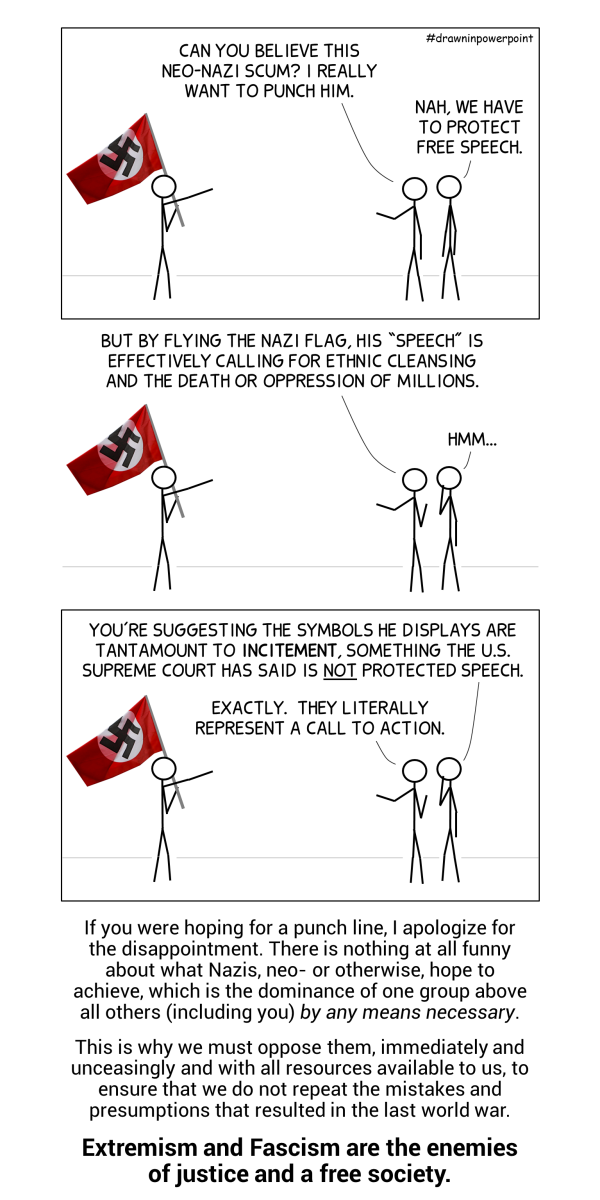
It is useful to consider the three primary arguments set forth by Skokie in support of its effort to forbid the march. First, the village argued that the display of the swastika promoted “hatred against persons of Jewish faith or ancestry” and that speech that promotes racial or religious hatred is unprotected by the First Amendment. The courts rightly rejected this argument, not on the ground that the swastika doesn’t promote religious hatred, but on the ground that that is not a reason for suppressing speech. After all, it the Nazis could be prohibited from marching in Skokie because the swastika incites religious hatred, then presumably they couldn’t march anywhere for the same reason, and movies could not show the swastika, and even documentaries could not show the swastika. And if the swastika can be banned on this basis, then what other symbols or ideas can be suppressed for similar reasons. What about movies showing members of the Ku Klux Klan? News accounts showing Palestinians committing suicide bombings in Israel or showing Israelis attacking civilians?
Second, the village argued that the purpose of the marches was to inflict emotional harm on the Jewish residents of Skokie and, especially, on the survivors. Certainly, some residents would be deeply offended, shocked and terrified to see Nazis marching through the streets of Skokie. But they might also be offended, shocked and terrified to know that Schindler’s List was playing at a movie theatre in Skokie, or in Chicago, or in Illinois, and African-Americans might be offended, shocked and terrified to know that the movie Birth of a Nation was playing in a theatre in their town or nation. And so on. Moreover, it is doubtful that the actual intent of the Nazis was to inflict emotional harm on the residents of Skokie. Initially, the Nazis sought to march in a totally different community in Chicago, one with almost no Jewish population. But they were denied a permit. They then decided to march in Skokie in order to get publicity for their grievance. Indeed, the signs they planned to carry in Skokie did not say “Bring Back the Holocaust,” but “White Free Speech” and “Free Speech for the White Man.” Making First Amendment rights turn on judgments about a speaker’s subjective intent is a dangerous business, because intent is very elusive and police, prosecutors and jurors are very prone to attribute evil intentions to those whose views they despise.
Third, the village argued that if the Nazis were permitted to march there would be uncontrollable violence. But is this a reason to suppress speech? Isn’t the obligation of the government to protect the speaker and to control and punish the lawbreakers, rather than to invite those who would silence the speech to use threats of violence to achieve their ends? If the village of Skokie had won on this point, then southern communities who wanted to prosecute civil rights marchers in Selma, Montgomery and Birmingham could equally do so, on the plea that such demonstrations would trigger “uncontrollable violence.” Moreover, once government gives in to such threats of violence it effectively invites a “heckler’s veto,” empowering any group of people who want to silence others to do so simply by threatening to violate the law.
The outcome of the Skokie controversy was one of the truly great victories for the First Amendment in American history. It proved that the rule of law must and can prevail. Because of our profound commitment to the principle of free expression even in the excruciatingly painful circumstances of Skokie more than thirty years ago, we remain today the international symbol of free speech.
— by Geoffrey R. Stone,




 Blowhard, Esq.
 Callowman
 Sherbrooke
 Eddie Pensier
 Enzo Nakamura
 Epaminondas
 Fabrizio del Wrongo
 Fenster
 Brundle Guy
 Glynn Marshes
 Paleo Retiree
 Atypical Neurotic
 Question Lady
 Sax von Stroheim
 Sir Barken Hyena
 The Mistaken
 Uncouth Reflections